FabulousFusionFood's Meat-based Recipes 24th Page
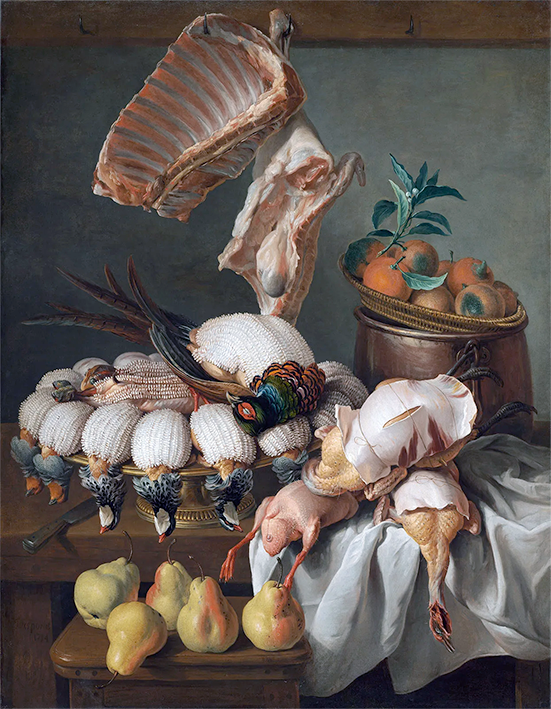 Painting of 'Still Life with Dressed Game, Meat, and Fruit' by
Alexandre-François Desportes.
Welcome to FabulousFusionFood's Meat-based Recipes Page — Meat is animal tissue, often muscle, that is eaten as food. Humans have hunted and farmed other animals for meat since prehistory. The Neolithic Revolution allowed the domestication of vertebrates, including chickens, sheep, goats, pigs, horses, and cattle, starting around 11,000 years ago. Since then, selective breeding has enabled farmers to produce meat with the qualities desired by producers and consumers.
The word meat comes from the Old English word mete, meaning food in general. In modern usage, meat primarily means skeletal muscle with its associated fat and connective tissue, but it can include offal, other edible organs such as liver and kidney. The term is sometimes used in a more restrictive sense to mean the flesh of mammalian species (pigs, cattle, sheep, goats, etc.) raised and prepared for human consumption, to the exclusion of fish, other seafood, insects, poultry, or other animals.
Here I've used a broader definition of 'meat' to include the flesh of animals, birds and insects. Fish, shellfish, aquatic crustaceans and seafood are excluded and have their own section on this site as Fish and Seafood. Insects are now included in their own section as I will be increasing the number of insect-based recipes on this site over the coming months.
As this site also includes historic recipes, there will be some unusual animals in the lists (like crane and flamingos from ancient Roman cookery) also game meats (or bushmeat) will include agouti, and capybara from South America, snakes from many cultures, antelopes and cane rats from Africa. Also the culinary sub-types of birds, poultry for domesticated birds, game for game birds and fowl for Galliforms (chicken-like) and Anseriformes (waterfowl). Offal, the internal organs, feet and heads of animals also has its own section.
The alphabetical list of all the meat-based recipes on this site follows, (limited to 100 recipes per page). There are 4905 recipes in total:
Page 24 of 50
| Keema Curry Origin: Pakistan | Khinkali Origin: Georgia | Kitoza Origin: Madagascar |
| Keema Mattar Origin: India | Khoodra Mafrooka Origin: Sudan | Kittitian Jerk Chicken Origin: Saint Kitts |
| Keema Naan Origin: India | Khoresh B'Amieh (Okra Stew) Origin: Iran | Kiwi Lamb Curry Origin: New Zealand |
| Keema Style Haggis Curry Origin: Scotland | Khoresht Rivas (Persian Lamb and Rhubarb Stew) Origin: Iran | Kjötsúpa II (Lamb Soup) Origin: Iceland |
| Kefta dyal Ghriba (Synagogue Koftas) Origin: Tunisia | Khoresht-e Gheymeh (Persian Lamb Stew with Dried Limes and Split Peas) Origin: Iran | Kjötsúpa (Icelandic Lamb Stew) Origin: Iceland |
| Keftedes (Greek Meatballs) Origin: Greece | Khoresht-e Loobia (Stewed Mutton with String Beans) Origin: Iran | Kjufteta Po Cirpanski (Meatballs and Potatoes) Origin: Bulgaria |
| Keftedhakia (Fried Small Meatballs) Origin: Cyprus | Khoresht-e Zereshk (Barberry, Lamb and Nut Stew) Origin: Iran | Kleftiko (Lamb in the Oven) Origin: Cyprus |
| Keftedhes Arnisious Skharas (Lamb Patties, Cypriot Style) Origin: Cyprus | Khoreshte Kalal (Lamb Stew with Barberry Sauce) Origin: Iran | Kleftiko (Roast Leg of Lamb) Origin: Cyprus |
| Keftedhes sta Karvouna (Beef and Garlic Sausages) Origin: Cyprus | Khormya (Spiced Lamb with Yoghurt) Origin: Kazakhstan | Kobi Keema (Cabbage and Minced Meat Curry) Origin: India |
| Kejenou avec Agouti (Kejenou with Cane Rat) Origin: Cote dIvoire | Khorovats (Armenian Shish Kebabs) Origin: Armenia | Kodoyo (Fish with Baobab Leaves) Origin: Togo |
| Keke Pu'a (Steamed Pork Buns) Origin: American Samoa | Khukura re Pyaj Tareko (Chicken Curry with Onion) Origin: Nepal | Koenigsberger Klopse (German Meatballs) Origin: Germany |
| Kelaguen Mannok (Chamorro-style Chicken Salad) Origin: Guam | Khuzi (Emirati Lamb with Rice) Origin: UAE | Kofta Curry (Meatball Curry) Origin: Pakistan |
| Kelaguen Mannok (Chamorro-style Chicken Salad) Origin: Northern Mariana Islands | Kibbeh Origin: Lebanon | Kofta Nakhod (Meatballs with Chickpeas) Origin: Afghanistan |
| Keleya Zaara (Tunisian Lamb with Saffron) Origin: Tunisia | Kibbeh Origin: Syria | Kofta Nakhod (Meatballs with Chickpeas) Origin: Tajikistan |
| Kelia Ayam (Indonesian Chicken Curry) Origin: Indonesia | Kid Goat Korma Origin: Anglo-Indian | Kohlapuri Chicken (Maharashtra Chicken Curry) Origin: India |
| Kenyan Chicken Tikka Origin: Kenya | Kidney and Beef Soup Origin: Britain | Koko na Nyama (Meat with Koko) Origin: Central African Republic |
| Kenyan Kima (Chopped Beef Chilli-fry) Origin: Kenya | Kifta Lil Atfaal (Cinnamon Meatballs) Origin: Libya | Kokoretsi Origin: Greece |
| Kenyan Matoke Origin: Britain | Kig ha Farz (Meat with Stuffing) Origin: France | Kokosja Supa (Chicken Soup with Red Bell Peppers) Origin: Serbia |
| Kerala-style Snake Meat Curry Origin: India | Kilishi (Dried Sliced Beef) Origin: Nigeria | Kolkas (Turkish Cypriot Chicken and Taro Stew) Origin: Northern Cyprus |
| Kereviz Geragoor (Celery Stew) Origin: Armenia | Kilmeny Kail Origin: Scotland | Kolokasi (Greek Cypriot Taro with Pork) Origin: Cyprus |
| Kerrie Sult (Curried Brawn) Origin: South Africa | Kilmeny Kail Origin: Scotland | Kombdi Masala Origin: India |
| Kerrieboontjies (South African Curried Beans) Origin: South Africa | Kima (Chopped Beef and Chilli Fry) Origin: Senegal | Kondré de Porc (Kondré of Pork) Origin: Cameroon |
| Kesar Mango Curry Origin: India | King Prawn Dopiaza Curry Origin: Britain | Kontomire Stew (Cocoyam Leaf Stew) Origin: Ghana |
| Keshi Yena (Filled Cheese Shells) Origin: Aruba | Kingdom of Fife Pie Origin: Scotland | Koozy II (Leg of Lamb) Origin: Iraq |
| Keshi Yena (Stuffed Cheese) Origin: Curacao | Kip Pastei (Surinamese Chicken Pie) Origin: Suriname | Korean-flavoured Lamb Shanks with Swede and Potato Mash Origin: Fusion |
| Keşkek (Slow-cooked Lamb and Farro Stew) Origin: Turkey | Kipes or Quipes Origin: Dominican Republic | Koro Owu Soup (Cotton Seed Soup) Origin: Nigeria |
| Kewa Phagsha (Spicy Pork with Potatoes) Origin: Bhutan | Kiribati Poi Origin: Kiribati | Koroke (Taro Croquettes) Origin: Palau |
| Khabourga (Stuffed Lamb Flank) Origin: Armenia | Kirsch-Schnitzel (Veal Cutlets With Cherry Sauce) Origin: Germany | Kotlet Schabowy (Polish Breaded Pork Cutlet) Origin: Poland |
| Khalia (Georgian Spicy Beef Stew) Origin: Georgia | Kishke (Stuffed Derma) Origin: Uzbekistan | Kotleta de-voliay (Russian Chicken Kiev) Origin: Russia |
| Khanum Budu (Egg-coated Meat Patty) Origin: Armenia | Kishmish Vashli Tolma Origin: Armenia | Kotmis Satsivi (Roast Chicken with Walnut Sauce) Origin: Georgia |
| Khao Pune (Chicken Curry Noodles) Origin: Laos | Kissra be Omregayga Origin: Sudan | Kouneli Stifado (Rabbit Stew) Origin: Greece |
| Khasi Ko Masu (Nepali Goat Meat Curry) Origin: Nepal | Kissuto Rombo (Baked Kid Goat) Origin: Sao Tome | Koupepia (Dolmades) Origin: Cyprus |
| Khela Kalia (West Bengali Lamb Curry) Origin: India | Kitfo (Ethiopian Steak Tartar) Origin: Ethiopia | |
| Kheulwa de Tabaski (Fried Mutton for Tabaski) Origin: Senegal | Kitfo Leb Leb (Fried Beef with Spices) Origin: Ethiopia |
Page 24 of 50