FabulousFusionFood's East Africa Recipes Home Page
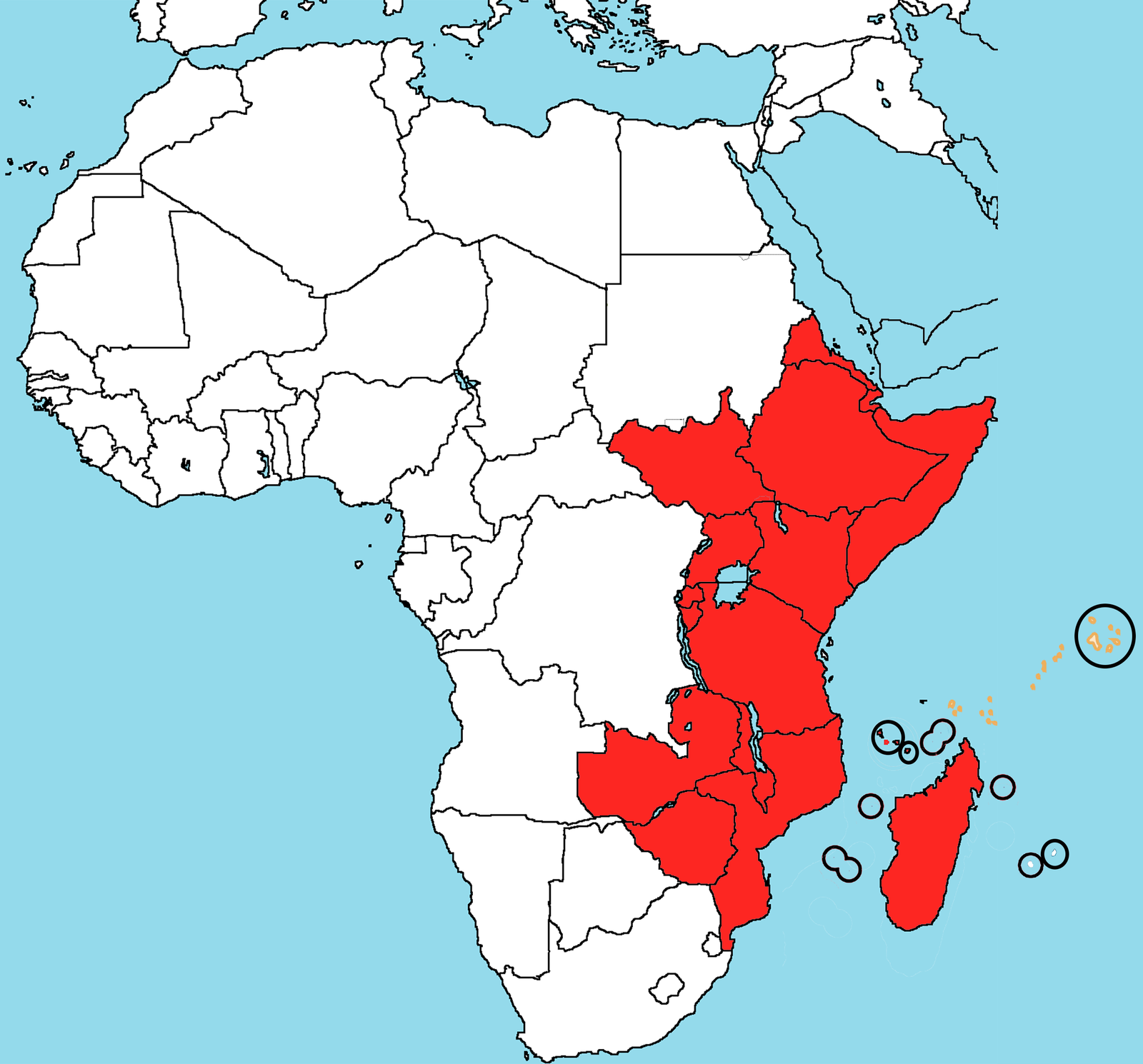 The map of EastAfrica with the 19 countries and 3 French territories. Offshore islands are circled.
Welcome to the summary page for FabulousFusionFood's East Africa recipes. This page provides links to all the East Africa recipes presented on this site, with 1053 recipes in total.
These recipes, for the major part, originate in East Africa. Otherwise they are fusion recipes with major East African influences.
East Africa also known as Eastern Africa or the East of Africa, is a region at the eastern edge of the African continent, distinguished by its geographical, historical, and cultural landscape. Defined in varying scopes, the region is recognized in the United Nations Statistics Division scheme as encompassing 10 to 11 sovereign states and territories, with some definitions extending to 18 due to historical and socio-political contexts. East Africa is acknowledged as the cradle of early modern humans, who first emerged around 200,000 years ago before spreading globally.
According to the theory of the recent African origin of modern humans, the predominantly held belief among most archaeologists, East Africa in the area of the African Great Lakes is where anatomically modern humans first appeared. There are differing theories on whether there was a single exodus or several; a multiple dispersal model involves the Southern Dispersal theory. Some researchers have suggested that North Africa was the region of Africa from which modern humans who first trekked out of the continent.
According to both genetic and fossil evidence, it has been posited that archaic Homo sapiens evolved into anatomically modern humans in the Horn of Africa around 200,000 years ago and dispersed from there. The recognition of Homo sapiens idaltu and Omo Kibish as anatomically modern humans would justify the description of contemporary humans with the subspecies name Homo sapiens sapiens. Because of their early dating and unique physical characteristics idaltu and kibish represent the immediate ancestors of anatomically modern humans as suggested by the Out-of-Africa theory
 Map of East Africa with the 22 nations and territories numbered.
The corresponding countries are : 1: Burundi; 2: Comoros;
3: Djibouti; 4: Eritrea; 5: Ethiopia; 6: French Southern
Territories (also ringed in dark blue); 7: Kenya; 8: Madagascar;
9: Malawi; 10: Mauritius; 11: Mayotte (France);
12: Mozambique; 13: Réunion (France); 14: Rwanda;
15: Seychelles; 16: Somalia; 17: Somaliland; 18: South Sudan;
19: Tanzania; 20: Uganda; 21: Zambia; 22: Zimbabwe.Djibouti, Eritrea, Ethiopia, Somalia, and the Red Sea coast of Sudan are considered the most likely location of the land known to the Ancient Egyptians as Punt. The old kingdom's first mention dates to the 25th century BCE. The ancient Puntites were a nation of people that had close relations with Pharaonic Egypt during the times of Pharaoh Sahure and Queen Hatshepsut.
The Kingdom of Aksum was a trading empire centered Eritrea and northern Ethiopia. It existed from approximately 100–940 CE, growing from the proto-Aksumite Iron Age period c. 4th century BCE to achieve prominence by the 1st century CE. The kingdom is mentioned in the Periplus of the Erythraean Sea as an important market place for ivory, which was exported throughout the ancient world. Aksum was at the time ruled by Zoskales, who also governed the port of Adulis.[29] The Aksumite rulers facilitated trade by minting their own Aksumite currency. The state also established its hegemony over the declining Kingdom of Kush and regularly entered the politics of the kingdoms on the Arabian peninsula, eventually extending its rule over the region with the conquest of the Himyarite Kingdom.
Between 2500 and 3000 years ago, Bantu-speaking peoples began a millennia-long series of migrations eastward from their homeland around southern Cameroon. This Bantu expansion introduced agriculture into much of the African Great Lakes region. During the following fifteen centuries, the Bantu slowly intensified farming and grazing over all suitable regions of East Africa, in the process making contact with Austronesian- and Arabic-speaking settlers on southern coastal areas. The latter also spread Islam to the coastal belt, but most Bantu remained African Traditional Religion adherents.
On the coastal section of the African Great Lakes region, another mixed Bantu community developed through contact with Muslim Arab and Persian traders, leading to the development of the mixed Arab, Persian and African Swahili City States. The Swahili culture that emerged from these exchanges evinces many Arab and Islamic influences not seen in traditional Bantu culture, as do the many Afro-Arab members of the Bantu Swahili people. With its original speech community centred on the coastal parts of Tanzania (particularly Zanzibar) and Kenya—a seaboard referred to as the Swahili Coast—the Bantu Swahili language contains many Arabic loan-words as a consequence of these interactions.
Eastern Africa had an estimated population of 260 million in 2000. This was projected to reach 890 million by 2050, with an average growth rate of 2.5% per annum. The 2000 population is expected to quintuple over the course of the 21st century, to 1.6 billion as of 2100 (UN estimates as of 2017). In Ethiopia, there is an estimated population of 102 million as of 2016.
In some areas, traditional East Africans consume the milk and blood of cattle, but rarely the meat. Elsewhere, other peoples are farmers who grow a variety of grains and vegetables. Maize (corn) is the basis of ugali, the local version of West and Central Africa's fufu. Ugali is a starch dish eaten with meats or stews. In Uganda, steamed green bananas called matoke provide the starch filler of many meals.
Around 1000 years ago, Omani and Yemeni merchants settled on the Swahili Coast. Middle Eastern influences are especially reflected in the Swahili cuisine of the coast—steamed or cooked rice with spices in Persian style; saffron, cloves, cinnamon and several other spices; and pomegranate juice.
Several centuries later, the British and the Indians came, and both brought with them foods such as Indian spiced vegetable curries, lentil soups, chapattis and a variety of pickles which have influenced various local dishes. Some common ingredients used in this region include oranges, lemons, limes, chilies, capsicum peppers, maize, tomatoes, and strawberries.
In the Horn of Africa, the main traditional dishes in Eritrean cuisine and Ethiopian cuisine are tsebhis (stews) served with injera[3][23] (flatbread made from teff, wheat, or sorghum) and hilbet (paste made from legumes, mainly lentils and broad (fava) beans). Eritrean and Ethiopian cuisine (especially in the northern half) are very similar, given the shared history of the two countries.
Eritrean and Ethiopian food habits vary regionally. In the highlands, injera is the staple diet and is eaten daily among the Tigrinya. Injera is made out of teff, wheat, barley, sorghum or corn, and resembles a spongy, slightly sour pancake. When eating, diners generally share food from a large tray placed in the centre of a low dining table. Many injera are layered on this tray and topped with various spicy stews. Diners then break into the section of injera in front of them, tearing off pieces and dipping them into the stews.
The best known Ethiopian/Eritrean cuisine consists of various vegetable or meat side dishes and entrées, usually a wat, or thick stew, served atop injera, a large sourdough flatbread made of teff flour. One does not eat with utensils, but instead uses injera to scoop up the entrées and side dishes.
Tihlo, prepared from roasted barley flour, is very popular in Amhara, Agame, and Awlaelo (Tigray). Traditional Ethiopian cuisine employs no pork or shellfish of any kind, as they are forbidden in the Jewish and Ethiopian Orthodox Christian faiths. It is also very common to eat from the same dish in the centre of the table with a group of people.
Somali cuisine varies from region to region and consists of an exotic mixture of diverse culinary influences. It is the product of Somalia's rich tradition of trade and commerce. Despite the variety, there remains one thing that unites the various regional cuisines: all food is served halal. There are therefore no pork dishes, alcohol is not served, nothing that died on its own is eaten, and no blood is incorporated. Qaddo or lunch is often elaborate.
Varieties of bariis (rice), the most popular being basmati, usually serve as the main dish. Spices like cumin, cardamom, cloves, cinnamon and sage are used to aromatize these different rice dishes. Somalis serve dinner as late as 9 pm. During Ramadan, dinner is often served after Tarawih prayers, sometimes as late as 11 pm.
Xalwo (halwo) or halva is a popular confection served during special occasions such as Eid celebrations or wedding receptions. It is made from sugar, cornstarch, cardamom powder, nutmeg powder, and ghee. Peanuts are also sometimes added to enhance texture and flavor.[24] After meals, homes are traditionally perfumed using frankincense (lubaan) or incense (cuunsi), which is prepared inside an incense burner referred to as a dabqaad.
Food and nutrition security in East Africa (Rwanda, Burundi and South Sudan) is a significant issue. The region has been plagued by drought, conflict and economic instability since the 1990s. The current situation is characterized by low levels of food availability and high levels of malnutrition among young children. The solution proposed for this problem is to increase local food production. This would be achieved by increasing agricultural productivity by improving soil fertility and water management, which will help farmers grow more crops per year. This will also help reduce poverty in the region by providing more employment opportunities for local people.
East Africa, as defined by the United Nations scheme of African regions is divided into 19 states and 3 French territories. All the countries and territories are listed below:
These recipes, for the major part, originate in East Africa. Otherwise they are fusion recipes with major East African influences.
East Africa also known as Eastern Africa or the East of Africa, is a region at the eastern edge of the African continent, distinguished by its geographical, historical, and cultural landscape. Defined in varying scopes, the region is recognized in the United Nations Statistics Division scheme as encompassing 10 to 11 sovereign states and territories, with some definitions extending to 18 due to historical and socio-political contexts. East Africa is acknowledged as the cradle of early modern humans, who first emerged around 200,000 years ago before spreading globally.
According to the theory of the recent African origin of modern humans, the predominantly held belief among most archaeologists, East Africa in the area of the African Great Lakes is where anatomically modern humans first appeared. There are differing theories on whether there was a single exodus or several; a multiple dispersal model involves the Southern Dispersal theory. Some researchers have suggested that North Africa was the region of Africa from which modern humans who first trekked out of the continent.
According to both genetic and fossil evidence, it has been posited that archaic Homo sapiens evolved into anatomically modern humans in the Horn of Africa around 200,000 years ago and dispersed from there. The recognition of Homo sapiens idaltu and Omo Kibish as anatomically modern humans would justify the description of contemporary humans with the subspecies name Homo sapiens sapiens. Because of their early dating and unique physical characteristics idaltu and kibish represent the immediate ancestors of anatomically modern humans as suggested by the Out-of-Africa theory
Map of East Africa with the 22 nations and territories numbered.The corresponding countries are : 1: Burundi; 2: Comoros;
3: Djibouti; 4: Eritrea; 5: Ethiopia; 6: French Southern
Territories (also ringed in dark blue); 7: Kenya; 8: Madagascar;
9: Malawi; 10: Mauritius; 11: Mayotte (France);
12: Mozambique; 13: Réunion (France); 14: Rwanda;
15: Seychelles; 16: Somalia; 17: Somaliland; 18: South Sudan;
19: Tanzania; 20: Uganda; 21: Zambia; 22: Zimbabwe.
The Kingdom of Aksum was a trading empire centered Eritrea and northern Ethiopia. It existed from approximately 100–940 CE, growing from the proto-Aksumite Iron Age period c. 4th century BCE to achieve prominence by the 1st century CE. The kingdom is mentioned in the Periplus of the Erythraean Sea as an important market place for ivory, which was exported throughout the ancient world. Aksum was at the time ruled by Zoskales, who also governed the port of Adulis.[29] The Aksumite rulers facilitated trade by minting their own Aksumite currency. The state also established its hegemony over the declining Kingdom of Kush and regularly entered the politics of the kingdoms on the Arabian peninsula, eventually extending its rule over the region with the conquest of the Himyarite Kingdom.
Between 2500 and 3000 years ago, Bantu-speaking peoples began a millennia-long series of migrations eastward from their homeland around southern Cameroon. This Bantu expansion introduced agriculture into much of the African Great Lakes region. During the following fifteen centuries, the Bantu slowly intensified farming and grazing over all suitable regions of East Africa, in the process making contact with Austronesian- and Arabic-speaking settlers on southern coastal areas. The latter also spread Islam to the coastal belt, but most Bantu remained African Traditional Religion adherents.
On the coastal section of the African Great Lakes region, another mixed Bantu community developed through contact with Muslim Arab and Persian traders, leading to the development of the mixed Arab, Persian and African Swahili City States. The Swahili culture that emerged from these exchanges evinces many Arab and Islamic influences not seen in traditional Bantu culture, as do the many Afro-Arab members of the Bantu Swahili people. With its original speech community centred on the coastal parts of Tanzania (particularly Zanzibar) and Kenya—a seaboard referred to as the Swahili Coast—the Bantu Swahili language contains many Arabic loan-words as a consequence of these interactions.
Eastern Africa had an estimated population of 260 million in 2000. This was projected to reach 890 million by 2050, with an average growth rate of 2.5% per annum. The 2000 population is expected to quintuple over the course of the 21st century, to 1.6 billion as of 2100 (UN estimates as of 2017). In Ethiopia, there is an estimated population of 102 million as of 2016.
Food and Cuisine
The cuisine of East Africa varies from area to area. In the inland savannah, the traditional cuisine of cattle-keeping peoples is distinctive meaning that meat products are generally absent. Cattle, sheep, pigs and goats were regarded as a form of currency[20] and a store of wealth. They are not generally consumed as food.In some areas, traditional East Africans consume the milk and blood of cattle, but rarely the meat. Elsewhere, other peoples are farmers who grow a variety of grains and vegetables. Maize (corn) is the basis of ugali, the local version of West and Central Africa's fufu. Ugali is a starch dish eaten with meats or stews. In Uganda, steamed green bananas called matoke provide the starch filler of many meals.
Around 1000 years ago, Omani and Yemeni merchants settled on the Swahili Coast. Middle Eastern influences are especially reflected in the Swahili cuisine of the coast—steamed or cooked rice with spices in Persian style; saffron, cloves, cinnamon and several other spices; and pomegranate juice.
Several centuries later, the British and the Indians came, and both brought with them foods such as Indian spiced vegetable curries, lentil soups, chapattis and a variety of pickles which have influenced various local dishes. Some common ingredients used in this region include oranges, lemons, limes, chilies, capsicum peppers, maize, tomatoes, and strawberries.
In the Horn of Africa, the main traditional dishes in Eritrean cuisine and Ethiopian cuisine are tsebhis (stews) served with injera[3][23] (flatbread made from teff, wheat, or sorghum) and hilbet (paste made from legumes, mainly lentils and broad (fava) beans). Eritrean and Ethiopian cuisine (especially in the northern half) are very similar, given the shared history of the two countries.
Eritrean and Ethiopian food habits vary regionally. In the highlands, injera is the staple diet and is eaten daily among the Tigrinya. Injera is made out of teff, wheat, barley, sorghum or corn, and resembles a spongy, slightly sour pancake. When eating, diners generally share food from a large tray placed in the centre of a low dining table. Many injera are layered on this tray and topped with various spicy stews. Diners then break into the section of injera in front of them, tearing off pieces and dipping them into the stews.
The best known Ethiopian/Eritrean cuisine consists of various vegetable or meat side dishes and entrées, usually a wat, or thick stew, served atop injera, a large sourdough flatbread made of teff flour. One does not eat with utensils, but instead uses injera to scoop up the entrées and side dishes.
Tihlo, prepared from roasted barley flour, is very popular in Amhara, Agame, and Awlaelo (Tigray). Traditional Ethiopian cuisine employs no pork or shellfish of any kind, as they are forbidden in the Jewish and Ethiopian Orthodox Christian faiths. It is also very common to eat from the same dish in the centre of the table with a group of people.
Somali cuisine varies from region to region and consists of an exotic mixture of diverse culinary influences. It is the product of Somalia's rich tradition of trade and commerce. Despite the variety, there remains one thing that unites the various regional cuisines: all food is served halal. There are therefore no pork dishes, alcohol is not served, nothing that died on its own is eaten, and no blood is incorporated. Qaddo or lunch is often elaborate.
Varieties of bariis (rice), the most popular being basmati, usually serve as the main dish. Spices like cumin, cardamom, cloves, cinnamon and sage are used to aromatize these different rice dishes. Somalis serve dinner as late as 9 pm. During Ramadan, dinner is often served after Tarawih prayers, sometimes as late as 11 pm.
Xalwo (halwo) or halva is a popular confection served during special occasions such as Eid celebrations or wedding receptions. It is made from sugar, cornstarch, cardamom powder, nutmeg powder, and ghee. Peanuts are also sometimes added to enhance texture and flavor.[24] After meals, homes are traditionally perfumed using frankincense (lubaan) or incense (cuunsi), which is prepared inside an incense burner referred to as a dabqaad.
Food and nutrition security in East Africa (Rwanda, Burundi and South Sudan) is a significant issue. The region has been plagued by drought, conflict and economic instability since the 1990s. The current situation is characterized by low levels of food availability and high levels of malnutrition among young children. The solution proposed for this problem is to increase local food production. This would be achieved by increasing agricultural productivity by improving soil fertility and water management, which will help farmers grow more crops per year. This will also help reduce poverty in the region by providing more employment opportunities for local people.
East Africa, as defined by the United Nations scheme of African regions is divided into 19 states and 3 French territories. All the countries and territories are listed below:
East Africa
| Arms | Flag | Name of Territory | Capital | Name in Official Language(s) |
|---|---|---|---|---|
 |
 |
Burundi | Gitega | Uburundi/Burundi/Burundi |
 |
 |
Comoros | Moroni | Komori/Comores/جزر القمر (Juzur al-Qumur) |
 |
 |
Djibouti | Moro | Yibuuti/جيبوتي (Jībūtī)/Djibouti/Jabuuti |
 |
 |
Eritrea | Asmara | Eritrea |
 |
 |
Ethiopia | Addia Ababa | ኢትዮጵያ (Ītyōṗṗyā)/Itiyoophiyaa/ኢትዮጵያ/ Itoophiyaa/Itoobiya/ኢትዮጵያ |
 |
 |
French Southern Territories | Saint Pierre | Terres australes et antarctiques françaises |
 |
 |
Kenya | Nairobi | Kenya |
 |
 |
Madagascar | Antananarivo | Madagasikara/Madagascar |
 |
 |
Malawi | Lilongwe | Malaŵi/Malaŵi |
 |
 |
Mauritius | Port Louis | Mauritius/Maurice/Moris |
 |
 |
Mayotte (France) | Mamoudzou | Mayotte/Maore/Maiôty |
 |
 |
Mozambique | Maputo | Moçambique/Mozambiki/Msumbiji/Muzambhiki |
 |
 |
Réunion (France) | Saint Denis | La Réunion |
 |
 |
Rwanda | Kigali | Rwanda |
 |
 |
Seychelles | Victoria | Seychelles/Sesel |
 |
 |
Somalia | Mogadishu | 𐒈𐒝𐒑𐒛𐒐𐒘𐒕𐒖 (Soomaaliya) /الصومال (aṣ-Ṣūmāl) |
 |
 |
Somaliland | Hargeisa | Soomaaliland/صوماليلاند (Ṣūmālīlānd) |
 |
 |
South Sudan | Juba | South Sudan |
 |
 |
Tanzania | Dodoma | Tanzania/Tanzania |
 |
 |
Uganda | Kampala | Uganda/Yuganda |
 |
 |
Zambia | Lusaka | Zambia |
 |
 |
Zimbabwe | Harare | Zimbabwe |
The alphabetical list of all the East African recipes on this site follows, (limited to 100 recipes per page). There are 1053 recipes in total:
Page 1 of 11
| Aano Baraawe (Somali Caramel Fudge) Origin: Somalia | Awaze Tibs (Ethiopian Beef and Peppers) Origin: Ethiopia | Beignets d'Aubergines (Aubergine Fritters) Origin: Mauritius |
| Achards de papaye verte (Green Papaya Pickles) Origin: Mayotte | Bâton de Manioc (Cassava Sticks) Origin: Central Africa | Beignets de Bananes (Banana Fritters) Origin: Central African Republic |
| African Chicken Wings Origin: African Fusion | Baajiya (Somali Black-eyed Pea Fritters) Origin: Somalia | Beignets de Poulet (Malagasy Chicken Fritters) Origin: Madagascar |
| African Fish Curry Powder Origin: West Africa | Baamiye Suqaar (Meat and Okra Stew) Origin: Somalia | Benne-seed Wafers Origin: West Africa |
| African Hot Sauce Origin: sub-Saharan Africa | Bajiy (Red Lentil Fritters) Origin: Somalia | Berbere Sauce Origin: Djibouti |
| African Stew Curry Powder Origin: West Africa | Bajiyoo (Djibouti Pulse Dumplings) Origin: Djibouti | Berbere Spice Origin: Ethiopia |
| African-style Barbecue Sauce Origin: African Fusion | Bajiyos (Djiboutian Potato Pakoras) Origin: Djibouti | Bérédjé Origin: Mayotte |
| Afrikaanse Yakhni Origin: South Africa | Baked Banana Pudding Origin: Uganda | Bérédjé Origin: Comoros |
| Agatoke (Plantain and Vegetable Porridge) Origin: Burundi | Baked Beans with Nigerian Seasonings Origin: African Fusion | Bifes com Molho de Amendoim (Veal Steaks with Peanut Sauce) Origin: Mozambique |
| Agneau au Cari (Lamb Curry) Origin: Reunion | Baked Millet Biscuits Origin: Kenya | Bifes de Vitela com Molho de Amendoim (Veal Steaks with Peanut Sauce) Origin: Mozambique |
| Akoho sy Voanio (Chicken in Coconut Milk) Origin: Madagascar | Baked Millet Flour Bread Origin: Kenya | Bilingani la Kukaanga (Fried Cauliflower) Origin: Kenya |
| Alicha Kimem Origin: Ethiopia | Baked Rice Pudding with Peanuts Origin: Tanzania | Biltong Origin: Southern Africa |
| Alicha Sega Wot (Mild Beef Stew) Origin: Ethiopia | Baked Tropical Fruit Pudding Origin: Malawi | Biltong Pâté Origin: South Africa |
| Alitcha Birsen Origin: Eritrea | Banana Curry Chutney Origin: South Africa | Binch Akara (Bean Fritters) Origin: Zambia |
| Améijoas (Clams in Beer) Origin: Mozambique | Banana Peel and Black-eyed Bean Stew Origin: Tanzania | Binyewa (Ugandan Peanut Soup) Origin: Uganda |
| Amandazi Origin: Rwanda | Banana Peel Flour Origin: South Africa | Binyewa (Ugandan Groundnut Sauce) Origin: Uganda |
| Amarula No-bake Cheesecake Origin: South Africa | Banana Soup Origin: Malawi | Binyewa (Ugadan Peanut Soup) Origin: Uganda |
| Amashaza mu gitoke (Peas with Plantains) Origin: Uganda | Bananas with Split Green Peas Origin: Rwanda | Biriani de Poulet (Chicken Biriani) Origin: Mauritius |
| Ambasha Origin: Ethiopia | Barbecued Fish, Ethiopian Style Origin: Ethiopia | Biscuit Origin: Mayotte |
| Ambotic Origin: Mozambique | Barbecued Kibbeh Origin: African Fusion | Blancs de Poulet au Gingembre et à la Cardamome (Chicken Breasts with Ginger and Cardamom) Origin: Madagascar |
| Ambrevades au Curry (Pigeon Pea and Coconut Curry) Origin: Comoros | Bariis iskukari Origin: Djibouti | Bo-Kaap Kerrie (Cape Malay Curry) Origin: South Africa |
| Ambrocal Origin: Seychelles | Bariis Iskukaris Origin: Somaliland | Bo-Kaap Kerrie Poeier (Cape Malay Curry Powder) Origin: South Africa |
| Ananas con Vinho do Porto (Pineapple in Port Wine) Origin: Mozambique | Basbousa Origin: Somalia | Bobotie (Curried Meat Loaf) Origin: South Africa |
| Anjera (Somali Flatbreads) Origin: Somalia | Basico (Sudanese Sesame Seeds, Greens and Smoked Meat) Origin: South Sudan | Bobotie Pancakes Origin: South Africa |
| Apple and Pear Harvest Pie Origin: South Africa | Basto and Suugo Origin: Somalia | Boerwors Maalvleis Kerrie (Boerwors Minced Meat Curry) Origin: South Africa |
| Apricot Blatjang Origin: South Africa | Basto and Suugo Origin: Djibouti | Boko Boko Harees (Chicken with Bulgur Wheat) Origin: Burundi |
| Apricot Sabayah Origin: Somalia | Batabate Origin: Mayotte | Bolinhos de Najita (Najita Balls) Origin: Mozambique |
| Arroz com Mariscos (Rice with Shellfish) Origin: Mozambique | Battered Pepper Shark Origin: Zimbabwe | Bolo de Ananás (Cake with Pineapple Filling) Origin: Mozambique |
| Arroz de Moringa (Rice with Moringa Leaves) Origin: Mozambique | Bean and Almond Salad Origin: South Africa | Bolo de Laranje e Amêndoa (Orange and Almond Cake) Origin: Mozambique |
| Askoek Origin: South Africa | Beans and Bananas Origin: Burundi | Bonbons de Coco (Coconut Candies) Origin: Mauritius |
| Atar Alecha (Spiced Split Green Peas) Origin: Ethiopia | Beans with Tomatoes, Onions and Green Bell Pepper Origin: Zambia | Boo Sauce (Ugandan Cowpea Leaves with Peanut Butter) Origin: Uganda |
| Atchar Origin: Southern Africa | Beef and Mushrooms in Peanut Sauce Origin: Central African Republic | Boo with Okra Origin: Uganda |
| Atklit (Ethiopian Cabbage Potato Bowl) Origin: Ethiopia | Beef and Potato Soup Origin: South Africa | |
| Aubergine, Sweet Potato and Chickpea Balti Origin: South Africa | Beef Braised in Rooibos Tea with Sweet Potatoes Origin: South Africa |
Page 1 of 11