FabulousFusionFood's Canarian recipes Home Page
 The flag of Algeria (left) and the Coat of Arms (right).
Welcome to the summary page for FabulousFusionFood's Algerian recipes, part of the African Continent. This page provides links to all the Canarian recipes presented on this site, with 10 recipes in total.
The Canary Islands or Canaries are an archipelago in the Atlantic Ocean and the southernmost autonomous community of Spain. They are located 100 kilometers (62 miles) to the northwest of the African continent. The capitals are Santa Cruz de Tenerife (executive and legislative) and Las Palmas de Gran Canaria (executive and judicial), with Las Palmas de Gran Canaria being the largest city.
Canarian cuisene's main features are the freshness, variety, simplicity, and richness of its ingredients (which may be a result of the long geographical isolation the islands suffered), the mix of seafood and meat dishes, its cultural influences and the low knowledge of it by the rest of the world. Canarian cuisine is influenced by other cultures, especially that of the aboriginal inhabitants of the islands (Guanches), and has influenced Latin American cuisine (after the 20th century Canarian migration to Latin America).
The Canary Islands, (Spanish: Canarias) or Canaries are an archipelago in the Atlantic Ocean and the southernmost autonomous community of Spain. They are located 100 kilometers (62 miles) to the northwest of the African continent. The islands have a population of 2.25 million people and are the most populous overseas special territory of the European Union.
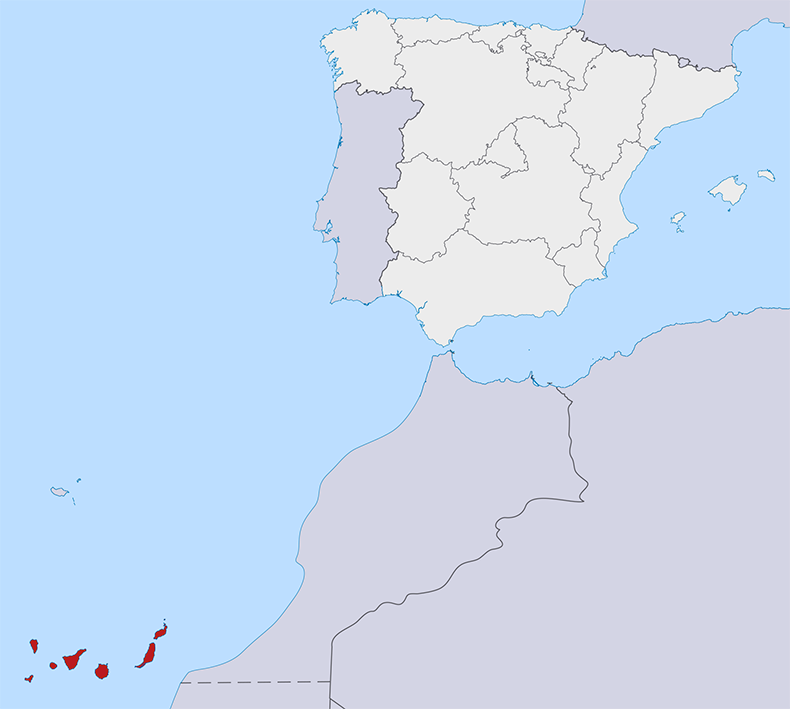 The image above shows the Canary Islands (red) in relation to neighbouring North Africa
and Spain (in yellow).The seven main islands are from largest to smallest in area, Tenerife, Fuerteventura, Gran Canaria, Lanzarote, La Palma, La Gomera, and El Hierro. The only other populated island is La Graciosa, which administratively is dependent on Lanzarote. The archipelago includes many smaller islands and islets, including Alegranza, Isla de Lobos, Montaña Clara, Roque del Oeste, and Roque del Este. It includes a number of rocks, including Garachico and Anaga. The island chain used to be referred to as 'the Fortunate Isles'. The Canary Islands are the southernmost region of Spain, and the largest and most populous archipelago of Macaronesia. It is also the largest and most populated archipelago in Spain. Because of their location, the Canary Islands have historically been considered a link between Africa, Europe, and the Americas.
In 1927, the Province of Canary Islands was split into two provinces, Santa Cruz de Tenerife and Las Palmas. In 1982, the autonomous community of the Canary Islands was established. The cities of Santa Cruz de Tenerife and Las Palmas de Gran Canaria are, jointly, the capitals of the islands. Those cities are also, respectively, the capitals of the provinces of Santa Cruz de Tenerife and Las Palmas. Las Palmas de Gran Canaria has been the largest city in the Canaries since 1768, except for a brief period in the 1910s. Between the 1833 territorial division of Spain and 1927, Santa Cruz de Tenerife was the sole capital of the Canary Islands. In 1927, it was ordered by decree that the capital of the Canary Islands would be shared between two cities, and this arrangement persists to the present day. The third largest city in the Canary Islands is San Cristóbal de La Laguna, another World Heritage Site on Tenerife.
During the Age of Sail, the islands were the main stopover for Spanish galleons during the Spanish colonisation of the Americas, which sailed that far south in order to catch the prevailing northeasterly trade winds.
Etymology: The name Islas Canarias is likely derived from the Latin name Canariae Insulae, meaning 'Islands of the Dogs', perhaps because monk seals or sea dogs were abundant, a name that was evidently generalized from the ancient name of one of these islands, Canaria – presumably Gran Canaria. According to the historian Pliny the Elder, the island Canaria contained 'vast multitudes of dogs of very large size'. The connection to dogs is retained in their depiction on the islands' coat-of-arms.
Other theories speculate that the name comes from the Nukkari Berber tribe living in the Moroccan Atlas, named in Roman sources as Canarii, though Pliny again mentions the relation of this term with dogs. The name of the islands is not derived from the canary bird; rather, the birds are named after the islands.
Mojo (pronounced mO-ho) is a sauce served with many dishes, which is made mainly of oil, garlic, vinegar, salt, red pepper, thyme, cumin, coriander and several other spices. The two main kinds are mojo rojo (red, often served with meat) and mojo verde (green, often served with fish), though both can be served with potatoes. The spicy red type is called mojo picón. This recipe is the base of the mojos of Latin America, especially Cuba, Dominican Republic, Puerto Rico, and Venezuela, due to heavy Canarian emigration, and have also influenced the cuisines of the non-Hispanic Caribbean islands.
One very typical Canarian product is gofio, a flour created by grinding roasted sweetcorn, which used to be the staple food for the local population for centuries. Gofio is produced locally and is added to many foods. For instance, it can be mixed with warm milk to be drunk in the morning, as well as made into a dough-like food called pella that can be eaten alongside meals. Gofio can also be stirred with fish broth and onions to create a dish called gofio escaldado or escaldón de gofio.
Local varieties of cheese are popular and numerous, specially goat cheese. Cheeses from both La Palma and Fuerteventura are protected by the Denominación de Origen label. Other notable cheeses are the Flor de Guía cheese and the queso tierno (tender cheese). Hard cheese is made into a paste called Almogrote on La Gomera island. Grilled cheese with mojo is sometimes served as a starter.
The Canary Islands or Canaries are an archipelago in the Atlantic Ocean and the southernmost autonomous community of Spain. They are located 100 kilometers (62 miles) to the northwest of the African continent. The capitals are Santa Cruz de Tenerife (executive and legislative) and Las Palmas de Gran Canaria (executive and judicial), with Las Palmas de Gran Canaria being the largest city.
Canarian cuisene's main features are the freshness, variety, simplicity, and richness of its ingredients (which may be a result of the long geographical isolation the islands suffered), the mix of seafood and meat dishes, its cultural influences and the low knowledge of it by the rest of the world. Canarian cuisine is influenced by other cultures, especially that of the aboriginal inhabitants of the islands (Guanches), and has influenced Latin American cuisine (after the 20th century Canarian migration to Latin America).
The Canary Islands, (Spanish: Canarias) or Canaries are an archipelago in the Atlantic Ocean and the southernmost autonomous community of Spain. They are located 100 kilometers (62 miles) to the northwest of the African continent. The islands have a population of 2.25 million people and are the most populous overseas special territory of the European Union.
The image above shows the Canary Islands (red) in relation to neighbouring North Africaand Spain (in yellow).
In 1927, the Province of Canary Islands was split into two provinces, Santa Cruz de Tenerife and Las Palmas. In 1982, the autonomous community of the Canary Islands was established. The cities of Santa Cruz de Tenerife and Las Palmas de Gran Canaria are, jointly, the capitals of the islands. Those cities are also, respectively, the capitals of the provinces of Santa Cruz de Tenerife and Las Palmas. Las Palmas de Gran Canaria has been the largest city in the Canaries since 1768, except for a brief period in the 1910s. Between the 1833 territorial division of Spain and 1927, Santa Cruz de Tenerife was the sole capital of the Canary Islands. In 1927, it was ordered by decree that the capital of the Canary Islands would be shared between two cities, and this arrangement persists to the present day. The third largest city in the Canary Islands is San Cristóbal de La Laguna, another World Heritage Site on Tenerife.
During the Age of Sail, the islands were the main stopover for Spanish galleons during the Spanish colonisation of the Americas, which sailed that far south in order to catch the prevailing northeasterly trade winds.
Etymology: The name Islas Canarias is likely derived from the Latin name Canariae Insulae, meaning 'Islands of the Dogs', perhaps because monk seals or sea dogs were abundant, a name that was evidently generalized from the ancient name of one of these islands, Canaria – presumably Gran Canaria. According to the historian Pliny the Elder, the island Canaria contained 'vast multitudes of dogs of very large size'. The connection to dogs is retained in their depiction on the islands' coat-of-arms.
Other theories speculate that the name comes from the Nukkari Berber tribe living in the Moroccan Atlas, named in Roman sources as Canarii, though Pliny again mentions the relation of this term with dogs. The name of the islands is not derived from the canary bird; rather, the birds are named after the islands.
Canarian Cuisine
Canarian cuisine's main features are the freshness, variety, simplicity, and richness of its ingredients (which may be a result of the long geographical isolation the islands suffered), the mix of seafood and meat dishes, its cultural influences and the low knowledge of it by the rest of the world. Canarian cuisine is influenced by other cultures, especially that of the aboriginal inhabitants of the islands (Guanches), and has influenced Latin American cuisine (after the 20th century Canarian migration to Latin America).Mojo (pronounced mO-ho) is a sauce served with many dishes, which is made mainly of oil, garlic, vinegar, salt, red pepper, thyme, cumin, coriander and several other spices. The two main kinds are mojo rojo (red, often served with meat) and mojo verde (green, often served with fish), though both can be served with potatoes. The spicy red type is called mojo picón. This recipe is the base of the mojos of Latin America, especially Cuba, Dominican Republic, Puerto Rico, and Venezuela, due to heavy Canarian emigration, and have also influenced the cuisines of the non-Hispanic Caribbean islands.
One very typical Canarian product is gofio, a flour created by grinding roasted sweetcorn, which used to be the staple food for the local population for centuries. Gofio is produced locally and is added to many foods. For instance, it can be mixed with warm milk to be drunk in the morning, as well as made into a dough-like food called pella that can be eaten alongside meals. Gofio can also be stirred with fish broth and onions to create a dish called gofio escaldado or escaldón de gofio.
Local varieties of cheese are popular and numerous, specially goat cheese. Cheeses from both La Palma and Fuerteventura are protected by the Denominación de Origen label. Other notable cheeses are the Flor de Guía cheese and the queso tierno (tender cheese). Hard cheese is made into a paste called Almogrote on La Gomera island. Grilled cheese with mojo is sometimes served as a starter.
Canary Islands' National Dishes:
Below are listed the dishes considered to be Canary Islands' national foods along with links to the recipes for those dishes:| Mojo Rojo (Canaries Red Sauce) Origin: Spain | Mojo Verde (Canaries Green Sauce) Origin: Spain | Papas Arrugadas (Canaries Wrinkled Potatoes) Origin: Spain |
The alphabetical list of all Canarian recipes on this site follows, (limited to 100 recipes per page). There are 10 recipes in total:
Page 1 of 1
| Mojo Rojo (Canaries Red Sauce) Origin: Spain | Bacalao Encebollado con Almendras al Estilo Canario (Cod with Onions and Almonds, Canary Style) Origin: Spain | Mojo Picón (Spicy Canarian Chilli Sauce) Origin: Spain |
| Mojo Verde (Canaries Green Sauce) Origin: Spain | Caldo de Papas y Cilantro (Potato and Coriander Soup) Origin: Spain | Mojo Rojo (Canaries Red Sauce) Origin: Spain |
| Papas Arrugadas (Canaries Wrinkled Potatoes) Origin: Spain | Canarian Ropa Vieja Origin: Spain | Mojo Verde (Canaries Green Sauce) Origin: Spain |
| Almogrote Gomero (Cheese and Tomato Paste) Origin: Spain |
Page 1 of 1