FabulousFusionFood's Saint Helenian Recipes Home Page
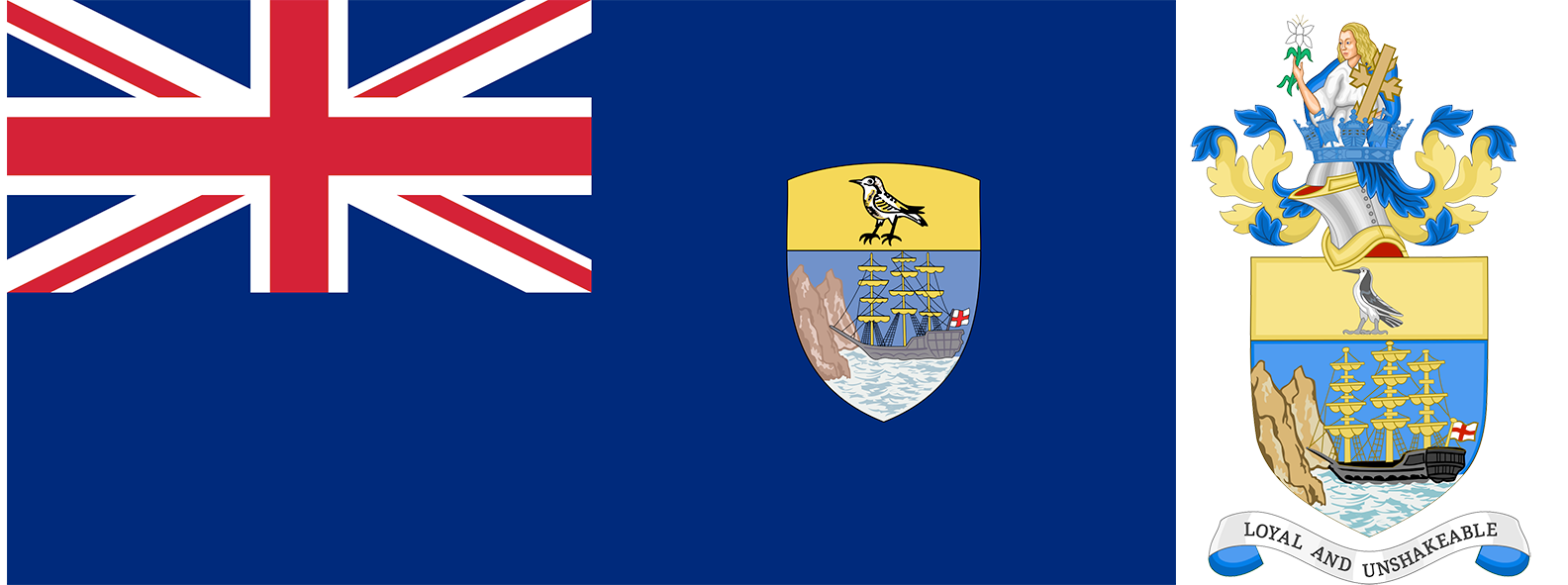 The flag of Saint Helena (left) and the coat of arms of Saint Helena (right).
Welcome to the summary page for FabulousFusionFood's Saint Helena recipes, part of Africa. This page provides links to all the Saint Lucian recipes presented on this site, with 17 recipes in total.
This is a continuation of an entire series of pages that will, I hope, allow my visitors to better navigate this site. As well as displaying recipes by name, country and region of origin I am now planning a whole series of pages where recipes can be located by meal type and main ingredient. This page gives a listing of all the Indian recipes added to this site.
Saint Helena is one of the three constituent parts of Saint Helena, Ascension and Tristan da Cunha a remote British overseas territory and is the most populous island.
Fish cakes in a St Helena style, with egg binding and chilli, and a risotto-with-curry dish called pilau (or plo, a cross between a risotto and the Indian rice dish pulao). Most of the local recipes are variations of world dishes brought to the island by travellers. Chinese, Indian and South African influences are notable.
Saint Helena is one of the three constituent parts of Saint Helena, Ascension and Tristan da Cunha,[5] a remote British overseas territory. It is a volcanic and tropical island, located in the South Atlantic Ocean, some 1,874 km (1,165 miles) west of the mainland of the continent of Africa, with the Southern African nations of Angola and Namibia on its southeastern coast being the closest nations geographically. The island is around 1,950 km (1,210 mi) west of the coast of southwestern South Africa, and 4,000 km (2,500 mi) east of the major seaport city of Rio de Janeiro, Brazil in South America.
 Image of the Atlantic with the location of Saint Helena picked out
and circled, a blow-up map of Saint Helena is show, inset.Saint Helena measures about 16 by 8 km and had a population of 4,439 in the 2021 census. It was named after Saint Helena (AD c.246/248–330), influential mother of the famous Roman Emperor Saint Constantine I the Great. (A.D 272–337, reigned 306–337), of the ancient Roman Empire. It is one of the most remote major islands in the world and was uninhabited until the 16th century, when it was discovered by the Portuguese explorers/traders en route southward around the continent of Africa, then east across the Indian Ocean to the Indian subcontinent (India) of South Asia in 1502. For about the next four centuries, the island was an important stopover for ships between Europe and Asia sailing around the African continent and its southern Cape of Good Hope, before the opening of the shortcut Suez Canal in 1869, in Egypt between the Mediterranean and Red Seas. Saint Helena is the United Kingdom's second-oldest overseas territory/possession of the old British Empire, after the islands of Bermuda, off the southeast coast of North America. Until the opening of its airport in 2017, the primary method of reaching Saint Helena was a 6-day journey by sea, most recently since 1989 on the RMS St Helena passenger steamship liner.
Saint Helena is known for being the site of Napoleon Bonaparte's second and longest period of exile, following his final defeat in June 1815, until his death there six years later.
Etymology: According to long-established tradition, the island was sighted on 21 May 1502 by the four ships of the 3rd Portuguese Armada, commanded by João da Nova, a Galician navigator in the service of Portugal, during his return voyage to Lisbon, who named it Santa Helena after Saint Helena of Constantinople. This tradition was reviewed by a 2022 paper[6] which concluded that the Portuguese chronicles[7] published at least fifty years after the sighting are the sole primary source for the discovery. Although contradictory in describing other events, these chronicles almost unanimously claim that João da Nova found Saint Helena sometime in 1502, although none of them gives a precise date.
This is a continuation of an entire series of pages that will, I hope, allow my visitors to better navigate this site. As well as displaying recipes by name, country and region of origin I am now planning a whole series of pages where recipes can be located by meal type and main ingredient. This page gives a listing of all the Indian recipes added to this site.
Saint Helena is one of the three constituent parts of Saint Helena, Ascension and Tristan da Cunha a remote British overseas territory and is the most populous island.
Fish cakes in a St Helena style, with egg binding and chilli, and a risotto-with-curry dish called pilau (or plo, a cross between a risotto and the Indian rice dish pulao). Most of the local recipes are variations of world dishes brought to the island by travellers. Chinese, Indian and South African influences are notable.
Saint Helena is one of the three constituent parts of Saint Helena, Ascension and Tristan da Cunha,[5] a remote British overseas territory. It is a volcanic and tropical island, located in the South Atlantic Ocean, some 1,874 km (1,165 miles) west of the mainland of the continent of Africa, with the Southern African nations of Angola and Namibia on its southeastern coast being the closest nations geographically. The island is around 1,950 km (1,210 mi) west of the coast of southwestern South Africa, and 4,000 km (2,500 mi) east of the major seaport city of Rio de Janeiro, Brazil in South America.
Image of the Atlantic with the location of Saint Helena picked outand circled, a blow-up map of Saint Helena is show, inset.
Saint Helena is known for being the site of Napoleon Bonaparte's second and longest period of exile, following his final defeat in June 1815, until his death there six years later.
Etymology: According to long-established tradition, the island was sighted on 21 May 1502 by the four ships of the 3rd Portuguese Armada, commanded by João da Nova, a Galician navigator in the service of Portugal, during his return voyage to Lisbon, who named it Santa Helena after Saint Helena of Constantinople. This tradition was reviewed by a 2022 paper[6] which concluded that the Portuguese chronicles[7] published at least fifty years after the sighting are the sole primary source for the discovery. Although contradictory in describing other events, these chronicles almost unanimously claim that João da Nova found Saint Helena sometime in 1502, although none of them gives a precise date.
Saint Helenian Cuisine:
Fish cakes in a St Helena style, with egg binding and chilli, and a risotto-with-curry dish called pilau (or plo, a cross between a risotto and the Indian rice dish pulao). Most of the local recipes are variations of world dishes brought to the island by travellers. Chinese, Indian and South African influences are notable.Saint Helena's National Dishes:
Below are listed the dishes considered to be Saint Helena's national foods along with links to the recipes for those dishes:| Plo Origin: St Helena |
The alphabetical list of all the Saint Helenian recipes on this site follows, (limited to 100 recipes per page). There are 17 recipes in total:
Page 1 of 1
| Plo Origin: St Helena | Saint Helena Rock Cakes Origin: St Helena | St Helena Curry and Rice Origin: St Helena |
| Coconut Bread Pudding Origin: St Helena | Saint Helena Tomato Paste Origin: St Helena | St Helena Fishcakes Origin: St Helena |
| Plo Origin: St Helena | Saint Helena Tomato Sauce Origin: St Helena | St Helena Hertzoggies Origin: St Helena |
| Saint Helena Coconut Rock Cakes Origin: St Helena | St Helena Black Pudding Origin: St Helena | St Helena Pumpkin Fritters Origin: St Helena |
| Saint Helena Curry Puffs Origin: St Helena | St Helena Coconut Fingers Origin: St Helena | St Helena Pumpkin Pudding Origin: St Helena |
| Saint Helena Ginger Beer Origin: St Helena | St Helena Crab Soup Origin: St Helena |
Page 1 of 1