FabulousFusionFood's Israeli Recipes Home Page
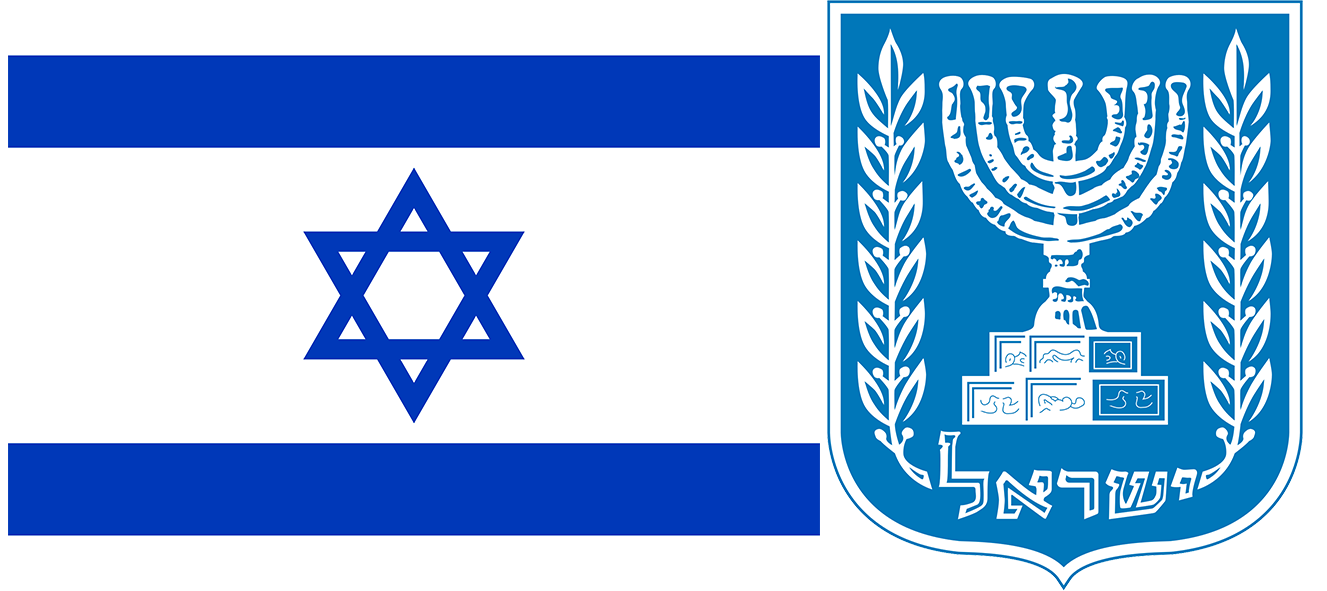 The flag of Israel (left) and the emblem of Israel (right).
Welcome to the summary page for FabulousFusionFood's Iraqi recipes, part Asia. This page provides links to all the Iraqi recipes presented on this site, with 34 recipes in total.
This is a continuation of an entire series of pages that will, I hope, allow my visitors to better navigate this site. As well as displaying recipes by name, country and region of origin I am now planning a whole series of pages where recipes can be located by meal type and main ingredient. This page gives a listing of all the Israeli recipes added to this site. Baku is the capital and largest city.
Israel (מְדִינַת יִשְׂרָאֵל (Medīnat Yisrā'el in Hebrew), دولة إسرائيل (Dawlat Isrā'īl in Arabic)), is a country in the Southern Levant region of West Asia. It shares borders with Lebanon to the north, Syria to the north-east, Jordan to the east, Egypt to the south-west and the Mediterranean Sea to the west. Its proclaimed capital is Jerusalem, while Tel Aviv is its largest urban area and economic centre.
Israeli cuisine includes local dishes as well as Jewish cuisine brought to the country by immigrants. Particularly since the late 1970s, a fusion cuisine has developed. The cuisine has adapted elements of the Mizrahi, Sephardi, and Ashkenazi styles of cooking. It incorporates many foods traditionally eaten in the Levantine, Arab, Middle Eastern and Mediterranean cuisines, such as falafel, hummus, shakshouka, couscous, and za'atar. Schnitzel, pizza, hamburgers, French fries, rice and salad are common.
Israel officially the State of Israel, is a country in the Southern Levant region of West Asia. It shares borders with Lebanon to the north, Syria to the north-east, Jordan to the east, Egypt to the south-west and the Mediterranean Sea to the west. It occupies the Palestinian territories of the West Bank in the east and the Gaza Strip in the south-west, as well as the Syrian Golan Heights in the northeast. Israel also has a small coastline on the Red Sea at its southernmost point, and part of the Dead Sea lies along its eastern border. Its proclaimed capital is Jerusalem, while Tel Aviv is its largest urban area and economic centre.
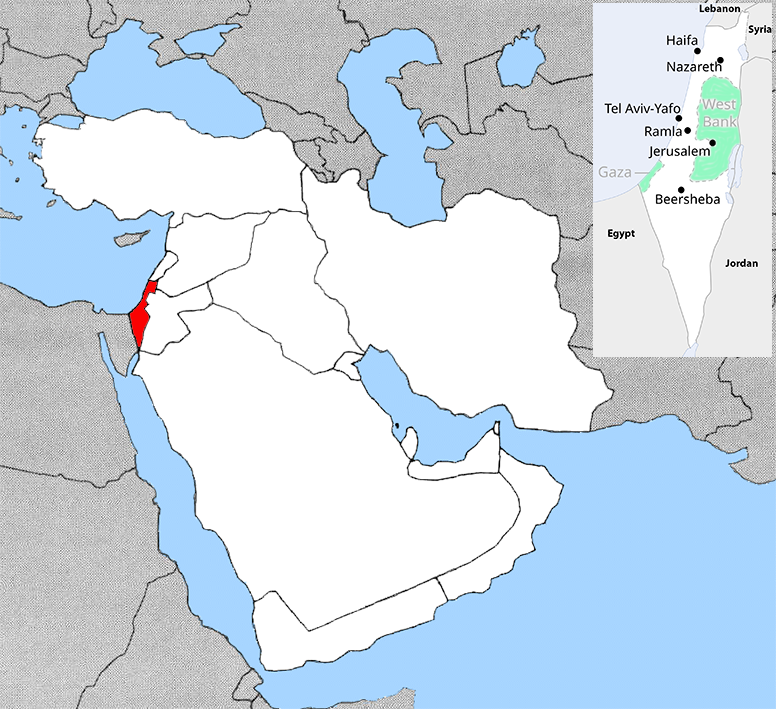 Location of Israel in West Asia with the land mass of Israel
picked out in red. The inset image shows a blow-up of Israel with Gaza and the
West Bank demarcated in light green.Israel is located in a region known as the Land of Israel, synonymous with Canaan, the Holy Land, the Palestine region, and Judea. In antiquity it was home to the Canaanite civilisation, followed by the kingdoms of Israel and Judah. Situated at a continental crossroad, the region experienced demographic changes under the rule of empires from the Romans to the Ottomans. European antisemitism in the late 19th century galvanised Zionism, which sought to establish a homeland for the Jewish people in Palestine and gained British support with the Balfour Declaration. After World War I, Britain occupied the region and established Mandatory Palestine in 1920. Increased Jewish immigration in the lead-up to the Holocaust and British foreign policy in the Middle East led to intercommunal conflict between Jews and Arabs, which escalated into a civil war in 1947 after the United Nations (UN) proposed partitioning the land between them.
After the end of the British Mandate for Palestine, Israel declared independence on 14 May 1948. Neighbouring Arab states invaded the area the next day, beginning the First Arab–Israeli War. An armistice in 1949 left Israel in control of more territory than the UN partition plan had called for; and no new independent Arab state was created as the rest of the former Mandate territory was held by Egypt and Jordan, respectively the Gaza Strip and the West Bank. The majority of Palestinian Arabs either fled or were expelled in what is known as the Nakba, with those remaining becoming the new state's main minority. Over the following decades, Israel's population increased greatly as the country received an influx of Jews who emigrated, fled or were expelled from the Arab world.
Following the 1967 Six-Day War, Israel occupied the West Bank, Gaza Strip, Egyptian Sinai Peninsula and Syrian Golan Heights. After the 1973 Yom Kippur War, Israel signed peace treaties with Egypt—returning the Sinai in 1982—and Jordan. In 1993, Israel signed the Oslo Accords, which established mutual recognition and limited Palestinian self-governance in parts of the West Bank and Gaza. In the 2020s, it normalised relations with several more Arab countries via the Abraham Accords. However, efforts to resolve the Israeli–Palestinian conflict after the interim Oslo Accords have not succeeded, and the country has engaged in several wars and clashes with Palestinian militant groups. Israel established and continues to expand settlements across the illegally occupied territories, contrary to international law, and has effectively annexed East Jerusalem and the Golan Heights in moves largely unrecognised internationally. Israel's practices in its occupation of the Palestinian territories have drawn sustained international criticism—along with accusations that it has committed war crimes, crimes against humanity, and genocide against the Palestinian people—from experts, human rights organisations and UN officials.
The country's Basic Laws establish a parliament elected by proportional representation, the Knesset, which determines the makeup of the government headed by the prime minister and elects the figurehead president. Israel has one of the largest economies in the Middle East, one of the highest standards of living in Asia, the world's 26th-largest economy by nominal GDP and 16th by nominal GDP per capita. One of the most technologically advanced and developed countries globally, Israel spends proportionally more on research and development than any other country in the world. It is widely believed to possess nuclear weapons. Israeli culture comprises Jewish and Jewish diaspora elements alongside Arab influences.
Etymology: The names Land of Israel and Children of Israel have historically been used to refer to the biblical Kingdom of Israel and the entire Jewish people respectively. The name Israel (Hebrew: Yīsrāʾēl; Septuagint Ancient Greek: Ἰσραήλ, Israēl, 'El (God) persists/rules') refers to the patriarch Jacob who, according to the Hebrew Bible, was given the name after he successfully wrestled with the Angel of the Lord. The earliest known archaeological artefact to mention the word Israel as a collective is the Merneptah Stele of ancient Egypt (dated to the late-13th century BCE)
Under the British Mandate (1920–1948), the entire region was known as Palestine. Upon establishment in 1948, the country formally adopted the name State of Israel (Hebrew: מְדִינַת יִשְׂרָאֵל, Medīnat Yisrā'el [mediˈnat jisʁaˈʔel]; Arabic: دَوْلَة إِسْرَائِيل, Dawlat Isrāʼīl, [dawlat ʔisraːˈʔiːl]) after other proposed names including Land of Israel (Eretz Israel), Ever (from ancestor Eber), Zion, and Judea, were considered but rejected. The name Israel was suggested by David Ben-Gurion and passed by a vote of 6–3. In the early weeks after establishment, the government chose the term Israeli to denote a citizen of the state.
Roughly half of the Jewish population attests to keeping kosher at home. Kosher restaurants make up around a quarter of the total as of 2015. Pork—often called 'white meat' in Israel—is produced and consumed despite attempts to ban it; it is forbidden by both Judaism and Islam but is permitted by Christianity and mostly produced in traditionally Christian areas of northern Israel. Other non-kosher foods produced and eaten in Israel include rabbits, ostriches, and non-kosher fish.
This is a continuation of an entire series of pages that will, I hope, allow my visitors to better navigate this site. As well as displaying recipes by name, country and region of origin I am now planning a whole series of pages where recipes can be located by meal type and main ingredient. This page gives a listing of all the Israeli recipes added to this site. Baku is the capital and largest city.
Israel (מְדִינַת יִשְׂרָאֵל (Medīnat Yisrā'el in Hebrew), دولة إسرائيل (Dawlat Isrā'īl in Arabic)), is a country in the Southern Levant region of West Asia. It shares borders with Lebanon to the north, Syria to the north-east, Jordan to the east, Egypt to the south-west and the Mediterranean Sea to the west. Its proclaimed capital is Jerusalem, while Tel Aviv is its largest urban area and economic centre.
Israeli cuisine includes local dishes as well as Jewish cuisine brought to the country by immigrants. Particularly since the late 1970s, a fusion cuisine has developed. The cuisine has adapted elements of the Mizrahi, Sephardi, and Ashkenazi styles of cooking. It incorporates many foods traditionally eaten in the Levantine, Arab, Middle Eastern and Mediterranean cuisines, such as falafel, hummus, shakshouka, couscous, and za'atar. Schnitzel, pizza, hamburgers, French fries, rice and salad are common.
Israel officially the State of Israel, is a country in the Southern Levant region of West Asia. It shares borders with Lebanon to the north, Syria to the north-east, Jordan to the east, Egypt to the south-west and the Mediterranean Sea to the west. It occupies the Palestinian territories of the West Bank in the east and the Gaza Strip in the south-west, as well as the Syrian Golan Heights in the northeast. Israel also has a small coastline on the Red Sea at its southernmost point, and part of the Dead Sea lies along its eastern border. Its proclaimed capital is Jerusalem, while Tel Aviv is its largest urban area and economic centre.
Location of Israel in West Asia with the land mass of Israelpicked out in red. The inset image shows a blow-up of Israel with Gaza and the
West Bank demarcated in light green.
After the end of the British Mandate for Palestine, Israel declared independence on 14 May 1948. Neighbouring Arab states invaded the area the next day, beginning the First Arab–Israeli War. An armistice in 1949 left Israel in control of more territory than the UN partition plan had called for; and no new independent Arab state was created as the rest of the former Mandate territory was held by Egypt and Jordan, respectively the Gaza Strip and the West Bank. The majority of Palestinian Arabs either fled or were expelled in what is known as the Nakba, with those remaining becoming the new state's main minority. Over the following decades, Israel's population increased greatly as the country received an influx of Jews who emigrated, fled or were expelled from the Arab world.
Following the 1967 Six-Day War, Israel occupied the West Bank, Gaza Strip, Egyptian Sinai Peninsula and Syrian Golan Heights. After the 1973 Yom Kippur War, Israel signed peace treaties with Egypt—returning the Sinai in 1982—and Jordan. In 1993, Israel signed the Oslo Accords, which established mutual recognition and limited Palestinian self-governance in parts of the West Bank and Gaza. In the 2020s, it normalised relations with several more Arab countries via the Abraham Accords. However, efforts to resolve the Israeli–Palestinian conflict after the interim Oslo Accords have not succeeded, and the country has engaged in several wars and clashes with Palestinian militant groups. Israel established and continues to expand settlements across the illegally occupied territories, contrary to international law, and has effectively annexed East Jerusalem and the Golan Heights in moves largely unrecognised internationally. Israel's practices in its occupation of the Palestinian territories have drawn sustained international criticism—along with accusations that it has committed war crimes, crimes against humanity, and genocide against the Palestinian people—from experts, human rights organisations and UN officials.
The country's Basic Laws establish a parliament elected by proportional representation, the Knesset, which determines the makeup of the government headed by the prime minister and elects the figurehead president. Israel has one of the largest economies in the Middle East, one of the highest standards of living in Asia, the world's 26th-largest economy by nominal GDP and 16th by nominal GDP per capita. One of the most technologically advanced and developed countries globally, Israel spends proportionally more on research and development than any other country in the world. It is widely believed to possess nuclear weapons. Israeli culture comprises Jewish and Jewish diaspora elements alongside Arab influences.
Etymology: The names Land of Israel and Children of Israel have historically been used to refer to the biblical Kingdom of Israel and the entire Jewish people respectively. The name Israel (Hebrew: Yīsrāʾēl; Septuagint Ancient Greek: Ἰσραήλ, Israēl, 'El (God) persists/rules') refers to the patriarch Jacob who, according to the Hebrew Bible, was given the name after he successfully wrestled with the Angel of the Lord. The earliest known archaeological artefact to mention the word Israel as a collective is the Merneptah Stele of ancient Egypt (dated to the late-13th century BCE)
Under the British Mandate (1920–1948), the entire region was known as Palestine. Upon establishment in 1948, the country formally adopted the name State of Israel (Hebrew: מְדִינַת יִשְׂרָאֵל, Medīnat Yisrā'el [mediˈnat jisʁaˈʔel]; Arabic: دَوْلَة إِسْرَائِيل, Dawlat Isrāʼīl, [dawlat ʔisraːˈʔiːl]) after other proposed names including Land of Israel (Eretz Israel), Ever (from ancestor Eber), Zion, and Judea, were considered but rejected. The name Israel was suggested by David Ben-Gurion and passed by a vote of 6–3. In the early weeks after establishment, the government chose the term Israeli to denote a citizen of the state.
Israeli Cuisine:
The heterogeneous nature of culture in Israel is also manifested in Israeli cuisine, a diverse combination of local ingredients and dishes, with diasporic dishes from around the world. An Israeli fusion cuisine has developed, with the adoption and continued adaption of elements of various Jewish styles of cuisine including Mizrahi, Sephardic, Yemenite Jewish and Ashkenazi, and many foods traditionally eaten in the Middle East. Israeli cuisine is also influenced by geography, giving prominence to foods common in the Mediterranean region such as olives, chickpeas, dairy products, fish, and fresh fruits and vegetables. The main meal is usually lunch rather than dinner. Jewish holidays influence the cuisine, with many traditional foods served at holiday times. Shabbat dinner, eaten on Friday night, is a significant meal in a large proportion of Israeli homes. While not all Jews in Israel keep kosher, the observance of kashrut influences the menu in homes, public institutions and many restaurants.Roughly half of the Jewish population attests to keeping kosher at home. Kosher restaurants make up around a quarter of the total as of 2015. Pork—often called 'white meat' in Israel—is produced and consumed despite attempts to ban it; it is forbidden by both Judaism and Islam but is permitted by Christianity and mostly produced in traditionally Christian areas of northern Israel. Other non-kosher foods produced and eaten in Israel include rabbits, ostriches, and non-kosher fish.
Israel's National Dishes:
Below are listed the dishes considered to be Israel's national foods along with links to the recipes for those dishes:| Israeli Chicken and Rice Pilaf Origin: Israel | Israeli Shakshuka Origin: Israel | Ptitim (Israeli Couscous) Origin: Israel |
| Israeli Falafel Origin: Israel | Me'orav Yerushalmi (Jerusalem Mixed Grill) Origin: Israel | Sabich Origin: Israel |
| Israeli Salad Origin: Israel | Pelēkie Zirņi ar Speķi (Grey Peas with Bacon) Origin: Israel |
The alphabetical list of all the Israeli recipes on this site follows, (limited to 100 recipes per page). There are 34 recipes in total:
Page 1 of 1
| Israeli Chicken and Rice Pilaf Origin: Israel | Israeli Chicken and Aubergine Shakshuka Origin: Israel | Malabi Milk Pudding with Rose Water Origin: Israel |
| Israeli Falafel Origin: Israel | Israeli Chicken and Rice Pilaf Origin: Israel | Markouk Origin: Israel |
| Israeli Salad Origin: Israel | Israeli Falafel Origin: Israel | Matbucha (Spicy Cooked Tomato and Pepper Salad) Origin: Israel |
| Israeli Shakshuka Origin: Israel | Israeli Halva Origin: Israel | Matzo Bread Origin: Israel |
| Me'orav Yerushalmi (Jerusalem Mixed Grill) Origin: Israel | Israeli Mamul (Israeli Date Pastries) Origin: Israel | Matzo Brei Origin: Israel |
| Pelēkie Zirņi ar Speķi (Grey Peas with Bacon) Origin: Israel | Israeli Pita Bread Origin: Israel | Me'orav Yerushalmi (Jerusalem Mixed Grill) Origin: Israel |
| Ptitim (Israeli Couscous) Origin: Israel | Israeli Salad Origin: Israel | Mujadara Origin: Israel |
| Sabich Origin: Israel | Israeli Shakshuka Origin: Israel | Paprika Potatoes Origin: Israel |
| Amba Sauce Origin: Israel | Israeli-style Pita Bread Origin: Israel | Pelēkie Zirņi ar Speķi (Grey Peas with Bacon) Origin: Israel |
| Barbecued Fish with Amba Mango Sauce Origin: Israel | Kocktail Yafo (Fish Cocktail) Origin: Israel | Potato Bourekas with Spicy Tomato Sauce Origin: Israel |
| Hamantaschen (Tricorn Purim Pastries) Origin: Israel | Laffa Bread Origin: Israel | Prune-stuffed Chicken Origin: Israel |
| Hamutzim (Israeli Pickled Vegetables) Origin: Israel | Limonana Origin: Israel | Ptitim (Israeli Couscous) Origin: Israel |
Page 1 of 1