FabulousFusionFood's Timorese Recipes Home Page
 The flag of East Timor (left) and the emblem of East Timor (right).
Welcome to the summary page for FabulousFusionFood's Timorese recipes, part of Asia. This page provides links to all the Laotian recipes presented on this site, with 10 recipes in total.
This is a continuation of an entire series of pages that will, I hope, allow my visitors to better navigate this site. As well as displaying recipes by name, country and region of origin I am now planning a whole series of pages where recipes can be located by meal type and main ingredient. This page gives a listing of all the Timorese recipes added to this site.
These recipes, for the major part, originate in East Timor (Timor Leste). Otherwise they are fusion recipes with major Timorese components.
Timor Leste (East Timor), officially the Democratic Republic of Timor-Leste (República Democrática de Timor-Leste in Portuguese and Repúblika Demokrátika Timór Lorosa'e in Tetum) is a country in Southeast Asia. It comprises the eastern half of the island of Timor, the coastal exclave of Oecusse in the island's northwest, and the outer islands of Atauro and Jaco. Timor-Leste shares a land border with Indonesia to the west, and Australia is the country's southern neighbour, across the Timor Sea. The country's size is 14,950 square kilometres (5,770 sq mi). Dili, on the north coast of Timor, is its capital and largest city.
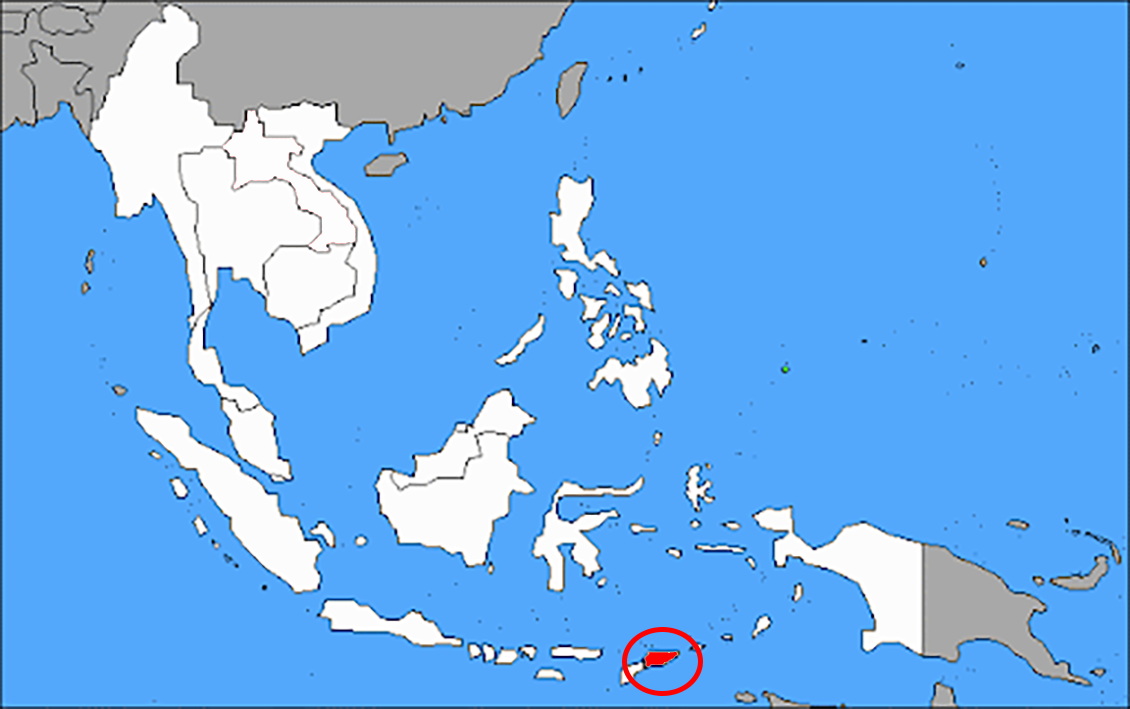 Location of Laos in Southeast Asia with East Timor picked out in red and circled.Timor was settled over time by various Papuan and Austronesian peoples, which created a diverse mix of cultures and languages linked to both Southeast Asia and Melanesia. East Timor came under Portuguese influence in the sixteenth century, remaining a Portuguese colony until 1975. Internal conflict preceded a unilateral declaration of independence and an Indonesian invasion and annexation. The subsequent Indonesian occupation was characterised by extreme abuses of human rights, including torture and massacres, a series of events named the East Timor genocide. Resistance continued throughout Indonesian rule and in 1999, a United Nations–sponsored act of self-determination led to Indonesia relinquishing control of the territory. On 20 May 2002, as Timor-Leste, it became the first new sovereign state of the 21st century. That same year, relations with Indonesia were established and normalized, with Indonesia also supporting Timor-Leste's accession into ASEAN.
The national government is a semi-presidential system, with the popularly elected president sharing power with a prime minister appointed by the National Parliament. Power is centralised under the national government, although many local leaders have informal influence. The country maintains a policy of international cooperation and is a member of the Community of Portuguese Language Countries, an observer of the Pacific Islands Forum, and is in negotiations to join ASEAN by October 2025. The country remains relatively poor, with an economy that relies heavily on natural resources, especially oil, and foreign aid.
The total population is over 1.34 million at the 2022 census, and is heavily skewed towards young people due to a high fertility rate. Education has led to increasing literacy over the past half-century, especially in the two official languages of Portuguese and Tetum. East Timor is the only sovereign country in Asia where Portuguese is an official language. High ethnic and linguistic diversity is reflected by the 30 indigenous languages spoken in the country. The majority of the population is Catholic, which coexists alongside strong local traditions and beliefs, especially in rural areas.
Etymology: 'Timor' is derived from timur, meaning 'east' in Malay, thus resulting in a tautological place name meaning 'East East'. In Indonesian, this results in the name Timor Timur (the name of the former de facto Indonesian province; Timor Leste is used instead to refer to the country). In Portuguese, the country is called Timor-Leste (Leste meaning 'east'). In Tetum, it is Timór Lorosa'e (Lorosa'e can be literally translated as 'where the sun rises').
The official names under its constitution are 'Democratic Republic of Timor-Leste' in English, 'República Democrática de Timor-Leste' in Portuguese, and 'Repúblika Demokrátika Timór-Leste' in Tetum. The official short form of the name is 'Timor-Leste, and it uses the ISO codes TLS & TL..
This is a continuation of an entire series of pages that will, I hope, allow my visitors to better navigate this site. As well as displaying recipes by name, country and region of origin I am now planning a whole series of pages where recipes can be located by meal type and main ingredient. This page gives a listing of all the Timorese recipes added to this site.
These recipes, for the major part, originate in East Timor (Timor Leste). Otherwise they are fusion recipes with major Timorese components.
Timor Leste (East Timor), officially the Democratic Republic of Timor-Leste (República Democrática de Timor-Leste in Portuguese and Repúblika Demokrátika Timór Lorosa'e in Tetum) is a country in Southeast Asia. It comprises the eastern half of the island of Timor, the coastal exclave of Oecusse in the island's northwest, and the outer islands of Atauro and Jaco. Timor-Leste shares a land border with Indonesia to the west, and Australia is the country's southern neighbour, across the Timor Sea. The country's size is 14,950 square kilometres (5,770 sq mi). Dili, on the north coast of Timor, is its capital and largest city.
Location of Laos in Southeast Asia with East Timor picked out in red and circled.The national government is a semi-presidential system, with the popularly elected president sharing power with a prime minister appointed by the National Parliament. Power is centralised under the national government, although many local leaders have informal influence. The country maintains a policy of international cooperation and is a member of the Community of Portuguese Language Countries, an observer of the Pacific Islands Forum, and is in negotiations to join ASEAN by October 2025. The country remains relatively poor, with an economy that relies heavily on natural resources, especially oil, and foreign aid.
The total population is over 1.34 million at the 2022 census, and is heavily skewed towards young people due to a high fertility rate. Education has led to increasing literacy over the past half-century, especially in the two official languages of Portuguese and Tetum. East Timor is the only sovereign country in Asia where Portuguese is an official language. High ethnic and linguistic diversity is reflected by the 30 indigenous languages spoken in the country. The majority of the population is Catholic, which coexists alongside strong local traditions and beliefs, especially in rural areas.
Etymology: 'Timor' is derived from timur, meaning 'east' in Malay, thus resulting in a tautological place name meaning 'East East'. In Indonesian, this results in the name Timor Timur (the name of the former de facto Indonesian province; Timor Leste is used instead to refer to the country). In Portuguese, the country is called Timor-Leste (Leste meaning 'east'). In Tetum, it is Timór Lorosa'e (Lorosa'e can be literally translated as 'where the sun rises').
The official names under its constitution are 'Democratic Republic of Timor-Leste' in English, 'República Democrática de Timor-Leste' in Portuguese, and 'Repúblika Demokrátika Timór-Leste' in Tetum. The official short form of the name is 'Timor-Leste, and it uses the ISO codes TLS & TL..
Timorese Cuisine:
he cuisine of Timor-Leste consists of regional popular foods such as pork, fish, basil, tamarind, legumes, corn, rice, root vegetables, and tropical fruit. East Timorese cuisine has influences from Southeast Asian foods and from Portuguese dishes from its colonisation by Portugal. Flavours and ingredients from other former Portuguese colonies can be found due to the presence of Portuguese soldiers from other colonies in Timor-Leste.East Timor's National Dishes:
Below are listed the dishes considered to be East Timor's national foods along with links to the recipes for those dishes:| Feijoada (Pork, Black Bean and Sausage Stew) Origin: East Timor |
The alphabetical list of all Timorese recipes on this site follows, (limited to 100 recipes per page). There are 10 recipes in total:
Page 1 of 1
| Feijoada (Pork, Black Bean and Sausage Stew) Origin: East Timor | Budu Sauce (Fermented Anchovy Sauce) Origin: East Timor | Pastéis de nata (Cream Custards) Origin: East Timor |
| Ai Manas (Chilli Sauce with Eggs) Origin: East Timor | Feijoada (Pork, Black Bean and Sausage Stew) Origin: East Timor | Pepes Ikan (Fish in Curry Sauce) Origin: East Timor |
| Batar Da'an (Maize, Mung Bean and Squash Stew) Origin: East Timor | Ikan Sabuko (Grilled Tamarind Fish) Origin: East Timor | Salted Duck Eggs Origin: East Timor |
| Bibinka (Savoury Coconut Rice Cake) Origin: East Timor |
Page 1 of 1