FabulousFusionFood's Tajik Recipes Home Page
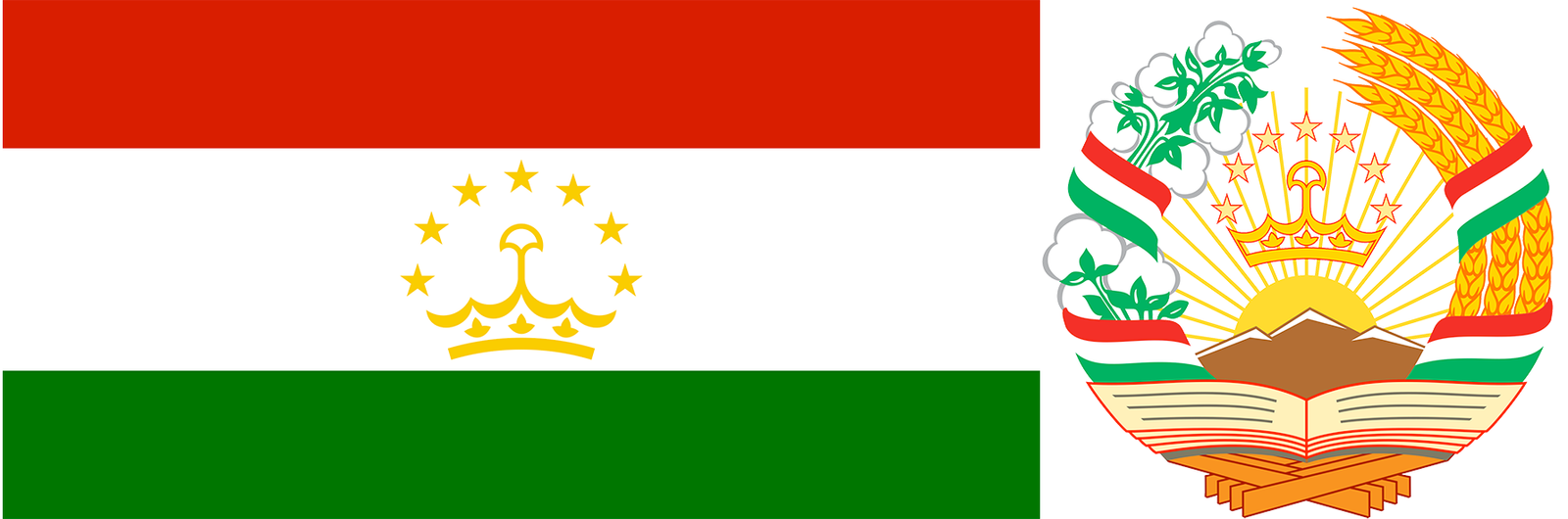 The flag of Tajikistan (left) and the emblem of Tajikistan (right).
Welcome to the summary page for FabulousFusionFood's Tajik recipes, part Asia. This page provides links to all the Kyrgyz recipes presented on this site, with 10 recipes in total.
This is a continuation of an entire series of pages that will, I hope, allow my visitors to better navigate this site. As well as displaying recipes by name, country and region of origin I am now planning a whole series of pages where recipes can be located by meal type and main ingredient. This page gives a listing of all the Tajik recipes added to this site.
Tajikistan (Ҷумҳурии Тоҷикистон in Tajik and Республика Таджикистан in Russian) is a landlocked country in Central Asia. Dushanbe is the capital and most populous city. Tajikistan borders Afghanistan to the south, Uzbekistan to the west, Kyrgyzstan to the north, and China to the east and is narrowly separated from Pakistan by Afghanistan's Wakhan Corridor. Dushanbe is the capital and largest city.
Tajik cuisine is a traditional cuisine of Tajikistan, and has much in common with Iranian, Afghan, Russian, Chinese, and Uzbek cuisines. Palov or palav (pilaf) (Tajik: палав), also called osh (Tajik: ош), is the national dish in Tajikistan, as in other countries in the region. Green tea (Tajik: чойи кабуд) is the national drink.
Tajikistan is a landlocked country in Central Asia. Dushanbe is the capital and most populous city. Tajikistan borders Afghanistan to the south, Uzbekistan to the west, Kyrgyzstan to the north, and China to the east and is narrowly separated from Pakistan by Afghanistan's Wakhan Corridor. It has a population of over 10.7 million people.
 Location of Tajikistan in Central Asia with the land mass of Tajikistan
picked out in red.The territory was previously home to cultures of the Neolithic and the Bronze Age, including the Oxus civilization in west, with the Indo-Iranians arriving during the Andronovo culture. Parts of country were part of the Sogdian and Bactrian civilizations, and was ruled by those including the Achaemenids, Alexander the Great, the Greco-Bactrians, the Kushans, the Kidarites and Hephthalites, the First Turkic Khaganate, the Umayyad and Abbasid Caliphates, the Samanid Empire, the Kara-Khanids, Seljuks, Khwarazmians, the Mongols, Timurids and Khanate of Bukhara. The region was later conquered by the Russian Empire, before becoming part of the Soviet Union. Within the Soviet Union, the country's borders were drawn when it was part of Uzbekistan as an autonomous republic before becoming a constituent republic of the Soviet Union on 5 December 1929.
On 9 September 1991, Tajikistan declared itself an independent sovereign state as the Soviet Union was disintegrating. A civil war was fought after independence, lasting from May 1992 to June 1997. Since the end of the war, newly established political stability and foreign aid have allowed the country's economy to grow. The country has been led since 1994 by Emomali Rahmon, who heads an authoritarian regime and whose human rights record has been criticised.
Tajikistan is a presidential republic consisting of four provinces. Tajiks form the ethnic majority in the country, and their national language is Tajik. Russian is used as the official inter-ethnic language. While the state is constitutionally secular, Islam is nominally adhered to by 97.5% of the population. In the Gorno-Badakhshan oblast, there is a linguistic diversity where Rushani, Shughni, Ishkashimi, Wakhi, and Tajik are some of the languages spoken. Mountains cover more than 90% of the country. It is a developing country with a transitional economy that is dependent on remittances and on the production of aluminium and cotton. Tajikistan is a member of the United Nations, CIS, OSCE, OIC, ECO, SCO, CSTO, and a NATO PfP partner.
Etymology: The term 'Tajik' itself ultimately derives from the Middle Persian Tāzīk, the Turkic rendition of the Arabic ethnonym Ṭayyi’, denoting a Qahtanite Arab tribe who emigrated to the Transoxiana region of Central Asia in the 7th century AD. Tajikistan appeared as Tadjikistan or Tadzhikistan in English prior to 1991. This is due to a transliteration from the Russian: Таджикистан. In Russian, there is no single letter 'j' to represent the phoneme /d͡ʒ/, and therefore дж, or dzh, is used. Tadzhikistan is the alternate spelling and is used in English literature derived from Russian sources.
While the Library of Congress's 1997 Country Study of Tajikistan found it difficult to definitively state the origins of the word 'Tajik' because the term is ;embroiled in twentieth-century political disputes about whether Turkic or Iranic peoples were the original inhabitants of Central Asia', scholars concluded that contemporary Tajiks are the descendants of the Eastern Iranic inhabitants of Central Asia, in particular, the Sogdians and the Bactrians and possibly other groups. In later works, Richard Frye expands on the complexity of the historical origins of the Tajiks. In a 1996 publication, Frye explains that 'factors must be taken into account in explaining the evolution of the peoples whose remnants are the Tajiks in Central Asia' and that 'the peoples of Central Asia, whether Iranic or Turkic speaking, have one culture, one religion, one set of social values and traditions with only language separating them'.
Palav or osh, generically known as plov (pilaf), is a rice dish made with julienned carrot, and pieces of meat, all fried together in vegetable oil or mutton fat in a special cookware called deg (a wok-shaped cauldron) over an open flame. The meat is cubed before or after being cooked, the carrots can be yellow or orange, and the rice is coloured yellow or orange by the frying carrots and the oil. The dish is eaten communally from a single large plate placed at the centre of the table, often in with one's hands in the traditional way.
Another traditional dish that is still eaten with hands from a communal plate is qurutob (Tajik: қурутоб), whose name describes the preparation method: qurut (Tajik: қурут, dried balls of salty cheese) is dissolved in water (Tajik: об, ob) and the liquid is poured over strips of а thin flaky flatbread (patyr or fatir, Tajik: фатир, or more accurately фатир равғанӣ, fatir ravghani, i.e., fatir made with butter or tallow for flakiness). Before serving the dish is topped with onions fried in oil until golden and topped with fresh seasonal vegetables. No meat is added. Qurutob is considered as one of the national dishes, predominantly consumed in the Southern regions.
Meals are almost always served with non (Tajik: нон), flatbread found throughout Central Asia. If a Tajik has food but not non, he will say he is out of food. If non is dropped on the ground, people will put it up on a high ledge for beggars or birds. Legend holds that one is not supposed to put non upside down because this will bring bad luck. The same holds if anything is put on top of the non, unless it is another piece of non.
This is a continuation of an entire series of pages that will, I hope, allow my visitors to better navigate this site. As well as displaying recipes by name, country and region of origin I am now planning a whole series of pages where recipes can be located by meal type and main ingredient. This page gives a listing of all the Tajik recipes added to this site.
Tajikistan (Ҷумҳурии Тоҷикистон in Tajik and Республика Таджикистан in Russian) is a landlocked country in Central Asia. Dushanbe is the capital and most populous city. Tajikistan borders Afghanistan to the south, Uzbekistan to the west, Kyrgyzstan to the north, and China to the east and is narrowly separated from Pakistan by Afghanistan's Wakhan Corridor. Dushanbe is the capital and largest city.
Tajik cuisine is a traditional cuisine of Tajikistan, and has much in common with Iranian, Afghan, Russian, Chinese, and Uzbek cuisines. Palov or palav (pilaf) (Tajik: палав), also called osh (Tajik: ош), is the national dish in Tajikistan, as in other countries in the region. Green tea (Tajik: чойи кабуд) is the national drink.
Tajikistan is a landlocked country in Central Asia. Dushanbe is the capital and most populous city. Tajikistan borders Afghanistan to the south, Uzbekistan to the west, Kyrgyzstan to the north, and China to the east and is narrowly separated from Pakistan by Afghanistan's Wakhan Corridor. It has a population of over 10.7 million people.
Location of Tajikistan in Central Asia with the land mass of Tajikistanpicked out in red.
On 9 September 1991, Tajikistan declared itself an independent sovereign state as the Soviet Union was disintegrating. A civil war was fought after independence, lasting from May 1992 to June 1997. Since the end of the war, newly established political stability and foreign aid have allowed the country's economy to grow. The country has been led since 1994 by Emomali Rahmon, who heads an authoritarian regime and whose human rights record has been criticised.
Tajikistan is a presidential republic consisting of four provinces. Tajiks form the ethnic majority in the country, and their national language is Tajik. Russian is used as the official inter-ethnic language. While the state is constitutionally secular, Islam is nominally adhered to by 97.5% of the population. In the Gorno-Badakhshan oblast, there is a linguistic diversity where Rushani, Shughni, Ishkashimi, Wakhi, and Tajik are some of the languages spoken. Mountains cover more than 90% of the country. It is a developing country with a transitional economy that is dependent on remittances and on the production of aluminium and cotton. Tajikistan is a member of the United Nations, CIS, OSCE, OIC, ECO, SCO, CSTO, and a NATO PfP partner.
Etymology: The term 'Tajik' itself ultimately derives from the Middle Persian Tāzīk, the Turkic rendition of the Arabic ethnonym Ṭayyi’, denoting a Qahtanite Arab tribe who emigrated to the Transoxiana region of Central Asia in the 7th century AD. Tajikistan appeared as Tadjikistan or Tadzhikistan in English prior to 1991. This is due to a transliteration from the Russian: Таджикистан. In Russian, there is no single letter 'j' to represent the phoneme /d͡ʒ/, and therefore дж, or dzh, is used. Tadzhikistan is the alternate spelling and is used in English literature derived from Russian sources.
While the Library of Congress's 1997 Country Study of Tajikistan found it difficult to definitively state the origins of the word 'Tajik' because the term is ;embroiled in twentieth-century political disputes about whether Turkic or Iranic peoples were the original inhabitants of Central Asia', scholars concluded that contemporary Tajiks are the descendants of the Eastern Iranic inhabitants of Central Asia, in particular, the Sogdians and the Bactrians and possibly other groups. In later works, Richard Frye expands on the complexity of the historical origins of the Tajiks. In a 1996 publication, Frye explains that 'factors must be taken into account in explaining the evolution of the peoples whose remnants are the Tajiks in Central Asia' and that 'the peoples of Central Asia, whether Iranic or Turkic speaking, have one culture, one religion, one set of social values and traditions with only language separating them'.
Tajik Cuisine:
Tajik cuisine is a traditional cuisine of Tajikistan, and has much in common with Iranian, Afghan, Russian, Chinese, and Uzbek cuisines. Palov or palav (pilaf) (Tajik: палав), also called osh (Tajik: ош), is the national dish in Tajikistan, as in other countries in the region. Green tea (Tajik: чойи кабуд) is the national drink.Palav or osh, generically known as plov (pilaf), is a rice dish made with julienned carrot, and pieces of meat, all fried together in vegetable oil or mutton fat in a special cookware called deg (a wok-shaped cauldron) over an open flame. The meat is cubed before or after being cooked, the carrots can be yellow or orange, and the rice is coloured yellow or orange by the frying carrots and the oil. The dish is eaten communally from a single large plate placed at the centre of the table, often in with one's hands in the traditional way.
Another traditional dish that is still eaten with hands from a communal plate is qurutob (Tajik: қурутоб), whose name describes the preparation method: qurut (Tajik: қурут, dried balls of salty cheese) is dissolved in water (Tajik: об, ob) and the liquid is poured over strips of а thin flaky flatbread (patyr or fatir, Tajik: фатир, or more accurately фатир равғанӣ, fatir ravghani, i.e., fatir made with butter or tallow for flakiness). Before serving the dish is topped with onions fried in oil until golden and topped with fresh seasonal vegetables. No meat is added. Qurutob is considered as one of the national dishes, predominantly consumed in the Southern regions.
Meals are almost always served with non (Tajik: нон), flatbread found throughout Central Asia. If a Tajik has food but not non, he will say he is out of food. If non is dropped on the ground, people will put it up on a high ledge for beggars or birds. Legend holds that one is not supposed to put non upside down because this will bring bad luck. The same holds if anything is put on top of the non, unless it is another piece of non.
Tajikistan's National Dishes:
Below are listed the dishes considered to be Tajikistan's national foods along with links to the recipes for those dishes:| Oshi Palov (Beef and Vegetable Pilau) Origin: Tajikistan | Qurutob Origin: Tajikistan |
The alphabetical list of all the Kyrgyz recipes on this site follows, (limited to 100 recipes per page). There are 10 recipes in total:
Page 1 of 1
| Oshi Palov (Beef and Vegetable Pilau) Origin: Tajikistan | Kofta Nakhod (Meatballs with Chickpeas) Origin: Tajikistan | Pita Bread Origin: Tajikistan |
| Qurutob Origin: Tajikistan | Lagman Spice Blend Origin: Tajikistan | Qatiq (Fermented Milk Drink) Origin: Tajikistan |
| Fatir (Tajik Flatbread) Origin: Tajikistan | Oshi Palov (Beef and Vegetable Pilau) Origin: Tajikistan | Qurutob Origin: Tajikistan |
| Home-made Qurt Origin: Tajikistan |
Page 1 of 1