FabulousFusionFood's Uzbekistani Recipes Home Page
 The flag of Uzbekistan (left) and the emblem of Uzbekistan (right).
Welcome to the summary page for FabulousFusionFood's Uzbekistani recipes, part Asia. This page provides links to all the Uzbekistani recipes presented on this site, with 15 recipes in total.
This is a continuation of an entire series of pages that will, I hope, allow my visitors to better navigate this site. As well as displaying recipes by name, country and region of origin I am now planning a whole series of pages where recipes can be located by meal type and main ingredient. This page gives a listing of all the Uzbekistani recipes added to this site.
Uzbekistan (Ўзбекистон Республикаси (O‘zbekiston Respublikasi in Uzbek)), s a doubly landlocked country located in Central Asia. It is surrounded by five countries: Kazakhstan to the north, Kyrgyzstan to the northeast, Tajikistan to the southeast, Afghanistan to the south, and Turkmenistan to the southwest. Tashkent is the capital and largest city.
Uzbek cuisine is influenced by local agriculture; since there is a great deal of grain farming in Uzbekistan, bread and noodles are of importance and Uzbek cuisine has been characterised as "noodle-rich". Mutton is a popular variety of meat due to the abundance of sheep in the country and it is part of various Uzbek dishes. Uzbekistan's signature dish is palov (or plov), a main course typically made with rice, meat, carrots, and onions, though it was not available to ordinary people until the 1930s. There are many regional variations of the dish. Often the fat found near the sheep tail, qurdiuq, is used. In the past, the cooking of palov was reserved for men, but the Soviets allowed women to cook it as well. Since then, it seems, the old gender roles have been restored.
Uzbekistan officially the Republic of Uzbekistan, is a doubly landlocked country located in Central Asia. It is surrounded by five countries: Kazakhstan to the north, Kyrgyzstan to the northeast, Tajikistan to the southeast, Afghanistan to the south, and Turkmenistan to the southwest, making it one of only two doubly landlocked countries on Earth, the other being Liechtenstein. The country has a population of more than 37.6 million, making it the most populous country in Central Asia. Uzbekistan is a member of the Organization of Turkic States. Uzbek, spoken by the Uzbek people, is the official language and spoken by the majority of its inhabitants, while Russian and Tajik are significant minority languages. Islam is the predominant religion, and most Uzbeks are Sunni Muslims.
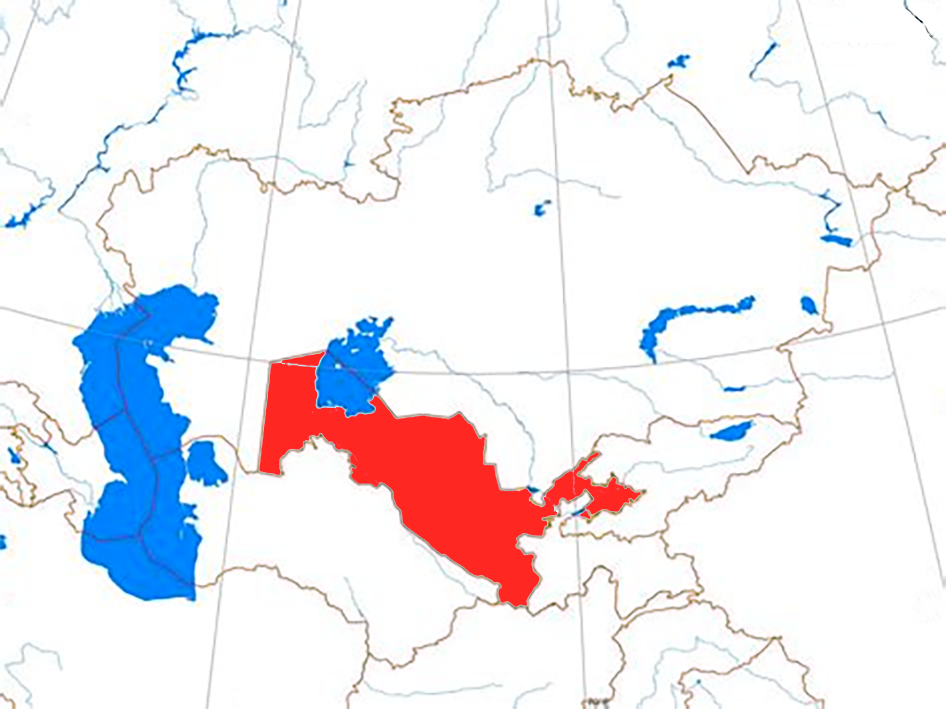 Location of Armenia in Central Asia with the land mass of Uzbekistan
picked out in red.The first recorded settlers in the land of what is contemporary Uzbekistan were Eastern Iranian nomads, known as Scythians, who founded kingdoms in Khwarazm, Sogdiana, and Bactria in the 8th–6th centuries BC, as well as Fergana and Margiana in the 3rd century BC – 6th century AD. The area was incorporated into the Achaemenid Empire and, after a period of Greco-Bactrian rule and later by the Sasanian Empire, until the Muslim conquest of Persia in the seventh century. The early Muslim conquests and the subsequent Samanid Empire converted most of the people into adherents of Islam. During this period, cities began to grow rich from the Silk Road, and became a center of the Islamic Golden Age. The local Khwarazmian dynasty was destroyed by the Mongol invasion in the 13th century, leading to a dominance by Mongol peoples. Timur in the 14th century established the Timurid Empire. Its capital was Samarkand, which became a center of science under the rule of Ulugh Beg, giving birth to the Timurid Renaissance. The territories of the Timurid dynasty were conquered by Kipchak Shaybanids in the 16th century. Conquests by Emperor Babur towards the east led to the foundation of the Mughal Empire in India. Most of Central Asia was gradually incorporated into the Russian Empire during the 19th century, with Tashkent becoming the political center of Russian Turkestan. In 1924, national delimitation created the Uzbek Soviet Socialist Republic as a republic of the Soviet Union. It declared independence as the Republic of Uzbekistan in 1991.
Uzbekistan is a secular state, with a semi-presidential constitutional government. Uzbekistan comprises 12 regions (vilayats), Tashkent City, and one autonomous republic, Karakalpakstan. While non-governmental organisations have defined Uzbekistan as 'an authoritarian state with limited civil rights', significant reforms under Uzbekistan's second president, Shavkat Mirziyoyev, have been made following the death of the first president, Islam Karimov. Owing to these reforms, relations with the neighbouring countries of Kyrgyzstan, Tajikistan, and Afghanistan have drastically improved. An United Nations report of 2020 found much progress toward achieving the UN's Sustainable Development Goals.
The Uzbek economy is in a gradual transition to the market economy, with foreign trade policy being based on import substitution. In September 2017, the country's currency became fully convertible at market rates. Uzbekistan is a major producer and exporter of cotton. With the gigantic power-generation facilities from the Soviet era and an ample supply of natural gas, Uzbekistan has become the largest electricity producer in Central Asia. From 2018 to 2021, the republic received a BB− sovereign credit rating by both Standard and Poor (S&P) and Fitch Ratings. The Brookings Institution described Uzbekistan as having large liquid assets, high economic growth, low public debt, and a low GDP per capita. Uzbekistan is a member of the Commonwealth of Independent States (CIS), United Nations (UN) and the Shanghai Cooperation Organisation (SCO).
Etymology: The name 'Uzbeg'istán' appears in the 16th century Tarikh-i Rashidi. The origin of the word Uzbek remains disputed, with three main hypotheses: 'free', 'independent' or 'own master/leader', requiring an amalgamation of uz (Turkic: 'own'), beg ('master' or 'leader')
eponymously named after Oghuz Khagan, also known as Oghuz Beg]
A contraction of Uğuz, earlier Oğuz, that is, Oghuz (tribe), amalgamated with bek 'oguz-leader'.
All three have the middle syllable/phoneme being cognate with the Turkic title Beg.
Bread (nan or non) is baked in a tandur, which is frequently a pot rather than the deep pit or oven of India and Afghanistan. Many varieties of rice are eaten. Potatoes were introduced by the Soviets, and some elder Uzbeks still refuse to eat them.
The most popular meat is mutton. Beef is common, and goat is eaten only rarely. Horse meat is used as well; there are sausages made of horse meat, as is the case with many other Turkic peoples. Karakul sheep provide meat but also fat, particularly the fat from the tail end, called qurdiuq.
Uzbekistan's signature dish is palov (plov or osh or palov, 'pilaf'), a main course consisting of rice, chunks of meat, grated carrots and onions. It is cooked in a kazan (or deghi) over an open fire. Chickpeas, raisins, barberries, or fruit may be added for variation.
Although often prepared at home for family and guests by the head of household or the housewife, palov is made on special occasions by the oshpaz, or the osh master chef, who cooks the dish over an open flame, sometimes serving up to 1,000 people from a single cauldron on holidays or occasions such as weddings. Nahor oshi, or 'morning plov', is served in the early morning (between 6 and 9 am) to large gatherings of guests, typically as part of a wedding celebration.
Other national dishes include shurpa (shurva or shorva), a soup made of large pieces of fatty meat (usually mutton) and fresh vegetables; norin and lagman, noodle-based dishes that may be served as a soup or a main course; manti (also called qasqoni), chuchvara, and somsa, stuffed pockets of dough served as an appetizer or a main course (ranging from 'wonderfully flaky and rich' to 'heavy, stodgy'); dimlama (a meat and vegetable stew) and various kebabs, usually served as a main course.
This is a continuation of an entire series of pages that will, I hope, allow my visitors to better navigate this site. As well as displaying recipes by name, country and region of origin I am now planning a whole series of pages where recipes can be located by meal type and main ingredient. This page gives a listing of all the Uzbekistani recipes added to this site.
Uzbekistan (Ўзбекистон Республикаси (O‘zbekiston Respublikasi in Uzbek)), s a doubly landlocked country located in Central Asia. It is surrounded by five countries: Kazakhstan to the north, Kyrgyzstan to the northeast, Tajikistan to the southeast, Afghanistan to the south, and Turkmenistan to the southwest. Tashkent is the capital and largest city.
Uzbek cuisine is influenced by local agriculture; since there is a great deal of grain farming in Uzbekistan, bread and noodles are of importance and Uzbek cuisine has been characterised as "noodle-rich". Mutton is a popular variety of meat due to the abundance of sheep in the country and it is part of various Uzbek dishes. Uzbekistan's signature dish is palov (or plov), a main course typically made with rice, meat, carrots, and onions, though it was not available to ordinary people until the 1930s. There are many regional variations of the dish. Often the fat found near the sheep tail, qurdiuq, is used. In the past, the cooking of palov was reserved for men, but the Soviets allowed women to cook it as well. Since then, it seems, the old gender roles have been restored.
Uzbekistan officially the Republic of Uzbekistan, is a doubly landlocked country located in Central Asia. It is surrounded by five countries: Kazakhstan to the north, Kyrgyzstan to the northeast, Tajikistan to the southeast, Afghanistan to the south, and Turkmenistan to the southwest, making it one of only two doubly landlocked countries on Earth, the other being Liechtenstein. The country has a population of more than 37.6 million, making it the most populous country in Central Asia. Uzbekistan is a member of the Organization of Turkic States. Uzbek, spoken by the Uzbek people, is the official language and spoken by the majority of its inhabitants, while Russian and Tajik are significant minority languages. Islam is the predominant religion, and most Uzbeks are Sunni Muslims.
Location of Armenia in Central Asia with the land mass of Uzbekistanpicked out in red.
Uzbekistan is a secular state, with a semi-presidential constitutional government. Uzbekistan comprises 12 regions (vilayats), Tashkent City, and one autonomous republic, Karakalpakstan. While non-governmental organisations have defined Uzbekistan as 'an authoritarian state with limited civil rights', significant reforms under Uzbekistan's second president, Shavkat Mirziyoyev, have been made following the death of the first president, Islam Karimov. Owing to these reforms, relations with the neighbouring countries of Kyrgyzstan, Tajikistan, and Afghanistan have drastically improved. An United Nations report of 2020 found much progress toward achieving the UN's Sustainable Development Goals.
The Uzbek economy is in a gradual transition to the market economy, with foreign trade policy being based on import substitution. In September 2017, the country's currency became fully convertible at market rates. Uzbekistan is a major producer and exporter of cotton. With the gigantic power-generation facilities from the Soviet era and an ample supply of natural gas, Uzbekistan has become the largest electricity producer in Central Asia. From 2018 to 2021, the republic received a BB− sovereign credit rating by both Standard and Poor (S&P) and Fitch Ratings. The Brookings Institution described Uzbekistan as having large liquid assets, high economic growth, low public debt, and a low GDP per capita. Uzbekistan is a member of the Commonwealth of Independent States (CIS), United Nations (UN) and the Shanghai Cooperation Organisation (SCO).
Etymology: The name 'Uzbeg'istán' appears in the 16th century Tarikh-i Rashidi. The origin of the word Uzbek remains disputed, with three main hypotheses: 'free', 'independent' or 'own master/leader', requiring an amalgamation of uz (Turkic: 'own'), beg ('master' or 'leader')
eponymously named after Oghuz Khagan, also known as Oghuz Beg]
A contraction of Uğuz, earlier Oğuz, that is, Oghuz (tribe), amalgamated with bek 'oguz-leader'.
All three have the middle syllable/phoneme being cognate with the Turkic title Beg.
Uzbek Cuisine:
Uzbek cuisine shares the culinary traditions of peoples across Central Asia. Grain farming is widespread in Uzbekistan, making breads and noodles an important part of the cuisine, which has been described as 'noodle-rich'.Bread (nan or non) is baked in a tandur, which is frequently a pot rather than the deep pit or oven of India and Afghanistan. Many varieties of rice are eaten. Potatoes were introduced by the Soviets, and some elder Uzbeks still refuse to eat them.
The most popular meat is mutton. Beef is common, and goat is eaten only rarely. Horse meat is used as well; there are sausages made of horse meat, as is the case with many other Turkic peoples. Karakul sheep provide meat but also fat, particularly the fat from the tail end, called qurdiuq.
Uzbekistan's signature dish is palov (plov or osh or palov, 'pilaf'), a main course consisting of rice, chunks of meat, grated carrots and onions. It is cooked in a kazan (or deghi) over an open fire. Chickpeas, raisins, barberries, or fruit may be added for variation.
Although often prepared at home for family and guests by the head of household or the housewife, palov is made on special occasions by the oshpaz, or the osh master chef, who cooks the dish over an open flame, sometimes serving up to 1,000 people from a single cauldron on holidays or occasions such as weddings. Nahor oshi, or 'morning plov', is served in the early morning (between 6 and 9 am) to large gatherings of guests, typically as part of a wedding celebration.
Other national dishes include shurpa (shurva or shorva), a soup made of large pieces of fatty meat (usually mutton) and fresh vegetables; norin and lagman, noodle-based dishes that may be served as a soup or a main course; manti (also called qasqoni), chuchvara, and somsa, stuffed pockets of dough served as an appetizer or a main course (ranging from 'wonderfully flaky and rich' to 'heavy, stodgy'); dimlama (a meat and vegetable stew) and various kebabs, usually served as a main course.
Uzbekistan's National Dishes:
Below are listed the dishes considered to be Uzbekistan's national foods along with links to the recipes for those dishes:| Osh (Uzbek Palov) Origin: Uzbekistan | Rabbit Pilaf Origin: Uzbekistan |
The alphabetical list of all the Uzbekistani recipes on this site follows, (limited to 100 recipes per page). There are 15 recipes in total:
Page 1 of 1
| Osh (Uzbek Palov) Origin: Uzbekistan | Home-made Qurt Origin: Uzbekistan | Osh (Uzbek Palov) Origin: Uzbekistan |
| Rabbit Pilaf Origin: Uzbekistan | Kishke (Stuffed Derma) Origin: Uzbekistan | Qatiq (Fermented Milk Drink) Origin: Uzbekistan |
| Anor Va Piyoz Salati (Uzbek Pomegranate and Onion Salad) Origin: Uzbekistan | Lagman Spice Blend Origin: Uzbekistan | Rabbit Pilaf Origin: Uzbekistan |
| Bukharan Pilaf Origin: Uzbekistan | Lawves (Walnut Fudge) Origin: Uzbekistan | Rabbit Pilaf Origin: Uzbekistan |
| Edkij Sous Shashlyka (Tart Kebab Sauce) Origin: Uzbekistan | Laza Hot Sauce Origin: Uzbekistan | Samarkandskij Jagnenok (Samarkand Lamb) Origin: Uzbekistan |
Page 1 of 1