FabulousFusionFood's Chilli-based Recipes 10th Page
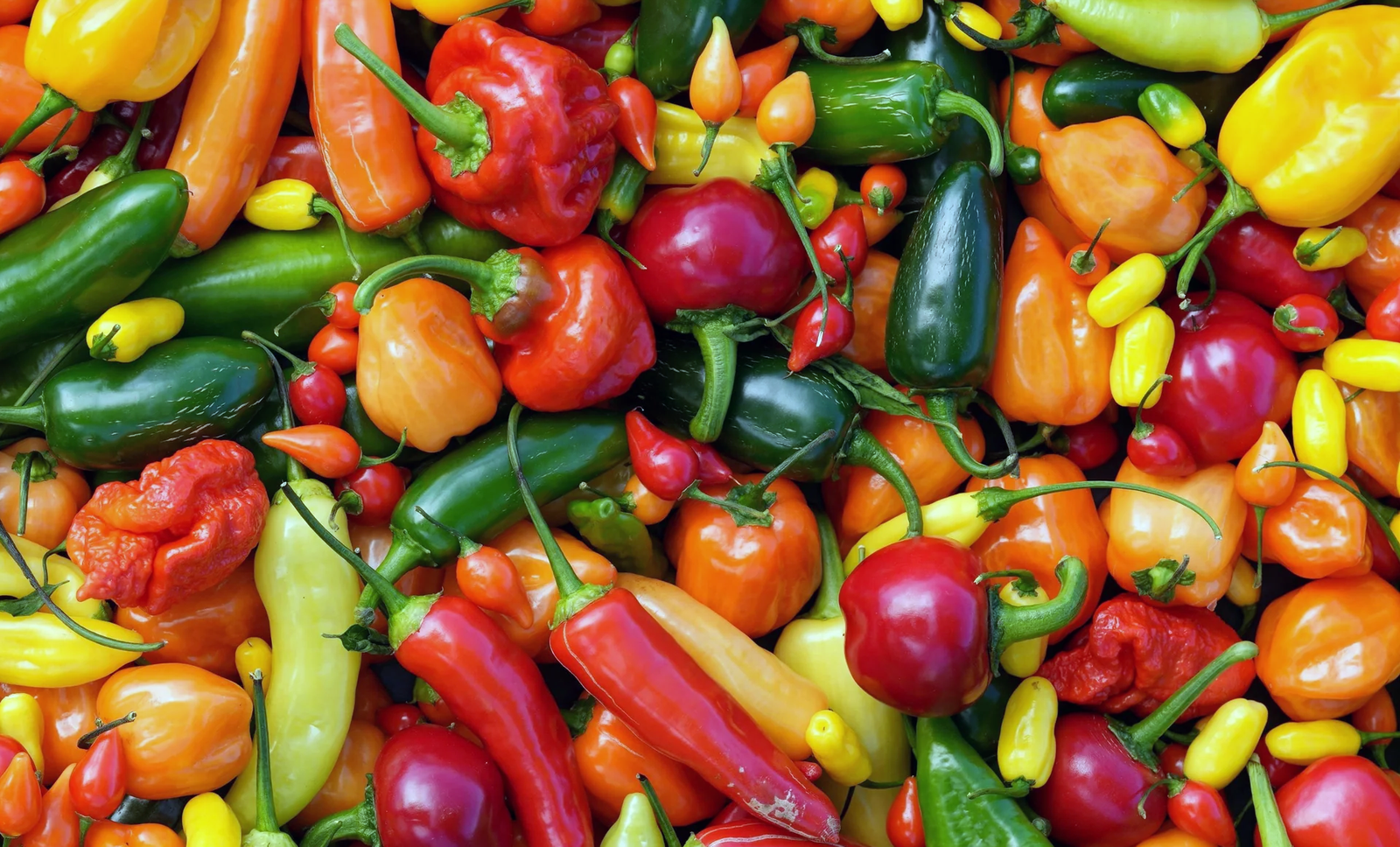 A mixture of different chilli peppers.
Welcome to FabulousFusionFood's Chilli-based Recipes Page — The recipes presented here all contain chilli peppers as a main ingredient. Chillies are the fruit of the chilli plant. Along with black pepper, they are unique spices in that they impart 'heat' to a dish without any associated bitterness. The dried and powdered fruit along with the fresh fruit and the dried fruit are all used as spices. As well as their capsaicin induced heat, chillies (depending on the variety or cultivar) can also imbue a dish with a fruity flavour. Smoked chillies are also used to impart a smokiness as well as heat to a dish.
Chilli peppers, also spelled chile or chili (from Classical Nahuatl chīlli [ˈt͡ʃiːlːi]) and known as hot peppers, are varieties of berry-fruit plants from the genus Capsicum, which are members of the nightshade family Solanaceae, cultivated for their pungency. Chilli peppers are widely used in many cuisines as a spice to add "heat" to dishes. Capsaicin and the related capsaicinoids give chillies their intensity when ingested or applied topically. Chilli peppers exhibit a range of heat and flavours. This diversity is the reason behind the availability of different types of chilli powder, each offering its own taste and heat level.
Chilli peppers originated in Central or South America and were first cultivated in Mexico. European explorers brought chillies back to the Old World in the late 16th century as part of the Columbian Exchange, which led to the cultivation of multiple varieties across the world for food and traditional medicine. Five Capsicum species have been widely cultivated: annuum, baccatum, chinense, frutescens, and pubescens.
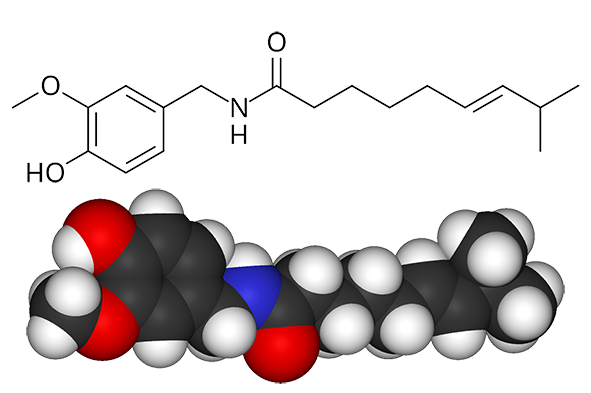 The capsaicin molecule, chemical structure (top) and space-filling model (bottom).
When peppers are consumed by mammals such as humans, capsaicin binds with pain receptors in the mouth and throat, potentially evoking pain via spinal relays to the brainstem and thalamus where heat and discomfort are perceived. However, birds are unable to perceive the hotness and so they can eat some of the hottest peppers. The intensity of the "heat" of chillies is commonly reported in Scoville heat units (SHU), invented by American pharmacist Wilbur Scoville in 1912. Historically, it was a measure of the dilution of an amount of chilli extract added to sugar syrup before its heat becomes undetectable to a panel of tasters; the more it has to be diluted to be undetectable, the more powerful the variety, and therefore the higher the rating. Since the 1980s, spice heat has been assessed quantitatively by high-performance liquid chromatography (HPLC), which measures the concentration of heat-producing capsaicinoids, typically with capsaicin content as the main measure
The alphabetical list of all the chilli-based on this site follows, (limited to 100 recipes per page). There are 2079 recipes in total:
Page 10 of 21
| Jollof Rice without Tomato Purée Origin: Nigeria | Kedjenou (Guineafowl Kedjenou) Origin: Cote dIvoire | Kissuto Rombo (Baked Kid Goat) Origin: Sao Tome |
| Kétoun (Stew of Tubers) Origin: Guinea | Kedjenou II Origin: Cote dIvoire | Kjufteta Po Cirpanski (Meatballs and Potatoes) Origin: Bulgaria |
| Kabritu Stoba (Stewed Kid Goat) Origin: Aruba | Keema and Lettuce Curry Origin: India | Kobi Bhaji Origin: India |
| Kachumbari Origin: Rwanda | Keema Mattar Origin: India | Kobi Keema (Cabbage and Minced Meat Curry) Origin: India |
| Kadhai Gosht Origin: Pakistan | Keftedes (Greek Meatballs) Origin: Greece | Kobi Sabji (Cabbage Sabji) Origin: India |
| Kadhi Origin: India | Kejenou avec Agouti (Kejenou with Cane Rat) Origin: Cote dIvoire | Kodoyo (Fish with Baobab Leaves) Origin: Togo |
| Kådun Pika (Spicy Chicken) Origin: Guam | Kekefia (Plantain Pottage) Origin: Nigeria | Kofta Curry (Meatball Curry) Origin: Pakistan |
| Kådun Pika (Spicy Chicken) Origin: Northern Mariana Islands | Kelaguen Mannok (Chamorro-style Chicken Salad) Origin: Guam | Koki Origin: Cameroon |
| Kaeng Khiao Wan (Thai Green Curry) Origin: Thailand | Kelaguen Mannok (Chamorro-style Chicken Salad) Origin: Northern Mariana Islands | Koki (Bean Cakes) Origin: Cameroon |
| Kaeng Phet Pet Yang (Thai Red Roast Duck Curry) Origin: Thailand | Kelewele II Origin: Liberia | Kokoda (Oceanian Ceviche) Origin: Fiji |
| Kai chutney (Red Weaver Ant Chutney) Origin: India | Kenyan Chilli Tomato Sauce Origin: Kenya | Kokoda (Fijian Ceviche) Origin: Fiji |
| Kaldu (Senegalese Caldou) Origin: Senegal | Kenyan Matoke Origin: Britain | Kokoda (Oceanian Ceviche) Origin: Papua New Guinea |
| Kalia (Meat and Potato Curry) Origin: Bangladesh | Kenyan Pilau Masala Origin: Kenya | Kokoda (Oceanian Ceviche) Origin: Solomon Islands |
| Kalia II (Meat and Potato Curry II) Origin: Bangladesh | Kerala Plantain Errisery Origin: India | Kokum Kari (Kokam Curry) Origin: India |
| Kaluun iyo Bariis (Spicy Fish Sauce with Rice) Origin: Somalia | Kerrieboontjies (South African Curried Beans) Origin: South Africa | Komprek Eromba (Water Dropwort Eromba) Origin: India |
| Kalya de Poulet (Chicken Kalya) Origin: Mauritius | Ketoun (Guinean Root Vegetable Porridge) Origin: Guinea | Kondré de Porc (Kondré of Pork) Origin: Cameroon |
| Kamuna Origin: Sierra Leone | Kewa Datshi (Potatoes with Cheese) Origin: Bhutan | Konkoé Turé Gbéli (Smoked Catfish Stew with Vegetables) Origin: Guinea |
| Kanda ti Nyma Origin: Central African Republic | Kewa Phagsha (Spicy Pork with Potatoes) Origin: Bhutan | Kontomire Stew (Cocoyam Leaf Stew) Origin: Ghana |
| Kang Ped Pla-dook (Red Curry with Catfish) Origin: Thailand | Khanom Jeen Nam Ya (Khanom Jeen Noodles) Origin: Thailand | Kopto à l'arachide (Kopto in Peanut Sauce) Origin: Niger |
| Kangchu Tsoem (Pig's Trotter Tshoem) Origin: Bhutan | Khanom Jeen Nam Ya (Khanom Jeen Noodles) Origin: Thailand | Korean-flavoured Lamb Shanks with Swede and Potato Mash Origin: Fusion |
| Kansiyé de Poisson (Fish Kansiyé) Origin: Guinea | Kharcho (Georgian Beef and Rice Soup) Origin: Georgia | Korma Masala Origin: India |
| Kansiyé de Poulet (Chicken Kansiyé) Origin: Guinea | Khatmitthi Raani (Tamarind Chutney) Origin: India | Koro Owu Soup (Cotton Seed Soup) Origin: Nigeria |
| Kansiyé Origin: Guinea-Bissau | Khatta Curry Origin: India | Koshari (Egyptian lentils) Origin: Egypt |
| Kari Ayam (Malaysian Chicken Curry) Origin: Malaysia | Khatta Meetha (Cabbage Curry) Origin: India | Kotor Bay Stewed Fish Origin: Montenegro |
| Kari Ikan (Fish Curry) Origin: Malaysia | Kheulwa de Tabaski (Fried Mutton for Tabaski) Origin: Senegal | Kouti (Cassava Croquettes) Origin: Guinea |
| Karkandji (Hibiscus Sauce) Origin: Chad | Khichiri Prawn Sauce Origin: India | Kpakpo Shito (Fresh Shitor) Origin: Ghana |
| Kashmiri Chicken Curry Origin: India | Khnom Jin Namya (Catfish Curry over Noodles) Origin: Thailand | Kpala (Jute Leaf Sauce) Origin: Cote dIvoire |
| Katakou au Poisson Frais (Palm Soup Base with Fresh Fish) Origin: Cote dIvoire | Khowsuey Origin: Chile | Kpalugu Beef Origin: Ghana |
| Katchourie Origin: Trinidad | Kibeba (Cassava and Cuttlefish Stew) Origin: Mozambique | Krækiberjasaft Chatni (Crowberry Chutney) Origin: Iceland |
| Ke'lagu'en Uhang (Prawns and Peppers) Origin: Guam | Kibeba de Angola Origin: Angola | Krain Krain (Jute Leaf Stew) Origin: Sierra Leone |
| Ke'lagu'en Uhang (Prawns and Peppers) Origin: Northern Mariana Islands | Kilishi (Dried Sliced Beef) Origin: Nigeria | Kuah Kuning (Yellow Gravy Soup) Origin: Papua |
| Kebab with Garlic Origin: Western Sahara | Kima (Chopped Beef and Chilli Fry) Origin: Senegal | Kuchela Origin: Trinidad |
| Kebabpizza (Kebab Pizza) Origin: Sweden | Kimchi Origin: Korea | |
| Kedjenou Origin: Cote dIvoire | Kiseli Kupus Origin: Croatia |
Page 10 of 21