FabulousFusionFood's Chilli-based Recipes 14th Page
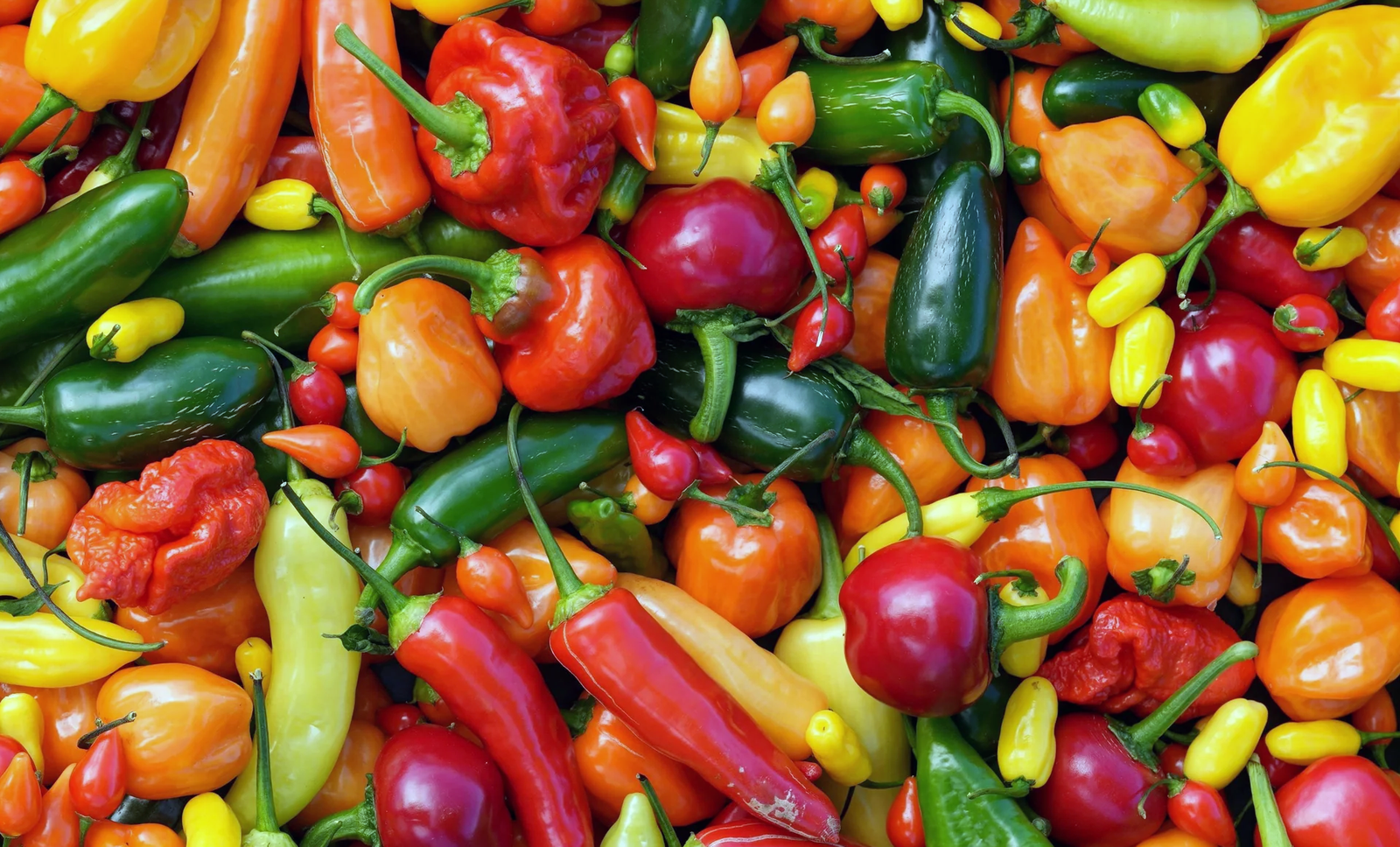 A mixture of different chilli peppers.
Welcome to FabulousFusionFood's Chilli-based Recipes Page — The recipes presented here all contain chilli peppers as a main ingredient. Chillies are the fruit of the chilli plant. Along with black pepper, they are unique spices in that they impart 'heat' to a dish without any associated bitterness. The dried and powdered fruit along with the fresh fruit and the dried fruit are all used as spices. As well as their capsaicin induced heat, chillies (depending on the variety or cultivar) can also imbue a dish with a fruity flavour. Smoked chillies are also used to impart a smokiness as well as heat to a dish.
Chilli peppers, also spelled chile or chili (from Classical Nahuatl chīlli [ˈt͡ʃiːlːi]) and known as hot peppers, are varieties of berry-fruit plants from the genus Capsicum, which are members of the nightshade family Solanaceae, cultivated for their pungency. Chilli peppers are widely used in many cuisines as a spice to add "heat" to dishes. Capsaicin and the related capsaicinoids give chillies their intensity when ingested or applied topically. Chilli peppers exhibit a range of heat and flavours. This diversity is the reason behind the availability of different types of chilli powder, each offering its own taste and heat level.
Chilli peppers originated in Central or South America and were first cultivated in Mexico. European explorers brought chillies back to the Old World in the late 16th century as part of the Columbian Exchange, which led to the cultivation of multiple varieties across the world for food and traditional medicine. Five Capsicum species have been widely cultivated: annuum, baccatum, chinense, frutescens, and pubescens.
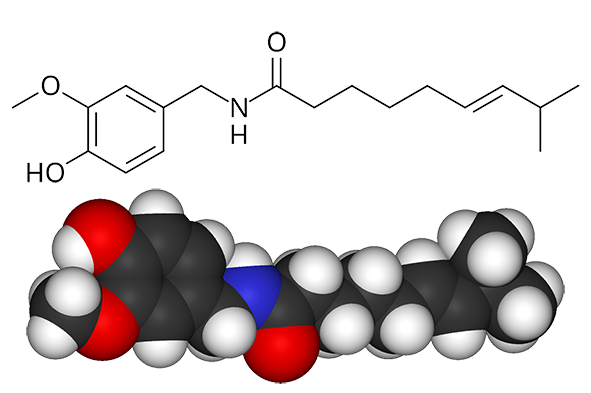 The capsaicin molecule, chemical structure (top) and space-filling model (bottom).
When peppers are consumed by mammals such as humans, capsaicin binds with pain receptors in the mouth and throat, potentially evoking pain via spinal relays to the brainstem and thalamus where heat and discomfort are perceived. However, birds are unable to perceive the hotness and so they can eat some of the hottest peppers. The intensity of the "heat" of chillies is commonly reported in Scoville heat units (SHU), invented by American pharmacist Wilbur Scoville in 1912. Historically, it was a measure of the dilution of an amount of chilli extract added to sugar syrup before its heat becomes undetectable to a panel of tasters; the more it has to be diluted to be undetectable, the more powerful the variety, and therefore the higher the rating. Since the 1980s, spice heat has been assessed quantitatively by high-performance liquid chromatography (HPLC), which measures the concentration of heat-producing capsaicinoids, typically with capsaicin content as the main measure
The alphabetical list of all the chilli-based on this site follows, (limited to 100 recipes per page). There are 1960 recipes in total:
Page 14 of 20
| Parthade Curry Origin: India | Peri-peri Prawn Pasta Origin: South Africa | Piri-piri Oil Origin: South Africa |
| Party Jollof Rice Origin: Nigeria | Peruvian Ceviche Origin: Peru | Piri-Piri Sauce Origin: West Africa |
| Pasilla Mole Origin: Britain | Peruvian Seviche Origin: Peru | Piri-Piri Sauce II Origin: sub-Saharan Africa |
| Pastırma Origin: Turkey | Pesmol (Mackerel with Bell Pepper in a Coconut and Chilli Sauce) Origin: Indonesia | Pizza Rustica (Italian Easter Ham Pie) Origin: Ghana |
| Pasta Piri-piri (Piri-piri Chilli Paste) Origin: Portugal | Phaal Chicken Curry Origin: India | Pizzoccheri with Miso Cabbage and Spiced Breadcrumbs Origin: Fusion |
| Pastelles Origin: Trinidad | Phaksha Pa Origin: Bhutan | Plantain and Coconut Soup Origin: Uganda |
| Pâte de piments végétariens (Seasoning Pepper Paste) Origin: French Guiana | Phaksha Paa (Bhutanese Pork with Chillies) Origin: Bhutan | Plantain Pilé à la Sauce d'Arachide (Crushed Plantains with Peanut Sauce) Origin: Cameroon |
| Patna or Bombay Pickled Onions Origin: Anglo-Indian | Phane Stew Origin: Botswana | Plantains and Fried Fish Origin: Liberia |
| Pau-Pau Chatni (Papaya Chutney) Origin: Seychelles | Pho Bo Noodle Soup (Pho Bo Soup) Origin: Vietnam | Plasas Origin: Sierra Leone |
| Pav Bhaji Masala Origin: India | Phool gobhi Achari Origin: India | Plasas (Sierra Leonean Chicken Peanut Stew) Origin: Sierra Leone |
| Pazun Hin (Prawn Curry) Origin: Myanmar | Phoulourie Origin: Trinidad | Podina Chutney (Mint Chutney) Origin: Pakistan |
| Pe Kyar Zan Thoke (Glass Noodle Salad) Origin: Myanmar | Pick a Pepper Soup Origin: Equatorial Guinea | Point-and-kill Origin: Nigeria |
| Peanut and Greens Soup Origin: African Fusion | Pickle Masala Origin: India | Poison Braisé (Barbecued Fish) Origin: Senegal |
| Peanut Soup Origin: West Africa | Pickle Masala Powder Origin: India | Poisson au Fúmbwa (Fish with Fumbwa) Origin: Central African Republic |
| Pebre (Chilean Chilli Salsa) Origin: Chile | Pickled Baby Corn Origin: America | Poisson aux Coco (Coconut Fish) Origin: Tanzania |
| Peixe Grelhado (Grilled Fish) Origin: Guinea-Bissau | Pickled Radish Pods Origin: Britain | Poisson Capitaine en Feuille de Bananaier (White Grouper in Banana Leaves) Origin: Burkina Faso |
| Peixe Grelhado com Piri-Piri (Grilled Fish with Piri-Piri) Origin: Mozambique | Pickled Red Cabbage Origin: Britain | Poisson Farci à la Saint-Louisienne (Stuffed Fish, in the Manner of St Louis) Origin: Senegal |
| Pem Pem Origin: Gambia | Pickling Spice Origin: Britain | Poisson Grillé (Grilled Fish) Origin: Seychelles |
| Pemahun Origin: Sierra Leone | Pickling Spices Origin: Britain | Poisson Salé (Salt Fish) Origin: Mauritius |
| Penang Prawn Curry Origin: Thailand | Pied de Veau aux Pois Chiches (Calf's Feet with Chickpeas) Origin: Burkina Faso | Poisson Yassa (Fish Yassa) Origin: Senegal |
| Pèpè Soupe (Ivorian Pepper Soup) Origin: Cote dIvoire | Piezly Mukhat (Chickpea and Onion Stew) Origin: Tajikistan | Poisson Yassa Mauritanienne (Mauritanian Fish Yassa) Origin: Mauritania |
| Pépésup (Pepper Soup) Origin: Equatorial Guinea | Pig Tail Bouillon with Dumplings Origin: Saint Lucia | Pol Sambol Origin: Sri Lanka |
| Pepián Origin: Guatemala | Pigeons grillés au makala (Grilled Makala Pigeons) Origin: DR-Congo | Polbo á Feira (Galician Style Octopus) Origin: Spain |
| Pepper Chicken Origin: Sierra Leone | Pika (Onion and Chilli Pickle) Origin: Curacao | Pollo Borracho Chileano (Chilean Drunken Chicken) Origin: Chile |
| Pepper Soup Origin: Liberia | Pikliz Origin: Haiti | Pollo con Salsa de Cacahuetes (Chicken with Peanut Sauce) Origin: Equatorial Guinea |
| Pepper Soupe de Poisson (Fish Pepper Soup) Origin: Cameroon | Pilipili ya Kukaanga (Kenyan Chilli Sauce) Origin: Kenya | Pollo Mexicana (Chicken Mexicana) Origin: Mexico |
| Peppered Snails Origin: Nigeria | Piment d'Attiéké (Pepper Sauce for Attiéké) Origin: Cote dIvoire | Polvo à São Tomé (Sao Tomean Octopus) Origin: Sao Tome |
| Pepperpot Origin: Antigua | Pindzur Origin: North Macedonia | Polvo a Modo ze de Lino (Octopus Stew) Origin: Cape Verde |
| Pepre Watra Origin: Suriname | Piperies Mikres Toursi (Greek Pickled Green Chillies) Origin: Greece | Pondu Origin: Congo |
| Perch Benachin Origin: Gambia | Pipián (Chicken in Peanut Sauce) Origin: Philippines | Poo Pad Pong Curry (Thai Crab Curry Recipe) Origin: Thailand |
| Peri Peri Kari Camarão (Fiery Prawn Curry) Origin: Mozambique | Pipis de Galinha (Portuguese Chicken Giblets) Origin: Portugal | Porc-Colombo Origin: Guadeloupe |
| Peri Peri Sauce Origin: India | Piquant Grape Jelly Origin: South Africa | Pork and Bacon Meatballs Origin: Britain |
| Peri-peri Chicken Origin: South Africa | Piquante Sauce Origin: American | |
| Peri-Peri Chicken with Peri-Peri Rice Origin: Mozambique | Pique (Puerto Rican Spiced Vinegar) Origin: Puerto Rico |
Page 14 of 20