FabulousFusionFood's Nut-based Recipes 14th Page
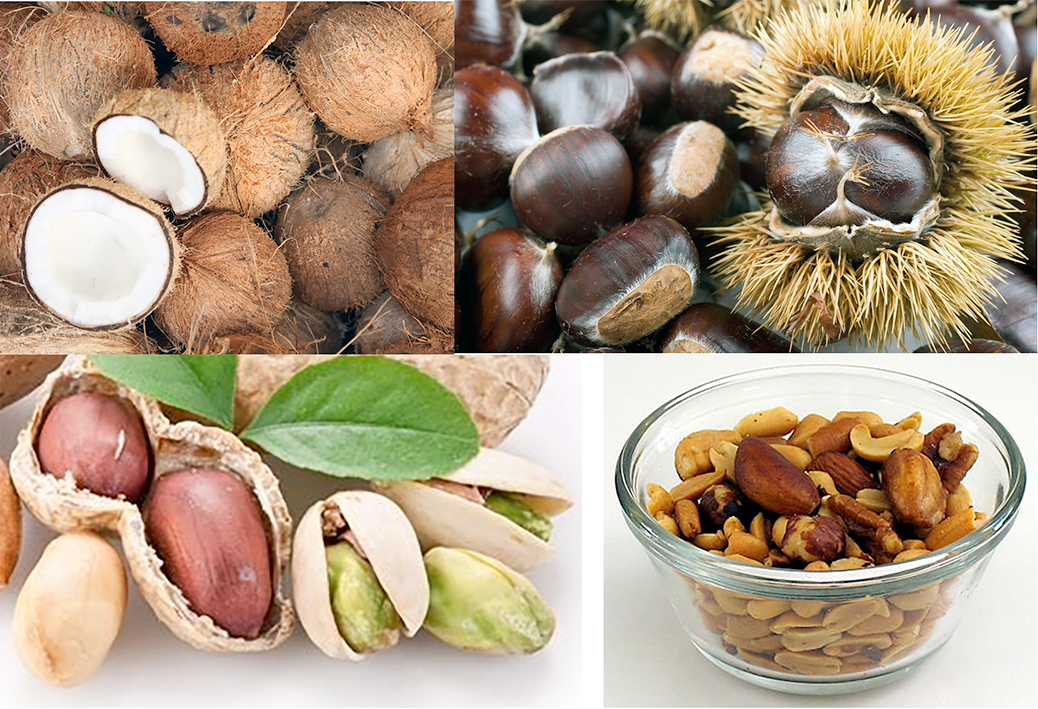 Different nuts. Clockwise: coconuts, sweet chestnuts, bowl of mixed nuts,
peanuts and pistachios.
Welcome to FabulousFusionFood's Nut-based Recipes Page —A nut is a fruit consisting of a hard or tough nutshell protecting a kernel which is usually edible. In general usage and in a culinary sense, many dry seeds are called nuts. In a botanical context, "nut" implies that the shell does not open to release the seed (indehiscent).
Most seeds come from fruit that naturally free themselves from the shell, but this is not the case in nuts such as hazelnuts, chestnuts, and acorns, which have hard shell walls and originate from a compound ovary. The general and original usage of the term is less restrictive, and many nuts (in the culinary sense), such as almonds, pistachios, and Brazil nuts, are not nuts in a botanical sense. Common usage of the term often refers to any hard-walled, edible kernel as a nut. Nuts are an energy-dense and nutrient-rich food source.
Botanically, a nut is a fruit with a woody pericarp developing from a syncarpous gynoecium. True nuts include, for example, chestnut, hazelnut and filbert. Culinarily, the term 'nut' is used much more widely, and includes examples of drupes (such as pecans and almonds) or seeds (such as pine nuts and peanuts).
Also widely known as nuts are dry drupes, which include pecans, almonds, macadamia (Macadamia integrifolia), candlenut (Aleurites moluccanus) and the water caltrop (Trapa bicornis). A drupe is an indehiscent fruit that has an outer fleshy part consisting of the exocarp, or skin, and mesocarp, or flesh, which surround a single pit or stone, the endocarp with a seed (kernel) inside. In a dry drupe, the outer parts dry up and the remaining husk is part of the ovary wall or pericarp, and the hard inner wall surrounding the seed represents the inner part of the pericarp.
Walnuts and hickories (Juglandaceae) have fruit that are difficult to classify. They are considered to be nuts under some definitions but are also referred to as drupaceous nuts.
In common use, a "tree nut" is, as the name implies, any nut coming from a tree. This most often comes up regarding food allergies; a person may be allergic specifically to peanuts (which are not tree nuts but legumes), whereas others may be allergic to the wider range of nuts that grow on trees.
The sweet potato arrived in Europe with the Columbian exchange. It is recorded, for example, in Elinor Fettiplace's Receipt Book, compiled in England in 1604.
Nuts are eaten by humans and wildlife. Because nuts generally have a high oil content, they are a significant energy source. Many seeds are edible by humans and used in cooking, eaten raw, sprouted, or roasted as a snack food, ground to make nut butters, or pressed for oil that is used in cooking and cosmetics.
Nuts used for food are a common source of food allergens. Reactions can range from mild symptoms to severe ones, a condition known as anaphylaxis, which can be life-threatening. The reaction is due to the release of histamine by the body in response to an allergen in the nuts, causing skin and other possible reactions. Many experts suggest that a person with an allergy to peanuts should avoid eating tree nuts, and vice versa.
The nuts linked to from this page are: acorn; almond; beech nuts; betel nut; brazil nut; bush mango; filbert; ginkgo nut; kola nut; candlenut; cashew; chestnut; coconut; hazelnut; macadamia; ogbono; palm nut; peanut; pecan; pine nut; pistachio; walnut.
The alphabetical list of all the nut-based recipes on this site follows, (limited to 100 recipes per page). There are 4134 recipes in total:
Page 14 of 42
| English Madeleines Origin: Britain | Fermented Krill Sauce Origin: Japan | Fish Steaks with Barbecue Sauce Origin: Anguilla |
| Ensalada de Endibias al Cabrales (Salad of Chicory Leaves and Blue Cheese) Origin: Spain | Fesenjoon (Persian Chicken) Origin: Iran | Fish Waterzooï Origin: Belgium |
| Ensalada de Frutas Tropicales (Tropical Fruit Salad) Origin: Equatorial Guinea | Festive Venison Wellington Origin: South Africa | Fisk på grönsakspytt (Ham Cakes) Origin: Sweden |
| Epicurean Sauce Origin: Britain | Feuilles de Consoude Farcies (Stuffed Comfrey Leaves) Origin: France | Fistikli Baklava (Turkish Pistachio Baklava) Origin: Turkey |
| Epicurean Sauce Origin: Britain | Feuilles de Manioc Malienne (Malian Cassava Leaf Stew) Origin: Mali | Five-spice Pickled Vegetable Achara Origin: Philippines |
| Equatorial Guinea Peanut Sauce Origin: Equatorial Guinea | Fferins Cnau Coco (Coconut Sweets) Origin: Welsh | Flan (Guatemalan Caramel Custard) Origin: Guatemala |
| Es Cendol (Cold Dessert) Origin: Brunei | Ffesant Nadolig (Christmas Pheasant) Origin: Welsh | Flan Amande et d'abricot (Almond and Apricot Flan) Origin: France |
| Esparregados de Bacalhau (Cod Esparregados) Origin: Angola | Fiadone Origin: France | Flan Coco Antillais (French Antilles Coconut Flan) Origin: Saint-Martin |
| Eve's Pudding Origin: England | Field Mushrooms in Buttermilk Origin: British | Flan Coco Antillais (French Antilles Coconut Flan) Origin: Saint Barthelemy |
| Excellent Small Cakes Origin: Britain | Fig and Almond Cheesecake Origin: Britain | Flan Coco Antillais (French Antilles Coconut Flan) Origin: French Guiana |
| Ezme (Spicy Turkish Salad) Origin: Turkey | Fig, Walnut and Orange Cake Origin: Ireland | Flan Coco Antillais (French Antilles Coconut Flan) Origin: Guadeloupe |
| Fögnè Sourtinaadi (Fonio Couscous with Meatballs in Tomato Sauce) Origin: Guinea | Figolli (Maltese Easter Biscuits) Origin: Malta | Flan Coco Antillais (French Antilles Coconut Flan) Origin: Martinique |
| Fa'apapa (Samoan Coconut Bread) Origin: Samoa | Fijian Chicken and Potato Curry Origin: Fiji | Flan Coco Antillais (French Antilles Coconut Flan) Origin: Sint Maarten |
| Fa'apapa (Samoan Coconut Bread) Origin: American Samoa | Fijian Crab Curry Origin: Fiji | Flan de Maracuyá y Coco (Passionfruit and Coconut Flan) Origin: Mexico |
| Fafa (Taro Leaves with Coconut Cream) Origin: Tahiti | Fijian Indian Tomato Chutney Origin: Fiji | Florentine Pizza Origin: Italy |
| Faikai Malaulau (Tapioca dumplings in Caramel Sauce) Origin: Wallis Futuna | Fijian Palao Masala Origin: Fiji | Foamy Sauce Origin: Scotland |
| Fakalate (Coconut Dumplings) Origin: Tonga | Fijian Suruwa (Fijian Fish Curry) Origin: Fiji | Fochabers Gingerbread Origin: Scotland |
| Fakatokelau Origin: Tokelau | Fijian Topoi Origin: Fiji | Foie au coco (Liver with Coconut) Origin: Mayotte |
| Faluda Origin: Pakistan | Filipino Beef Rendang Origin: Philippines | Folaa Rice Origin: Sri Lanka |
| Fanesca ecuatoriana (Ecuadorian Easter soup) Origin: Ecuador | Filipino Cassava Cake Origin: Philippines | Folon Origin: Cameroon |
| Fanouropita (Greek Spiced Sultana Cake) Origin: Greece | Filipino Chicken Curry Origin: Philippines | Fondé de Mil (Millet Porridge) Origin: Senegal |
| Farina Pie Origin: Bermuda | Filipino Chicken Curry 2 Origin: Philippines | Fonio and Oat Balls in Peanut Sauce Origin: Fusion |
| Farine Breakfast Porridge Origin: Guyana | Filipino Fish Curry Origin: Philippines | Fonio Bread Origin: Fusion |
| Farine Grits Origin: Guyana | Filipino Sweet and Sour Pork Origin: Philippines | Fonio Cuit à la Vapeur (Steamed Fonio) Origin: Senegal |
| Farka (Couscous Breakfast) Origin: Tunisia | Fillet of Salmon with Green Couscous Origin: Fusion | Fonio, Sauce Gombo et Crevettes (Fonio, Okra Sauce and Prawns) Origin: Mali |
| Fat Hen and Potato Gratin Origin: Britain | Fine-herbs Sauce Origin: Britain | Fonnell Origin: England |
| Fa’ausi (Coconut Bread in Coconut Milk Caramel) Origin: Samoa | Finsk Brød (Finnish Bread) Origin: Denmark | For to make blank manger (To Make White Food) Origin: England |
| Fa’ausi (Coconut Bread in Coconut Milk Caramel) Origin: American Samoa | Firecracker Barbecued Salmon Origin: American | Forager’s Risotto Origin: Britain |
| Fekei Origin: Tuvalu | Firnee Origin: Afghanistan | Foubey (Millet Couscous with Moringa) Origin: Niger |
| Fekei Origin: Rotuma | Firni (Ground Rice Blancmange) Origin: India | Foufu et Eru (Cameroonian Beef with Cassava Leaves) Origin: Cameroon |
| Fénénésti (Blended Rice Pancakes) Origin: Mayotte | Fish and Breadfruit Casserole Origin: Nauru | Fragrant Coconut Rice Origin: Thailand |
| Fénénésti (Blended Rice Pancakes) Origin: Comoros | Fish Molee (Keralan Fish Stew) Origin: India | Fragrant Lamb Kofta Curry Origin: Britain |
| Fennel and Almond Soup Origin: North Africa | Fish Padha (Sri Lankan Fish Pickle) Origin: Sri Lanka | |
| Fennel and Walnut Soup Origin: Britain | Fish Serre Origin: Belize |
Page 14 of 42