FabulousFusionFood's Nut-based Recipes 20th Page
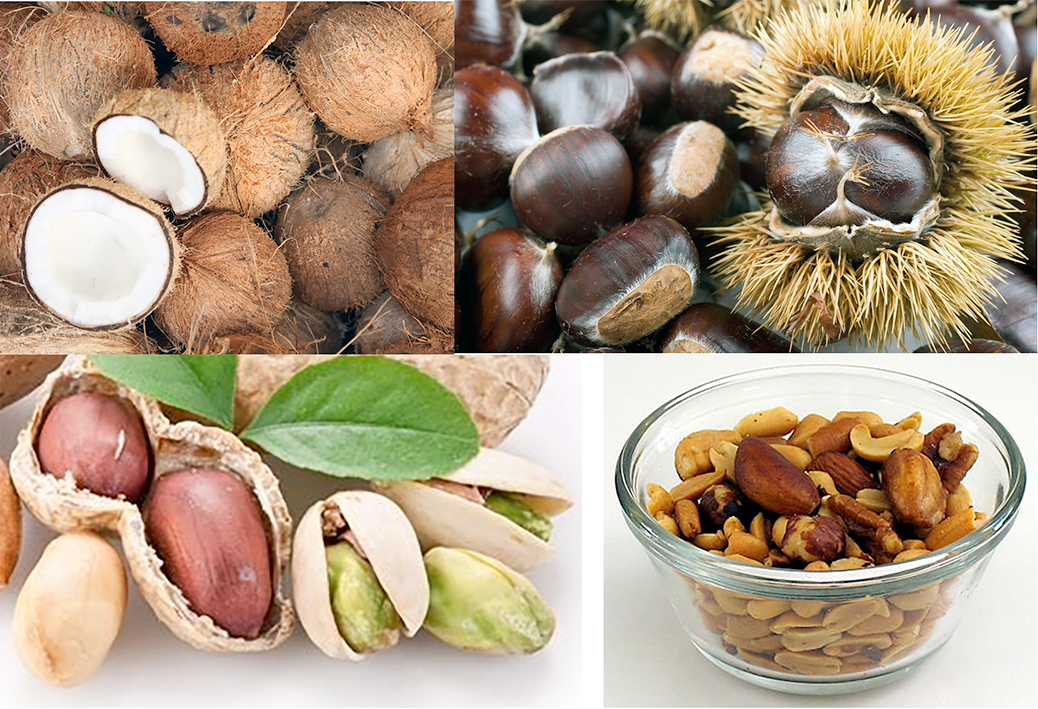 Different nuts. Clockwise: coconuts, sweet chestnuts, bowl of mixed nuts,
peanuts and pistachios.
Welcome to FabulousFusionFood's Nut-based Recipes Page —A nut is a fruit consisting of a hard or tough nutshell protecting a kernel which is usually edible. In general usage and in a culinary sense, many dry seeds are called nuts. In a botanical context, "nut" implies that the shell does not open to release the seed (indehiscent).
Most seeds come from fruit that naturally free themselves from the shell, but this is not the case in nuts such as hazelnuts, chestnuts, and acorns, which have hard shell walls and originate from a compound ovary. The general and original usage of the term is less restrictive, and many nuts (in the culinary sense), such as almonds, pistachios, and Brazil nuts, are not nuts in a botanical sense. Common usage of the term often refers to any hard-walled, edible kernel as a nut. Nuts are an energy-dense and nutrient-rich food source.
Botanically, a nut is a fruit with a woody pericarp developing from a syncarpous gynoecium. True nuts include, for example, chestnut, hazelnut and filbert. Culinarily, the term 'nut' is used much more widely, and includes examples of drupes (such as pecans and almonds) or seeds (such as pine nuts and peanuts).
Also widely known as nuts are dry drupes, which include pecans, almonds, macadamia (Macadamia integrifolia), candlenut (Aleurites moluccanus) and the water caltrop (Trapa bicornis). A drupe is an indehiscent fruit that has an outer fleshy part consisting of the exocarp, or skin, and mesocarp, or flesh, which surround a single pit or stone, the endocarp with a seed (kernel) inside. In a dry drupe, the outer parts dry up and the remaining husk is part of the ovary wall or pericarp, and the hard inner wall surrounding the seed represents the inner part of the pericarp.
Walnuts and hickories (Juglandaceae) have fruit that are difficult to classify. They are considered to be nuts under some definitions but are also referred to as drupaceous nuts.
In common use, a "tree nut" is, as the name implies, any nut coming from a tree. This most often comes up regarding food allergies; a person may be allergic specifically to peanuts (which are not tree nuts but legumes), whereas others may be allergic to the wider range of nuts that grow on trees.
The sweet potato arrived in Europe with the Columbian exchange. It is recorded, for example, in Elinor Fettiplace's Receipt Book, compiled in England in 1604.
Nuts are eaten by humans and wildlife. Because nuts generally have a high oil content, they are a significant energy source. Many seeds are edible by humans and used in cooking, eaten raw, sprouted, or roasted as a snack food, ground to make nut butters, or pressed for oil that is used in cooking and cosmetics.
Nuts used for food are a common source of food allergens. Reactions can range from mild symptoms to severe ones, a condition known as anaphylaxis, which can be life-threatening. The reaction is due to the release of histamine by the body in response to an allergen in the nuts, causing skin and other possible reactions. Many experts suggest that a person with an allergy to peanuts should avoid eating tree nuts, and vice versa.
The nuts linked to from this page are: acorn; almond; beech nuts; betel nut; brazil nut; bush mango; filbert; ginkgo nut; kola nut; candlenut; cashew; chestnut; coconut; hazelnut; macadamia; ogbono; palm nut; peanut; pecan; pine nut; pistachio; walnut.
The alphabetical list of all the nut-based recipes on this site follows, (limited to 100 recipes per page). There are 4134 recipes in total:
Page 20 of 42
| Kari Ayam (Malaysian Chicken Curry) Origin: Malaysia | Kentish Cobnut Cake Origin: England | Khuzi (Emirati Lamb with Rice) Origin: UAE |
| Kari Ayam (Malay Gravy Chicken Curry with White Pumpkin) Origin: Malaysia | Kentish Lenten Pie Origin: Britain | Kibbeh Origin: Lebanon |
| Kari Ikan (Malaysian Fish Curry) Origin: Malaysia | Kenyan Kima (Chopped Beef Chilli-fry) Origin: Kenya | Kibbeh Origin: Syria |
| Kari Kambing (Mutton or Goat Curry) Origin: Indonesia | Kenyan Mchuzi wa Samaki (Swahili Fish Curry) Origin: Kenya | Kilishi (Dried Sliced Beef) Origin: Nigeria |
| Kari Koko (Seychellois King Prawn and Coconut Curry) Origin: Seychelles | Kenyan Samosas Origin: Kenya | Kilo'a Origin: Tokelau |
| Kari Koko Zourit (Octopus Curry) Origin: Seychelles | Kerala Masala Powder Origin: India | Kima (Chopped Beef and Chilli Fry) Origin: Senegal |
| Kari Velouté (French Curry Sauce) Origin: France | Kerala Plantain Errisery Origin: India | King Cake Origin: Europe |
| Karithopasta (Greek Walnut Syrup Cake) Origin: Greece | Kerala-style Snake Meat Curry Origin: India | King Scallop in Molee Sauce Origin: Manx |
| Karithopita (Greek Walnut Cake) Origin: Greece | Keralan Garam Masala Origin: India | Kingdom of Fife Pie Origin: Scotland |
| Karkandji (Hibiscus Sauce) Origin: Chad | Kesar Mango Curry Origin: India | Kip Pastei (Surinamese Chicken Pie) Origin: Suriname |
| Karni Mulá ku Zuurkool (Minced Beef with Sauerkraut) Origin: Curacao | Ketoun (Guinean Root Vegetable Porridge) Origin: Guinea | Kipper Cream Origin: Scotland |
| Kashata na nazi (Ugandan Coconut Candy) Origin: Uganda | Khajoor ke Laddu (Date and Fruit Sweetmeat Balls) Origin: Pakistan | Kiri Bath (Coconut Milk Rice) Origin: Sri Lanka |
| Kashmiri Chicken Curry Origin: India | Khajoor Pak (Date and Milk Sweetmeats) Origin: Pakistan | Kiribati Coconut Crab Curry Origin: Kiribati |
| Kastaneli Pasta (Chestnut Cake) Origin: Turkey | Khalia (Georgian Spicy Beef Stew) Origin: Georgia | Kiribati Poi Origin: Kiribati |
| Kastanie Kuchen (Chestnut Cake) Origin: Switzerland | Khalva (Syrup Walnut Dessert) Origin: Azerbaijan | Kittitian Pumpkin And Lentil Curry Origin: Saint Kitts |
| Katakou au Poisson Frais (Palm Soup Base with Fresh Fish) Origin: Cote dIvoire | Khanom Jeen Nam Ya (Khanom Jeen Noodles) Origin: Thailand | Kittitian Style Conkies Origin: Saint Kitts |
| Katami Satsabeli Baga (Duck in Georgian Walnut Sauce) Origin: Georgia | Khanom Jeen Nam Ya (Khanom Jeen Noodles) Origin: Thailand | Kiwi Lamb Curry Origin: New Zealand |
| Katsu-karē (Cutlet Curry with Black Curry Sauce) Origin: Japan | Khao Man (Coconut Rice) Origin: Brunei | Kizaca (Cassava Leaf and Peanut Stew) Origin: Angola |
| Kau Kau (Papuan Baked Sweet Potato) Origin: Papua New Guinea | Khao Pune (Chicken Curry Noodles) Origin: Laos | Knol Khol Poriyal (Spicy Fried Kholrabi) Origin: India |
| Kazakiye Riz (Kazkah Rice) Origin: Kazakhstan | Kharcho (Georgian Beef and Rice Soup) Origin: Georgia | Kobi Bhaji Origin: India |
| Ke'lagu'en Uhang (Prawns and Peppers) Origin: Guam | Khatai Biscuits Origin: Afghanistan | Kobi Sabji (Cabbage Sabji) Origin: India |
| Ke'lagu'en Uhang (Prawns and Peppers) Origin: Northern Mariana Islands | Khatta Meetha (Cabbage Curry) Origin: India | Kodoyo (Fish with Baobab Leaves) Origin: Togo |
| Kedgeree 2 Origin: Fusion | Kheer Origin: India | Koeki di Pinda y Chuculati (Peanut and Chocolate Chip Cookies) Origin: Aruba |
| Kedgeree Fisherman's Pie with Winter Vegetable Topping Origin: Britain | Khichiri Prawn Sauce Origin: India | Koenigsberger Klopse (German Meatballs) Origin: Germany |
| Kedjenou Origin: Cote dIvoire | Khnom Jin Namya (Catfish Curry over Noodles) Origin: Thailand | Kofta Curry (Meatball Curry) Origin: Pakistan |
| Kedjenou II Origin: Cote dIvoire | Khobz Tunis (Almond and Orange Blossom Cake) Origin: Tunisia | Kohlapuri Chicken (Maharashtra Chicken Curry) Origin: India |
| Keftedhes Arnisious Skharas (Lamb Patties, Cypriot Style) Origin: Cyprus | Khoresht-e Zereshk (Barberry, Lamb and Nut Stew) Origin: Iran | Kokada (Aruban Coconut Candy) Origin: Aruba |
| Kehp sukusuk (Wet Yam) Origin: Federated States Micronesia | Khoreshte Kalal (Lamb Stew with Barberry Sauce) Origin: Iran | Kokada (Bonaire Coconut Candy) Origin: Bonaire |
| Kejenou avec Agouti (Kejenou with Cane Rat) Origin: Cote dIvoire | Khormya (Spiced Lamb with Yoghurt) Origin: Kazakhstan | Kokada (Curaçao Coconut Candy) Origin: Dominica |
| Kekstorte (German Biscuit Cake) Origin: Germany | Khoshaf'ar'asali (Pumpkin and Nut Pudding) Origin: Egypt | Koko Alaisa (Cocoa Rice Pudding) Origin: Samoa |
| Kelaguen Mannok (Chamorro-style Chicken Salad) Origin: Guam | Khowsuey Origin: Chile | Koko na Nyama (Meat with Koko) Origin: Central African Republic |
| Kelaguen Mannok (Chamorro-style Chicken Salad) Origin: Northern Mariana Islands | Khubani ka Meetha (Apricot Mousse) Origin: India | Kokoda (Oceanian Ceviche) Origin: Fiji |
| Kelewele II Origin: Liberia | Khumb Matar (Mushroom and Green Pea Curry) Origin: India | |
| Kelia Ayam (Indonesian Chicken Curry) Origin: Indonesia | Khumbi Aloo (Mushroom and Potato Curry) Origin: India |
Page 20 of 42