FabulousFusionFood's Nut-based Recipes 12th Page
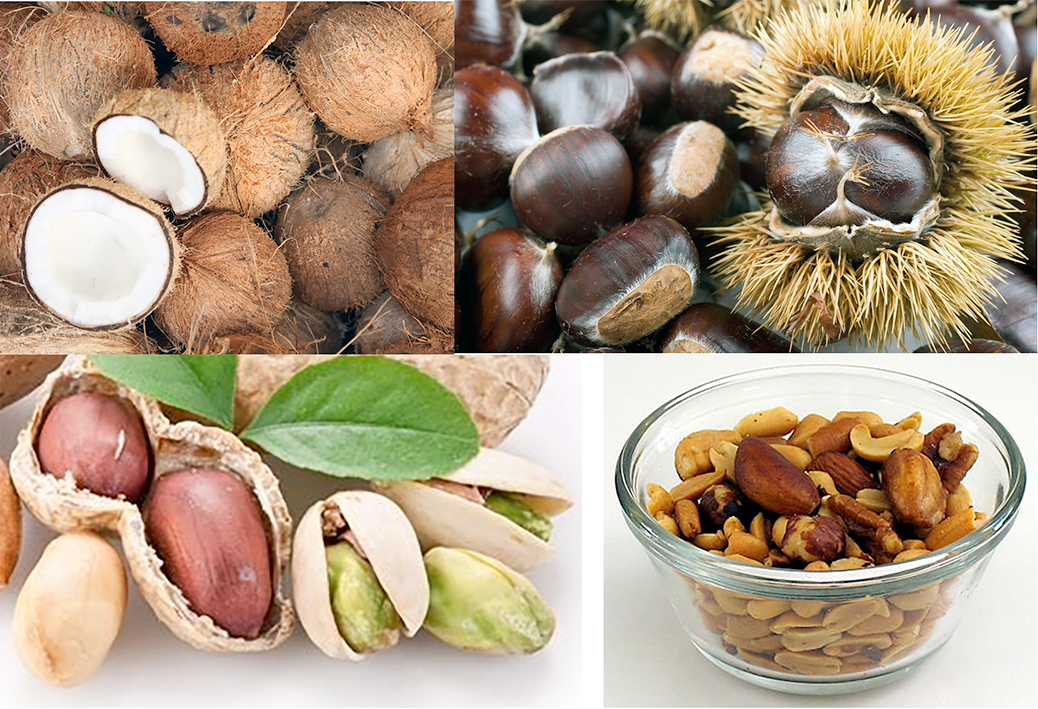 Different nuts. Clockwise: coconuts, sweet chestnuts, bowl of mixed nuts,
peanuts and pistachios.
Welcome to FabulousFusionFood's Nut-based Recipes Page —A nut is a fruit consisting of a hard or tough nutshell protecting a kernel which is usually edible. In general usage and in a culinary sense, many dry seeds are called nuts. In a botanical context, "nut" implies that the shell does not open to release the seed (indehiscent).
Most seeds come from fruit that naturally free themselves from the shell, but this is not the case in nuts such as hazelnuts, chestnuts, and acorns, which have hard shell walls and originate from a compound ovary. The general and original usage of the term is less restrictive, and many nuts (in the culinary sense), such as almonds, pistachios, and Brazil nuts, are not nuts in a botanical sense. Common usage of the term often refers to any hard-walled, edible kernel as a nut. Nuts are an energy-dense and nutrient-rich food source.
Botanically, a nut is a fruit with a woody pericarp developing from a syncarpous gynoecium. True nuts include, for example, chestnut, hazelnut and filbert. Culinarily, the term 'nut' is used much more widely, and includes examples of drupes (such as pecans and almonds) or seeds (such as pine nuts and peanuts).
Also widely known as nuts are dry drupes, which include pecans, almonds, macadamia (Macadamia integrifolia), candlenut (Aleurites moluccanus) and the water caltrop (Trapa bicornis). A drupe is an indehiscent fruit that has an outer fleshy part consisting of the exocarp, or skin, and mesocarp, or flesh, which surround a single pit or stone, the endocarp with a seed (kernel) inside. In a dry drupe, the outer parts dry up and the remaining husk is part of the ovary wall or pericarp, and the hard inner wall surrounding the seed represents the inner part of the pericarp.
Walnuts and hickories (Juglandaceae) have fruit that are difficult to classify. They are considered to be nuts under some definitions but are also referred to as drupaceous nuts.
In common use, a "tree nut" is, as the name implies, any nut coming from a tree. This most often comes up regarding food allergies; a person may be allergic specifically to peanuts (which are not tree nuts but legumes), whereas others may be allergic to the wider range of nuts that grow on trees.
The sweet potato arrived in Europe with the Columbian exchange. It is recorded, for example, in Elinor Fettiplace's Receipt Book, compiled in England in 1604.
Nuts are eaten by humans and wildlife. Because nuts generally have a high oil content, they are a significant energy source. Many seeds are edible by humans and used in cooking, eaten raw, sprouted, or roasted as a snack food, ground to make nut butters, or pressed for oil that is used in cooking and cosmetics.
Nuts used for food are a common source of food allergens. Reactions can range from mild symptoms to severe ones, a condition known as anaphylaxis, which can be life-threatening. The reaction is due to the release of histamine by the body in response to an allergen in the nuts, causing skin and other possible reactions. Many experts suggest that a person with an allergy to peanuts should avoid eating tree nuts, and vice versa.
The nuts linked to from this page are: acorn; almond; beech nuts; betel nut; brazil nut; bush mango; filbert; ginkgo nut; kola nut; candlenut; cashew; chestnut; coconut; hazelnut; macadamia; ogbono; palm nut; peanut; pecan; pine nut; pistachio; walnut.
The alphabetical list of all the nut-based recipes on this site follows, (limited to 100 recipes per page). There are 4134 recipes in total:
Page 12 of 42
| Croquettes de Pommes de Terre Dauphine (Dauphine Potato Croquettes) Origin: France | Curry de Boeuf au Yaourt (Beef Curry with Yoghurt) Origin: Mauritius | Dantina Soppu Gashi (Red Amaranth Curry) Origin: India |
| Crunchy N'Dizi (Crunchy Bananas) Origin: Kenya | Curry de Lotte au Citron Vert (Monkfish Curry with Lime) Origin: Senegal | Daqoos Spice Blend Origin: Qatar |
| Cuciadate (Italian Fig Rolls) Origin: Italy | Curry de Lotte Bretonne (Breton Monkfish Curry) Origin: France | Daqoos Spice Blend Origin: Kuwait |
| Cucurbitas mode Alexandrino (Alexandrine Melon) Origin: Roman | Curry de Pintade à la Noix de Coco (Guinea Fowl and Coconut Curry) Origin: Madagascar | Daraba Origin: Chad |
| Cumberland Sausage Origin: England | Curry de pollo y coco (Chicken and Coconut Curry) Origin: Dominican Republic | Dark Rum Cake Origin: America |
| Cupcake Christmas Trees Origin: Canada | Curry de porc au taro tahitien (Tahitian Pork Curry with Taro) Origin: Tahiti | Date and Bran Muffins Origin: British |
| Curau (Fresh Sweetcorn Pudding) Origin: Brazil | Curry de poulet au gingembre et lait de coco (Chicken curry with ginger and coconut milk) Origin: Burkina Faso | Date and Nut Laddu Origin: Anglo-Indian |
| Curried Baked Cod with Cauliflower and Chickpeas Origin: Fusion | Curry de Poulet aux Bananes Plantain (Chicken and Plantain Curry) Origin: Cote dIvoire | Date and Walnut Loaf Origin: Britain |
| Curried Baked Hake with Cauliflower and Chickpeas Origin: South Africa | Curry Mouan (Chicken Curry) Origin: Cambodia | Date Chutney Origin: India |
| Curried Beef and Squash Origin: Tanzania | Curry Trey Ruah (Curried Snapper) Origin: Cambodia | Date Loaf Origin: Britain |
| Curried Beef Gratin Origin: African Fusion | Curry Vert avec Poisson, Cuit à Vapeur (Steamed Green Curry with Fish) Origin: France | Dates Alexandrine Origin: Roman |
| Curried Beef Stew Origin: South Africa | Curry Vovoka (Malagasy Curry Powder) Origin: Madagascar | Dau Khuon Xao Lan (Curried Tofu Stir-fry) Origin: Vietnam |
| Curried Chestnut Soup Origin: Britain | Custard Pie Origin: Pitcairn Islands | Daube de Banane Plantains (Daube de Banane) Origin: Seychelles |
| Curried Chicken Origin: Saint Kitts | Custard-baked Sago Pudding with Meringue Topping Origin: South Africa | Daube de Manioc au Lait de Coco (Cassava Stew with Coconut Milk) Origin: Seychelles |
| Curried Chicken and Peach Salad Origin: America | Cyri Cocos a Dail Gwyrdd (Cockle and Greens Curry) Origin: Welsh | Daylily Flower Lo Mein Origin: American |
| Curried Corn Origin: Somalia | Cyri Oen Cymreig (Welsh Lamb Curry) Origin: Welsh | de Varenne White Sauce Origin: Britain |
| Curried Daylilies Origin: Britain | Cyw Iâr Glan Teifi (Teifiside Chicken) Origin: Welsh | Deadnettle and Chilli Soup Origin: African Fusion |
| Curried Fireweed Shoots Origin: Canada | D'Uxelles Sauce Origin: Britain | Deccan Chicken Curry Origin: Sri Lanka |
| Curried Gazelle Origin: Zambia | Dékoudéssi aux Boeuf (Palm Nut Soup with Beef) Origin: Togo | Decorated Simnel Cake Origin: Britain |
| Curried Gazelle Origin: Zambia | Dékoudéssi aux Poisson Fumé (Palm Soup with Smoked Fish) Origin: Togo | Deep Fried Coconut King Prawns Origin: Britain |
| Curried Green Banana Skin Origin: India | Dékoudéssi aux Poulet (Palm Soup with Chicken) Origin: Togo | Deep Fried Sweet Potato Balls Origin: India |
| Curried Mushrooms and Rice Origin: Fusion | Dabo Kolo (Crunchy Spice Bites) Origin: Ethiopia | Deep-fried Turkey Origin: Fusion |
| Curried Mutton Stew Origin: South Africa | Dacquoise Origin: France | Déguè II Origin: Senegal |
| Curried Noodles Origin: Kenya | Dadelbrood (Date Loaf with Caramel Syrup) Origin: South Africa | Delebdeb Origin: Palau |
| Curried Rice Origin: Fusion | Dagaa (Dried Fish with Tomatoes) Origin: Tanzania | Demok (Taro Leaves in Coconut Milk) Origin: Palau |
| Curried Rice with Beef Origin: Ghana | Dahinou Saloum Origin: Senegal | Dessert Dulse Oatcakes Origin: Ireland |
| Curried Scallops in Coconut Milk with Stevia Origin: American | Dakbungalow Curry Powder Origin: Anglo-Indian | Devilled Almonds Origin: Britain |
| Curried Spinach with peanut butter Origin: Burundi | Dakhine Origin: Senegal | Dhaktyla (Ladies' Fingers) Origin: Cyprus |
| Curried Squash Soup Origin: Britain | Dakua (Groundnut and Roast Maize Balls) Origin: Nigeria | Dhal Dhokla Origin: India |
| Curried Squash, Coconut and Lime Soup Origin: Solomon Islands | Dal Makani (Black Dal Curry) Origin: India | Dhallo Black Curry (Cuttlefish Black Curry) Origin: Sri Lanka |
| Curried Sweet Potato Soup Origin: New Zealand | Damson and Cobnut Mincemeat Origin: Britain | Dhaltjies (Cape Malay Chilli Bites) Origin: South Africa |
| Curry and Cardamom Cookies Origin: American | Dan Dan Noodles Origin: America | Dhansak Masala Origin: India |
| Curry comorien (Comoros Curry) Origin: Comoros | Dan Dan Noodles II Origin: Fusion | |
| Curry de Boeuf (Beef Curry) Origin: Mauritius | Dandelion Roots with Soy Sauce Origin: Japan |
Page 12 of 42