FabulousFusionFood's Nut-based Recipes 21st Page
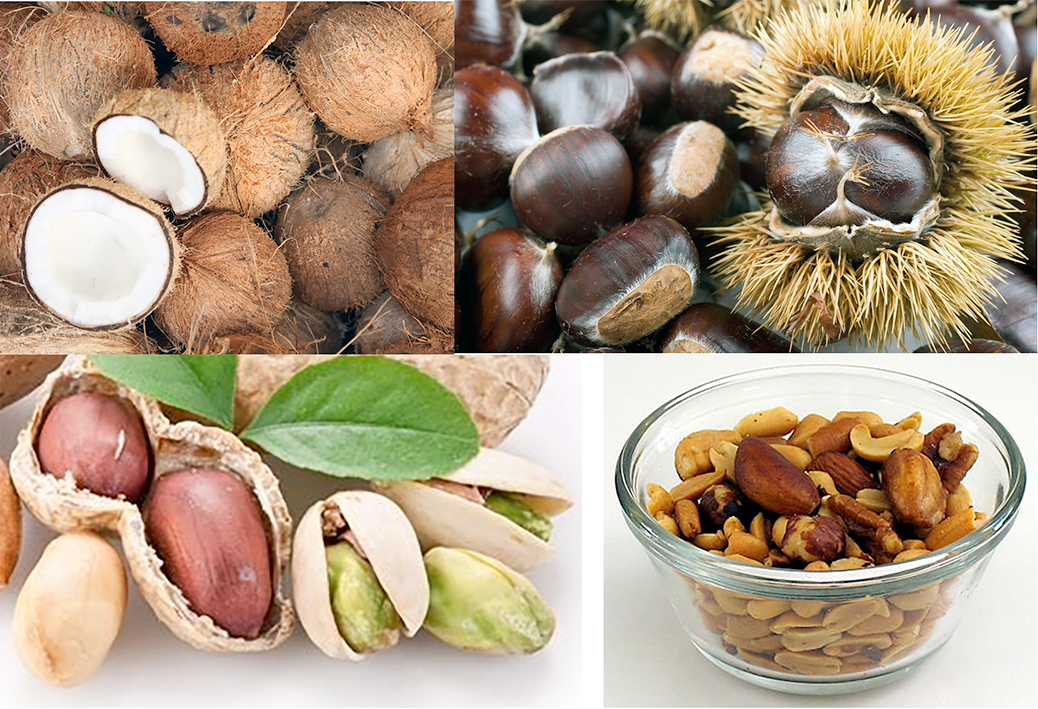 Different nuts. Clockwise: coconuts, sweet chestnuts, bowl of mixed nuts,
peanuts and pistachios.
Welcome to FabulousFusionFood's Nut-based Recipes Page —A nut is a fruit consisting of a hard or tough nutshell protecting a kernel which is usually edible. In general usage and in a culinary sense, many dry seeds are called nuts. In a botanical context, "nut" implies that the shell does not open to release the seed (indehiscent).
Most seeds come from fruit that naturally free themselves from the shell, but this is not the case in nuts such as hazelnuts, chestnuts, and acorns, which have hard shell walls and originate from a compound ovary. The general and original usage of the term is less restrictive, and many nuts (in the culinary sense), such as almonds, pistachios, and Brazil nuts, are not nuts in a botanical sense. Common usage of the term often refers to any hard-walled, edible kernel as a nut. Nuts are an energy-dense and nutrient-rich food source.
Botanically, a nut is a fruit with a woody pericarp developing from a syncarpous gynoecium. True nuts include, for example, chestnut, hazelnut and filbert. Culinarily, the term 'nut' is used much more widely, and includes examples of drupes (such as pecans and almonds) or seeds (such as pine nuts and peanuts).
Also widely known as nuts are dry drupes, which include pecans, almonds, macadamia (Macadamia integrifolia), candlenut (Aleurites moluccanus) and the water caltrop (Trapa bicornis). A drupe is an indehiscent fruit that has an outer fleshy part consisting of the exocarp, or skin, and mesocarp, or flesh, which surround a single pit or stone, the endocarp with a seed (kernel) inside. In a dry drupe, the outer parts dry up and the remaining husk is part of the ovary wall or pericarp, and the hard inner wall surrounding the seed represents the inner part of the pericarp.
Walnuts and hickories (Juglandaceae) have fruit that are difficult to classify. They are considered to be nuts under some definitions but are also referred to as drupaceous nuts.
In common use, a "tree nut" is, as the name implies, any nut coming from a tree. This most often comes up regarding food allergies; a person may be allergic specifically to peanuts (which are not tree nuts but legumes), whereas others may be allergic to the wider range of nuts that grow on trees.
The sweet potato arrived in Europe with the Columbian exchange. It is recorded, for example, in Elinor Fettiplace's Receipt Book, compiled in England in 1604.
Nuts are eaten by humans and wildlife. Because nuts generally have a high oil content, they are a significant energy source. Many seeds are edible by humans and used in cooking, eaten raw, sprouted, or roasted as a snack food, ground to make nut butters, or pressed for oil that is used in cooking and cosmetics.
Nuts used for food are a common source of food allergens. Reactions can range from mild symptoms to severe ones, a condition known as anaphylaxis, which can be life-threatening. The reaction is due to the release of histamine by the body in response to an allergen in the nuts, causing skin and other possible reactions. Many experts suggest that a person with an allergy to peanuts should avoid eating tree nuts, and vice versa.
The nuts linked to from this page are: acorn; almond; beech nuts; betel nut; brazil nut; bush mango; filbert; ginkgo nut; kola nut; candlenut; cashew; chestnut; coconut; hazelnut; macadamia; ogbono; palm nut; peanut; pecan; pine nut; pistachio; walnut.
The alphabetical list of all the nut-based recipes on this site follows, (limited to 100 recipes per page). There are 4134 recipes in total:
Page 21 of 42
| Kokoda (Fijian Ceviche) Origin: Fiji | Kuku Sabzi (Persian Herb Frittata) Origin: Iran | Lakh (Sweet Millet Porridge) Origin: Senegal |
| Kokoda (Oceanian Ceviche) Origin: Papua New Guinea | Kuku wa Nazi (Chicken with Coconut Milk) Origin: Kenya | Lakh Mauritanienne Origin: Mauritania |
| Kokoda (Oceanian Ceviche) Origin: Solomon Islands | Kukulhu Kurandi Riha (Maldives Chicken Gizzard Curry) Origin: Maldives | Lakhou bissap Origin: Senegal |
| Kokos Taart (Coconut Tart) Origin: Sint Eustatius | Kukulhu Riha (Maldives Chicken Curry) Origin: Maldives | Laksa Origin: Malaysia |
| Kokos Taart (Coconut Tart) Origin: Sint Maarten | Kukulu Musamma Origin: Sri Lanka | Laksa Paste Origin: Singapore |
| Kokos Taart (Coconut Tart) Origin: Aruba | Kulfi Origin: India | Laksa Paste Origin: Malaysia |
| Kokos Taart (Coconut Tart) Origin: Curacao | Kuli-kuli Origin: Benin | Laksa Paste II Origin: Malaysia |
| Kolacky Origin: Poland | Kuli-kuli (Groundnut Cakes) Origin: Nigeria | Lamb and Apricot Cape Malay Curry Origin: South Africa |
| Kombdi Masala Origin: India | Kulich (Russian Easter Cake) Origin: Russia | Lamb and Cabbage Rolls Origin: Britain |
| Kongodo (Peanut Brittle) Origin: Equatorial Guinea | Kulich (Russian Easter Bread) Origin: Russia | Lamb Biryani Origin: Britain |
| Koozy II (Leg of Lamb) Origin: Iraq | Kulikuli (Peanut Balls) Origin: Nigeria | Lamb Biryani Origin: India |
| Kopto à l'arachide (Kopto in Peanut Sauce) Origin: Niger | Kuljon (Oysters Fried in Egg Batter) Origin: Korea | Lamb Burgers with Mint and Pine Nuts Origin: Cyprus |
| Korma Curry Paste Origin: Britain | Kunun gyada Origin: Nigeria | Lamb Chops with Pine-nut Lemon Crust Origin: Fusion |
| Korma Masala Origin: India | Kunun Kwakwa Origin: Nigeria | Lamb Curry with Winter Vegetables and Spinach Origin: Fusion |
| Koro Owu Soup (Cotton Seed Soup) Origin: Nigeria | Kurambiedes (Greek Christmas Biscuits) Origin: Greece | Lamb Flaps Origin: Papua New Guinea |
| Kosrae Soup (Tuna, Banana and Coconut Milk Soup) Origin: Federated States Micronesia | Kutia Origin: Ukraine | Lamb Rogan Josh Origin: India |
| Kotmis Satsivi (Roast Chicken with Walnut Sauce) Origin: Georgia | Kwacoco with Banga Soup Origin: Cameroon | Lamb Rogan Josh Origin: Britain |
| Kougin Patatez (Breton Potato Cake) Origin: France | Kwahu Nsusua Abomu (Turkey Berry and Fish Stew) Origin: Ghana | Lamb shish with olive and walnut tahini Origin: Britain |
| Koumrangan Origin: Chad | Kwarezimal (Maltese Lenten Cake) Origin: Malta | Lamb Stew with Chestnuts and Pomegranates Origin: Georgia |
| Koumrangan avec Patte d'Arachide (Koumrangan with Peanut Paste) Origin: Chad | Kwarezimal (Almond Cakes) Origin: Malta | Lamb Tagine Pie Origin: Fusion |
| Koupes (Minced Meat in a Wheat Flour Paste) Origin: Cyprus | Kwerstkhi Nigozee Satsabelly (Egg Salad In Walnut Sauce) Origin: Georgia | Lamb Tarkari (Lamb Yoghurt Curry) Origin: Nepal |
| Kourabiedes (Greek Almond Crescents) Origin: Greece | Kyazangi Kaukswe (Rice Noodles with Curry) Origin: Myanmar | Lamb's Lettuce Pesto Origin: Britain |
| Kozhukattai Payasam Origin: India | L'Ham Lahlou (Sweet Lamb for Ramadan) Origin: Algeria | Lammfärsfyllda squashbåtar (Lamb-stuffed Squash Boats) Origin: Sweden |
| Kozi Ishtu (Keralan Chicken Ishtu) Origin: India | La Bouille du Tchad (Chadian Porridge) Origin: Chad | Lampara Curry Origin: Sri Lanka |
| Kpé (Peanut Paste) Origin: Central African Republic | La Bouillie Origin: Chad | Lao Tam Som (Lao Green Papaya Salad) Origin: Laos |
| Krækiberjasaft Chatni (Crowberry Chutney) Origin: Iceland | La Galette des Rois (Kings Cake) Origin: France | Laplap Origin: Vanuatu |
| Krampez Yar (Cornish Chicken Pie) Origin: England | La Salsa de Cacahuete (Peanut Sauce) Origin: Equatorial Guinea | Laska Origin: Malaysia |
| Kransekage Konfekt (Almond Allsorts) Origin: Denmark | La Torta Tre Monti (Sammarinese Three Mountain Cake) Origin: San Marino | Last-minute Mincemeat Christmas Cake Origin: Britain |
| Kransekage Stænger (Danish Almond Sticks) Origin: Denmark | Ladob Banan (Bananas in Coconut Milk) Origin: Seychelles | Lauki Kofta Curry (Bottle Gourd Kofta Curry) Origin: India |
| Kringle (Estonian Cinnamon Braid Bread) Origin: Estonia | Lafet Time (Honey-glazed Pork with Salad) Origin: Vanuatu | Launceston Cake Origin: Britain |
| Kubecake Origin: Ghana | Lahm Lhalou (Lamb Stew with Prunes) Origin: Algeria | Lawves (Walnut Fudge) Origin: Uzbekistan |
| Kuddelfleck (Tripe) Origin: Luxembourg | Lahmajoun Origin: Armenia | Layer Cake Origin: Britain |
| Kujja Kulfi (Saffron and Nut Ice Cream) Origin: India | Lahpet Thoke (Burmese Tea Leaf Salad) Origin: Myanmar | |
| Kuku Paka (Chicken-coconut Curry) Origin: East Africa | Lakh Origin: Senegal |
Page 21 of 42