FabulousFusionFood's Frying Recipes 11th Page
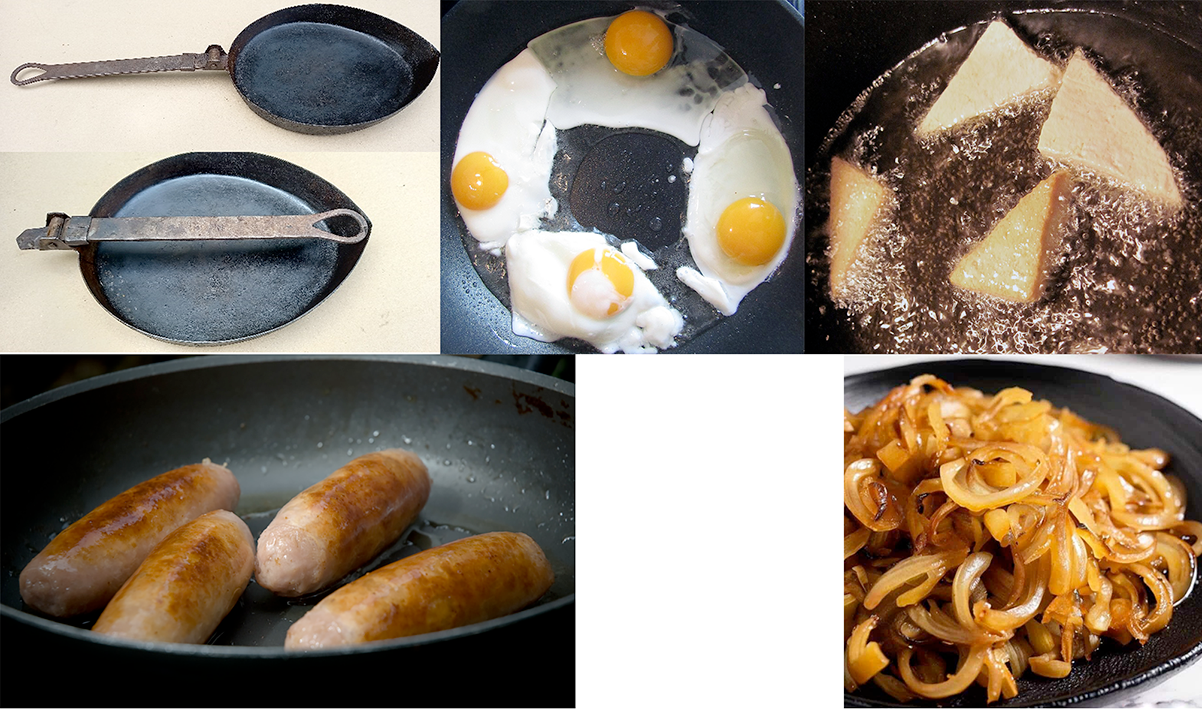 Clockwise from top left: Ancient Roman Frying pan, gentle-fried eggs,
shallow-fried tofu, sautéed onions and pan-fried sausages.
Welcome to FabulousFusionFood's Frying Recipes Page — Frying is the cooking of food in oil or another fat. Similar to sautéing, pan-fried foods are generally turned over once or twice during cooking to make sure that the food is evenly cooked, using tongs or a spatula, whilst sautéed foods are cooked by "tossing in the pan". A large variety of foods may be fried.
Historically, for frying, metalware is required as the temperature reached by cooking in hot oil generally far exceeds the boiling point of water 100°C (212°F). As such a society needs to attain bronze age metalwork before frying in hot oil becomes a viable cooking method. In the west, frying is believed to have first appeared in the Ancient Egyptian kitchen, during the Old Kingdom, around 2500 BCE. The Romans had special cookware, the fretale a special frying pan made of bronze round or oval in shape, with a lip for pouring. Though it must be mentioned here that Romans also had rectangular iron trays with handles for roasting or frying. "Oven-to-table ware," in the form of shallow pans and earthenware dishes was common — these are referred to as patellae and patinae. The fretale with a foldable handle (see image) was part of the field kit for a Roman soldier (see image). Frying may originally have been developed as a way to preserve food, as the frying process sterilises the food then bottling the fried food in the frying oil excludes air and helps prevent decay.
Frying techniques vary in the amount of fat required, the cooking time, the type of cooking vessel required, and the manipulation of the food. Sautéing, stir-frying, pan frying, shallow frying, and deep frying are all standard frying techniques. There are separate entries for stir-frying and deep frying and this page is about shallow frying methods: sautéing, pan frying and shallow frying.
Pan-frying, sautéing, and stir-frying involve cooking foods in a thin layer of fat on a hot surface, such as a frying pan, griddle, wok, or sauté pan. Stir frying involves frying quickly at very high temperatures, requiring that the food be stirred continuously to prevent it from adhering to the cooking surface and burning. Shallow frying is a type of pan frying using only enough fat to immerse approximately one-third to one-half of each piece of food; fat used in this technique is typically only used once.
Gentle frying or low-temperature frying is an oil- or fat-based cooking method used for relatively fragile or starchy foods. While gentle frying is most notably used to cook fried eggs, it is also used for delicate fish, tender cuts of meat, sausages, and as a first step in preparing fried potatoes. Low-temperature frying is useful if the frying fat scorches at higher heat levels (e.g. butter), or if the frying fat has flavour that the cook wants to preserve (e.g. olive oil). Overheated oils can produce unhealthy, even carcinogenic, compounds.
Pan frying or pan-frying is a form of frying food characterized by the use of minimal cooking oil or fat (compared to shallow frying or deep frying), typically using just enough to lubricate the pan. In the case of a greasy food such as bacon, no oil or fats may need to be added. As a form of frying, the technique relies on oil or fat as the heat transfer medium, and on correct temperature and time to not overcook or burn the food. Pan frying can serve to retain the moisture in foods such as meat and seafood. The food is typically flipped at least once to ensure that both sides are cooked properly. Pan frying takes place at lower heat than sautéing. This is because the food to be pan fried – such as chicken breasts, steak, pork chops, or fish fillets – is not cut into small pieces before cooking. It requires a lower heat so that the exterior of the food does not overcook by the time the interior reaches the proper temperature, and to keep foods in a moister state. However, the oil should always be hot enough to ensure that the moisture in the food can escape in the form of steam; the force of the steam escaping keeps the oil from soaking into the food. The same amount of oil is used as for sautéing – just enough to glaze the pan.
Sautéing or sauteing (UK: /ˈsoʊteɪɪŋ/, US: /soʊˈteɪɪŋ, sɔː-/; from French sauté, French: [sote], 'jumped', 'bounced', in reference to tossing while cooking) is a method of cooking that uses a relatively small amount of oil or fat in a shallow pan over relatively high heat. Various sauté methods exist. Ingredients for sautéing are usually cut into small pieces or thinly sliced to provide a large surface area, which facilitates fast cooking. The primary mode of heat transfer during sautéing is conduction between the pan and the food being cooked. Food that is sautéed is browned while preserving its texture, moisture, and flavour. If meat, chicken, or fish is sautéed, the sauté is often finished by deglazing the pan's residue to make a sauce. Sautéing may be compared with pan frying, in which larger pieces of food (for example, chops or steaks) are cooked quickly in oil or fat, and flipped onto both sides. Some cooks make a distinction between the two based on the depth of the oil used, while others use the terms interchangeably
Shallow frying is a hot oil-based cooking technique. Pieces of food are cooked by partial submersion in hot oil. It is typically used to prepare portion-sized cuts of meat, fish, potatoes and patties such as fritters. Shallow frying can also be used to cook vegetables. Shallow frying is distinct from deep frying, which uses enough oil to fully submerge the food to be cooked, and pan frying, which only uses a negligible depth of oil. t is a medium-high to high heat cooking process. Temperatures between 160–190°C (320–374°F) are typical, but shallow frying may be performed at temperatures as low as 150°C (302°F) for a longer period of time. The high heat promotes protein denaturation-browning and, in some cases, a Maillard reaction. Deep frying usually takes place at temperatures between 177–205°C (351–401°F) so shallow-frying can oftentimes be considered a less intense cooking technique. Foods to be shallow fried are commonly pre-portioned into single servings before being placed in oil. Since the food is only partly submerged, it must be turned over partway through the cooking process. Some cooks recommend cooking the "presentation" side of the food first.
The alphabetical list of all the frying-based recipes on this site follows, (limited to 100 recipes per page). There are 1693 recipes in total:
Page 11 of 17
| Masala Fish Fried with Brinjals Origin: South Africa | Mochi Doughnuts Origin: Hawaii | Mushroom-stuffed Draniki Origin: Belarus |
| Masala French Fries Origin: India | Mofo Akondro (Malagasy Banana Fritters) Origin: Madagascar | Mushrooms with Parsley and Garlic Origin: Britain |
| Masale Origin: Somalia | Mofo Sakay (Spiced Fritters) Origin: Madagascar | Mustard Beef with Potato Gratin Origin: Australia |
| Maschi Origin: Sudan | Mofongo Origin: Puerto Rico | Mustard-crusted Herring Origin: Britain |
| Matbucha (Spicy Cooked Tomato and Pepper Salad) Origin: Israel | Mologathanni Soup Origin: Sri Lanka | Mutton Rissole Origin: Britain |
| Matchstick Potatoes Origin: Britain | Molokhia Origin: Egypt | Mysore Bonda Origin: Italy |
| Matzo Brei Origin: Israel | Monkey Gland Steak Origin: Southern Africa | Nachinyonaya Forel (Stuffed Trout) Origin: Georgia |
| Matzoh Onion Stuffing Origin: Jewish | Montserrat Jerk Prawns Origin: Montserrat | Nachynka Z Kapusty (Cabbage Filling For Vareniki) Origin: Ukraine |
| Mawa Gujiya Origin: India | Montserratian Johnny Cakes Origin: Montserrat | Nam Prik Pao (Thai Chilli Paste) Origin: Thailand |
| Mazavaroo au Limon Origin: Mauritius | Montserratian Rotis Origin: Montserrat | Namak Paray Origin: Pakistan |
| Mazze de Tamburo (Fried Shaggy Parasols) Origin: Italy | Moo Shu Pancakes Origin: China | Nasi Goreng (Fried Rice) Origin: Indonesia |
| Mbongo Tjobi Origin: Cameroon | Mooli and Garlic Beef with Pine Nuts Origin: Australia | Nasi Goreng (Fried Rice) Origin: Cocos Islands |
| Me'orav Yerushalmi (Jerusalem Mixed Grill) Origin: Israel | Moongre ki Subzi (Radish Pod and Potato Sauté) Origin: India | Nasi Goreng (Fried Rice) Origin: New Caledonia |
| Meadow Waxcap Frittata Origin: Britain | Moos Bukaani (Fried Plantains) Origin: Somalia | Nasi Goreng Istimewa (Fried Rice Breakfast) Origin: Indonesia |
| Meatballs in Yoghurt Sauce Origin: Uganda | Moqueca de Pixe à Baiana (Grilled Fish, Baian Style) Origin: Brazil | Nasi Trafasie (Surinamese Fried Rice) Origin: Suriname |
| Medallones de Congrio Frito (Fried Conger Eel Medallions) Origin: Easter Island | Morel Rösti Origin: Switzerland | Ndrovi ya Nazi (Banana with Coconut Milk) Origin: Comoros |
| Mexican Chicken Sausage Origin: Fusion | Morels with Yellow Bell Peppers Origin: Britain | Nepalese Mustard Greens Bhutuwa Origin: Nepal |
| Mexican-style Mackerel and Rice Origin: Fusion | Moroho (Fried Greens) Origin: Lesotho | Nepalese Mustard Greens Bhutuwa Origin: Nepal |
| Mho Kazun Ywet Kyaw (Stir-fried Water Spinach with Straw Mushrooms) Origin: Myanmar | Morue Rôtie à la Sauce Tomate (Roast Salt Cod with Tomato Sauce) Origin: Monaco | Nettle and Sorrel Omelette Origin: Ireland |
| Miške (Mice) Origin: Slovenia | Moshari me Patates (Veal with Potatoes) Origin: Cyprus | Nettle Purée and Oatmeal Cakes (Nettle Purée Oatcakes) Origin: British |
| Microwave Polenta and Sausage Origin: American | Mozzarella Fritters Origin: Ireland | Nettle Purée Fritters Origin: Britain |
| Middle Easters Falafel (Middle Eastern Falafel) Origin: Middle East | Mseman (Moroccan Flatbread) Origin: Morocco | New Year's Eve Latkes Origin: Germany |
| Mielie Fritters Origin: Zimbabwe | Mucver (Turkish Courgette Patties) Origin: Turkey | Ngege with Peanut Sauce (Tilapia with Peanut Sauce) Origin: East Africa |
| Migas de Extremadura (Migas with Serrano Ham) Origin: Spain | Mughlai-style Camel Curry Origin: India | Nigerian Buns Origin: Nigeria |
| Mikate ya Maji (Zenji Pancakes) Origin: Tanzania | Mulku (Murukku) Origin: Mauritius | Nigerian Fried Rice II Origin: Nigeria |
| Mikates (Congolese Sweet Doughnuts) Origin: DR-Congo | Multi-grain Pancakes Origin: American | Nigerian Fried Turkey Origin: Nigeria |
| Milanesa Uruguaya Origin: Uruguay | Multi-grain Pancakes with Reedmace Pollen Origin: American | Nigerian Pancakes with Prawns Origin: Nigeria |
| Milka Micic (Cheese-filled Crepes) Origin: Serbia | Multi-grain Waffles Origin: British | Nimki (Crispy Flour Crackers) Origin: Bengal |
| Minari-buchimgae (Water Dropwort Pancake) Origin: Korea | Mushroom Bruschetta Origin: Britain | NjaNjaMoto (Smelt in Njangsa Sauce) Origin: Cameroon |
| Mini Crab Cakes Origin: Fusion | Mushroom Croquettes Origin: Belarus | Noix de St-Jacques à la crème d'oignons de Roscoff (Scallops with Roscoff Onion Cream) Origin: France |
| Minutal marinum (Seafood Fricassee) Origin: Roman | Mushroom Cutlets with Walnut Sauce Origin: British | Nori-crusted Sirloin with Shiitake Mushrooms and Wasabi Origin: Fusion |
| Mititei (Romanian Minced Meat Sausages) Origin: Romania | Mushroom Fricassee Origin: American | Nuegados de Yucca y Masa Origin: El Salvador |
| Miyeok Julgi Bokkeum (Korean Kelp Stem Accompaniment) Origin: Korea | Mushroom Frittata Origin: Britain | |
| Mkatra Foutra (Comoran Yeasted Bread) Origin: Comoros | Mushroom Pâté Origin: Britain |
Page 11 of 17