FabulousFusionFood's Frying Recipes 6th Page
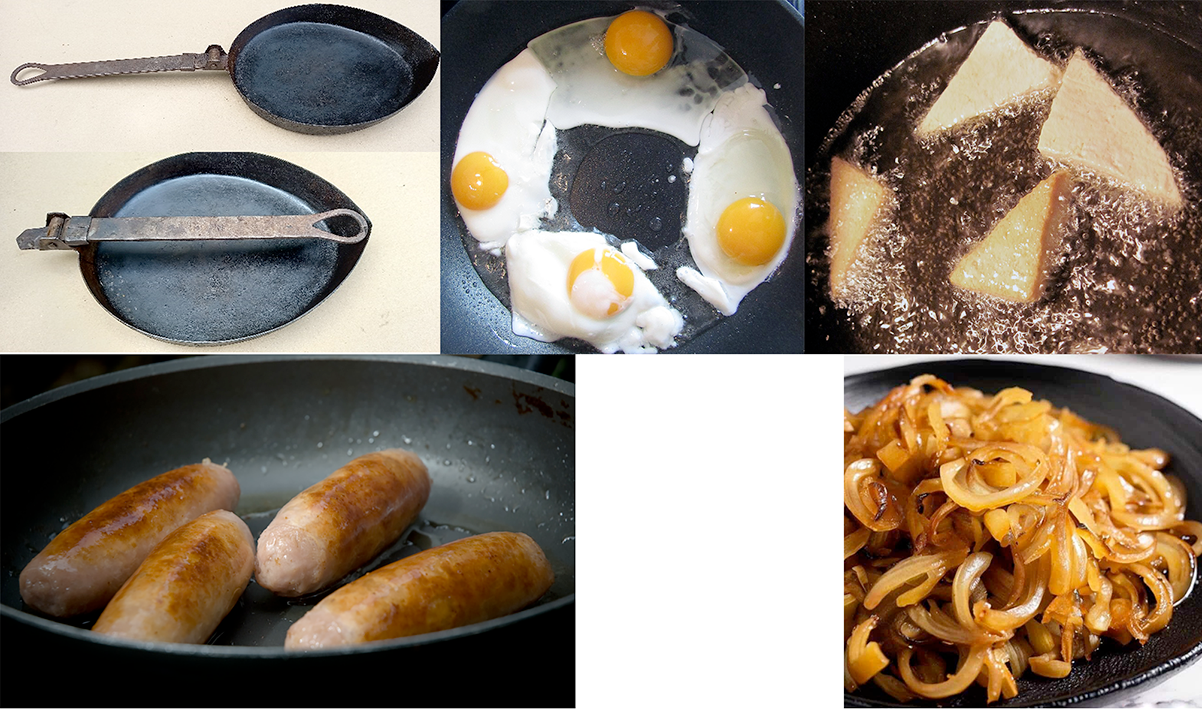 Clockwise from top left: Ancient Roman Frying pan, gentle-fried eggs,
shallow-fried tofu, sautéed onions and pan-fried sausages.
Welcome to FabulousFusionFood's Frying Recipes Page — Frying is the cooking of food in oil or another fat. Similar to sautéing, pan-fried foods are generally turned over once or twice during cooking to make sure that the food is evenly cooked, using tongs or a spatula, whilst sautéed foods are cooked by "tossing in the pan". A large variety of foods may be fried.
Historically, for frying, metalware is required as the temperature reached by cooking in hot oil generally far exceeds the boiling point of water 100°C (212°F). As such a society needs to attain bronze age metalwork before frying in hot oil becomes a viable cooking method. In the west, frying is believed to have first appeared in the Ancient Egyptian kitchen, during the Old Kingdom, around 2500 BCE. The Romans had special cookware, the fretale a special frying pan made of bronze round or oval in shape, with a lip for pouring. Though it must be mentioned here that Romans also had rectangular iron trays with handles for roasting or frying. "Oven-to-table ware," in the form of shallow pans and earthenware dishes was common — these are referred to as patellae and patinae. The fretale with a foldable handle (see image) was part of the field kit for a Roman soldier (see image). Frying may originally have been developed as a way to preserve food, as the frying process sterilises the food then bottling the fried food in the frying oil excludes air and helps prevent decay.
Frying techniques vary in the amount of fat required, the cooking time, the type of cooking vessel required, and the manipulation of the food. Sautéing, stir-frying, pan frying, shallow frying, and deep frying are all standard frying techniques. There are separate entries for stir-frying and deep frying and this page is about shallow frying methods: sautéing, pan frying and shallow frying.
Pan-frying, sautéing, and stir-frying involve cooking foods in a thin layer of fat on a hot surface, such as a frying pan, griddle, wok, or sauté pan. Stir frying involves frying quickly at very high temperatures, requiring that the food be stirred continuously to prevent it from adhering to the cooking surface and burning. Shallow frying is a type of pan frying using only enough fat to immerse approximately one-third to one-half of each piece of food; fat used in this technique is typically only used once.
Gentle frying or low-temperature frying is an oil- or fat-based cooking method used for relatively fragile or starchy foods. While gentle frying is most notably used to cook fried eggs, it is also used for delicate fish, tender cuts of meat, sausages, and as a first step in preparing fried potatoes. Low-temperature frying is useful if the frying fat scorches at higher heat levels (e.g. butter), or if the frying fat has flavour that the cook wants to preserve (e.g. olive oil). Overheated oils can produce unhealthy, even carcinogenic, compounds.
Pan frying or pan-frying is a form of frying food characterized by the use of minimal cooking oil or fat (compared to shallow frying or deep frying), typically using just enough to lubricate the pan. In the case of a greasy food such as bacon, no oil or fats may need to be added. As a form of frying, the technique relies on oil or fat as the heat transfer medium, and on correct temperature and time to not overcook or burn the food. Pan frying can serve to retain the moisture in foods such as meat and seafood. The food is typically flipped at least once to ensure that both sides are cooked properly. Pan frying takes place at lower heat than sautéing. This is because the food to be pan fried – such as chicken breasts, steak, pork chops, or fish fillets – is not cut into small pieces before cooking. It requires a lower heat so that the exterior of the food does not overcook by the time the interior reaches the proper temperature, and to keep foods in a moister state. However, the oil should always be hot enough to ensure that the moisture in the food can escape in the form of steam; the force of the steam escaping keeps the oil from soaking into the food. The same amount of oil is used as for sautéing – just enough to glaze the pan.
Sautéing or sauteing (UK: /ˈsoʊteɪɪŋ/, US: /soʊˈteɪɪŋ, sɔː-/; from French sauté, French: [sote], 'jumped', 'bounced', in reference to tossing while cooking) is a method of cooking that uses a relatively small amount of oil or fat in a shallow pan over relatively high heat. Various sauté methods exist. Ingredients for sautéing are usually cut into small pieces or thinly sliced to provide a large surface area, which facilitates fast cooking. The primary mode of heat transfer during sautéing is conduction between the pan and the food being cooked. Food that is sautéed is browned while preserving its texture, moisture, and flavour. If meat, chicken, or fish is sautéed, the sauté is often finished by deglazing the pan's residue to make a sauce. Sautéing may be compared with pan frying, in which larger pieces of food (for example, chops or steaks) are cooked quickly in oil or fat, and flipped onto both sides. Some cooks make a distinction between the two based on the depth of the oil used, while others use the terms interchangeably
Shallow frying is a hot oil-based cooking technique. Pieces of food are cooked by partial submersion in hot oil. It is typically used to prepare portion-sized cuts of meat, fish, potatoes and patties such as fritters. Shallow frying can also be used to cook vegetables. Shallow frying is distinct from deep frying, which uses enough oil to fully submerge the food to be cooked, and pan frying, which only uses a negligible depth of oil. t is a medium-high to high heat cooking process. Temperatures between 160–190°C (320–374°F) are typical, but shallow frying may be performed at temperatures as low as 150°C (302°F) for a longer period of time. The high heat promotes protein denaturation-browning and, in some cases, a Maillard reaction. Deep frying usually takes place at temperatures between 177–205°C (351–401°F) so shallow-frying can oftentimes be considered a less intense cooking technique. Foods to be shallow fried are commonly pre-portioned into single servings before being placed in oil. Since the food is only partly submerged, it must be turned over partway through the cooking process. Some cooks recommend cooking the "presentation" side of the food first.
The alphabetical list of all the frying-based recipes on this site follows, (limited to 100 recipes per page). There are 1693 recipes in total:
Page 6 of 17
| Csusztatott Palacsinta (Chocolate Pancakes) Origin: Hungary | Dodo Oni-yeri (Egg-coated Fried Plantain) Origin: Nigeria | Edible Flower Pancakes Origin: American |
| Cucumeres (Braised Cucumbers) Origin: Roman | Dominica Cassava Bread Origin: Dominica | Egg and Prawns on Toast Origin: South Africa |
| Cucurbitas Elixatas et Frictas (Gourds, Stewed and Fried) Origin: Roman | Dominica Reef Chicken Origin: Dominica | Egg Bhurji (Spicy Scrambled Egg) Origin: India |
| Cumberland Hot Dogs with Sweet Chilli and Tomato Relish Origin: British | Dominica Saltfish Accra Origin: Dominica | Egg Fu Yung Origin: China |
| Cumberland Sausage Origin: England | Dominica Titiwi Accra Origin: Dominica | Egg Sponge with Milk Origin: Roman |
| Curaçao Pastechi di Karni (Meat Pastechi) Origin: Curacao | Dominican Chimichurri Burgers Origin: Dominican Republic | Eggs Benedict Pancakes Origin: Britain |
| Curly Dock Seed Flour Pancakes Origin: Britain | Dominican Mountain Chicken Origin: Dominica | Eggy Bread Origin: Britain |
| Curried Crumbed Fish Origin: Britain | Dosa (Rice and Lentil Crêpes) Origin: India | Empanadas de Atun Fritas (Fried Tuna Empanadas) Origin: Mexico |
| Curried Fishcakes Origin: Zimbabwe | Double ka Meetha Origin: India | Empanadas de carneo (Argentinian Meat Empanadas) Origin: Argentina |
| Curried Lamb Chops Origin: Fusion | Doubles Origin: Trinidad | Empanadas de carneo (Argentinian Meat Empanadas) Origin: Vatican City |
| Curried Tempura Grasshoppers Origin: Fusion | Dover Sole with Salt Marsh Greens Origin: Britain | Empanadas de frijoles negros y queso (Black Bean and Cheese Empanadas) Origin: Mexico |
| Cyw Iâr â Bwyd Môr (Chicken with Seafood) Origin: Welsh | Draenog y Môr Gyda Saws Dail Surion Bach (Sea Bass with Sorrel Sauce) Origin: Welsh | Empanadas Dulces (Sweet Pies) Origin: Colombia |
| Dabcadz Patlijan (Fried Aubergines) Origin: Armenia | Draenog y Môr o'r Badell gyda Tatws Newydd wedi Malu a Saets (Pan-fried Sea Bass with Garlic and Sage Smashed New Potatoes) Origin: Welsh | Empanadas Fritas (Fried Empanadas) Origin: Mexico |
| Dabgadz Banir Boerag (Fried Cheese Turnovers) Origin: Armenia | Draniki Origin: Belarus | Empanadas fritas de atún y queso (Fried Tuna and Cheese Empanadas) Origin: Easter Island |
| Dabo Origin: Ethiopia | Driblws (Turkey Giblets, Chinese Style) Origin: Welsh | Empanadas fritas de mariscos (Fried Seafood Empanadas) Origin: Easter Island |
| Dadar Jagung (Prawn and Corn Fritters) Origin: Indonesia | Drisheen Sausage Origin: Ireland | Empanadas Method II Origin: Chile |
| Danske Omelet (Danish Omelette) Origin: Denmark | Drop Scones Origin: Scotland | Empanadas Mexicanas de Masa (Mexican Masa Empanadas) Origin: Mexico |
| Daylily Fritters Origin: Britain | Dry Baking Mix Pancakes Origin: American | English Muffins Origin: English |
| Deep Fried Coconut King Prawns Origin: Britain | Dry Beef Curry Origin: India | English Muffins II Origin: Britain |
| Deep Fried Sweet Potato Balls Origin: India | Dry Curried Chicken Origin: Aruba | Entrecote a La Plancha Con Salsa De Aceitunas (Pan-grilled Steaks with Olive Sauce) Origin: Spain |
| Deep-fried Pork Fillet Origin: China | Dry Keema Curry Origin: India | Escalope de Porc Cordon Bleu (Pork Schnitzel Cordon Bleu) Origin: Switzerland |
| Deep-fried River Fish with Chilli Bean Sauce Origin: China | Dry Rice and Fish Origin: Liberia | Escalope De Veau Cordon Bleu (Veal Cordon Bleu) Origin: Switzerland |
| Deep-fried Sweetbreads Origin: British | Dry-fry Pork, Kenyan Style Origin: Kenya | Ewa Dodo (Black-eyed peas with Plantains) Origin: Niger |
| Deep-fried Turkey Origin: Fusion | Duck Egg Scotch Eggs Origin: Scotland | Fërgesë e Tiranës me Mish Viçi (Tiranian Veal with Fried Cottage Cheese) Origin: Albania |
| Des Mervelles (Jersey Wonders) Origin: Jersey | Duck Fajitas with Cherry Salsa Origin: Fusion | Fabaciae Frictae (Fried Green Beans) Origin: Roman |
| Devilled Duck Liver and Wilding Apple Origin: Britain | Dulse Croquettes Origin: Scotland | Fagato Alla Veneziana (Venetian Liver) Origin: Italy |
| Dhaktyla (Ladies' Fingers) Origin: Cyprus | Dulse Potato Cakes Origin: Ireland | Fairy Ring Champignon Omelette Origin: France |
| Dhaltjies (Cape Malay Chilli Bites) Origin: South Africa | Dumplings in Cold Spicy Sauce Origin: Fusion | Falafel Origin: Bahrain |
| Dholl Pooris Origin: Mauritius | Dundee Lamb Chops Origin: Scotland | Fania Origin: Uruguay |
| Dibi Origin: Gambia | Dundu Oniyeri Origin: Nigeria | Fari Masa Origin: Niger |
| Djibouti Banana Fritters Origin: Djibouti | Durban Style Rotis Origin: South Africa | Farz buen (Crepes cooked like scrambled eggs) Origin: France |
| Djibouti Sambusas Origin: Djibouti | Easter Frittata Origin: American | Fatayas Sénégalais (Senegalese Fatayas) Origin: Senegal |
| Dock Rissoles Origin: Ancient | Easter Ledge Pudding Origin: Britain | |
| Dodo (Fried Plantain Accompaniment) Origin: Nigeria | Easterledge Origin: England |
Page 6 of 17