FabulousFusionFood's Frying Recipes 15th Page
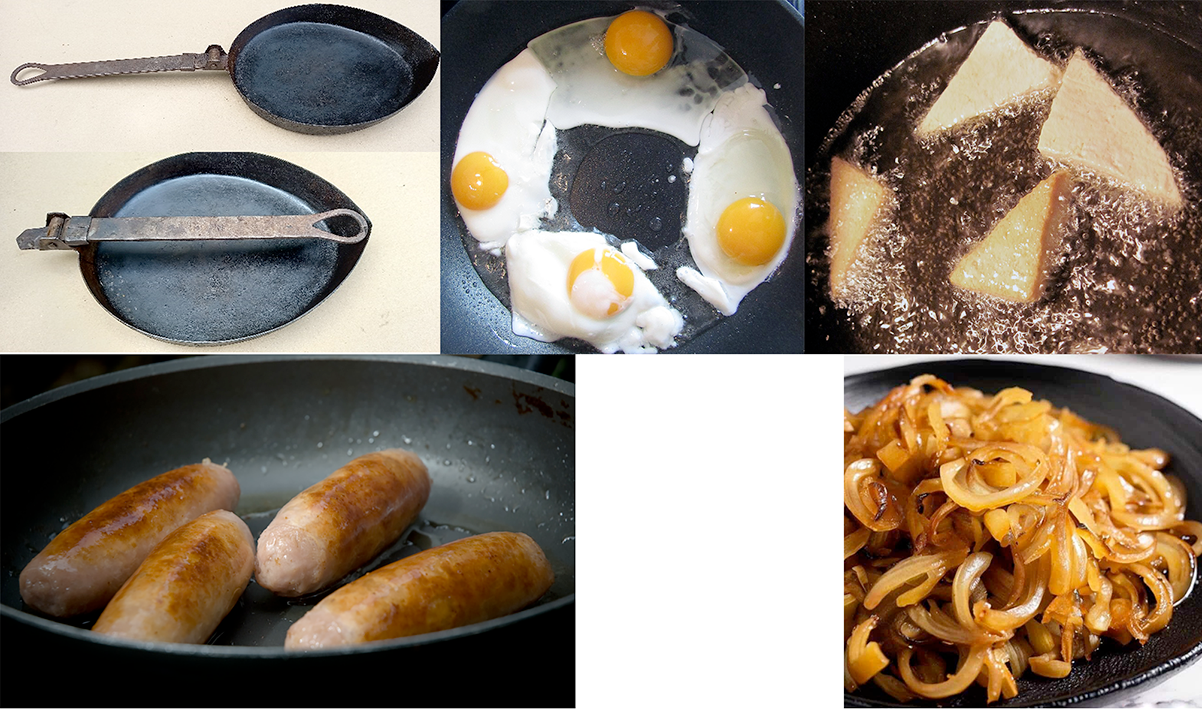 Clockwise from top left: Ancient Roman Frying pan, gentle-fried eggs,
shallow-fried tofu, sautéed onions and pan-fried sausages.
Welcome to FabulousFusionFood's Frying Recipes Page — Frying is the cooking of food in oil or another fat. Similar to sautéing, pan-fried foods are generally turned over once or twice during cooking to make sure that the food is evenly cooked, using tongs or a spatula, whilst sautéed foods are cooked by "tossing in the pan". A large variety of foods may be fried.
Historically, for frying, metalware is required as the temperature reached by cooking in hot oil generally far exceeds the boiling point of water 100°C (212°F). As such a society needs to attain bronze age metalwork before frying in hot oil becomes a viable cooking method. In the west, frying is believed to have first appeared in the Ancient Egyptian kitchen, during the Old Kingdom, around 2500 BCE. The Romans had special cookware, the fretale a special frying pan made of bronze round or oval in shape, with a lip for pouring. Though it must be mentioned here that Romans also had rectangular iron trays with handles for roasting or frying. "Oven-to-table ware," in the form of shallow pans and earthenware dishes was common — these are referred to as patellae and patinae. The fretale with a foldable handle (see image) was part of the field kit for a Roman soldier (see image). Frying may originally have been developed as a way to preserve food, as the frying process sterilises the food then bottling the fried food in the frying oil excludes air and helps prevent decay.
Frying techniques vary in the amount of fat required, the cooking time, the type of cooking vessel required, and the manipulation of the food. Sautéing, stir-frying, pan frying, shallow frying, and deep frying are all standard frying techniques. There are separate entries for stir-frying and deep frying and this page is about shallow frying methods: sautéing, pan frying and shallow frying.
Pan-frying, sautéing, and stir-frying involve cooking foods in a thin layer of fat on a hot surface, such as a frying pan, griddle, wok, or sauté pan. Stir frying involves frying quickly at very high temperatures, requiring that the food be stirred continuously to prevent it from adhering to the cooking surface and burning. Shallow frying is a type of pan frying using only enough fat to immerse approximately one-third to one-half of each piece of food; fat used in this technique is typically only used once.
Gentle frying or low-temperature frying is an oil- or fat-based cooking method used for relatively fragile or starchy foods. While gentle frying is most notably used to cook fried eggs, it is also used for delicate fish, tender cuts of meat, sausages, and as a first step in preparing fried potatoes. Low-temperature frying is useful if the frying fat scorches at higher heat levels (e.g. butter), or if the frying fat has flavour that the cook wants to preserve (e.g. olive oil). Overheated oils can produce unhealthy, even carcinogenic, compounds.
Pan frying or pan-frying is a form of frying food characterized by the use of minimal cooking oil or fat (compared to shallow frying or deep frying), typically using just enough to lubricate the pan. In the case of a greasy food such as bacon, no oil or fats may need to be added. As a form of frying, the technique relies on oil or fat as the heat transfer medium, and on correct temperature and time to not overcook or burn the food. Pan frying can serve to retain the moisture in foods such as meat and seafood. The food is typically flipped at least once to ensure that both sides are cooked properly. Pan frying takes place at lower heat than sautéing. This is because the food to be pan fried – such as chicken breasts, steak, pork chops, or fish fillets – is not cut into small pieces before cooking. It requires a lower heat so that the exterior of the food does not overcook by the time the interior reaches the proper temperature, and to keep foods in a moister state. However, the oil should always be hot enough to ensure that the moisture in the food can escape in the form of steam; the force of the steam escaping keeps the oil from soaking into the food. The same amount of oil is used as for sautéing – just enough to glaze the pan.
Sautéing or sauteing (UK: /ˈsoʊteɪɪŋ/, US: /soʊˈteɪɪŋ, sɔː-/; from French sauté, French: [sote], 'jumped', 'bounced', in reference to tossing while cooking) is a method of cooking that uses a relatively small amount of oil or fat in a shallow pan over relatively high heat. Various sauté methods exist. Ingredients for sautéing are usually cut into small pieces or thinly sliced to provide a large surface area, which facilitates fast cooking. The primary mode of heat transfer during sautéing is conduction between the pan and the food being cooked. Food that is sautéed is browned while preserving its texture, moisture, and flavour. If meat, chicken, or fish is sautéed, the sauté is often finished by deglazing the pan's residue to make a sauce. Sautéing may be compared with pan frying, in which larger pieces of food (for example, chops or steaks) are cooked quickly in oil or fat, and flipped onto both sides. Some cooks make a distinction between the two based on the depth of the oil used, while others use the terms interchangeably
Shallow frying is a hot oil-based cooking technique. Pieces of food are cooked by partial submersion in hot oil. It is typically used to prepare portion-sized cuts of meat, fish, potatoes and patties such as fritters. Shallow frying can also be used to cook vegetables. Shallow frying is distinct from deep frying, which uses enough oil to fully submerge the food to be cooked, and pan frying, which only uses a negligible depth of oil. t is a medium-high to high heat cooking process. Temperatures between 160–190°C (320–374°F) are typical, but shallow frying may be performed at temperatures as low as 150°C (302°F) for a longer period of time. The high heat promotes protein denaturation-browning and, in some cases, a Maillard reaction. Deep frying usually takes place at temperatures between 177–205°C (351–401°F) so shallow-frying can oftentimes be considered a less intense cooking technique. Foods to be shallow fried are commonly pre-portioned into single servings before being placed in oil. Since the food is only partly submerged, it must be turned over partway through the cooking process. Some cooks recommend cooking the "presentation" side of the food first.
The alphabetical list of all the frying-based recipes on this site follows, (limited to 100 recipes per page). There are 1693 recipes in total:
Page 15 of 17
| Seafood Pastechi Origin: Sint Eustatius | Sliced Hilsa Fish Fried in Curry Condiments Origin: Anglo-Indian | Spiced Sesame Lamb Patties Origin: Fusion |
| Seafood Pastechi Origin: Saba | Slim Cakes Origin: Ireland | Spicy Okra Origin: India |
| Seafood Pastechi Origin: Aruba | Smoked Catfish with Seashore Greens Origin: Fusion | Spicy Sev (Spicy Gram Flour Threads) Origin: India |
| Seafood Pastechi Origin: Curacao | Smoked Haddock and Champ Cakes Origin: Northern Ireland | Spicy Sri Lankan Fried Cashews Origin: Sri Lanka |
| Seaweed, Greens, and Feta Spring Omelette Origin: Britain | Smoked Salmon and Horseradish Potato Farls Origin: Scotland | Spicy Stuffing on the Wild Side Origin: Fusion |
| Selsig Cig Eidion a Mêl (Beef Sausages and Honey) Origin: Welsh | Smoored Fish with Tomatoes Origin: South Africa | Spicy Szechuan Pork Recipe Origin: China |
| Selsyg Kernowek (Cornish Sausages) Origin: England | Smoorsnoek with Cabbage Origin: South Africa | Spicy Tofu Origin: China |
| Sesame Pork Stir-fry Origin: Australia | Socca (Chickpea-flour Crêpes) Origin: Monaco | Spinach and Paneer Kati Roll Origin: India |
| Sev Origin: India | Socca Origin: Monaco | Spinach and Potato Croquettes Origin: Ireland |
| Sfenz (Libyan Hanukkah Doughnuts) Origin: Libya | Soepies (Cuttlefish) Origin: Roman | Sprats Moju Origin: Sri Lanka |
| Sfoungato (Cretan Eggs, Tomatoes and Courgettes) Origin: Greece | Soft-wrapped Pork and Prawn Rolls Origin: Fusion | Spring Roll Wrappers Origin: China |
| Shaiyah (Pan-fried Meat) Origin: South Sudan | Sokossoko (Ivorian Stir-fried Beef) Origin: Cote dIvoire | Spring Rolls Origin: Fusion |
| Shako (Gizzard and Tripe Stir-fry) Origin: Nigeria | Sokossoko de Viande (Sokossoko with Meat) Origin: Burkina Faso | Spring Rolls with Bobotie Filling Origin: South Africa |
| Shakshooka (Egg and Chilli Breakfast) Origin: Libya | Sole avec La Sauce Joinville (Sole with Joinville Sauce) Origin: France | Spring Rolls with Pork and Shrimp Origin: China |
| Shakshouka 2 (Chilli, Egg and Tomato Breakfast) Origin: Libya | Somali-style Liver Origin: Somaliland | Springtime Fritters Origin: Ancient |
| Shakshouka 2 (Chilli, Egg and Tomato Breakfast) Origin: Yemen | Somali-style Liver Origin: Somalia | Spurgos su razinomis (Lithuanian Raisin Doughnuts) Origin: Lithuania |
| Shark and Bake Origin: Trinidad | Sōngshǔ Yú (Squirrel Fish) Origin: China | Spynoches y Fryed (Fried Spinach) Origin: British |
| Shellfish Forcemeats Origin: Roman | Sonhos de Banana (Banana Dreams) Origin: Sao Tome | Squid Salad with Chicory, Anchovies and Sun-dried Tomatoes Origin: Britain |
| Shin Ngoa Lap (Spicy Beef Salad) Origin: Laos | Soorok (Iranian Fry Bread) Origin: Iran | St George's Mushroom and Asparagus Omelette Origin: Britain |
| Si Byan (Burmese Fish Curry) Origin: Myanmar | Sopaipillas Origin: Chile | St George's Mushroom Frittata Origin: Britain |
| Sierra Leonean Pancakes Origin: Sierra Leone | Sopapillas Origin: American | St Helena Fishcakes Origin: St Helena |
| Sierra Leonean Sausage Fried Rice Origin: Sierra Leone | Soufflé Omelette Origin: France | St Helena Pumpkin Fritters Origin: St Helena |
| Silpancho Origin: Bolivia | Sour and Spicy Pork with Noodles Origin: China | St Kitts Spicy Plantains Origin: Saint Kitts |
| Sint Barthélemy Rotis Origin: Saint Barthelemy | Sourdough Pancakes Origin: America | Staffordshire Oatcakes Origin: England |
| Sint Eustatian Johnny Cakes Origin: Sint Eustatius | Sous Vide of Camel Ribs Origin: Fusion | Steak au Poivre Origin: France |
| Sint Eustatius Pastechi di Karni (Meat Pastechi) Origin: Sint Eustatius | South African Lamb Pilaff Origin: South Africa | Steak Diane Origin: Australia |
| Sint Maarten Pastechi di Karni (Meat Pastechi) Origin: Sint Maarten | Southern Fried Chicken II Origin: America | Steak Frites (Steak and Chips) Origin: France |
| Sint Maarten Rotis Origin: Sint Maarten | Southern-fried Chicken Origin: American | Steamed, Buttered, Hogweed Flower Buds Origin: Britain |
| Sippets à la Reine Origin: Britain | Spam Kelaguen Origin: Northern Mariana Islands | Stejk iz oleniny s brusnichnym sousom (Reindeer Steak with Lingonberry Sauce) Origin: Siberia |
| Siwin wedi'i serio gyda Stwns Bara Lawr, Samffir, Sbigoglys a Phys (Seared Sea Trout with Laver Mash, Samphire, Spinach and Peas) Origin: Welsh | Spam Kelaguen Origin: Guam | Sticky Asian-style Pork Neck Chops Origin: Britain |
| Skirlie Origin: Scotland | Spanish Fries Origin: Spain | Sticky Guinness Chicken Wings Origin: Ireland |
| Sladký Lokše (Sweet Slovak Potato Pancakes) Origin: Slovakia | Spareribs in Sweet and Sour Sauce Origin: China | Stinging Nettle Chips Origin: Britain |
| Slangetjies (Pea Flour Noodles) Origin: South Africa | Speckkartoffel (Potatoes With Bacon) Origin: Germany | |
| Slapan Origin: Welsh | Speckpfannekuchen (Bacon Pancakes) Origin: Germany |
Page 15 of 17