FabulousFusionFood's Nut-based Recipes 28th Page
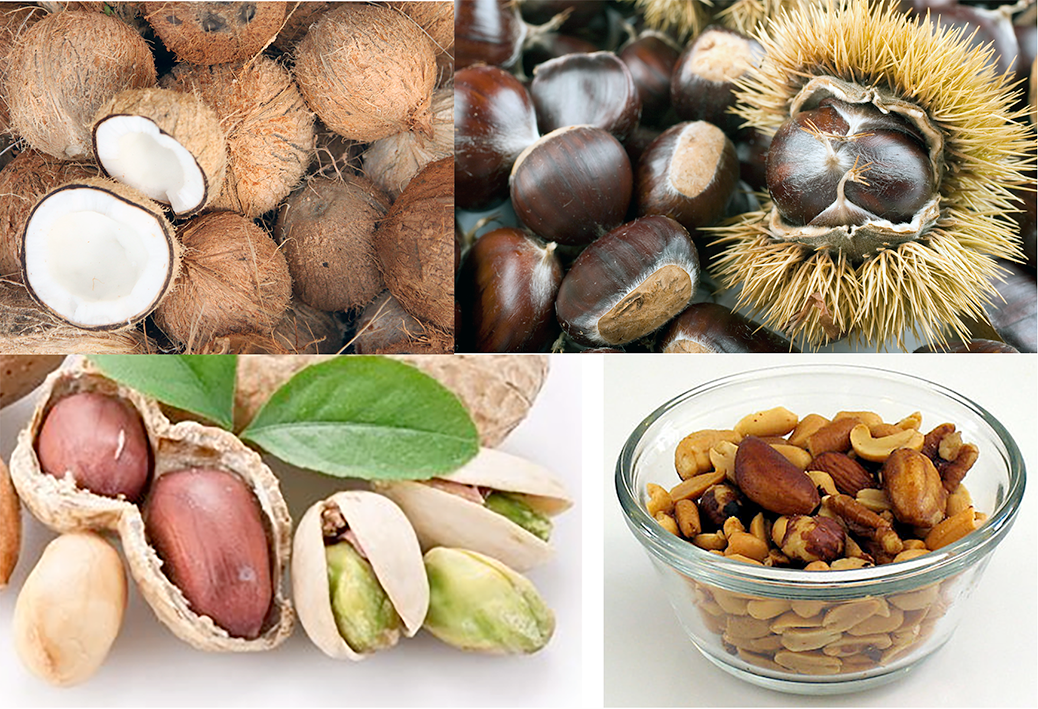 Different nuts. Clockwise: coconuts, sweet chestnuts, bowl of mixed nuts,
peanuts and pistachios.
Welcome to FabulousFusionFood's Nut-based Recipes Page —A nut is a fruit consisting of a hard or tough nutshell protecting a kernel which is usually edible. In general usage and in a culinary sense, many dry seeds are called nuts. In a botanical context, "nut" implies that the shell does not open to release the seed (indehiscent).
Most seeds come from fruit that naturally free themselves from the shell, but this is not the case in nuts such as hazelnuts, chestnuts, and acorns, which have hard shell walls and originate from a compound ovary. The general and original usage of the term is less restrictive, and many nuts (in the culinary sense), such as almonds, pistachios, and Brazil nuts, are not nuts in a botanical sense. Common usage of the term often refers to any hard-walled, edible kernel as a nut. Nuts are an energy-dense and nutrient-rich food source.
Botanically, a nut is a fruit with a woody pericarp developing from a syncarpous gynoecium. True nuts include, for example, chestnut, hazelnut and filbert. Culinarily, the term 'nut' is used much more widely, and includes examples of drupes (such as pecans and almonds) or seeds (such as pine nuts and peanuts).
Also widely known as nuts are dry drupes, which include pecans, almonds, macadamia (Macadamia integrifolia), candlenut (Aleurites moluccanus) and the water caltrop (Trapa bicornis). A drupe is an indehiscent fruit that has an outer fleshy part consisting of the exocarp, or skin, and mesocarp, or flesh, which surround a single pit or stone, the endocarp with a seed (kernel) inside. In a dry drupe, the outer parts dry up and the remaining husk is part of the ovary wall or pericarp, and the hard inner wall surrounding the seed represents the inner part of the pericarp.
Walnuts and hickories (Juglandaceae) have fruit that are difficult to classify. They are considered to be nuts under some definitions but are also referred to as drupaceous nuts.
In common use, a "tree nut" is, as the name implies, any nut coming from a tree. This most often comes up regarding food allergies; a person may be allergic specifically to peanuts (which are not tree nuts but legumes), whereas others may be allergic to the wider range of nuts that grow on trees.
The sweet potato arrived in Europe with the Columbian exchange. It is recorded, for example, in Elinor Fettiplace's Receipt Book, compiled in England in 1604.
Nuts are eaten by humans and wildlife. Because nuts generally have a high oil content, they are a significant energy source. Many seeds are edible by humans and used in cooking, eaten raw, sprouted, or roasted as a snack food, ground to make nut butters, or pressed for oil that is used in cooking and cosmetics.
Nuts used for food are a common source of food allergens. Reactions can range from mild symptoms to severe ones, a condition known as anaphylaxis, which can be life-threatening. The reaction is due to the release of histamine by the body in response to an allergen in the nuts, causing skin and other possible reactions. Many experts suggest that a person with an allergy to peanuts should avoid eating tree nuts, and vice versa.
The nuts linked to from this page are: acorn; almond; beech nuts; betel nut; brazil nut; bush mango; filbert; ginkgo nut; kola nut; candlenut; cashew; chestnut; coconut; hazelnut; macadamia; ogbono; palm nut; peanut; pecan; pine nut; pistachio; walnut.
The alphabetical list of all the nut-based recipes on this site follows, (limited to 100 recipes per page). There are 4553 recipes in total:
Page 28 of 46
| Mortis (Chicken Paté) Origin: Britain | Mulled Wine Cheesecake Origin: Britain | Mutton with Peppers and Chironji Origin: India |
| Mortrews Blank (Meat in White Sauce) Origin: England | Mulled Wine Cheesecake II Origin: Britain | My Lady of Portlandàs Mince Pyes Origin: Britain |
| Mortrews of Fysche (Mortar-paste of Fish) Origin: England | Mulled Wine Yule Stump Cake Origin: Britain | N'Dizi na Kasted (Banana Custard) Origin: Tanzania |
| Mother's Day Simnel Cupcakes Origin: Britain | Mulled Winter Fruit Crumble Origin: Britain | N'dolé (Bitterleaf Stew) Origin: Cameroon |
| Mother-in-law Masala Origin: South Africa | Mulligatawny Soup Origin: Britain | N'dolé avec Poisson (Fish and Bitterleaf Stew) Origin: Gabon |
| Mousakkas (Cypriot Moussaka) Origin: Cyprus | Mulligatawny Soup Origin: Anglo-Indian | N'dolé avec Poulet (Chicken N'Dolé) Origin: Cameroon |
| Mousse à la noix de coco et coulis de mangue (Coconut Mousse and Mango Coulis) Origin: Senegal | Multi-grain Mix Origin: American | Nèkango Karako (Home-made Peanut Paste) Origin: Central African Republic |
| Mouton à l'Arachide (Lamb with Peanuts) Origin: Benin | Mumu Origin: Papua New Guinea | Naatukodi Pulusu (Country Chicken Sour Curry) Origin: India |
| Moyo de Poulet Fume (Moyo of Smoked Chicken) Origin: Benin | Murgh Makhani (Butter Chicken) Origin: India | Nachinyonaya Forel (Stuffed Trout) Origin: Georgia |
| Mozambique Peri-Peri Origin: Mozambique | Murrumbidgee Cake Origin: Australia | Nadan Kozhi Curry Origin: India |
| Mpotompoto (Ghanaian Yam Porridge) Origin: Ghana | Musakhan (Chicken with Sumac and Caramelized Onions) Origin: Jordan | Naeamia bel Dakwa Origin: Sudan |
| Mrs Beeton Braised Neck of Veal Origin: British | Musakhan (Chicken with Sumac and Caramelized Onions) Origin: Lebanon | Nali Sauce (Piri-piri Sauce) Origin: Malawi |
| Mrs Beeton Herodotus Pudding Origin: Britain | Musakhan (Chicken with Sumac and Caramelized Onions) Origin: Palestine | Nam Van Sal Lee (Corn Sago Dessert Soup) Origin: Laos |
| Mrs Beeton's Fish Forcemeat Origin: British | Musakhan (Chicken with Sumac and Caramelized Onions) Origin: Syria | Namibischer Bananenkuchen (Namibian Banana Cake) Origin: Namibia |
| Mrs Black's Plum Pudding Origin: Scotland | Mushroom and Lesser Celandine Stroganoff Origin: Fusion | Nan Mburu Origin: Gambia |
| Mshakiki (Comorian Kebabs) Origin: Comoros | Mushroom Bhaji Origin: Britain | Nanaimo Bars Origin: Canada |
| Mtedza (Peanut Puffs) Origin: Malawi | Mushroom Curry Origin: Britain | Nandji Origin: Mali |
| Mtedza Butter (Peanut Butter) Origin: Malawi | Mushroom Cutlets with Walnut Sauce Origin: British | Nandji de Boeuf (Nandji of Beef) Origin: Cote dIvoire |
| Mtedza Puffs Origin: Malawi | Mushroom Fricassee Origin: American | Nandji Ivorienne Origin: Cote dIvoire |
| Mtedza Stuffing (Peanut Stuffing) Origin: Malawi | Mushroom Masala Origin: India | Nane Flor (Pig's Feet Stew) Origin: Ghana |
| Muamba de Galinha (Chicken Muamba) Origin: Angola | Mushroom Rice Stuffing Origin: American | Nanē Pia (Niuean Porridge) Origin: Niue |
| Muamba Nsusu (Congo Chicken Soup) Origin: Congo | Mushroom Stroganoff Origin: Britain | Naples Bisket Origin: Britain |
| Mudda (Green Banana Dumplings) Origin: Norfolk Island | Mushroom Tacos Origin: Britain | Nasi Goreng Istimewa (Fried Rice Breakfast) Origin: Indonesia |
| Mudda (Green Banana Dumplings) Origin: Pitcairn Islands | Musk Apple Cake Origin: Jewish | Nasi Kuning (Yellow Rice) Origin: Indonesia |
| Mughlai Beef Biriani Origin: India | Mussel Hodi Origin: Sri Lanka | Nasi Lemak Origin: Christmas Island |
| Mughlai Lamb Biriani Origin: India | Mustard Beef with Potato Gratin Origin: Australia | Nasi Lemak Origin: Cocos Islands |
| Muhammara (Hot Pepper Dip) Origin: Lebanon | Mustard Pork Loin Chops with Butternut Squash Roast Origin: Britain | Nasi Lemak Origin: Malaysia |
| Muhammara (Hot Pepper Dip) Origin: Syria | Muttai Kulambu (Tamil Nadu Egg Curry) Origin: India | Nasi Lemak Origin: Singapore |
| Muhammara (Syrian Sweet Pepper Spread) Origin: Syria | Mutton and Coconut Cream Curry Origin: Fusion | Nasturtium Leaf Pesto Origin: Britain |
| Muhogo ya andzi Na nyama (Cassava with Meat) Origin: Mayotte | Mutton Broth Origin: Britain | Nasturtiums with Cream Cheese and Almond Filling Origin: Britain |
| Mukbasa (Yemeni-style Roast Fish) Origin: Djibouti | Mutton Kulambu (Pondicherry Mutton Curry) Origin: India | Nata de Coco (Coconut Water Gel) Origin: Philippines |
| Muland Saangi Ambat (Radish Pod Gravy) Origin: India | Mutton Masala Origin: Sri Lanka | Native Jerk Seasoning Origin: Jamaica |
| Mullangi Sambar (White Radish Sambar) Origin: India | Mutton Rendang Origin: Indonesia | |
| Mulled Mead Origin: Roman | Mutton Rissole Origin: Britain |
Page 28 of 46