FabulousFusionFood's Nut-based Recipes 27th Page
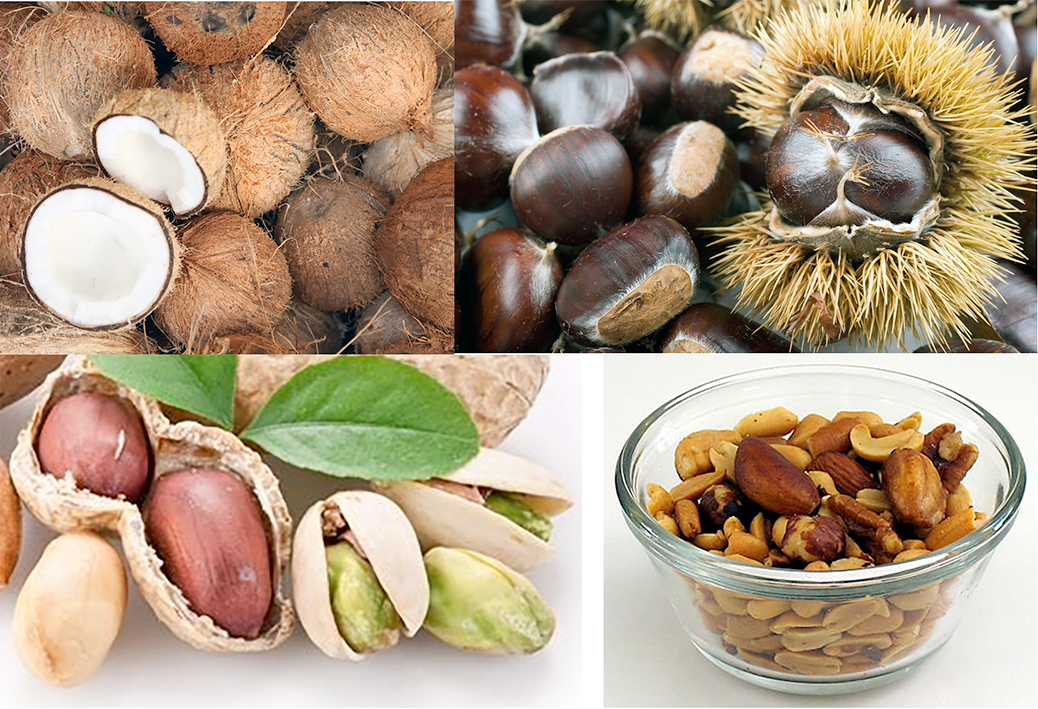 Different nuts. Clockwise: coconuts, sweet chestnuts, bowl of mixed nuts,
peanuts and pistachios.
Welcome to FabulousFusionFood's Nut-based Recipes Page —A nut is a fruit consisting of a hard or tough nutshell protecting a kernel which is usually edible. In general usage and in a culinary sense, many dry seeds are called nuts. In a botanical context, "nut" implies that the shell does not open to release the seed (indehiscent).
Most seeds come from fruit that naturally free themselves from the shell, but this is not the case in nuts such as hazelnuts, chestnuts, and acorns, which have hard shell walls and originate from a compound ovary. The general and original usage of the term is less restrictive, and many nuts (in the culinary sense), such as almonds, pistachios, and Brazil nuts, are not nuts in a botanical sense. Common usage of the term often refers to any hard-walled, edible kernel as a nut. Nuts are an energy-dense and nutrient-rich food source.
Botanically, a nut is a fruit with a woody pericarp developing from a syncarpous gynoecium. True nuts include, for example, chestnut, hazelnut and filbert. Culinarily, the term 'nut' is used much more widely, and includes examples of drupes (such as pecans and almonds) or seeds (such as pine nuts and peanuts).
Also widely known as nuts are dry drupes, which include pecans, almonds, macadamia (Macadamia integrifolia), candlenut (Aleurites moluccanus) and the water caltrop (Trapa bicornis). A drupe is an indehiscent fruit that has an outer fleshy part consisting of the exocarp, or skin, and mesocarp, or flesh, which surround a single pit or stone, the endocarp with a seed (kernel) inside. In a dry drupe, the outer parts dry up and the remaining husk is part of the ovary wall or pericarp, and the hard inner wall surrounding the seed represents the inner part of the pericarp.
Walnuts and hickories (Juglandaceae) have fruit that are difficult to classify. They are considered to be nuts under some definitions but are also referred to as drupaceous nuts.
In common use, a "tree nut" is, as the name implies, any nut coming from a tree. This most often comes up regarding food allergies; a person may be allergic specifically to peanuts (which are not tree nuts but legumes), whereas others may be allergic to the wider range of nuts that grow on trees.
The sweet potato arrived in Europe with the Columbian exchange. It is recorded, for example, in Elinor Fettiplace's Receipt Book, compiled in England in 1604.
Nuts are eaten by humans and wildlife. Because nuts generally have a high oil content, they are a significant energy source. Many seeds are edible by humans and used in cooking, eaten raw, sprouted, or roasted as a snack food, ground to make nut butters, or pressed for oil that is used in cooking and cosmetics.
Nuts used for food are a common source of food allergens. Reactions can range from mild symptoms to severe ones, a condition known as anaphylaxis, which can be life-threatening. The reaction is due to the release of histamine by the body in response to an allergen in the nuts, causing skin and other possible reactions. Many experts suggest that a person with an allergy to peanuts should avoid eating tree nuts, and vice versa.
The nuts linked to from this page are: acorn; almond; beech nuts; betel nut; brazil nut; bush mango; filbert; ginkgo nut; kola nut; candlenut; cashew; chestnut; coconut; hazelnut; macadamia; ogbono; palm nut; peanut; pecan; pine nut; pistachio; walnut.
The alphabetical list of all the nut-based recipes on this site follows, (limited to 100 recipes per page). There are 4134 recipes in total:
Page 27 of 42
| Nettle, Squash and Almond Curry Origin: Britain | Njahi in Coconut Sauce (Kenyan Black Beans in Coconut Sauce) Origin: Kenya | Nyembwe Sauce Origin: Gabon |
| Neujahrspretzel (German New Year's Pretzels) Origin: Germany | Njandu Curry (Kerala Crab Curry) Origin: India | Nyete Greens with Peanut Butter Origin: South Sudan |
| Nevis Jerk Marinade Origin: Saint Kitts | Nkatenkwan (Ghanaian Peanut Soup) Origin: Ghana | Nyona Penang Assam Laska Origin: Malaysia |
| New Caledonian Raw Fish Salad Origin: New Caledonia | Nnam Owondo Origin: Cameroon | Nyonya Curry Paste Origin: Singapore |
| New Orleans Black Muffins Origin: American | No Bake Cheesecake Origin: Britain | Nyonya-style Curry with Eggs Origin: Malaysia |
| New Orleans Style Pumpkin Pie Origin: South Africa | No Crust Easter Pie Origin: American | Nyponsoppa (Wild Rosehip Soup) Origin: Sweden |
| New Zealand Beef Curry Origin: New Zealand | No-bake Peanut Butter Flapjack Origin: Britain | Oarweed Chips Origin: Britain |
| New Zealand Chicken Curry Origin: New Zealand | Noix de Coco Caramélisée (Caramelized Coconut) Origin: Cameroon | Oat Mittai with Fruit and Nuts Origin: India |
| New Zealand Coconut Lamb Curry with Cashews Origin: New Zealand | Nom Banh Chok Origin: Cambodia | Oatmeal Bilberry Bread Origin: Northern Ireland |
| New Zealand Norfolk Fruit Chutney Origin: New Zealand | Non-alcoholic Glögg Origin: Sweden | Oatmeal Chocolate Smoothie Origin: American |
| Ngege with Peanut Sauce (Tilapia with Peanut Sauce) Origin: East Africa | Noodle Curry Paste Origin: Laos | Oatmeal Posset Origin: Scotland |
| Ngukassa (Plantain Soup) Origin: Central African Republic | Nori-wrapped Mochiko Chicken Origin: Hawaii | Obe Ata (Nigerian Pepper Soup) Origin: Nigeria |
| Ngunza et Boule de Manioc (Ngunza and Cassava Balls) Origin: Central African Republic | Nori-wrapped Mochiko Pork Origin: Hawaii | Obe Eja Dindin (Fried Fish Stew) Origin: Nigeria |
| Nhangana com Coco (Cowpea Leaves with Coconuts) Origin: Mozambique | Normandy Cheesecake Origin: Britain | Obe Eja Tutu (Fresh Fish Stew) Origin: Nigeria |
| Nhopi (Maize Meal with Pumpkin) Origin: Zimbabwe | North Indian Garam Masala Origin: India | Ocopa de Camarones (Prawn Ocopa) Origin: Peru |
| Nhopi (Corn Meal with Pumpkin) Origin: Zimbabwe | North-Africa Style Breast of Lamb Origin: Fusion | Ofio Drink (Tiger Nut Drink) Origin: Nigeria |
| Nhopi Dovi (Pumpkin with Groundnut Sauce) Origin: Zimbabwe | Noteye (Nutty) Origin: England | Ogbono Soup Origin: Nigeria |
| Nigerian Catfish Stew Origin: Nigeria | Nougat d'Arachide (Peanut Nougat) Origin: Togo | Ogbono Soup with Ugwu Origin: Nigeria |
| Nigerian Chicken Stew Origin: Nigeria | Nougat de Montélimar Origin: France | Ogbono Soup with Waterleaf Origin: Nigeria |
| Nigerian Goat Stew Origin: Nigeria | Nougat Glacé (Iced Nougat) Origin: France | Ohn Htamin (Burmese Coconut Rice) Origin: Myanmar |
| Nigerian Groundnut Soup Origin: Nigeria | Nougat Traditionelle (Traditional Nougat) Origin: France | Ohn-No Khaukswe (Coconut Noodles) Origin: Myanmar |
| Nigerian Guinea Fowl Stew Origin: Nigeria | Nowmbyls of Muskyls (Mussels in Almond Milk Sauce) Origin: England | Oil-based Flapjacks Origin: Britain |
| Nigerian Guineafowl Pepper Soup Origin: Nigeria | Nuernberger Rostbratwuerste (Nuremberg Grilled Sausage) Origin: Germany | Oka Popo (Samoan Raw Fish) Origin: Samoa |
| Nigerian Pancakes with Prawns Origin: Nigeria | Num Banh Choc (Rice Noodle Fish Soup) Origin: Cambodia | Oka Popo (Samoan Raw Fish) Origin: American Samoa |
| Nigerian Pancakes with Suya-spiced Tofu Scramble Origin: Nigeria | Nước Cốt Dừa (Coconut Milk Sauce) Origin: Vietnam | Okok (Eru Leaf Stew) Origin: Cameroon |
| Nigerian Peanut Fool Origin: Nigeria | Nusszopf (German Nut Braid with Marzipan) Origin: Namibia | Okpa (Bambara Groundnut Breakfast Pudding) Origin: Nigeria |
| Nigerian Pepper Soup Spices Origin: Nigeria | Nut Cutlet Origin: British | Okra Relish Origin: Tanzania |
| Nigerian Spicy Scrambled Eggs Origin: Nigeria | Nut-topped Sticky Toffee Pudding Origin: Britain | Olan Origin: India |
| Nigerian-style Spaghetti Origin: Nigeria | Nutella Swirl Banana Muffins Origin: Britain | Old Bay Seasoning Mix Origin: American |
| Nihari Masala Origin: India | Nutty Fridge Cake Origin: American | Old Fashioned Carrot Pudding Origin: Britain |
| Nila Bumbu Acar (Sour Spicy Carp) Origin: Indonesia | Nutty Moroccan Couscous Origin: Morocco | Olio di Peperoncino (Chilli Oil) Origin: Italy |
| Nilgiri Chicken Korma Origin: India | Nutty Rice Burgers Origin: Britain | Oluwombo Origin: Uganda |
| Nimino de Peixe (Nimino of Fish) Origin: Mozambique | Nyaba Origin: Sudan | |
| Niter Kebbeh (Spiced Ghee) Origin: Ethiopia | Nyeleng (Beef and Peanut Gumbo) Origin: Senegal |
Page 27 of 42