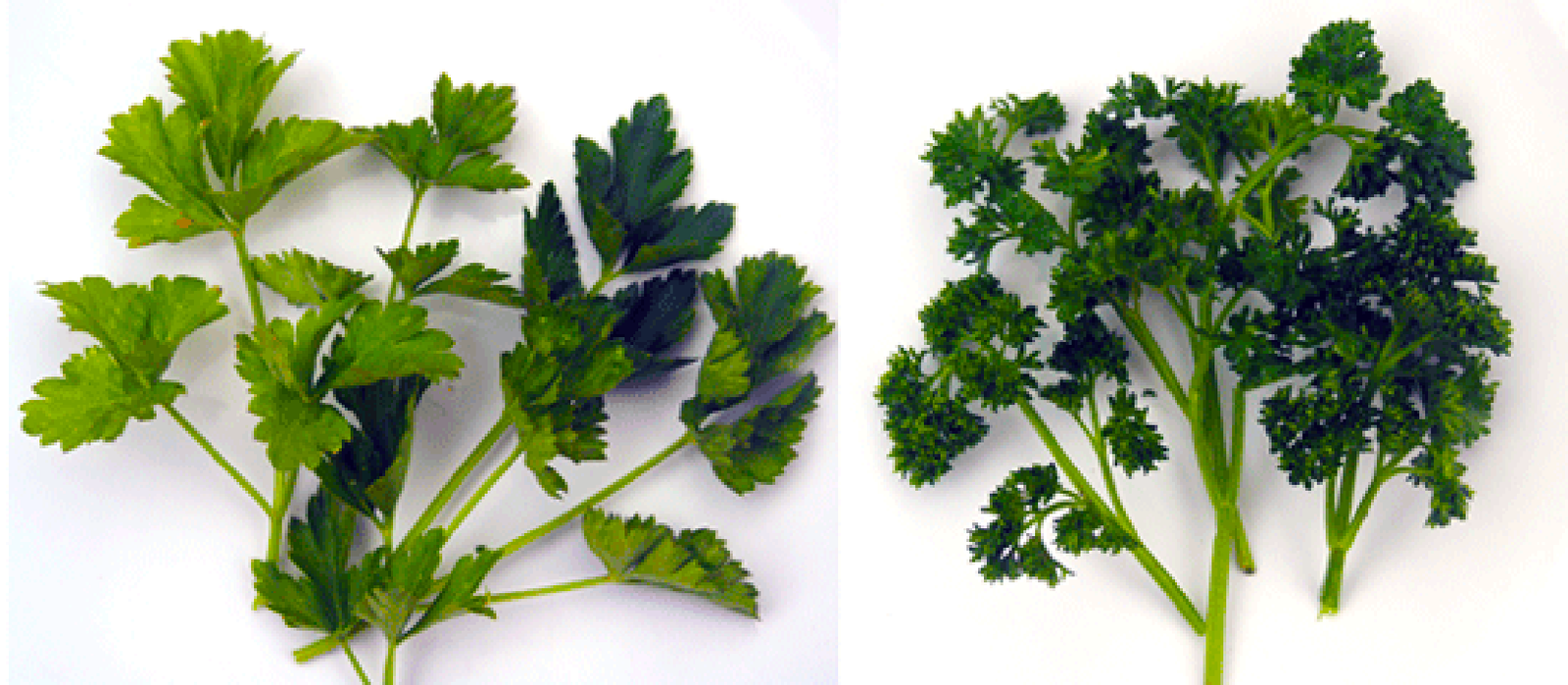
 Sprigs of flat leaf
parsley
Petroselinum
crispum var
neapolitanum
and curly parsley
Petroselinum
crispum var
crispum.
Sprigs of flat leaf
parsley
Petroselinum
crispum var
neapolitanum
and curly parsley
Petroselinum
crispum var
crispum.
Welcome to the summary page for FabulousFusionFood's Herb guide to Parsley along with all the Parsley containing recipes presented on this site, with 1797 recipes in total.
This is a continuation of an entire series of pages that will, I hope, allow my visitors to better navigate this site. As well as displaying recipes by name, country and region of origin I am now planning a whole series of pages where recipes can be located by meal type and main ingredient. This page gives information about Parsley and a listing of all the Parsley-based recipes added to this site.
These recipes, all contain Parsley as a major herb flavouring.
There are two main types of parsley used in cooking: Flat-leaf of Italian parsley Petroselinum crispum var neapolitanum (image, left) and curly-leaf parsley, Petroselinum crispum var crispum both being members of the Apiaceae (carrot) family. Both forms are used and grown as pot-herbs.
Garden parsley is a bright green hairless biennial herbaceous plant in temperate climates, an annual herb in sub-tropical and tropical areas. Where it grows as a biennial; in the first year, it forms a rosette of tripinnate leaves 10–25 cm long with numerous 1–3 cm leaflets, and a taproot used as a food store over the winter. In the second year it grows a flowering stem to 75 cm tall with sparser leaves and flat-topped 3–10 cm diameter umbels with numerous 2 mm diameter yellow to yellowish-green flowers. The seeds are ovoid, 2–3mm long, with prominent style remnants at the apex. The plant typically dies away after the seed is set. As a result, to ensure a continuous crop, parsley should be sown every year.
The flat-leaf variety of parsley (Petroselinum crispum var neapolitanum) is the closest in form to the wild parent plant. It is also preferred by many as it's easier to cultivate than the curly-leaf variety. Though the curly-leaf variety is preferred by others as it's far more decorative. Typically, also, flat-leaf parsley has a stronger flavour (see the next paragraph on the essential oils). There is a third type of parsley, Petroselinum crispum var tuberosum that is grown for its tuberous root (which looks like a miniature parsnip) and is commonly used in the cuisines of central and eastern Europe.
Parsley has a very distinctive aroma that is present in all parts of the plant (but is strongest in the root). The essential oils of the leaves have myristicin, limonene and 1,3,8-p-menthatriene as their main components. Monoterpenes and sesquiterpenes are also present as minor components. Interestingly the curly-leaf variety has an essential oil that is richer in myristicin, but typically contains much less essential oil than the flat-leaf variety. It should be noted that parsley should not be consumed in excess by pregnant women. It is safe in normal food quantities, but large amounts can have uterotonic effects
The English name, parsley derives from the classical Latin Petroselinum (literally meanint parsley and which is also the genus name of the plant), which, itself, derives from the Greek petroselinon [πετροσέλινον] (parsley). The Greek name being derived from the components petros [πέτρος] (rock, stone) and selinon [σέλινον] (celery). Thus parsley was 'the celery that grows on rocks'.
Flat-leaf parsley generally has a stronger flavour due to the higher levels of essential oils in the leaves. As a result flat-leaf parsley can be used either as a garnish or during cooking. Curly-leaf parsley is used almost exclusively as a garnish for fish dishes, apart from in the cuisines of West Africa where it is pounded with chillies, spices, garlic and onions to be used as a rub and marinade for fish.
Parsley is considered one of the four 'fines herbes' of French cuisine (along with tarragon, chervil and chives). It is one of the most commonly-employed herbs world-wide. The list of recipes below only gives those recipes for which parsley is a major component. The link given here lists all the parsley-associated recipes on this site. Please note that the list is extensive, with over 2100 recipes given in all.
This is a continuation of an entire series of pages that will, I hope, allow my visitors to better navigate this site. As well as displaying recipes by name, country and region of origin I am now planning a whole series of pages where recipes can be located by meal type and main ingredient. This page gives information about Parsley and a listing of all the Parsley-based recipes added to this site.
These recipes, all contain Parsley as a major herb flavouring.
There are two main types of parsley used in cooking: Flat-leaf of Italian parsley Petroselinum crispum var neapolitanum (image, left) and curly-leaf parsley, Petroselinum crispum var crispum both being members of the Apiaceae (carrot) family. Both forms are used and grown as pot-herbs.
Garden parsley is a bright green hairless biennial herbaceous plant in temperate climates, an annual herb in sub-tropical and tropical areas. Where it grows as a biennial; in the first year, it forms a rosette of tripinnate leaves 10–25 cm long with numerous 1–3 cm leaflets, and a taproot used as a food store over the winter. In the second year it grows a flowering stem to 75 cm tall with sparser leaves and flat-topped 3–10 cm diameter umbels with numerous 2 mm diameter yellow to yellowish-green flowers. The seeds are ovoid, 2–3mm long, with prominent style remnants at the apex. The plant typically dies away after the seed is set. As a result, to ensure a continuous crop, parsley should be sown every year.
The flat-leaf variety of parsley (Petroselinum crispum var neapolitanum) is the closest in form to the wild parent plant. It is also preferred by many as it's easier to cultivate than the curly-leaf variety. Though the curly-leaf variety is preferred by others as it's far more decorative. Typically, also, flat-leaf parsley has a stronger flavour (see the next paragraph on the essential oils). There is a third type of parsley, Petroselinum crispum var tuberosum that is grown for its tuberous root (which looks like a miniature parsnip) and is commonly used in the cuisines of central and eastern Europe.
Parsley has a very distinctive aroma that is present in all parts of the plant (but is strongest in the root). The essential oils of the leaves have myristicin, limonene and 1,3,8-p-menthatriene as their main components. Monoterpenes and sesquiterpenes are also present as minor components. Interestingly the curly-leaf variety has an essential oil that is richer in myristicin, but typically contains much less essential oil than the flat-leaf variety. It should be noted that parsley should not be consumed in excess by pregnant women. It is safe in normal food quantities, but large amounts can have uterotonic effects
The English name, parsley derives from the classical Latin Petroselinum (literally meanint parsley and which is also the genus name of the plant), which, itself, derives from the Greek petroselinon [πετροσέλινον] (parsley). The Greek name being derived from the components petros [πέτρος] (rock, stone) and selinon [σέλινον] (celery). Thus parsley was 'the celery that grows on rocks'.
Flat-leaf parsley generally has a stronger flavour due to the higher levels of essential oils in the leaves. As a result flat-leaf parsley can be used either as a garnish or during cooking. Curly-leaf parsley is used almost exclusively as a garnish for fish dishes, apart from in the cuisines of West Africa where it is pounded with chillies, spices, garlic and onions to be used as a rub and marinade for fish.
Parsley is considered one of the four 'fines herbes' of French cuisine (along with tarragon, chervil and chives). It is one of the most commonly-employed herbs world-wide. The list of recipes below only gives those recipes for which parsley is a major component. The link given here lists all the parsley-associated recipes on this site. Please note that the list is extensive, with over 2100 recipes given in all.
The alphabetical list of all Parsley recipes on this site follows, (limited to 100 recipes per page). There are 1797 recipes in total:
Page 1 of 18
| A Common Batter Origin: British | Albóndigas con Tomate (Meatballs with Tomato Sauce) Origin: Spain | Arroz con Camarón (Rice with Prawns) Origin: Ecuador |
| A forced cabbage Origin: British | Albóndigas al curry (Curried meatballs) Origin: Spain | Arroz Con Pollo (Costa Rican Arroz con Pollo) Origin: Costa Rica |
| A Quickly-made Gravy Origin: British | Aliter Assaturas (Another Sauce for Roast Meat) Origin: Roman | Arroz Con Pollo Panameño (Panamanian Arroz con Pollo) Origin: Panama |
| A ragoo of oysters Origin: British | Aliter assaturas (Roast Meats, Another Way) Origin: Roman | Artichauts camus sauce bretonne (Camus artichokes with Breton sauce) Origin: France |
| A Substitute for Caper Sauce Origin: British | Aliter Haedum sive Agnum Assum (Roast Kid or Lamb, Another Way) Origin: Roman | Artichokes à la Barigoulle Origin: British |
| A Tansie for Lent Origin: England | Aliter in cervum assum iura ferventia (Plum Sauce for Venison) Origin: Roman | Aruba Green Seasoning Origin: Aruba |
| A Third Salamongundy Origin: British | Aliter in Elixis Palumbis sive Columbis (Sauce for Boiled Wood Pigeons and Doves) Origin: Roman | Aruban Curry Chicken Origin: Aruba |
| Abadejo a la Pimienta Verde (Pollock with Green Pepper) Origin: Spain | Aliter in Palumbis sive Columbis (Sauce for Boiled Wood Pigeons and Doves, Another Way) Origin: Roman | Aruk Khass (Lettuce Fritters) Origin: Iraq |
| Abbacchio alla scottadito (Barbecued Milk-fed Lamb Chops) Origin: Vatican City | Aliter Ius in Avibus (Sauce for Birds, Another Way) Origin: Roman | Asado de Tenera (Roast Veal) Origin: Spain |
| Abbachio al Forno (Italian Roast Baby Lamb) Origin: Italy | Aliter Laseratum (Another Hing Sauce) Origin: Roman | Ascot Pie Origin: England |
| Accras de Morue Origin: French Guiana | Aliter Phoenicoptero (Flamingo, Another Way) Origin: Roman | Ash Reshteh (Persian Noodle Soup with Beans) Origin: Iran |
| Accras de Morue (Salt Cod Fritters) Origin: Saint Barthelemy | Almejas à la Marinera (Marinated Clams) Origin: Spain | Ashanti Chicken Origin: Ghana |
| Accras de Morue (Salt Cod Fritters) Origin: Sint Maarten | Almejas à la Naranja (Clams with Orange Sauce) Origin: Spain | Asheh Mast (Persian Herb and Yoghurt Soup) Origin: Iran |
| Accras de Morue (Salt Cod Fritters) Origin: Saint-Martin | Alubias Blancas Con Almejas (White Beans with Clams) Origin: Spain | Asparagus à la Polonaise Origin: Britain |
| Adana Kebab Origin: Turkey | Alubias blancas con calamar y aceite de romero (White Beans with Squid and Rosemary Oil) Origin: Spain | Asparagus and Crab Strata Origin: Britain |
| Adana Kebap Origin: Turkey | Améijoas (Clams in Beer) Origin: Mozambique | Asparagus and Morel Bread Pudding Origin: America |
| Adenydd Cath Fôr gyda Saws Tartar Cyflym (Fried Skate Wings with Quick Home-made Tartar Sauce) Origin: Welsh | Amiwo au Poulet (Chicken Amiwo) Origin: Benin | Asparagus Frittata Origin: Britain |
| Admiral Sauce Origin: Britain | Andorran Meatballs Origin: Andorra | Asparagus in Egg Sauce Origin: Britain |
| Advieh-spiced Persian Meatballs Origin: Iran | Anginares me Avgolemono (Artichokes with Egg and Lemon Sauce) Origin: Cyprus | Asparagus Salad Origin: Britain |
| African All Purpose Seasoning Origin: Nigeria | Anginares Yemistes (Stuffed Artichokes) Origin: Cyprus | Asparagus Sauce Origin: British |
| African Chicken (Macanese One-pan Chicken Curry) Origin: Macau | Anguilla Green Seasoning Origin: Anguilla | Aspic Jelly Origin: Britain |
| Ailes de raie sauce au beurre noir (Skate wings with black butter sauce) Origin: France | Anguillan Saltfish Origin: Anguilla | Assaisonnement Vert (Guianan Green Seasoning) Origin: French Guiana |
| Air Fried Beef Brisket Origin: Britain | Anna Potatoes Origin: Britain | Assaturas in collare (Of Roast Neck) Origin: Roman |
| Air Fryer Baby Potatoes Origin: Britain | Another way to fricasey tripe Origin: British | Atún Imperial (Imperial Tuna) Origin: Peru |
| Air Fryer Baked Eggs Origin: Britain | Antiguan Green Seasoning Origin: Antigua | Australian Camel Stew Origin: Australia |
| Air Fryer Beef Wellington Origin: Britain | Antiguan Jerk Seasoning Origin: Antigua | Avgolemono (Egg and Lemon Soup) Origin: Greece |
| Air Fryer Chicken Kiyiv Origin: Britain | Antipasto Rice Origin: Italy | Avocado Leaf Chimichurri Origin: Fusion |
| Air Fryer Hasselback Potatoes Origin: Britain | Apple and Peanut Butter Soup Origin: American | Avocado Leaf Flavoured Pickle Origin: Fusion |
| Air Fryer Quesadillas Origin: Britain | Arancini di Riso (Rice 'Oranges') Origin: Italy | Béchamel Maigre Origin: British |
| Air Fryer Sweet Potato Wedges Origin: Britain | Arjoli Dip Origin: Malta | Béchamel Sauce Origin: British |
| Air Fryer White Fish Origin: Britain | Armjanskij sup chechevicy (Armenian Lentil Soup) Origin: Armenia | Baba Ghanoush Origin: Iraq |
| Al Machboos (Emirati Spiced Rice With Chicken) Origin: UAE | Aros di Koko (Coconut Rice) Origin: Dominica | Baba Ghanoush Origin: Egypt |
| Al Mechoui (Spit-roasted Baby Lamb) Origin: Mauritania | Arran Potato Salad Origin: Scotland | |
| Al Mechoui (Spit-roasted Baby Lamb) Origin: Western Sahara | Arroz con Calamares (Rice with Squid) Origin: Spain |
Page 1 of 18