FabulousFusionFood's Ungulate-based Recipes 28th Page
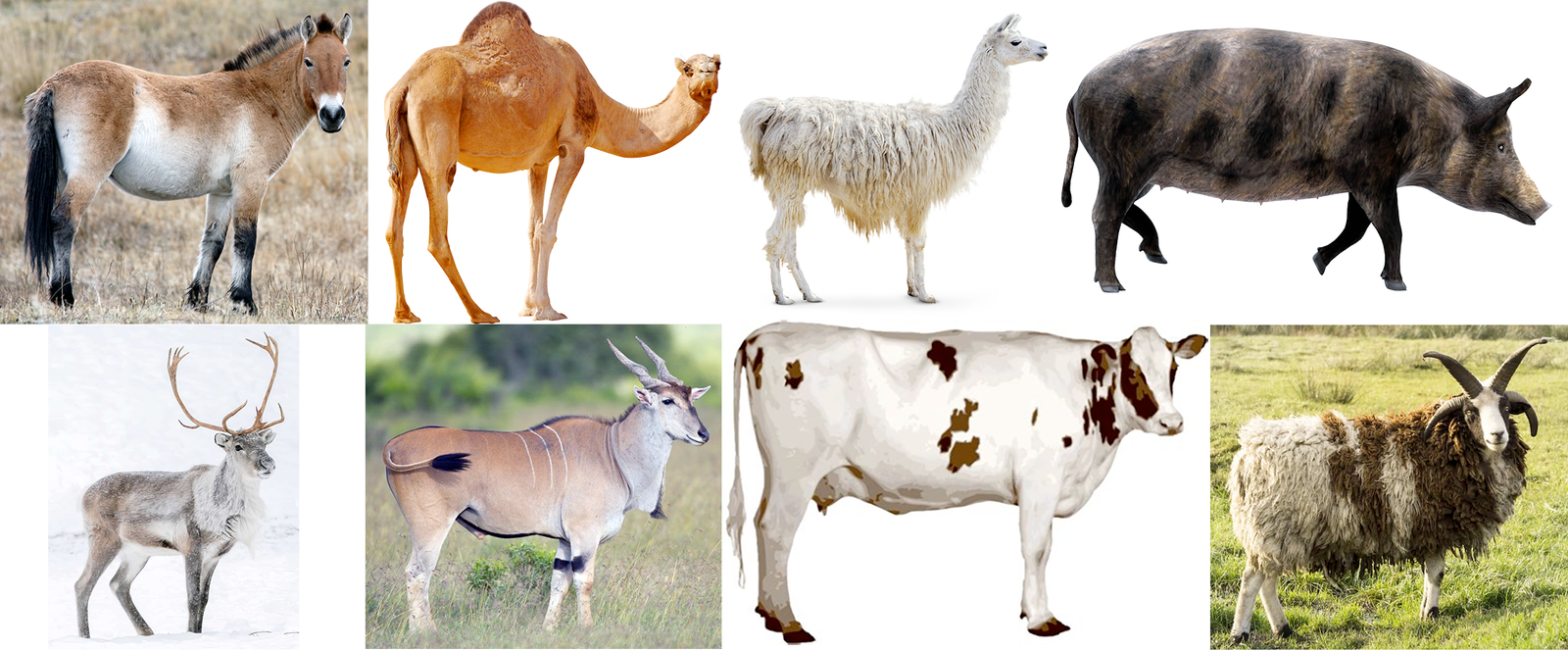 Commonly farmed ungulates. Top: horse, camel, llama, pig. Right: reindeer, eland, cow, sheep.
Welcome to FabulousFusionFood's Ungulate-based Recipes Page — The recipes presented here are all based on ungulate-derived meats as an ingredient. Ungulates are defined as animals that walk on their (usually horned) toes. They are often (indeed typically) herd animals and commonly the most frequently domesticated for food. After a formal re-classification these animals are now part of the clade Euungulata ('true ungulates'), which primarily consists of large mammals with hooves (apart from cetaceans, dolphins and whales which are related to hippopotami and represent some of the most recent members of the group). The oldest surviving members of Euungulata are the horses, tapir (which are eaten as game) and rhinoceri. Next come the camels and llamas, followed by pigs and peccaries. The next group is probably the biggest in terms of both farmed and game animals and includes all ruminants, the North American pronghorn, giraffes, true deer, cows (bovids), sheep and goats and true antelopes. Finally we have the hippopotami and cetaceans.
Horses are domesticated and in come cultures they are eaten. Camels are not truly known in the wild, though there are feral examples and they are farmed for riding, milk and for meat. Of the South American camelids, the guanaco and vicuña are wild and the llama, alpaca, and chilihueque are domesticated. In pre-Columbian south America they were as a mix of camel and sheep (beasts of burden, for their wool and their meat). Pigs are unusual amongst ungulates in being omnivorous. Pigs were domesticated in the Neolithic, both in East Asia and in the Near East (they are attested in Cyprus 11 400 years ago and in China 8000 years ago). When domesticated pigs arrived in Europe, they extensively interbred with wild boar but retained their domesticated features.
Deer, long hunted for game have been domesticated and are now farmed; though in truth only reindeer have really been partly domesticated. Other deer species are more accurately ranched. This includes elk, moose, red deer, roe deer and white-tailed deer. The same is true for South African antelopes (which systematically are classed with cattle as bovids). Elands have proven susceptible to true domestication and are farmed in the Ukraine and Zimbabwe. In South Africa, the gemsbok, kudu and springbok have been brought into ranch farming and their meats are widely available commercially.
In evolutionary terms, domestic cows (European Cattle, Asian Cattle, Buffalo and yak) are closely related to sheep and goats (which are sufficiently closely related to one another that they can form hybrids). Apart from pigs, these remain the most widely and intensively farmed species.
The alphabetical list of all the ungulate-based recipes on this site follows, (limited to 100 recipes per page). There are 2800 recipes in total:
Page 28 of 29
| Varenga (Roast, Shredded, Beef) Origin: Madagascar | Vulvae [et] Steriles (Sterile Sow's Womb) Origin: Roman | Yambo Origin: Aruba |
| Vary Amin'anana (Rice with Greens and Minced Beef) Origin: Madagascar | Vulvam ut Tostam (Grilled Sterile Sow's Womb) Origin: Roman | Yaprak Sarmasi (Vine Leaf Rolls) Origin: Turkey |
| Vary Amin'Anana (Hot Pepper Beef) Origin: Madagascar | Vulvulae Isiciatae (Forcemeat for Sow's Womb) Origin: Roman | Yaroa Dominicana Origin: Dominican Republic |
| Veal or Mutton Gravy Origin: Britain | Vyne Grace Origin: England | Yarpakh Dolmasy (Vine Leaves Stuffed with Lamb and Rice) Origin: Azerbaijan |
| Vegetarian Quiche Origin: Britain | Wastels yfarced (White Bread, Stuffed) Origin: England | Yebeh (White Yam Porridge) Origin: Sierra Leone |
| Venison Bredie Origin: Scotland | West African Meat Kebabs Origin: West Africa | Yiouvetsi (Oven-baked Orzo with Lamb) Origin: Cyprus |
| Venison Liver Pâté Origin: Britain | West African Roast Lamb Origin: West Africa | Yoghurt Lamb Steaks with Minted Yoghurt Origin: Britain |
| Venison, Potato and Mushroom Stew Origin: Britain | Westmoreland Cure for Sweet Hams Origin: Britain | Youvarlakia Soupa Avgolemono (Meatball Soup with Egg and Lemon) Origin: Greece |
| Ventrem Plenum (Stuffed Pig's Stomach) Origin: Roman | Wet Fry Pork, Kenyan Style Origin: Kenya | Ysgwydd Cig Oen Cymreig wedi ei bobi'n araf â chyri (Slow-cooked curried shoulder of Welsh Lamb) Origin: Welsh |
| Vepřo Knedlo Zelo (Pork with Sauerkraut and Bread Dumplings) Origin: Czech | Wet Thar Hin (Pork Curry) Origin: Myanmar | Ysgwydd Oen Mewn Dull Gwledig (Rustic Lamb Shoulder Roast) Origin: Welsh |
| Veprove S Krenem (Piquant Pork with Horseradish) Origin: Russia | Wethani Kyet (Dry Burmese Pork Curry) Origin: Myanmar | Yuca con Chicharrón (Cassava with Pork Crackling) Origin: El Salvador |
| Vereshchaka (Pork and Beetroot Casserole) Origin: Russia | Wethani Kyet II (Dry Burmese Pork Curry II) Origin: Myanmar | Yuk Gae Jang (Spicy Beef and Vegetable Soup) Origin: Korea |
| Vermicelles (Vermicelli) Origin: Mauritania | Whisky Cream Sauce Origin: Scotland | Zürcher Eintopf (Zürich Style Hotpot) Origin: Switzerland |
| Viande Nyembwe (Meat Nyembwe) Origin: Gabon | White Curry Origin: Fusion | Zürcher Geschnetzeltes (Cut Meat, Zürich Style) Origin: Switzerland |
| Victorian Beef Kofta Curry Origin: Anglo-Indian | Whole Chicken Soup Origin: China | Z'habitants (Martinique Callaloo) Origin: Martinique |
| Victorian Beef Tikka Kebab Origin: Anglo-Indian | Whole Meat Mould Origin: England | Zafrani Mutton Korma Origin: Pakistan |
| Victorian Beef Vindaloo Origin: Anglo-Indian | Wie man zerwúlawirstlach machen soll (How one should make Saveloy) Origin: Germany | Zahtar-spiced Barbecued Goat Origin: Jordan |
| Victorian Chicken Pilau Origin: Anglo-Indian | Wieprozowina w Smietanie (Baked Pork Chops in Sour Cream) Origin: Poland | Zahtar-spiced Barbecued Mutton Origin: Jordan |
| Victorian Pickled Vindaloo Origin: Anglo-Indian | Wild Mustard Greens with Ham Hocks Origin: American | Zalatina (Pork in Lemon and Vinegar Jelly) Origin: Cyprus |
| Vietnamese Pho Origin: Vietnam | Willowherb Bubble and Squeak Origin: Britain | Zalzett Malti (Maltese Sausages) Origin: Malta |
| Vindaloush with Fungee Origin: Caribbean | Wonchoi Origin: Ghana | Zaphulis Tolma (Stuffed Summer Vegetables) Origin: Azerbaijan |
| Vine Leaves Stuffed with Fennel, Salami and Eggs Origin: Albania | Wonton Soup Origin: China | Zelka Mandza (Macedonian Cabbage Stew) Origin: North Macedonia |
| Vinthaleaux Origin: India | Wontons Origin: China | Zigni (Eritrean Spiced Meat Stew) Origin: Eritrea |
| Virgin Bull Cocktail Origin: Non-alcoholic | Wors in Creamy Mushroom Sauce Origin: Namibia | Zimbabwean Sorpotel Origin: Zimbabwe |
| Virgin Islands Pates Origin: British Virgin Islands | Wouré Burakhè Magilinri (Sweet Potato Leaf Sauce) Origin: Guinea | Zoldbableves (French Bean Soup) Origin: Hungary |
| Virgin Islands Pates Origin: US Virgin Islands | Wu Hua Rou (Five-flower Pork) Origin: China | Zom (Bitter Greens with Meat) Origin: Cameroon |
| Vitellina Fricta (Fried Veal) Origin: Roman | Xarba Arbija (Libyan Soup) Origin: Libya | Zupa Chrzanowa (Polish Horseradish Soup) Origin: Poland |
| Vitulinam sive Bubulam cum Porris (Veal or Beef with Leeks) Origin: Roman | Xavier Steak Origin: American | Zuppa Paradiso (Paradise Soup) Origin: Italy |
| Vodhino Casarolas (Roast Beef Casserole) Origin: Cyprus | Xerem de Festa (A Feast Dish) Origin: Cape Verde | Zuppa Pavese (Pavia Soup) Origin: Italy |
| Vodhino Rosto me Saltsa Tomata (Beef and Tomato Pot Roast) Origin: Cyprus | Xinjiang Lamb Casserole Origin: China | Zurbiyaan Origin: Yemen |
| Vodhino Stfadho (Grilled Pork Cutlets) Origin: Cyprus | Xinjiang Lamb Skewers Origin: Fusion | Zürchner Geschnetzeltes (Zurich-style Ragout) Origin: Switzerland |
| Vryonoye Miaso Po-Russki (Boiled Beef Russian Style) Origin: Russia | Yétissé de Chèvre (Yétissé of Goat) Origin: Guinea | Žuvies kukuliai (Fish Dumplings) Origin: Lithuania |
| Vulvae Steriles (Sterile Sows' Wombs) Origin: Roman | Yakisoba Origin: Japan | |
| Vulvae [et] Steriles (Sterile Sow's Womb) Origin: Roman | Yala Çorbası (Yoghurt Soup) Origin: Turkey |
Page 28 of 29