FabulousFusionFood's Ungulate-based Recipes 24th Page
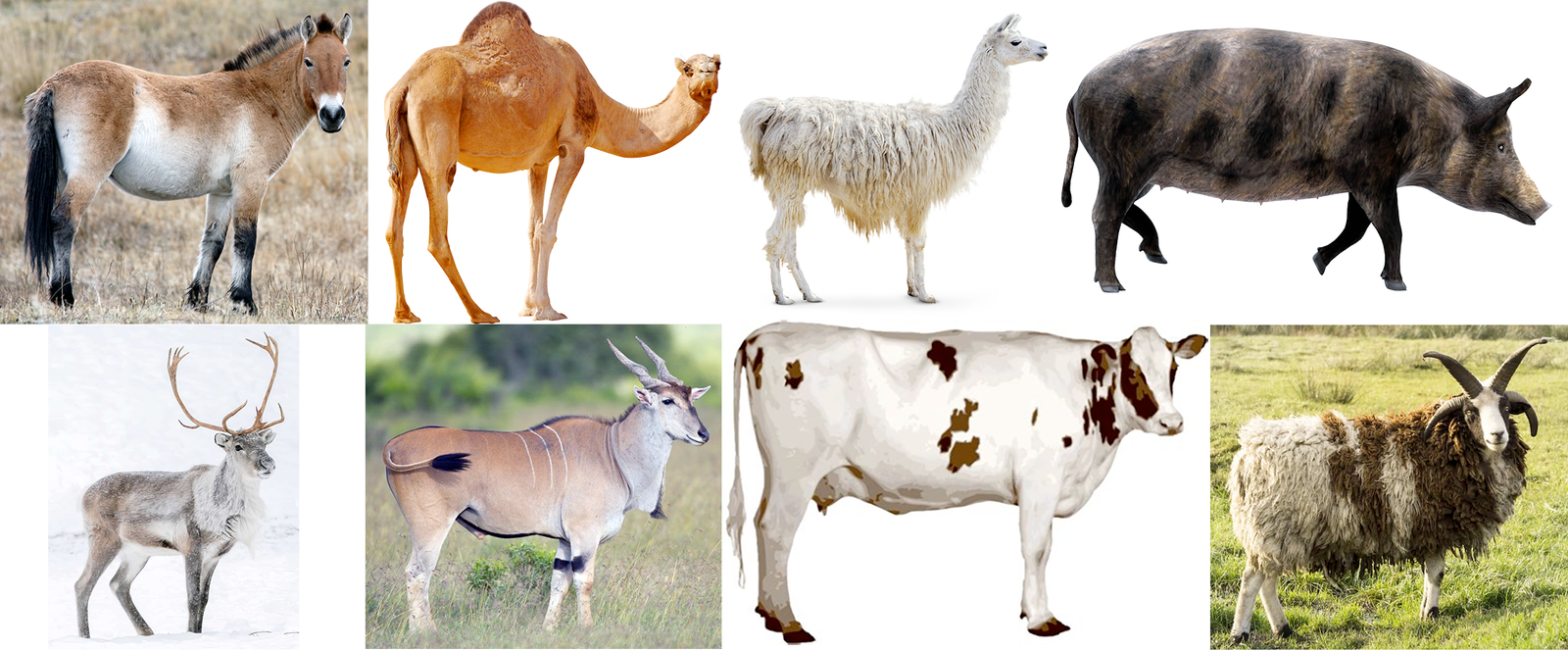 Commonly farmed ungulates. Top: horse, camel, llama, pig. Right: reindeer, eland, cow, sheep.
Welcome to FabulousFusionFood's Ungulate-based Recipes Page — The recipes presented here are all based on ungulate-derived meats as an ingredient. Ungulates are defined as animals that walk on their (usually horned) toes. They are often (indeed typically) herd animals and commonly the most frequently domesticated for food. After a formal re-classification these animals are now part of the clade Euungulata ('true ungulates'), which primarily consists of large mammals with hooves (apart from cetaceans, dolphins and whales which are related to hippopotami and represent some of the most recent members of the group). The oldest surviving members of Euungulata are the horses, tapir (which are eaten as game) and rhinoceri. Next come the camels and llamas, followed by pigs and peccaries. The next group is probably the biggest in terms of both farmed and game animals and includes all ruminants, the North American pronghorn, giraffes, true deer, cows (bovids), sheep and goats and true antelopes. Finally we have the hippopotami and cetaceans.
Horses are domesticated and in come cultures they are eaten. Camels are not truly known in the wild, though there are feral examples and they are farmed for riding, milk and for meat. Of the South American camelids, the guanaco and vicuña are wild and the llama, alpaca, and chilihueque are domesticated. In pre-Columbian south America they were as a mix of camel and sheep (beasts of burden, for their wool and their meat). Pigs are unusual amongst ungulates in being omnivorous. Pigs were domesticated in the Neolithic, both in East Asia and in the Near East (they are attested in Cyprus 11 400 years ago and in China 8000 years ago). When domesticated pigs arrived in Europe, they extensively interbred with wild boar but retained their domesticated features.
Deer, long hunted for game have been domesticated and are now farmed; though in truth only reindeer have really been partly domesticated. Other deer species are more accurately ranched. This includes elk, moose, red deer, roe deer and white-tailed deer. The same is true for South African antelopes (which systematically are classed with cattle as bovids). Elands have proven susceptible to true domestication and are farmed in the Ukraine and Zimbabwe. In South Africa, the gemsbok, kudu and springbok have been brought into ranch farming and their meats are widely available commercially.
In evolutionary terms, domestic cows (European Cattle, Asian Cattle, Buffalo and yak) are closely related to sheep and goats (which are sufficiently closely related to one another that they can form hybrids). Apart from pigs, these remain the most widely and intensively farmed species.
The alphabetical list of all the ungulate-based recipes on this site follows, (limited to 100 recipes per page). There are 2800 recipes in total:
Page 24 of 29
| Serbian Burek Origin: Serbia | Siamban (Jambon) Origin: Ireland | Slow-cooked Moorish Lamb with Buttermilk Dressing Origin: Fusion |
| Sertesporkolt (Pork Porkolt) Origin: Hungary | Sic Farcies eam Sepiam Coctam (Stuffed and Cooked Cuttlefish) Origin: Roman | Slow-cooked Ox Cheek Rendang Origin: Singapore |
| Sesame Pork Stir-fry Origin: Australia | Sichuan Beef Stir-fry Origin: China | Slow-Cooker Pork and Apple Curry Origin: America |
| Seswaa (Pounded Meat) Origin: Botswana | Sieftalia (Caul-wrapped Lamb Sausages) Origin: Cyprus | Slow-roast Lamb Shoulder with Honey, Herbs and Harissa Origin: Britain |
| Setsamandi (Lamb, Rice and Herb Gruel) Origin: Georgia | Sierra Leonean Pork Fried Rice Origin: Sierra Leone | Slow-roasted Lamb Shanks with Tomatoes and Olives Origin: Australia |
| Shaiyah (Pan-fried Meat) Origin: South Sudan | Sierra Leonean Sausage Fried Rice Origin: Sierra Leone | Slow-roasted Lamb with Advieh Origin: Fusion |
| Shako (Gizzard and Tripe Stir-fry) Origin: Nigeria | Sierra Leonean Style Couscous Origin: Sierra Leone | Slow-simmered Beefsteak Fungus Origin: Britain |
| Shakshouka 2 (Chilli, Egg and Tomato Breakfast) Origin: Yemen | Sierra Leonean White Okra Draw Soup Origin: Sierra Leone | Small Raised Mutton Pies Origin: Scotland |
| Shami Kebab Origin: India | Siga Wot (Ethiopian Beef Stew) Origin: Ethiopia | Smoked Beef Origin: Britain |
| Sharba Ramadan (Ramadan Soup) Origin: Libya | Silpancho Origin: Bolivia | Smoky Prawn Jollof Rice Origin: Nigeria |
| Sharbat Libya (Libyan Soup) Origin: Libya | Simboro (Meat with Taro Leaves and Coconut Milk) Origin: Vanuatu | Snyboontjies Bredie (Green Bean Bredie) Origin: South Africa |
| Shashlyk Origin: Azerbaijan | Simple Fried Rice Origin: Zambia | Soft-wrapped Pork and Prawn Rolls Origin: Fusion |
| Shatkora Beef Curry BIR Origin: Britain | Sindhi-style Pilau Origin: Pakistan | Soganli Yahni (Mutton Stew with Onions) Origin: Turkey |
| Shawarma-style pulled lamb with tahini-yogurt dressing Origin: Fusion | Singapore Hokkien Mee Origin: Singapore | Sokossoko (Ivorian Stir-fried Beef) Origin: Cote dIvoire |
| Shchi (Russian Cabbage Soup) Origin: Russia | Sinigang na Baboy (Pork Sinigang) Origin: Philippines | Sokossoko de Rognon (Sokossoko with Kidneys) Origin: Burkina Faso |
| Sheftalia (Grilled Spiced Meat Rolls) Origin: Cyprus | Sint Eustatian Goat Water Origin: Sint Eustatius | Sokossoko de Viande (Sokossoko with Meat) Origin: Burkina Faso |
| Sheikh Kebab Origin: India | Sint Eustatius Pastechi di Karni (Meat Pastechi) Origin: Sint Eustatius | Solyanka (Russian Sweet and Sour Meat Soup) Origin: Russia |
| Shepherd's Pie Origin: Britain | Sint Eustatius Stewed Goat Meat Origin: Sint Eustatius | Solyanka (Siberian Sweet and Sour Meat Soup) Origin: Siberia |
| Shi Zi Tou (Lion’s Head Meatballs) Origin: China | Sint Maarten Pastechi di Karni (Meat Pastechi) Origin: Sint Maarten | Somali-style Liver Origin: Somaliland |
| Shida Kartli (Beef-wrapped Eggs in Tomato Sauce) Origin: South Ossetia | Sint Maarten Pork Ribs Origin: Sint Maarten | Somali-style Liver Origin: Somalia |
| Shifa (Lebanese Lamb and Pine Nut Pizza) Origin: Lebanon | Şiş Kebab Origin: Northern Cyprus | Somerset Pork with Apples Origin: England |
| Shin Ngoa Lap (Spicy Beef Salad) Origin: Laos | Sis Kebap (Turkish Shish Kebab) Origin: Turkey | Somlar Mochu Sachko (Sour Beef Stew) Origin: Cambodia |
| Shinwari Karahi Origin: Pakistan | Sisig Origin: Philippines | Sopa de Arroz (Rice Soup) Origin: Peru |
| Shisa Nyama Origin: South Africa | Skerpikjøt (Faroese Air-dried Mutton) Origin: Denmark | Sopa de Boldroegas (Portuguese Common Purslane Soup) Origin: Portugal |
| Shisa Nyama Origin: eSwatini | Skilpadjie (Afrikaans Faggots) Origin: South Africa | Sopa de Hígado de Pollo (Chicken Liver Soup) Origin: Peru |
| Shish Kebabs Origin: Britain | Skirlie Origin: Scotland | Sopa de Res (Cuban Beef Stock) Origin: Cuba |
| Shoko (Nigerian Beef and Spinach) Origin: Nigeria | Skoudehkaris (Djibouti Rice) Origin: Djibouti | Sopa de Trigo Origin: Portugal |
| Shorba Origin: Sudan-a | Sloppy Joe Pizza Origin: American | Sopi di Pampuna (Pumpkin Soup) Origin: Aruba |
| Shorbet Ads (Sudanese Lentil Soup) Origin: Sudan | Slow Cooker Barbacoa Beef Origin: Mexico | Sopi Mondongo (Soul-food Soup) Origin: Aruba |
| Shredded Pork and Noodle Soup Origin: China | Slow Cooker Lamb Rogan Josh Origin: Britain | Sorpotel Origin: India |
| Shuizhu niurou (Spicy Water-boiled Beef) Origin: China | Slow Cooker Pork Adobo Burritos Origin: Mexico | Souko Dounguouri (Meat Stew with White Beans) Origin: Niger |
| Shurpa Origin: Uzbekistan | Slow Cooker Salsa Chicken Origin: America | Soup Joumou (Haitian Squash Soup) Origin: Haiti |
| Shuwa (Slow-cooked Spicy Lamb) Origin: Oman | Slow-cooked Lamb Curry Origin: Britain | |
| Shuwa II Origin: Oman | Slow-cooked Lamb Madras Origin: Britain |
Page 24 of 29