FabulousFusionFood's Ungulate-based Recipes 22tn Page
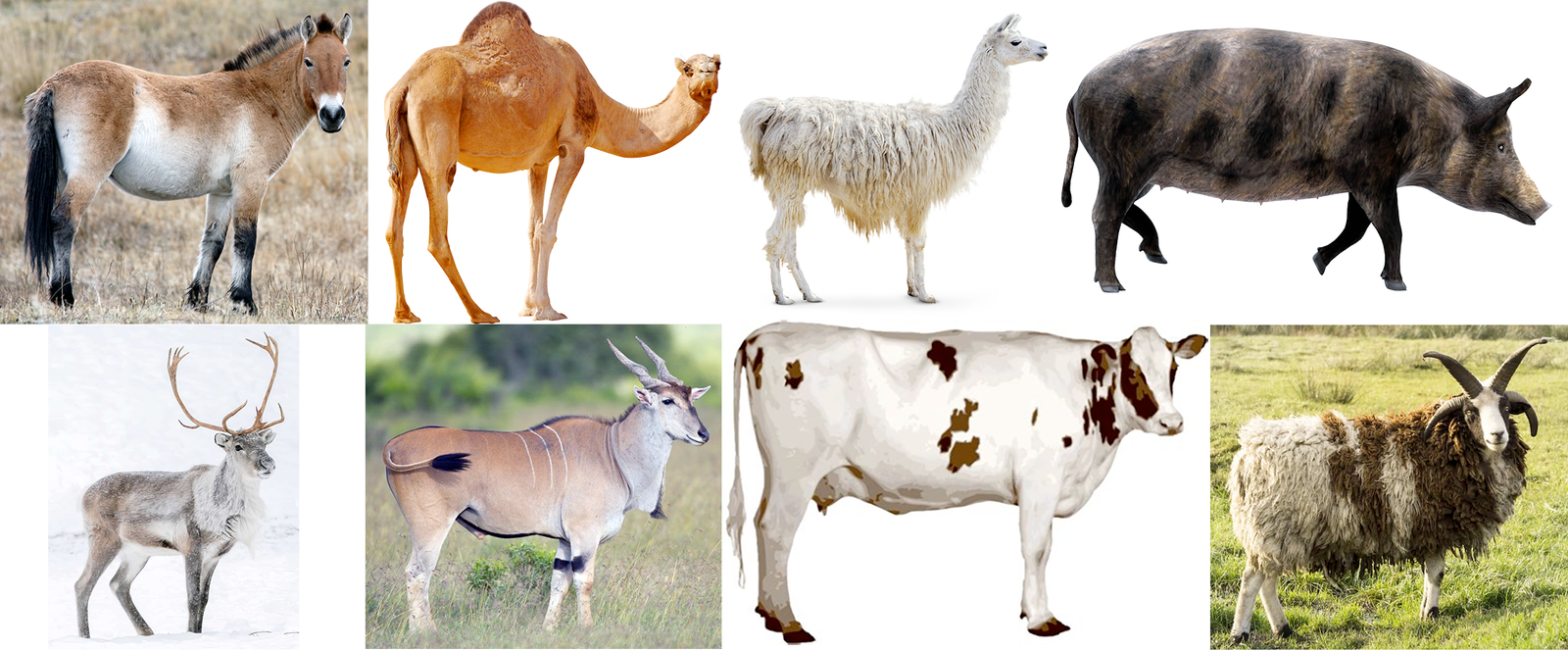 Commonly farmed ungulates. Top: horse, camel, llama, pig. Right: reindeer, eland, cow, sheep.
Welcome to FabulousFusionFood's Ungulate-based Recipes Page — The recipes presented here are all based on ungulate-derived meats as an ingredient. Ungulates are defined as animals that walk on their (usually horned) toes. They are often (indeed typically) herd animals and commonly the most frequently domesticated for food. After a formal re-classification these animals are now part of the clade Euungulata ('true ungulates'), which primarily consists of large mammals with hooves (apart from cetaceans, dolphins and whales which are related to hippopotami and represent some of the most recent members of the group). The oldest surviving members of Euungulata are the horses, tapir (which are eaten as game) and rhinoceri. Next come the camels and llamas, followed by pigs and peccaries. The next group is probably the biggest in terms of both farmed and game animals and includes all ruminants, the North American pronghorn, giraffes, true deer, cows (bovids), sheep and goats and true antelopes. Finally we have the hippopotami and cetaceans.
Horses are domesticated and in come cultures they are eaten. Camels are not truly known in the wild, though there are feral examples and they are farmed for riding, milk and for meat. Of the South American camelids, the guanaco and vicuña are wild and the llama, alpaca, and chilihueque are domesticated. In pre-Columbian south America they were as a mix of camel and sheep (beasts of burden, for their wool and their meat). Pigs are unusual amongst ungulates in being omnivorous. Pigs were domesticated in the Neolithic, both in East Asia and in the Near East (they are attested in Cyprus 11 400 years ago and in China 8000 years ago). When domesticated pigs arrived in Europe, they extensively interbred with wild boar but retained their domesticated features.
Deer, long hunted for game have been domesticated and are now farmed; though in truth only reindeer have really been partly domesticated. Other deer species are more accurately ranched. This includes elk, moose, red deer, roe deer and white-tailed deer. The same is true for South African antelopes (which systematically are classed with cattle as bovids). Elands have proven susceptible to true domestication and are farmed in the Ukraine and Zimbabwe. In South Africa, the gemsbok, kudu and springbok have been brought into ranch farming and their meats are widely available commercially.
In evolutionary terms, domestic cows (European Cattle, Asian Cattle, Buffalo and yak) are closely related to sheep and goats (which are sufficiently closely related to one another that they can form hybrids). Apart from pigs, these remain the most widely and intensively farmed species.
The alphabetical list of all the ungulate-based recipes on this site follows, (limited to 100 recipes per page). There are 2653 recipes in total:
Page 22 of 27
| Saint Helena Curry Puffs Origin: St Helena | Sarma (Stuffed Cabbage Leaves) Origin: Serbia | Scots Kidney Collops Origin: Scotland |
| Saint Kitts and Nevis Jerk Burger Origin: Saint Kitts | Sarmale (Stuffed Cabbage Leaves) Origin: Romania | Scots Minced Collops Origin: Scotland |
| Saint Lucia Curried Goat Origin: Saint Lucia | Sarson Saag Gosht (Lamb and Rapeseed Greens Curry with Yoghurt) Origin: India | Scots Mutton Pies Origin: Scotland |
| Saint Lucian Bouillon Origin: Saint Lucia | Saté (Marinated Kebabs) Origin: Aruba | Scottish Bacon and Potato Pie Origin: Scotland |
| Saint Martin Poulet de Colombo Origin: Sint Maarten | Satan's Fantasy Chili Origin: American | Scottish Fruit Pudding Origin: Scotland |
| Saint Martin Poulet de Colombo Origin: Saint-Martin | Sathe Curry (Beef and Coconut Curry) Origin: Sri Lanka | Scottish Lentil Soup Origin: Scotland |
| Saint Vincent Chicken Pelau Origin: Saint Vincent | Sauce aux Arachides du Tchad (Chadian Peanut Sauce) Origin: Chad | Scottish Steak Pie Origin: Scotland |
| Saint Vincent Curry Goat Origin: Saint Vincent | Sauce Gbanbouda (Tô with Okra Sauce and Peanuts) Origin: Guinea | Sea Spaghetti alla Bolognese Origin: Fusion |
| Saint Vincent Pig Feet Souse Origin: Saint Vincent | Sauce Gombo Origin: Niger | Seco de Chivo (Dry-fried Goat Meat) Origin: Ecuador |
| Saint-Martin Pork Ribs Origin: Saint-Martin | Sauce Gombo et Boeuf (Okra Sauce with Beef) Origin: Burkina Faso | Şeftali kebabı Origin: Northern Cyprus |
| Saka Saka du Mali (Malian Sweet Potato Leaf Sauce) Origin: Mali | Sauce Koumrangan (Hibiscus Leaf Sauce) Origin: Chad | Sega Wot (Red Beef Stew) Origin: Ethiopia |
| Saka-saka (Mutton and Cassava Leaf Stew) Origin: Guinea | Sauce Oseille (Sorrel Sauce) Origin: Burkina Faso | Segwopa (Dried Beef) Origin: Botswana |
| Sala Cattabia Apiciana (Apician Potted Salads) Origin: Roman | Sauerbraten Origin: Germany | Seik Kawab (Seikh Kebab) Origin: Anglo-Indian |
| Salada di Batata (Potato Salad) Origin: Aruba | Sauerbraten II (Soured Beef) Origin: Germany | Selsig Cig Eidion a Mêl (Beef Sausages and Honey) Origin: Welsh |
| Salade Greque (Greek Salad, French Style) Origin: France | Sausage Lattice Origin: Northern Ireland | Selsig Cymreig Gyda Phinafal (Pigs in Blankets with Pineapple) Origin: Welsh |
| Salmagundi with Herby Rack of Lamb Origin: Britain | Sausage Ragu Origin: Britain | Selsyg Kernowek (Cornish Sausages) Origin: England |
| Salsa Caruso (Caruso Sauce) Origin: Uruguay | Sausage Roly-poly Origin: England | Senegalese Beef and Cabbage Curry Origin: Senegal |
| Salt Pork Origin: Antigua | Savoury Chops Origin: Australia | Serabe (Boiled Offal) Origin: Botswana |
| Saltah Origin: Yemen | Savoury Duck Origin: English | Serbian Burek Origin: Serbia |
| Samarkandskij Jagnenok (Samarkand Lamb) Origin: Uzbekistan | Savoury Potato Roulade Origin: Ireland | Sesame Pork Stir-fry Origin: Australia |
| Sambusa Origin: Somalia | Savoury Suet Pastry Origin: Britain | Seswaa (Pounded Meat) Origin: Botswana |
| Samish Mirchi Soup (Mulligatawny Soup) Origin: India | Sawge y farcet (Pork Meatballs with Sage Coating) Origin: England | Setsamandi (Lamb, Rice and Herb Gruel) Origin: Georgia |
| Samlor Korko (Cambodian 'Mixing Soup') Origin: Cambodia | Schlesischer frischer Schinken (Silesian Fresh Ham) Origin: Germany | Shaiyah (Pan-fried Meat) Origin: South Sudan |
| Samsa Origin: Kyrgyzstan | Schwalbennester (Bavarian Veal) Origin: Germany | Shako (Gizzard and Tripe Stir-fry) Origin: Nigeria |
| Sancoche Origin: Trinidad | Schweinefleisch mit Wurzelgemüse und Äpfeln (Pork with Root Vegetables and Apples) Origin: Germany | Shakshouka 2 (Chilli, Egg and Tomato Breakfast) Origin: Yemen |
| Sancochi di Galinja (Chicken Stew) Origin: Aruba | Schweineschnitzel (Pork Schnitzels) Origin: Germany | Shami Kebab Origin: India |
| Sancocho de siete carnes (Seven meat stew) Origin: Dominican Republic | Schweinshaxe (Pork Hocks) Origin: Germany | Sharba Ramadan (Ramadan Soup) Origin: Libya |
| Sancocho Dominicano (Dominican Stew) Origin: Dominican Republic | Schyconys with the Bruesse (Stewed Chicken) Origin: England | Sharbat Libya (Libyan Soup) Origin: Libya |
| Saniyit Kufta (Baked Beef Patties) Origin: Egypt | Scotch Broth Origin: Scotland | Shashlyk Origin: Azerbaijan |
| Sapasui (Samoan Chop Suey) Origin: Samoa | Scotch Broth Soup Origin: Scotland | Shatkora Beef Curry BIR Origin: Britain |
| Sapasui (Samoan Chop Suey) Origin: American Samoa | Scotch Broth with Pepper Dulse Origin: Scotland | Shawarma-style pulled lamb with tahini-yogurt dressing Origin: Fusion |
| Sapasui Pisupo (Corned Beef Chop Suey) Origin: Tokelau | Scotch Hot Pot Origin: Scotland | Shchi (Russian Cabbage Soup) Origin: Russia |
| Sarapatel Origin: India | Scotch Pie Origin: Scotland | |
| Sarma (Meat-stuffed Cabbage Leaves) Origin: Kosovo | Scots Beef Dripping Pastry Origin: Scotland |
Page 22 of 27