FabulousFusionFood's Ungulate-based Recipes 27th Page
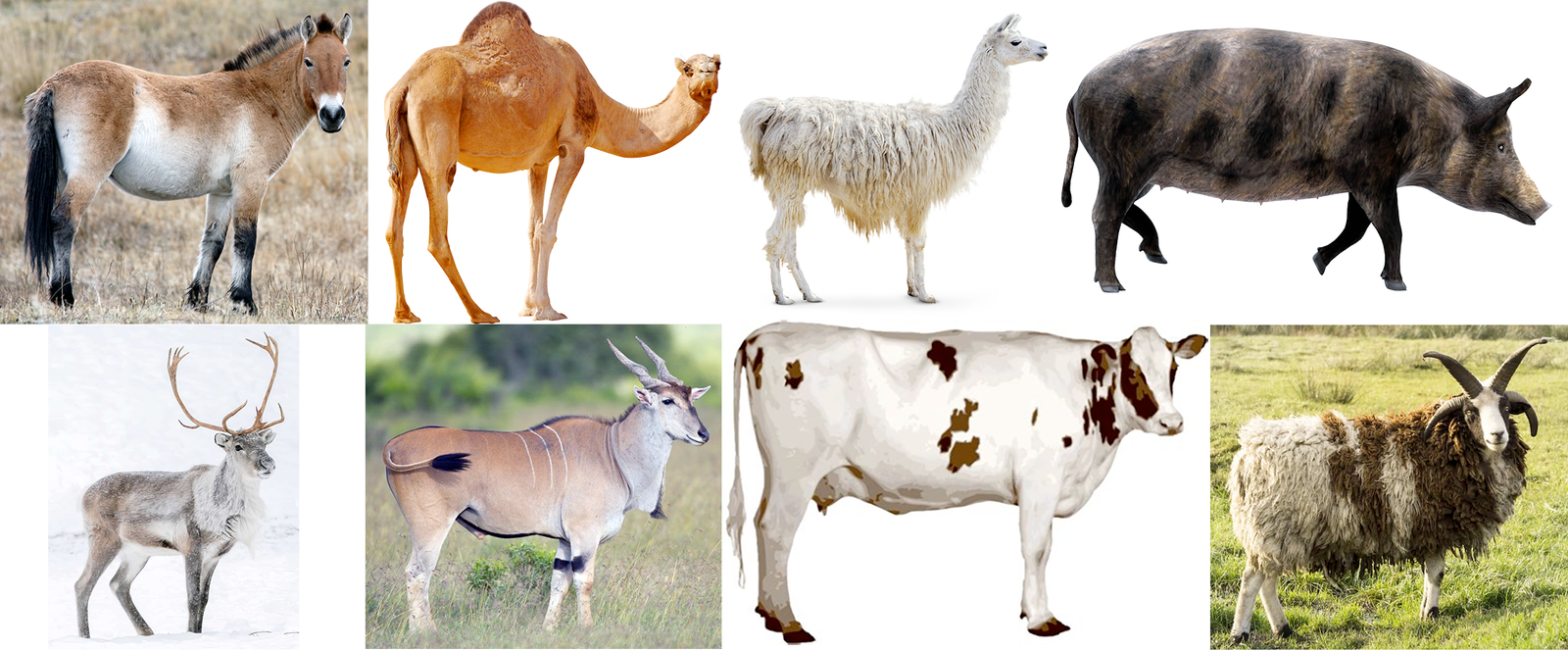 Commonly farmed ungulates. Top: horse, camel, llama, pig. Right: reindeer, eland, cow, sheep.
Welcome to FabulousFusionFood's Ungulate-based Recipes Page — The recipes presented here are all based on ungulate-derived meats as an ingredient. Ungulates are defined as animals that walk on their (usually horned) toes. They are often (indeed typically) herd animals and commonly the most frequently domesticated for food. After a formal re-classification these animals are now part of the clade Euungulata ('true ungulates'), which primarily consists of large mammals with hooves (apart from cetaceans, dolphins and whales which are related to hippopotami and represent some of the most recent members of the group). The oldest surviving members of Euungulata are the horses, tapir (which are eaten as game) and rhinoceri. Next come the camels and llamas, followed by pigs and peccaries. The next group is probably the biggest in terms of both farmed and game animals and includes all ruminants, the North American pronghorn, giraffes, true deer, cows (bovids), sheep and goats and true antelopes. Finally we have the hippopotami and cetaceans.
Horses are domesticated and in come cultures they are eaten. Camels are not truly known in the wild, though there are feral examples and they are farmed for riding, milk and for meat. Of the South American camelids, the guanaco and vicuña are wild and the llama, alpaca, and chilihueque are domesticated. In pre-Columbian south America they were as a mix of camel and sheep (beasts of burden, for their wool and their meat). Pigs are unusual amongst ungulates in being omnivorous. Pigs were domesticated in the Neolithic, both in East Asia and in the Near East (they are attested in Cyprus 11 400 years ago and in China 8000 years ago). When domesticated pigs arrived in Europe, they extensively interbred with wild boar but retained their domesticated features.
Deer, long hunted for game have been domesticated and are now farmed; though in truth only reindeer have really been partly domesticated. Other deer species are more accurately ranched. This includes elk, moose, red deer, roe deer and white-tailed deer. The same is true for South African antelopes (which systematically are classed with cattle as bovids). Elands have proven susceptible to true domestication and are farmed in the Ukraine and Zimbabwe. In South Africa, the gemsbok, kudu and springbok have been brought into ranch farming and their meats are widely available commercially.
In evolutionary terms, domestic cows (European Cattle, Asian Cattle, Buffalo and yak) are closely related to sheep and goats (which are sufficiently closely related to one another that they can form hybrids). Apart from pigs, these remain the most widely and intensively farmed species.
The alphabetical list of all the ungulate-based recipes on this site follows, (limited to 100 recipes per page). There are 2800 recipes in total:
Page 27 of 29
| The Ultimate American Diner Burger Origin: America | To Sowce a Pigge (Collar of Brawn) Origin: England | Traditional Thai Jungle Curry Origin: Thailand |
| The Ultimate Chilli Con Carne Origin: Fusion | Toad in the Hole Origin: Britain | Travers de Porc Grillé (Barbecued Ribs of Pork) Origin: Mauritius |
| The Ultimate Sharing Nachos Origin: Fusion | Toad-in-the-Hole Origin: Britain | Trimlestown Roast Sirloin Origin: Ireland |
| Thiébouyapp Origin: Senegal | Tocco (Genoese Meat Sauce) Origin: Italy | Trini Curried Pork Origin: Trinidad |
| Thiéré Bassi (Millet Couscous Stew) Origin: Senegal | Tolma (Cabbage Stuffed with Lamb) Origin: Georgia | Trinidadian Curried Goat Origin: Trinidad |
| Thiéré bassy Origin: Senegal | Tomatillo and Beef Curry Origin: Fusion | Trinidadian Curry Duck Origin: Trinidad |
| Thiebou Yapp Vermicelles Origin: Senegal | Tomato and Lettuce Soup Origin: Britain | Trinidadian Fried Wontons Origin: Trinidad |
| Thiéré Bassi Salté (Couscous with Meat and Tomato Sauce) Origin: Senegal | Tomato Keema (Tomato and Beef Curry) Origin: Pakistan | Trinidadian Pepper Pot Origin: Trinidad |
| Thiou a la Viande (Senegalese Beef Stew) Origin: Senegal | Tomato-less Jollof Rice Origin: Nigeria | Trinxat (Cabbage and Potato Cake) Origin: Andorra |
| Thiou Curry au Boeuf (Senegalese Beef Curry) Origin: Senegal | Tonkatsu Pork Origin: Japan | Tsebhi Sega (Spicy Minced Meat) Origin: Eritrea |
| Thorion ex Oryza (Goats' Cheese with Rice in Vine Leaves) Origin: Roman | Topcheta Corba (Meatball Soup) Origin: Bulgaria | Tsiren Dakakken Nama (Spicy Mince Meat Kebabs) Origin: Nigeria |
| Thyme-scented Lamb with Almond Skordalia Origin: Australia | Topside Pot Roast with Port and Root Vegetables Origin: Britain | Tsuivan (Stewed Vegetables, Meat and Fresh Noodles) Origin: Mongolia |
| Tibs Wet Origin: Ethiopia | Torresmo (Brazilian Pork Rinds) Origin: Brazil | Tteokguk (Korean Rice Cake Soup) Origin: Korea |
| Tick-Keeah Kebab Origin: India | Torresmo (Portuguese Pork Rinds) Origin: Portugal | Tuh'u (Mesopotamian Lamb and Beetroot Stew) Origin: Mesopotamia |
| Tiepbouyape Origin: Senegal | Tortellini di Natale (Christmas Tortellini) Origin: Italy | Tukasu (Mutton Stew with Dumplings) Origin: Mali |
| Tiga Dégué (Beef in Peanut Sauce) Origin: Mali | Torten Oen a Thatws (Welsh Lamb and Potato Torte) Origin: Welsh | Tunisian Spiced Lamb Balls Origin: Tunisia |
| Tiguadege Na Origin: Mali | Toto-kena Misy Anana sy Voanjo (Greens with Peanuts and Minced Beef) Origin: Madagascar | Turkish Dürüm (Doner Kebab Wrap) Origin: Turkey |
| Timpana (Baked Macaroni Pie) Origin: Malta | Tournedos Rossini (Fillet Rossini) Origin: France | Turkmen Kebap Origin: Turkmenistan |
| Tiopu Kuru (Breadfruit Stew) Origin: Cook Islands | Tournedos Rossini Origin: France | Turks and Caicos Coconut Pie Origin: Turks Caicos |
| Tishreeb Hummus (Chickpea Casserole) Origin: Iraq | Tourte bretonne (Breton pie) Origin: France | Turks and Caicos Jerk Pork Origin: Turks Caicos |
| Tjauw Min (Chowmein) Origin: Suriname | Tourtes parmeriennes (Parmesan Pies) Origin: France | Türlü (Meat, Vegetable and Okra Stew) Origin: Armenia |
| To bake an Olyve-Pye Origin: Britain | Tourtière Origin: Canada | Türlüh (Mixed Vegetable Stew) Origin: Armenia |
| To boil a chine of veal, or a chicken in sharp broth with herbs Origin: Britain | Traditional Cornish Pasty Origin: Cornwall | Turtures (Turtledoves) Origin: Roman |
| To Cure Back Bacon in the Wiltshire Way Origin: Britain | Traditional Historic Bobotie Origin: South Africa | Tuscan Sausage Gnocchi Origin: Britain |
| To Cure Hams Origin: Britain | Traditional Jerk Pork Origin: Jamaica | Ugandan Matooke Origin: Uganda |
| To Cure Tongues I Origin: Britain | Traditional Kitfo (Ethiopian Steak Tartar) Origin: Ethiopia | Ukrainian Borscht Origin: Ukraine |
| To Cure Tongues II Origin: Britain | Traditional Lamb with Emerald Mint Sauce Origin: New Zealand | Ukrainian Sausage from Lviv Origin: Ukraine |
| To Dry Pigs' Cheeks Origin: Britain | Traditional Mattar Keema Curry Origin: India | Ulster Pasties Origin: Northern Ireland |
| To Fricasey White Meat Origin: Britain | Traditional Pork Pie Origin: Britain | Uruguayan Tuco Origin: Uruguay |
| To make a Collar of Brawn of a Breast of Pork Origin: Britain | Traditional Pot Roast Origin: Britain | Vaca Atolada (Beef Ribs with Cassava) Origin: Brazil |
| To make a Frose Origin: England | Traditional Roast Turkey Origin: Britain | Valentine Lamb Steaks with Avocado and Sour Cream Origin: American |
| To make a Haggas Pudding. Origin: Britain | Traditional Salisbury Steak Origin: America | Valentine Pork au Poivre Origin: Britain |
| To Pickle Pork Origin: Britain | Traditional Sloppy Joes Origin: American | |
| To Salt Hams Origin: Britain | Traditional Spaghetti Bolognese Origin: Italy |
Page 27 of 29