FabulousFusionFood's Ungulate-based Recipes 26th Page
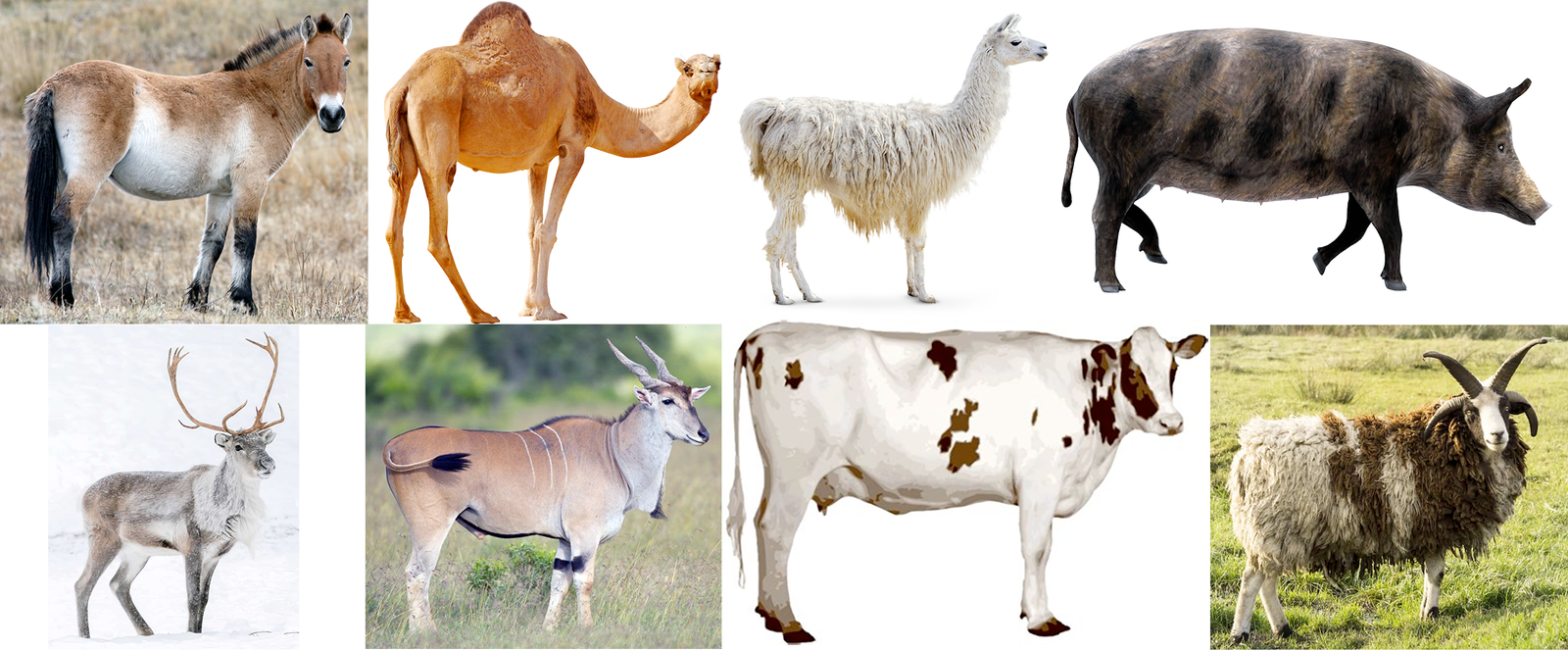 Commonly farmed ungulates. Top: horse, camel, llama, pig. Right: reindeer, eland, cow, sheep.
Welcome to FabulousFusionFood's Ungulate-based Recipes Page — The recipes presented here are all based on ungulate-derived meats as an ingredient. Ungulates are defined as animals that walk on their (usually horned) toes. They are often (indeed typically) herd animals and commonly the most frequently domesticated for food. After a formal re-classification these animals are now part of the clade Euungulata ('true ungulates'), which primarily consists of large mammals with hooves (apart from cetaceans, dolphins and whales which are related to hippopotami and represent some of the most recent members of the group). The oldest surviving members of Euungulata are the horses, tapir (which are eaten as game) and rhinoceri. Next come the camels and llamas, followed by pigs and peccaries. The next group is probably the biggest in terms of both farmed and game animals and includes all ruminants, the North American pronghorn, giraffes, true deer, cows (bovids), sheep and goats and true antelopes. Finally we have the hippopotami and cetaceans.
Horses are domesticated and in come cultures they are eaten. Camels are not truly known in the wild, though there are feral examples and they are farmed for riding, milk and for meat. Of the South American camelids, the guanaco and vicuña are wild and the llama, alpaca, and chilihueque are domesticated. In pre-Columbian south America they were as a mix of camel and sheep (beasts of burden, for their wool and their meat). Pigs are unusual amongst ungulates in being omnivorous. Pigs were domesticated in the Neolithic, both in East Asia and in the Near East (they are attested in Cyprus 11 400 years ago and in China 8000 years ago). When domesticated pigs arrived in Europe, they extensively interbred with wild boar but retained their domesticated features.
Deer, long hunted for game have been domesticated and are now farmed; though in truth only reindeer have really been partly domesticated. Other deer species are more accurately ranched. This includes elk, moose, red deer, roe deer and white-tailed deer. The same is true for South African antelopes (which systematically are classed with cattle as bovids). Elands have proven susceptible to true domestication and are farmed in the Ukraine and Zimbabwe. In South Africa, the gemsbok, kudu and springbok have been brought into ranch farming and their meats are widely available commercially.
In evolutionary terms, domestic cows (European Cattle, Asian Cattle, Buffalo and yak) are closely related to sheep and goats (which are sufficiently closely related to one another that they can form hybrids). Apart from pigs, these remain the most widely and intensively farmed species.
The alphabetical list of all the ungulate-based recipes on this site follows, (limited to 100 recipes per page). There are 2800 recipes in total:
Page 26 of 29
| Stuffed Chicken Roll-ups Origin: Cornwall | Tacos de Cabra (Goat Tacos) Origin: Mexico | Tasqebap (Fried Lamb with Tomatoes) Origin: Albania |
| Stuffed Poussin with Madeira Sauce Origin: Britain | Tacos de Carnitas (Pulled Pork Tacos) Origin: Mexico | Tass Kebab (Fried Lamb in Tomato Sauce) Origin: Armenia |
| Stuffed Tomato Parcels Origin: Britain | Tacos de Carnitas (Pulled Pork Tacos) Origin: Mexico | Tattie Hash Origin: England |
| Suaasat Origin: Greenland | Tacos de Comida Callejera (Mexican Street-food Tacos) Origin: Mexico | Tatws â Chig yn y Popty (Meat and Potatoes in the Oven) Origin: Welsh |
| Suani Tadjine (Kitchen Garden Tagine) Origin: Algeria | Tadjine Zdef (Mutton and Cheese Tagine) Origin: Benin | Tatws a Chig Mewn Popty Araf (Potatoes and Meat in the Slow Cooker) Origin: Welsh |
| Succotash Origin: Equatorial Guinea | Tagin Lisan 'asfur (Orzo Casserole) Origin: Egypt | Tatws Popty Eidion (Beef and Potatoes in the Oven) Origin: Welsh |
| Suffolk Pickle for Hams Origin: Britain | Tagine Almaaz bil Beleh (Goat Tagine with Dates) Origin: Morocco | Tatws Popty Porc (Pork and Potatoes in the Oven) Origin: Welsh |
| Sugar Bean Curry Origin: South Africa | Tagine bal Ghalmi wa Aflour (Lamb Tagine with Broad Beans) Origin: Morocco | Tatws Rhost a Bacwn (Baked Sliced Potatoes with Bacon) Origin: Welsh |
| Sumen Plenum (Stuffed Sow's Belly) Origin: Roman | Tagine bal Ghalmi wa Gharraa wa Na'Na' (Lamb Tagine with Courgette and Mint) Origin: Morocco | Tausug Beef Kulma Origin: Philippines |
| Summer Lamb Casserole Origin: Britain | Tagine bel Ghamli wal Barkouk wa Geijlane (Lamb Tagine with Prunes and Sesame Seeds) Origin: Morocco | Tavë Kosi (Baked Lamb and Yoghurt) Origin: Albania |
| Sunday Stew Origin: Nigeria | Tagine Lahm bil Beleh (Lamb Tagine with Dates) Origin: Morocco | Tavë Kosi (Baked Lamb and Yoghurt) Origin: Kosovo |
| Super-speedy Microwave Lamb Curry Origin: Britain | Tagine of Lamb with Pumpkin Origin: North Africa | Tave Elbanasi (Boiled Lamb with Yoghurt) Origin: Albania |
| Superlative Mincemeat Origin: Britain | Tagliatelle con gli Stridoli (Tagliatelle with Bladder Campion) Origin: Italy | Tave Kosi 2 (Baked Lamb with Yoghurt) Origin: Albania |
| Suqaar (Somali Beef Stew) Origin: Somalia | Tagliatelle con gli Stridoli (Tagliatelle with Bladder Campion) Origin: San Marino | Tchevapchitchi (Bulgarian Minced Meat Croquettes) Origin: Bulgaria |
| Surbraten (Corned Pork) Origin: Germany | Tagliatelle with Lucanian Sausage and Porcini Origin: Italy | Te Bua Toro Ni Baukin (Pumpkin, Cabbage and Corned Beef Bake) Origin: Kiribati |
| Surf and Turf Kebabs Origin: Britain | Taiwanese Beef Noodle Soup Origin: Taiwan | Teisen Borc (Welsh Pork Cake) Origin: Welsh |
| Şurpa (Shurpa) Origin: Turkmenistan | Tajine de chameau aux abricots secs (Camel tagine with dried apricots) Origin: Mali | Teisen Nionod â Chig Oen (Welsh Onion Cake with Lamb) Origin: Welsh |
| Suya Beef Heart Curry with Beans and Wild Greens Origin: Fusion | Tajine el Bey (Spinach and Rocotta Tagine) Origin: Algeria | Tejfolos Vadmalaclves (Wild Boar Soup with Sour Cream) Origin: Hungary |
| Suya Curry Origin: Fusion | Tamales Origin: Mexico | Tepsi kebabı (Turkish Tray Kebab) Origin: Turkey |
| Svíčková na smetaně Origin: Czech | Tamarillo and Beef Curry Origin: Fusion | Terîn Cig Oen (Welsh Lamb Terrine) Origin: Welsh |
| Svinekødsuppe (Skerpikjøt Soup) Origin: Denmark | Tanabour (Beef, Barley and Yoghurt Soup) Origin: Armenia | Terrine Hwyaden, Porc a Mafon (Duck, Pork and Raspberry Terrine) Origin: Welsh |
| Svinsko S Bel Bob (Pork with Beans) Origin: Bulgaria | Tandoori Lamb Chops Origin: Britain | Teviotdale Pie Origin: Scotland |
| Swazi Babotie Origin: eSwatini | Tangy Pork Fillet Origin: Britain | Tex-Mex Beef Tacos Origin: America |
| Sweet and Sour Pork Origin: China | Taro Guisado (Taro Stew) Origin: Easter Island | Tex-Mex Meatball Tacos Origin: America |
| Sweet Lamb Fillet Origin: Britain | Tarte a L'oingon (Onion Tart) Origin: Haiti | Texas Chili Origin: American |
| Székely Gulyas (Székely Goulash) Origin: Hungary | Tarten Cig Moch â Thatws (Bacon and Potato Pie) Origin: Welsh | Texas Red Chili Origin: America |
| Szalonnas Savanyu K'pszta (Sauerkraut with Bacon) Origin: Hungary | Tarten Eidion Tun (Corned Beef Pie) Origin: Welsh | Texas-style Pork and Beef Chili Origin: American |
| Szechuan-style Pork and Pepper Origin: China | Tarten Oen a Bricyll gyda Crwst Persli (Lamb and Apricot Pie with Parsley Crust) Origin: Welsh | Thai Pork Curry in the Burmese Style Origin: Myanmar |
| Szeged Gulyasz (Pork Goulash with Sauerkraut) Origin: Czech | Tarten Sibolau a Bacwn (Welsh Chipple and Bacon Pie) Origin: Welsh | Thai-style Red Curry of Beef, Bamboo and Apple Origin: Asian Fusion |
| Szureti Birkaporkolt (Mutton Porkolt) Origin: Hungary | Tarten Sibolau a Bacwn (Shepherd's Pie with Cheese-crusted Leek Topping) Origin: Welsh | The Author's Christmas Pudding Origin: Britain |
| T'fina Aricha (Beef and Wheat Stew) Origin: Tunisia | Tartes de Chare (Pies of Baked Meat) Origin: England | The Publisher's Pudding Origin: Britain |
| Tabah Moostafah (Tagine of Marrakech Lamb) Origin: Morocco | Tartes of Flesh (Meat Pie) Origin: England | The Stock-pot Origin: Britain |
| Tabasco Steaks with Watercress Butter Origin: Fusion | Tartlettes/Tartletes (Tartlets) Origin: England | |
| Taco Casserole Origin: America | Tas-Kebab (Lamb Cooked in Wine) Origin: Bulgaria |
Page 26 of 29