FabulousFusionFood's Ungulate-based Recipes 21st Page
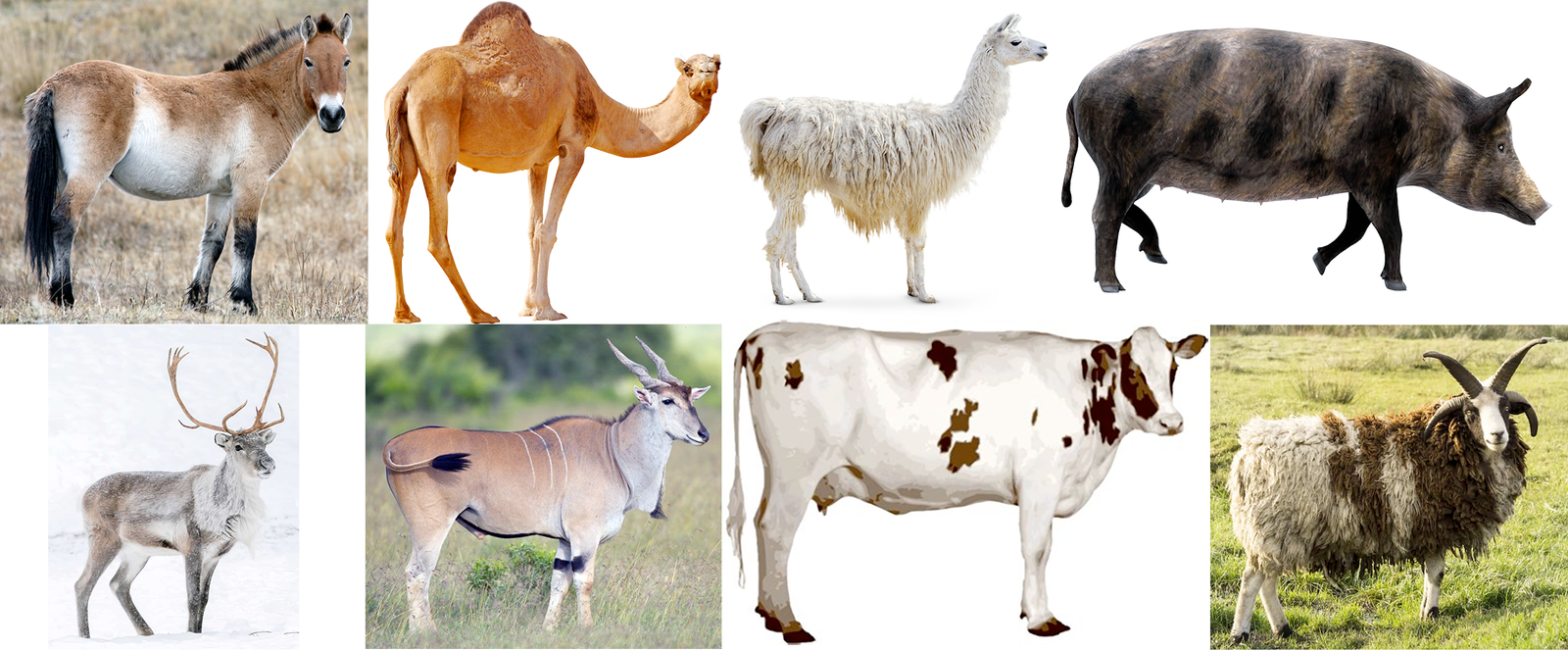 Commonly farmed ungulates. Top: horse, camel, llama, pig. Right: reindeer, eland, cow, sheep.
Welcome to FabulousFusionFood's Ungulate-based Recipes Page — The recipes presented here are all based on ungulate-derived meats as an ingredient. Ungulates are defined as animals that walk on their (usually horned) toes. They are often (indeed typically) herd animals and commonly the most frequently domesticated for food. After a formal re-classification these animals are now part of the clade Euungulata ('true ungulates'), which primarily consists of large mammals with hooves (apart from cetaceans, dolphins and whales which are related to hippopotami and represent some of the most recent members of the group). The oldest surviving members of Euungulata are the horses, tapir (which are eaten as game) and rhinoceri. Next come the camels and llamas, followed by pigs and peccaries. The next group is probably the biggest in terms of both farmed and game animals and includes all ruminants, the North American pronghorn, giraffes, true deer, cows (bovids), sheep and goats and true antelopes. Finally we have the hippopotami and cetaceans.
Horses are domesticated and in come cultures they are eaten. Camels are not truly known in the wild, though there are feral examples and they are farmed for riding, milk and for meat. Of the South American camelids, the guanaco and vicuña are wild and the llama, alpaca, and chilihueque are domesticated. In pre-Columbian south America they were as a mix of camel and sheep (beasts of burden, for their wool and their meat). Pigs are unusual amongst ungulates in being omnivorous. Pigs were domesticated in the Neolithic, both in East Asia and in the Near East (they are attested in Cyprus 11 400 years ago and in China 8000 years ago). When domesticated pigs arrived in Europe, they extensively interbred with wild boar but retained their domesticated features.
Deer, long hunted for game have been domesticated and are now farmed; though in truth only reindeer have really been partly domesticated. Other deer species are more accurately ranched. This includes elk, moose, red deer, roe deer and white-tailed deer. The same is true for South African antelopes (which systematically are classed with cattle as bovids). Elands have proven susceptible to true domestication and are farmed in the Ukraine and Zimbabwe. In South Africa, the gemsbok, kudu and springbok have been brought into ranch farming and their meats are widely available commercially.
In evolutionary terms, domestic cows (European Cattle, Asian Cattle, Buffalo and yak) are closely related to sheep and goats (which are sufficiently closely related to one another that they can form hybrids). Apart from pigs, these remain the most widely and intensively farmed species.
The alphabetical list of all the ungulate-based recipes on this site follows, (limited to 100 recipes per page). There are 2800 recipes in total:
Page 21 of 29
| Pork Vindaloo with Vindaloo Paste Origin: Britain | Pressure Cooker Cajun Meatball Stew Origin: American | Qabooli Rice Origin: Oman |
| Pork Vindhalo Origin: India | Pressure Cooker Calico Bean Stew Origin: American | Qofte të fëguara (Minted Meatballs) Origin: Albania |
| Pork with Cabbage and Bananas Origin: eSwatini | Pressure Cooker Coconut Lamb Curry Origin: Britain | Qotban (Lamb Kebabs) Origin: Morocco |
| Pork, Potato and Fennel Casserole Origin: Ireland | Pressure Cooker Curried Beef Stew Origin: South Africa | Quabili Pilau (Lamb and Yellow Rice with Carrots and Raisins) Origin: Afghanistan |
| Port, Clementine and Five-spice Ham Origin: Britain | Pressure Cooker Greek Meatballs with Spaghetti Sauce Origin: American | Quassatat with Beef and Peas Filling Origin: Malta |
| Portable Soup Origin: Britain | Pressure Cooker Massaman Beef Curry Origin: Britain | Quesabirria Tacos Origin: Mexico |
| Portable Tacos Origin: America | Pressure Cooker Steak and Kidney Pudding Origin: Britain | Queue de Boeuf Braisée (Braised Oxtail) Origin: Equatorial Guinea |
| Pot au Feau Origin: France | Pressure Cooker White Stock Origin: Britain | Queue de Boeuf Pinon (Oxtail Pinon) Origin: Togo |
| Pot au Feu Origin: France | Psoai (Pork in Piquant Sauce) Origin: Roman | Queues de Cochon salées (Salted Pigtails) Origin: Martinique |
| Potage Bananier (Congolese Banana Soup) Origin: DR-Congo | Pua’atoro aux Pommes de Terre Rissolées (Corned Beef with Fried Potatoes) Origin: Tahiti | Quick Demi-glace Sauce Origin: Britain |
| Potato and Broccoli Gratin with Goat's Cheese Origin: Ireland | Pudding and Souse Origin: Barbados | Quima Bhari Mirch (Red Bell Peppers Stuffed with Spicy Minced Lamb) Origin: India |
| Potato and Mutton Soup Origin: Scotland | Pudding Egusi (Egusi Pudding) Origin: Cameroon | Qurutob Origin: Tajikistan |
| Potato Zrazy Origin: Belarus | Puerto Rican Pasteles (Meat-stuffed Masa Pockets) Origin: Puerto Rico | Quzi (Iraqi Lamb over Rice) Origin: Iraq |
| Potes Cennin a Thatws (Leek and Potato Soup) Origin: Welsh | Puerto Rican Picadillo (Puerto Rican Stewed Minced Beef) Origin: Puerto Rico | Râble de Lièvre à la Poivrade (Saddle of Hare à la Poivrade) Origin: France |
| Potes Cig Eidion (Beef Pottage) Origin: Welsh | Puhādi (Mesopotamian Lamb Stew) Origin: Mesopotamia | Râgout de Boeuf aux Bananes (Beef Stew with Plantains) Origin: Central African Republic |
| Potes Cig Eidion II (Welsh Beef Stew II) Origin: Welsh | Pulled BBQ Pork Tacos with Wilted Cabbage Salad (Pulled BBQ Pork Tacos with Wilted Cabbage Salads) Origin: Britain | Rôti de Porc à l'Ananas (Roast Pork with Pineapple) Origin: Mauritius |
| Potjeikos Origin: Southern Africa | Pulled Firecracker Brisket Origin: Britain | Rabbit Pilaf Origin: Uzbekistan |
| Potsticker Dumplings Origin: China | Pulled Pork Tacos Origin: America | Rabo Encendido (Spicy Dominican Oxtail Stew) Origin: Dominican Republic |
| Potted Beef Origin: Britain | Pultes (Meat Pottage) Origin: Roman | Rack & Ruin Origin: Britain |
| Potted Hough Origin: Scotland | Pultes Cum Iure Oenococti (Pottage with Wine Sauce) Origin: Roman | Rack of Lamb Persillade Origin: France |
| Potted Ox Cheek Origin: Scotland | Pultes Iulianae (Julian Pottage) Origin: Roman | Rack of Lamb with Olive Crust Origin: Britain |
| Poulet à la Provençale (Provence-style Chicken) Origin: France | Pumpes (Pork Meatballs) Origin: England | Rack of Lamb with Sénégal Pepper Emulsion Origin: African Fusion |
| Poulet à la Moambe (Chicken Moambe) Origin: DR-Congo | Pumpkin Chili Origin: American | Raclette Origin: Switzerland |
| Poulet Moambe (Chicken Moambe) Origin: Congo | Pumpkin Goulash Origin: American | Rad Na Moo (Pork with Noodles in Gravy) Origin: Thailand |
| Poume d'oranges Origin: France | Pumpkin, Goat's Cheese and Kale Tart with Three-cornered Leeks Origin: Britain | Rag Pudding Origin: England |
| Pourcelet farci (Stuffed Suckling Pig) Origin: France | Pumpkin, Goat's Cheese and Kale Tart Origin: Britain | Ragoût d'Ignames et Boeuf (Beef Stew with Yams) Origin: Britain |
| Poutine Origin: Canada | Punjabi Mutton Curry Origin: India | Ragoût de Chévre au Riz (Goat Stew with Rice) Origin: DR-Congo |
| Poutine Origin: Saint Pierre | Punjene Paprika (Stuffed Peppers) Origin: Serbia | Ragoût de Porc au Citron Vert (Ragoût of Pork with Lime) Origin: Senegal |
| Powsowdie Origin: Scotland | Pupusas de Chicharrón (Pork Pupusas) Origin: El Salvador | Ragoût de Porc aux Potates Douces (Pork Stew with Sweet Potatoes) Origin: Cote dIvoire |
| Pre-cooked Goat Origin: Britain | Purée d'Azinkokoui au Boudin (Azinkokoui Purée with Boudin Sausage) Origin: Togo | Ragout Breton à la saucisse (Breton Stew with sausage) Origin: France |
| Pre-cooked Lamb Origin: Britain | Putóg bhán (Irish White Pudding) Origin: Ireland | Ragout d'Igname (Yam Porridge) Origin: Burkina Faso |
| Prego no Pão (Portuguese Prego Sandwich) Origin: Portugal | Pyes de Pares (Pies of Paris) Origin: England | Ragoût de cabri créole (Creole Goat Stew) Origin: Guadeloupe |
| Pressure Cooker Beef and Stout Stew Origin: Ireland | Pyggus in sauce (Pork in Sauce) Origin: England | |
| Pressure Cooker Beef in Pepper Sauce Origin: American | Pyrizhky (Ukrainian Meat Patties) Origin: Ukraine |
Page 21 of 29