FabulousFusionFood's Ungulate-based Recipes 25th Page
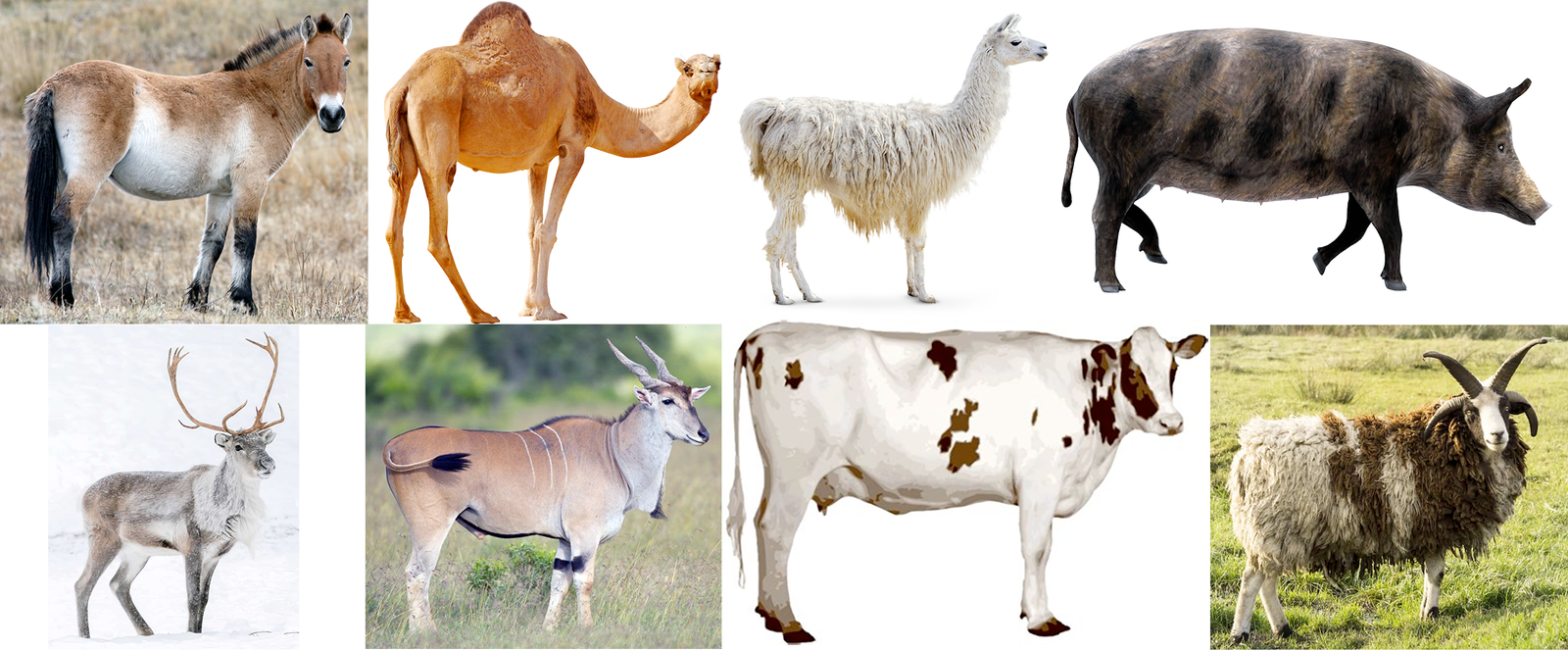 Commonly farmed ungulates. Top: horse, camel, llama, pig. Right: reindeer, eland, cow, sheep.
Welcome to FabulousFusionFood's Ungulate-based Recipes Page — The recipes presented here are all based on ungulate-derived meats as an ingredient. Ungulates are defined as animals that walk on their (usually horned) toes. They are often (indeed typically) herd animals and commonly the most frequently domesticated for food. After a formal re-classification these animals are now part of the clade Euungulata ('true ungulates'), which primarily consists of large mammals with hooves (apart from cetaceans, dolphins and whales which are related to hippopotami and represent some of the most recent members of the group). The oldest surviving members of Euungulata are the horses, tapir (which are eaten as game) and rhinoceri. Next come the camels and llamas, followed by pigs and peccaries. The next group is probably the biggest in terms of both farmed and game animals and includes all ruminants, the North American pronghorn, giraffes, true deer, cows (bovids), sheep and goats and true antelopes. Finally we have the hippopotami and cetaceans.
Horses are domesticated and in come cultures they are eaten. Camels are not truly known in the wild, though there are feral examples and they are farmed for riding, milk and for meat. Of the South American camelids, the guanaco and vicuña are wild and the llama, alpaca, and chilihueque are domesticated. In pre-Columbian south America they were as a mix of camel and sheep (beasts of burden, for their wool and their meat). Pigs are unusual amongst ungulates in being omnivorous. Pigs were domesticated in the Neolithic, both in East Asia and in the Near East (they are attested in Cyprus 11 400 years ago and in China 8000 years ago). When domesticated pigs arrived in Europe, they extensively interbred with wild boar but retained their domesticated features.
Deer, long hunted for game have been domesticated and are now farmed; though in truth only reindeer have really been partly domesticated. Other deer species are more accurately ranched. This includes elk, moose, red deer, roe deer and white-tailed deer. The same is true for South African antelopes (which systematically are classed with cattle as bovids). Elands have proven susceptible to true domestication and are farmed in the Ukraine and Zimbabwe. In South Africa, the gemsbok, kudu and springbok have been brought into ranch farming and their meats are widely available commercially.
In evolutionary terms, domestic cows (European Cattle, Asian Cattle, Buffalo and yak) are closely related to sheep and goats (which are sufficiently closely related to one another that they can form hybrids). Apart from pigs, these remain the most widely and intensively farmed species.
The alphabetical list of all the ungulate-based recipes on this site follows, (limited to 100 recipes per page). There are 2800 recipes in total:
Page 25 of 29
| Soupa Canja (Okra and Palm Oil Soup) Origin: Gambia | Special Nihari Origin: Pakistan | Steamed Spareribs in Black Bean Sauce Origin: China |
| Soupe aux pois et la viande (Pea Soup and Meat) Origin: Guinea-Bissau | Speckkartoffel (Potatoes With Bacon) Origin: Germany | Stecen Cig Oen Gyda Rhosmari a Cwrens Cochion (Lamb Steak with Rosemary and Red Currants) Origin: Welsh |
| Soupe d'Illane (Ilan Soup) Origin: Morocco | Spiced Beef Origin: Northern Ireland | Stecen Gafr Gyda Rhosmari a Cwrens Cochion (Goat Steak with Rosemary and Red Currants) Origin: Welsh |
| Soupe de mouton (Mutton soup) Origin: Saint-Martin | Spiced Mutton Origin: Northern Ireland | Stecen Porc Gyda Caws Llŷn a Saws Bricyll (Pork Steaks with Llŷn Cheese and Apricot Sauce) Origin: Welsh |
| Soupe De Pesach (Passover Soup) Origin: Morocco | Spiced Sesame Lamb Patties Origin: Fusion | Stegt Flæsk (Danish Roast Pork with Potatoes and Parsley Sauce) Origin: Denmark |
| Soupe de Porc Fume (Smoked Pork Soup) Origin: Burkina Faso | Spicy Beef and Longevity Noodles Origin: China | Stew Peas Origin: Jamaica |
| Soupe Djiboutienne (Djibouti Soup) Origin: Djibouti | Spicy Braised Cabbage Origin: Tanzania | Stewed Beef in Coconut Milk with Dumplings Origin: Trinidad |
| Soupe Kandja Origin: Mali | Spicy Lamb Burgers Origin: Britain | Stewed Beeff (Stewed Beef) Origin: England |
| Soupou Tehou (Beef Soup) Origin: Guinea | Spicy Lamb Kebabs Origin: Britain | Stewed Duck and Turnips Origin: British |
| Soupoukanja (Goat Stew with Okra) Origin: Senegal | Spicy Meatball Pizza Origin: Italy | Stewed Oxtail Origin: Zimbabwe |
| Souppa Patchia (Lamb's Head Soup) Origin: Cyprus | Spicy Pork Ribs Origin: Britain | Stewed Partridge Origin: Britain |
| Sour and Spicy Pork with Noodles Origin: China | Spicy Szechuan Pork Recipe Origin: China | Stewed Pork in Red Sauce Origin: Sao Tome |
| Souroundou (Nigerienne Fat Rice) Origin: Niger | Spotted Dick Origin: Britain | Stewed Pork with Chickpeas Origin: Fusion |
| Sous Vide of Camel Ribs Origin: Fusion | Spring Dolma Origin: Armenia | Stewed Venison Origin: British |
| Souse Origin: Saint Lucia | Spring Flower Salad with Dandelion Greens Origin: Britain | Sticky Asian-style Pork Neck Chops Origin: Britain |
| South African Cape Malay Curry Origin: South Africa | Spring Rolls Origin: Fusion | Sticky Lamb Ribs Origin: Britain |
| South African Christmas Pudding Origin: South Africa | Spring Rolls with Pork and Shrimp Origin: China | Sticky Stout-glazed Salt Beef with Chimichurri Origin: South Africa |
| South African Curried Leg of Lamb Origin: India | Springbok Potjekos Origin: South Africa | Stir-fried Beef with Spring Onions Origin: China |
| South African Lamb Curry Origin: South Africa | Squash Moussaka Origin: Armenia | Stir-fried Lamb with Spring Onions Origin: China |
| South African Lamb Pilaff Origin: South Africa | Srpska Corba ot Graha (Serbian Bean Stew) Origin: Serbia | Stir-fried Lamb with Three-Cornered Leeks Origin: China |
| South African Prego Steak Origin: South Africa | St Helena Curry and Rice Origin: St Helena | Stir-fried Pork with Bamboo Shoots Origin: China |
| South African Rhus Bukhari Origin: South Africa | St Lucian Pepper Pot Origin: Saint Lucia | Stiw Cig Oen Cymreig (Welsh Lamb Stew) Origin: Welsh |
| Souvlaki Origin: Greece | Stamppot (Potato-kale Mash with Sausage) Origin: Netherlands | Stiw Eidion Cymreig (Welsh Beef Stew) Origin: Welsh |
| Soya (Grilled Beef, Cameroon Style) Origin: Cameroon | Steak and Ale Pie Origin: Britain | Stovies Origin: Scotland |
| Soya (Barbecued Beef) Origin: Cameroon | Steak and Blue Cheese Origin: Britain | Stovies II Origin: Scotland |
| Spaghetti alla Carbonara Origin: Italy | Steak and Kidney Kebabs Origin: Britain | Stracotto alla Romana Origin: Italy |
| Spaghetti with Duck Egg Carbonara Origin: Britain | Steak and Kidney Pie Origin: Britain | Streptikos Artos (Plaited Bread) Origin: Roman |
| Spaghetti with Sun-dried Tomato and Garlic Pesto Origin: Italy | Steak and Kidney Pudding Origin: Britain | Strozzapreti (Penne Pasta with Cream and Bacon Sauce) Origin: San Marino |
| Spam Fried Rice Origin: Nauru | Steak au Poivre Origin: France | Studenetz (Jellied Ham Hocks) Origin: Ukraine |
| Spam Kelaguen Origin: Northern Mariana Islands | Steak Cooked in Milk Origin: Malawi | Stuffed Breadfruit Origin: Dominica |
| Spam Kelaguen Origin: Guam | Steak Diane Origin: Australia | Stuffed Breadfruit II Origin: Trinidad |
| Spam Musubi Origin: Hawaii | Steak Frites (Steak and Chips) Origin: France | Stuffed Cabbage Rolls Origin: American |
| Spare Ribs, Cabbage, and Sauerkraut Origin: American | Steak Tartare Origin: France | |
| Spareribs in Sweet and Sour Sauce Origin: China | Steak with Prego Sauce Origin: Portugal |
Page 25 of 29