FabulousFusionFood's Ungulate-based Recipes 2nd Page
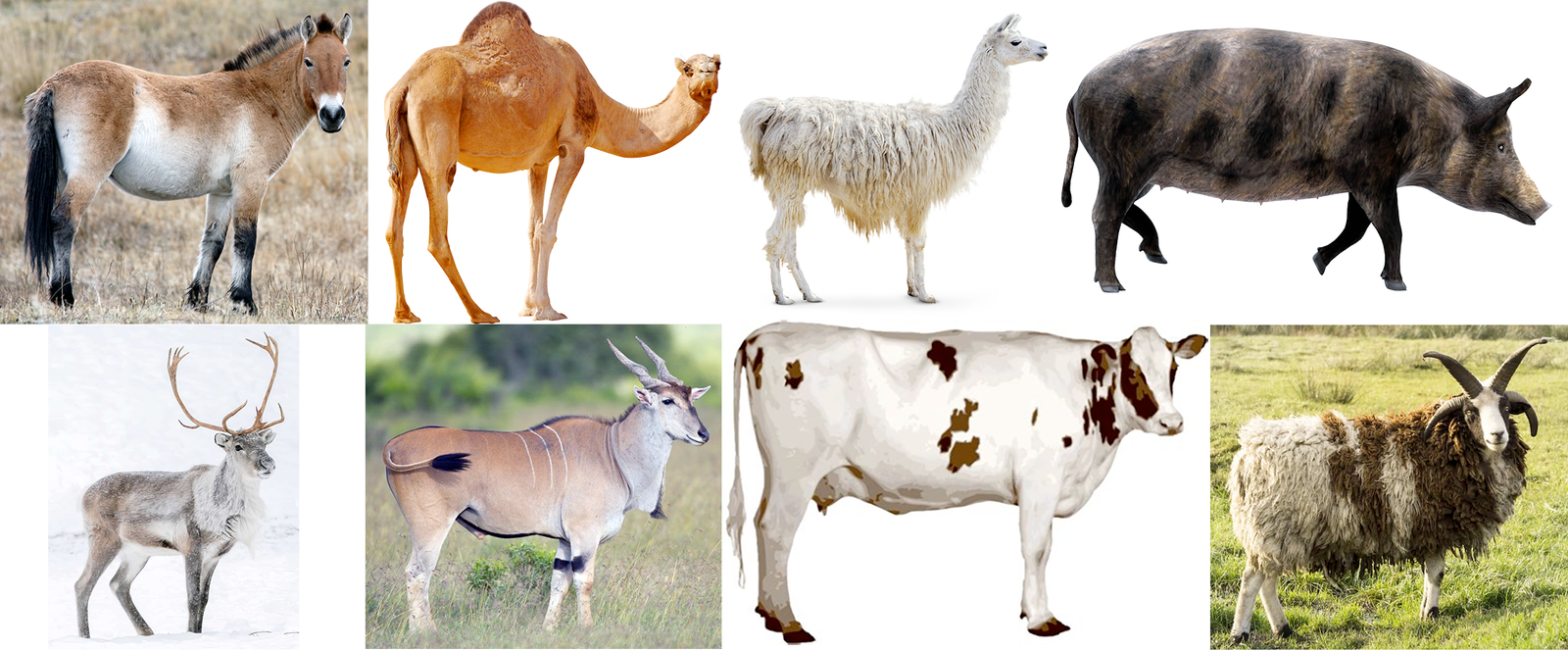 Commonly farmed ungulates. Top: horse, camel, llama, pig. Right: reindeer, eland, cow, sheep.
Welcome to FabulousFusionFood's Ungulate-based Recipes Page — The recipes presented here are all based on ungulate-derived meats as an ingredient. Ungulates are defined as animals that walk on their (usually horned) toes. They are often (indeed typically) herd animals and commonly the most frequently domesticated for food. After a formal re-classification these animals are now part of the clade Euungulata ('true ungulates'), which primarily consists of large mammals with hooves (apart from cetaceans, dolphins and whales which are related to hippopotami and represent some of the most recent members of the group). The oldest surviving members of Euungulata are the horses, tapir (which are eaten as game) and rhinoceri. Next come the camels and llamas, followed by pigs and peccaries. The next group is probably the biggest in terms of both farmed and game animals and includes all ruminants, the North American pronghorn, giraffes, true deer, cows (bovids), sheep and goats and true antelopes. Finally we have the hippopotami and cetaceans.
Horses are domesticated and in come cultures they are eaten. Camels are not truly known in the wild, though there are feral examples and they are farmed for riding, milk and for meat. Of the South American camelids, the guanaco and vicuña are wild and the llama, alpaca, and chilihueque are domesticated. In pre-Columbian south America they were as a mix of camel and sheep (beasts of burden, for their wool and their meat). Pigs are unusual amongst ungulates in being omnivorous. Pigs were domesticated in the Neolithic, both in East Asia and in the Near East (they are attested in Cyprus 11 400 years ago and in China 8000 years ago). When domesticated pigs arrived in Europe, they extensively interbred with wild boar but retained their domesticated features.
Deer, long hunted for game have been domesticated and are now farmed; though in truth only reindeer have really been partly domesticated. Other deer species are more accurately ranched. This includes elk, moose, red deer, roe deer and white-tailed deer. The same is true for South African antelopes (which systematically are classed with cattle as bovids). Elands have proven susceptible to true domestication and are farmed in the Ukraine and Zimbabwe. In South Africa, the gemsbok, kudu and springbok have been brought into ranch farming and their meats are widely available commercially.
In evolutionary terms, domestic cows (European Cattle, Asian Cattle, Buffalo and yak) are closely related to sheep and goats (which are sufficiently closely related to one another that they can form hybrids). Apart from pigs, these remain the most widely and intensively farmed species.
The alphabetical list of all the ungulate-based recipes on this site follows, (limited to 100 recipes per page). There are 2800 recipes in total:
Page 2 of 29
| Antiguan Curry Goat Origin: Antigua | Ashlyamfu (Noodles, Stew and Omelette) Origin: Kyrgyzstan | Balti Tandoori Keema Origin: Britain |
| Antiguan Rice and Peas Origin: Antigua | Assaturam (Roast Meat) Origin: Roman | Bamieh (Okra Stew) Origin: Iraq |
| Aper ita conditur (Seasoned Wild Boar) Origin: Roman | Assaturas in collare (Of Roast Neck) Origin: Roman | Bananes Farci (Stuffed Bananas) Origin: Wallis Futuna |
| Arabic Pasta with Beef and Yogurt Sauce Origin: Fusion | Assegas n Tajin s Ifrawen (Camel tagine with dried apricots) Origin: Western Sahara | Bandeja Paisa (Paisa Platter) Origin: Colombia |
| Ardshane House Irish Stew Origin: Ireland | Aurangabadi Naan Qaliya Origin: India | Banga Soup Origin: Nigeria |
| Armenian Basturma Origin: Armenia | Australian Camel Stew Origin: Australia | Bangaou Origin: Chad |
| Arni Gemisto me Horta ke Feta (Leg of Lamb Stuffed with Greens and Feta) Origin: Greece | Australian Meat Pie Origin: Australia | Bangers with Sweet and Sour Mash Origin: Britain |
| Arni Kappamas (Lamb and Potatoes Cooked in Tomato Sauce) Origin: Cyprus | Australo-Asian Roast Pork Origin: Australia | Bangladeshi Beef Shatkora Origin: Bangladesh |
| Arni me Fasolia (Lamb with Haricot Beans) Origin: Cyprus | Awaze Tibs (Ethiopian Beef and Peppers) Origin: Ethiopia | Bangladeshi Goat Curry Origin: Bangladesh |
| Arni me kounouppidhi Mesaritico (Lamb with Cauliflower à la Mesaorias) Origin: Cyprus | Ayimonlou et N'gbagba (Togolese Rice and Beans with N'gbagba) Origin: Togo | Bangladeshi Vindaloo Origin: Britain |
| Arni me Spanaki (Lamb with Spinach) Origin: Cyprus | Azindéssi aux Boeuf (Beef in Peanut Sauce) Origin: Togo | Barbacoa Origin: Mexico |
| Arni Psito (Oven-baked Lamb) Origin: Cyprus | Börek Sauvage (Wild Greens Börek) Origin: France | Barbecue Baharat Lamb Chops with Vegetable Salad Origin: Australia |
| Arni Souvla (Skewered Lamb) Origin: Cyprus | Baabath (Tripe Curry) Origin: Sri Lanka | Barbecue Steaks with Red Onion Marmalade Origin: Britain |
| Arni Ttavas (Oven-roasted Lamb with Onions) Origin: Cyprus | Baamiye Suqaar (Meat and Okra Stew) Origin: Somalia | Barbecued Bourbon Tri-tip Origin: American |
| Aromatic Lamb with Ginger and Potatoes Origin: Ireland | Bableves Csülökkel (Bean Soup with Knuckle of Pork) Origin: Hungary | Barbecued Butterflied Leg of Lamb Origin: Australia |
| Aromatic Pork and Potato Casserole Origin: Ireland | Bachelor Soup Origin: Britain | Barbecued Cuban Sandwich Origin: American |
| Arroz a la Cubana (Cuban-style Rice) Origin: Philippines | Bacon and Cabbage Origin: Ireland | Barbecued Kibbeh Origin: African Fusion |
| Arroz com Mariscos (Rice with Shellfish) Origin: Mozambique | Bacon and Egg Pasty Origin: England | Barbecued Lamb Chops with Redcurrant Mustard Glaze Origin: British |
| Arroz con Cerdo (Mexican Rice and Pork) Origin: Mexico | Bacon and Egg Pie Origin: Scotland | Barbecued Lamb Ribs Origin: Britain |
| Arroz con Chorizo (Rice with Chorizo) Origin: Ecuador | Bacon and Potato Pie Origin: England | Barbecued Leg of Lamb with Olives Origin: Australia |
| Arroz con Menestra y Carne (Rice with Meat in Stew) Origin: Ecuador | Bacon-wrapped Trout Origin: Britain | Barbecued Plum and Nut Stuffed Pork Chops Origin: British |
| Artolaganon (Fried Savoury Pasta) Origin: Roman | Bacwn Berw a Saws Persli (Boiled Bacon and Parsley Sauce) Origin: Welsh | Barbecued Pork Chops Dijonnaise Origin: British |
| Artolaganon II (Leavened Flatbread) Origin: Roman | Baekse Karē (Korean Curry Rice) Origin: Korea | Barbecued Spice-crusted Lamb Origin: Britain |
| Aruba Chicken Origin: Aruba | Bahamian Crab and Rice Origin: Saint Barthelemy | Barbecued Stuffed Tomatoes Origin: Britain |
| Aruban Curried Chicken Origin: Aruba | Bajan Curry Goat Origin: Barbados | Bariis Iskukaris Origin: Somaliland |
| Aruban Curried Goat Origin: Aruba | Bajan Curry Powder Origin: Barbados | Barley Kail Origin: Scotland |
| Aruban Curried Mutton Origin: Aruba | Bak Kut Teh (Spicy Sparerib Soup) Origin: Malaysia | Barokhé (Beef and Fish with Cassava Leaves) Origin: Mali |
| Aruban Curry Goat Origin: Aruba | Bakalca (Slovenian Lamb Stew) Origin: Slovenia | Baru Fida (Spinach Sauce with Peanuts and Beef Shank) Origin: Guinea |
| Arvi aur Gosht ka Khatta Salan (Taro and Lamb in a Tangy Sauce) Origin: India | Bakari Riha (Mutton Curry) Origin: Maldives | Basic Cajun Jambalaya Origin: Cajun |
| Asado Negro Origin: Venezuela | Bake Mete Pye (Pie of Baked Meat) Origin: England | Basic Irish Sausages Origin: Ireland |
| Ascension Plo Origin: Ascension | Baked Haggis with Whisky Cumberland Sauce Origin: Scotland | Basted Beef and Onion Kebabs Origin: Anglo-Indian |
| Ascot Pie Origin: England | Baked Lamb with Potatoes and Artichokes Origin: Ireland | Basterma (Spiced Dried Meat) Origin: Armenia |
| Asharbal Leebia (Libyan Soup 2) Origin: Libya | Baked Spicy Beef and Cheese Empanadas Origin: Mexico | |
| Asheh Mast (Persian Herb and Yoghurt Soup) Origin: Iran | Balti Curry Paste Origin: Britain |
Page 2 of 29