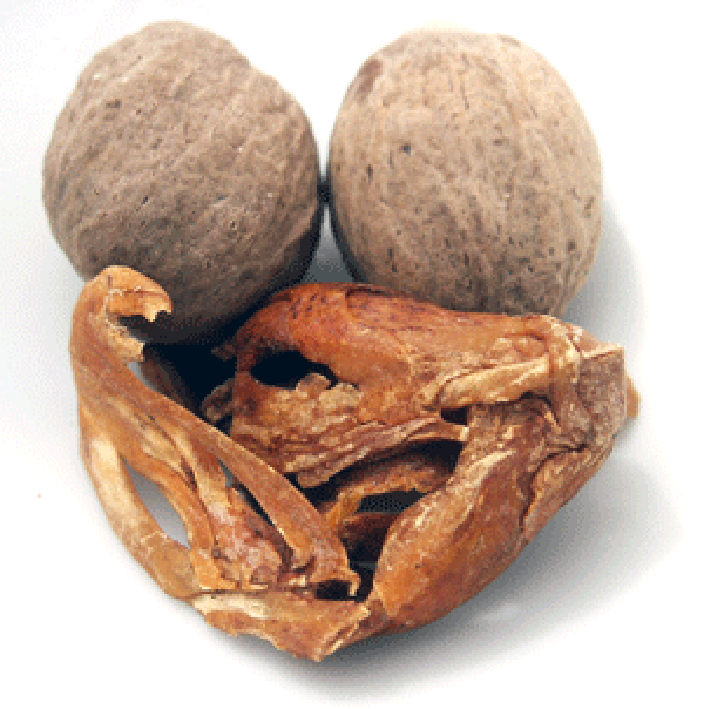
 Two nutmegs (top) and blades of mace (bottom).
Welcome to the summary page for FabulousFusionFood's Cook's Guide entry for Nutmeg along with all the recipes employing Nutmeg presented on this site, with 847 recipes in total.
This is a continuation of an entire series of pages that will, I hope, allow my visitors to better navigate this site. As well as displaying recipes by name, country and region of origin I am now planning a whole series of pages where recipes can be located by meal type and main ingredient. This page gives a listing of all the Nutmeg recipes added to this site.
These recipes, all contain Nutmeg as a major wild food ingredient.
Nutmeg is derived from the evergreen tree species Myristica fragrans that originate only from the Banda Islands of Indonesia. This tree is a member of the Myristicaceae (generally referred to as the Nutmeg family). There are about 100 distinct species of Myristica of which Papuan Nutmeg M argentea from New Guinea, and Bombay Nutmeg M malabarica from India are also used as spices. Nutmeg trees grow up to 20m tall thrive in very warm, humid climates. They need year-round water, but don't like flooding. There are both male and female type trees, both are required for pollination and fruit set. The trees produce their first crop of fruit after about 7 years and reach maturity after about 20 years.
Nutmegs bear yellowish fruit with a white pulp. This is split to reveal the seed inside. The seed itself is covered by a 'lacy' reddish covering (the arillus) and it is this arillus in dried form that yields mace. The seed within is the nutmeg. Both seed and arillus are generally sun-dried for about two months after which the arillus is removed and the seed itself is cracked, revealing the fragrant nutmeg interior.
Both nutmeg and mace have similar taste qualities, though nutmeg is slightly sweeter in taste and mace has a more delicate flavour. Mace is more expensive and tends to be used in light-coloured dishes where it imparts a bright yellow saffron-like colour. Nutmeg suits all milk-based products and is excellent grated freshly into cheese sauces. In Indian cuisine nutmeg is used almost exclusively for sweets. In European cuisine, nutmeg and mace are used especially in potato dishes and in processed meat products; they are also used in soups, sauces and baked goods. Japanese curry powders generally include nutmeg as an ingredient. Nutmeg is also a traditional ingredient in all mulled alcohols (mulled cider, mulled beer, mulled mead or mulled wine). Small quantities of grated nutmeg are also used in some Indian garam masala mixes.
Nutmeg is one of the great ancient spices; its mystery all the more so because no one knew its true source until the Portuguese discovery of the spice islands in 1512. The spice remained very expensive as, until the British transplanted trees to Zanzibar and Grenada during the late 1700s, the trees only grew on a few of the Spice Islands.
This is a continuation of an entire series of pages that will, I hope, allow my visitors to better navigate this site. As well as displaying recipes by name, country and region of origin I am now planning a whole series of pages where recipes can be located by meal type and main ingredient. This page gives a listing of all the Nutmeg recipes added to this site.
These recipes, all contain Nutmeg as a major wild food ingredient.
Nutmeg is derived from the evergreen tree species Myristica fragrans that originate only from the Banda Islands of Indonesia. This tree is a member of the Myristicaceae (generally referred to as the Nutmeg family). There are about 100 distinct species of Myristica of which Papuan Nutmeg M argentea from New Guinea, and Bombay Nutmeg M malabarica from India are also used as spices. Nutmeg trees grow up to 20m tall thrive in very warm, humid climates. They need year-round water, but don't like flooding. There are both male and female type trees, both are required for pollination and fruit set. The trees produce their first crop of fruit after about 7 years and reach maturity after about 20 years.
Nutmegs bear yellowish fruit with a white pulp. This is split to reveal the seed inside. The seed itself is covered by a 'lacy' reddish covering (the arillus) and it is this arillus in dried form that yields mace. The seed within is the nutmeg. Both seed and arillus are generally sun-dried for about two months after which the arillus is removed and the seed itself is cracked, revealing the fragrant nutmeg interior.
Both nutmeg and mace have similar taste qualities, though nutmeg is slightly sweeter in taste and mace has a more delicate flavour. Mace is more expensive and tends to be used in light-coloured dishes where it imparts a bright yellow saffron-like colour. Nutmeg suits all milk-based products and is excellent grated freshly into cheese sauces. In Indian cuisine nutmeg is used almost exclusively for sweets. In European cuisine, nutmeg and mace are used especially in potato dishes and in processed meat products; they are also used in soups, sauces and baked goods. Japanese curry powders generally include nutmeg as an ingredient. Nutmeg is also a traditional ingredient in all mulled alcohols (mulled cider, mulled beer, mulled mead or mulled wine). Small quantities of grated nutmeg are also used in some Indian garam masala mixes.
Nutmeg is one of the great ancient spices; its mystery all the more so because no one knew its true source until the Portuguese discovery of the spice islands in 1512. The spice remained very expensive as, until the British transplanted trees to Zanzibar and Grenada during the late 1700s, the trees only grew on a few of the Spice Islands.
The alphabetical list of all Nutmeg recipes on this site follows, (limited to 100 recipes per page). There are 847 recipes in total:
Page 1 of 9
| 'West Indian' Mulled Wine Origin: Fusion | Bahrain Baharat Spice Blend Origin: Bahrain | Bizar Spice Blend Origin: Qatar |
| A Cornish Cake Origin: Cornwall | Baileys Syllabub Origin: Ireland | Black Cake Origin: Jamaica |
| A Messe of Greens Origin: Britain | Bajan Sweet Bread Origin: Barbados | Blackcurrant Syrup Origin: Britain |
| Aam Kulfi (Mango Ice Cream) Origin: India | Baked Cod and Egg Sauce Origin: Scotland | Blan Manje Origin: Haiti |
| Achu Spice Blend Origin: Cameroon | Baked Eggs Florentine Origin: Italy | Blaunche Powder (Blanche Powder) Origin: England |
| Advieh Ash (Persian Soup Spice Blend) Origin: Iran | Baked Parsnips Irish Style Origin: Ireland | Blitzkuchen mit Obst (Lightning Cake with Fruit) Origin: Germany |
| Advieh Khoresh (Persian Stew Blend) Origin: Iran | Baked Rice Custard Origin: Australia | Bloms (Blom Meatballs) Origin: France |
| Advieh Polow (Persian Rice Spice Blend) Origin: Iran | Baked, Spiced, Red Cabbage Origin: Canada | Boharat Origin: Middle East |
| Advieh Torshi (Persian Pickle Spice Blend) Origin: Iran | Balchão de Camarão (Goan Prawn Pickle) Origin: India | Boiled Sea Kale Flowers Origin: Britain |
| Afalau Sur Bach wedi Piclo (Pickled Crabapples) Origin: Welsh | Bambam (Cassava Bread) Origin: Saint Vincent | Bojo (Suriname Cassava and Coconut Cake) Origin: Suriname |
| Air Fryer Carrot Cake Origin: Britain | Banana Akara Origin: Sierra Leone | Boletes in Cream Sauce Origin: American |
| Air Fryer Quick Christmas Cake Origin: Britain | Banana Ice Cream Origin: Britain | Botokin (Togolese Doughnuts) Origin: Togo |
| Air Fryer Sausage Rolls Origin: Britain | Banana Ketchup Origin: Jamaica | Bottle Masala Origin: India |
| American Apple Pie Origin: America | Banana Muffins Origin: Britain | Boudin de Pescado (Fish Pudding) Origin: Spain |
| Anchovy Paste Origin: Britain | Banana Pineapple Bread Origin: Nauru | Bouillie de Mil (Millet Porridge) Origin: Togo |
| Anginares Yemistes (Stuffed Artichokes) Origin: Cyprus | Banana Pineapple Bread Origin: Hawaii | Boules de Bananes (Banana Fritters) Origin: Guinea |
| Aniseed Toadstool Velouté Sauce Origin: Britain | Banana Porridge Origin: Jamaica | Bourbon Pumpkin Cheesecake Origin: America |
| Antiguan Jerk Seasoning Origin: Antigua | Bara Brith Origin: Welsh | Bourkakia me Tiri (Cheese Rolls) Origin: Greece |
| Apple and Cream Pie Origin: American | Bara Brith Aberteifi (Aberteifi Currant Loaf) Origin: Welsh | Boxemännercher (Gingerbread Men) Origin: Luxembourg |
| Apple and Pear Harvest Pie Origin: South Africa | Bara Brith Y Bala (Bala Currant Loaf) Origin: Welsh | Brambrack Origin: Ireland |
| Apple Kesari with Nutmeg Origin: India | Barbecued Plum and Nut Stuffed Pork Chops Origin: British | Bread and Butter Orange Pudding Origin: British |
| Apple Pie Smoothie Origin: American | Basic Bonnag Origin: Manx | Bread and Butter Pudding Origin: Britain |
| Apple Tansy Origin: Britain | Basic Irish Sausages Origin: Ireland | Bread and Butter Pudding II Origin: Britain |
| Apple, Cider and Onion Soup Origin: Britain | Basler Leckerli (Basel Biscuits) Origin: Switzerland | Breadfruit Puffs Origin: Saba |
| Apricot Sorbet Origin: Britain | Basundi (Thickened Milk Dessert) Origin: India | Breadfruit Puffs Origin: Dominica |
| Arkansas Cheesecake Origin: American | Bayerische Schweinekotletts (Bavarian Pork Chops) Origin: Germany | Breadfruit Puffs Origin: Guadeloupe |
| Arroz con Dulce (Puerto Rican Coconut Rice Pudding) Origin: Puerto Rico | Beef Koftas with Fruity Couscous Origin: Morocco | Breadfruit Puffs Origin: Martinique |
| Aruba Curry Powder Origin: Aruba | Beef with Calabash Nutmegs Origin: Nigeria | Bricyll wedi Piclo (Pickled Apricots) Origin: Welsh |
| Atwemo (Twisted Cakes) Origin: Ghana | Beignets Dougoub (Puffed Millet Doughnuts) Origin: Senegal | British Pumpkin Pie Origin: Britain |
| Augurken (Dutch Lunch Pickles) Origin: Netherlands | Belgian Mashed Potatoes Origin: Belgium | Broas de Mel (Madeira Molasses Biscuits) Origin: Portugal |
| Béchamel Origin: Britain | Berenjena con Queso al Horno (Aubergine with Almonds and Cheese) Origin: Spain | Brown Caper Sauce Origin: Britain |
| Bột Cary (Vietnamese Curry Powder) Origin: Vietnam | Bezar Spice Blend Origin: Bahrain | Brown Matelotte Sauce Origin: Britain |
| Bacalao a la Crema de Espárragos y Pimientos (Salt Cod with Cream of Asparagus and Peppers) Origin: Spain | Bezar Spice Blend Origin: UAE | |
| Bacon Clapshot Origin: Scotland | Bisort Bolognese Origin: Fusion |
Page 1 of 9