FabulousFusionFood's Crustacean-based Recipes Home Page
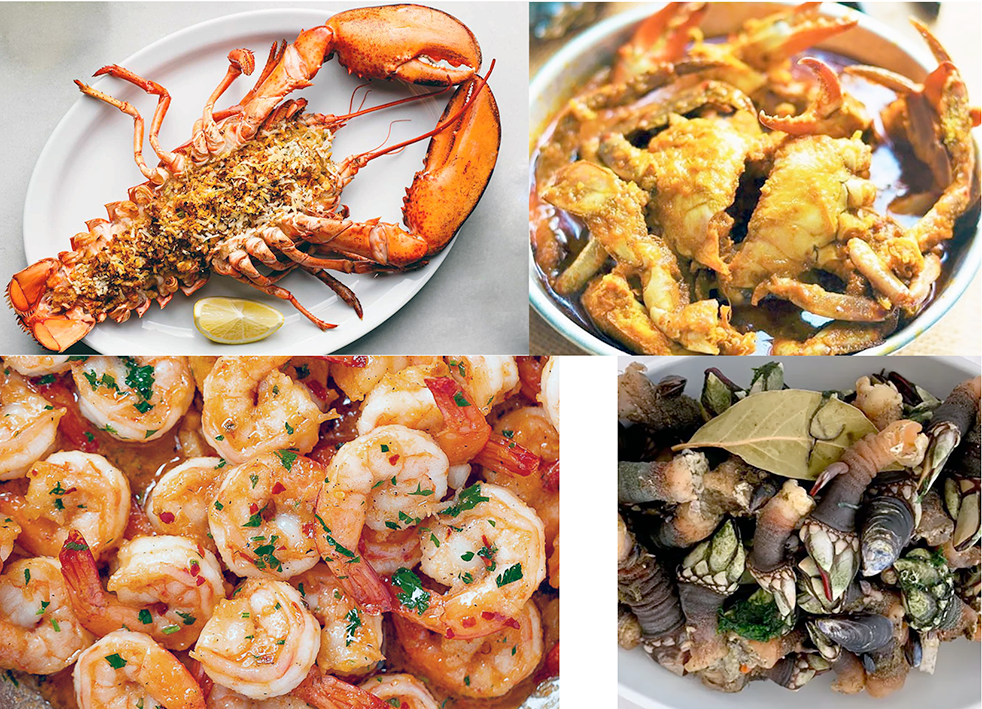 top: Grilled lobster, crab curry. Bottom: garlic prawns, boiled gooseneck barnacles.
Welcome to FabulousFusionFood's Crustacean-based Recipes Page —Crustaceans (from Latin meaning: "those with shells" or "crusted ones") are invertebrate animals that constitute one group of arthropods that are traditionally a part of the subphylum Crustacea (/krəˈsteɪʃə/), a large, diverse group of mainly aquatic arthropods including decapods (shrimps, prawns, crabs, lobsters and crayfish), seed shrimp, branchiopods, fish lice, krill, remipedes, isopods, barnacles, copepods, opossum shrimps, amphipods and mantis shrimp. The crustacean group can be treated as a subphylum under the clade Mandibulata. It is now well accepted that the hexapods (insects and entognathans) emerged deep in the crustacean group, with the completed pan-group referred to as Pancrustacea. The three classes Cephalocarida, Branchiopoda and Remipedia are more closely related to the hexapods than they are to any of the other crustaceans (oligostracans and multicrustaceans).
Most crustaceans are free-living aquatic animals, but some are terrestrial (e.g. woodlice, sandhoppers), some are parasitic (e.g. Rhizocephala, fish lice, tongue worms) and some are sessile (e.g. barnacles). The group has an extensive fossil record, reaching back to the Cambrian. More than 7.9 million tons of crustaceans per year are harvested by fishery or farming for human consumption, consisting mostly of shrimp and prawns. Krill and copepods are not as widely fished, but may be the animals with the greatest biomass on the planet, and form a vital part of the food chain. The scientific study of crustaceans is known as carcinology (alternatively, malacostracology, crustaceology or crustalogy), and a scientist who works in carcinology is a carcinologist.
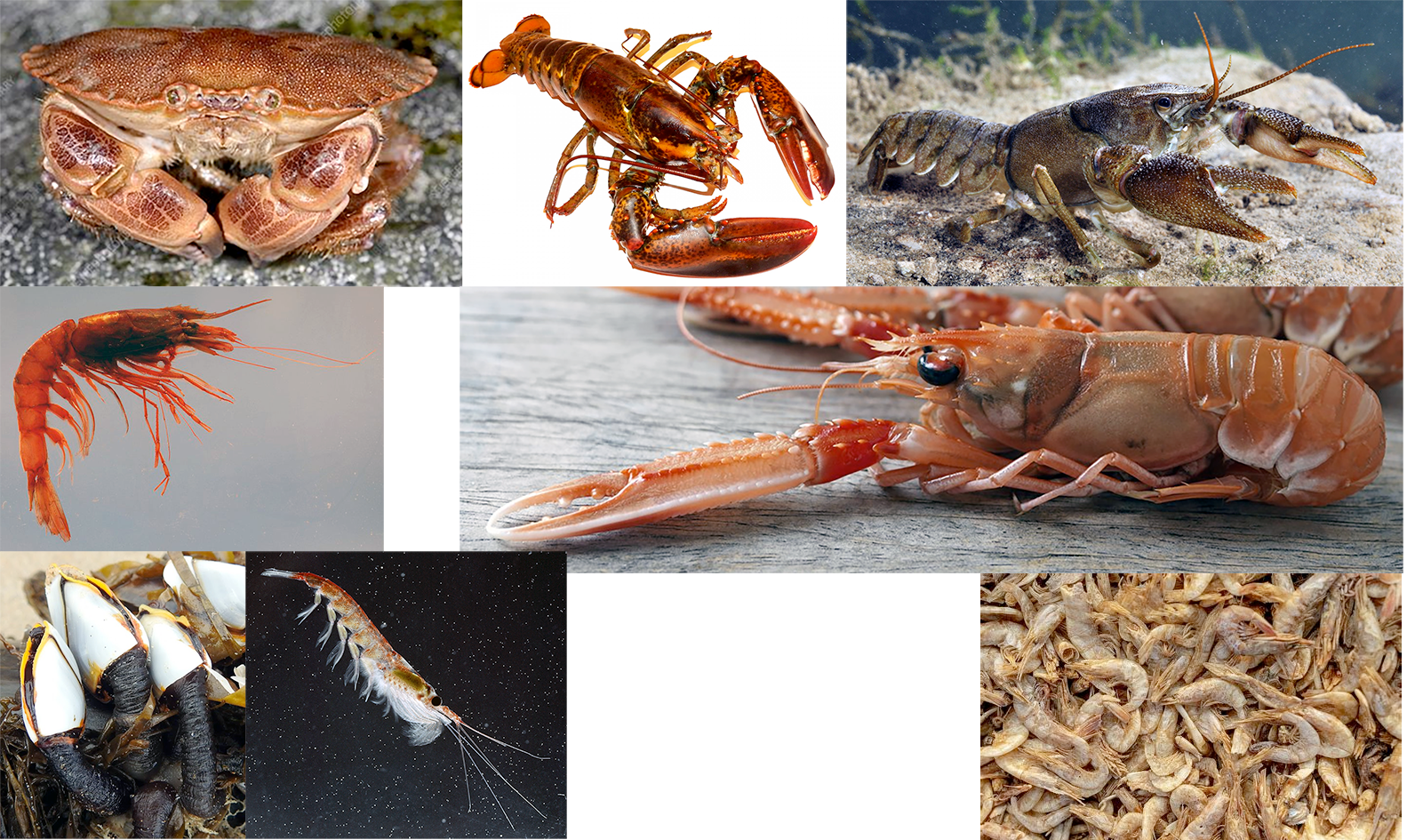 top l to r: edible brown crab, lobster. crayfish/crawfish; centre l to r: prawn/shrimp. langoustine;
bottom l to r: gooseneck barnacle, krill and West African dried prawns.
The name "crustacean" dates from the earliest works to describe the animals, including those of Pierre Belon and Guillaume Rondelet, but the name was not used by some later authors, including Carl Linnaeus, who included crustaceans among the "Aptera" in his Systema Naturae. The earliest nomenclatural valid work to use the name "Crustacea" was Morten Thrane Brünnich's Zoologiæ Fundamenta in 1772, although he also included chelicerates in the group.
The traditional classification of Crustacea based on morphology recognised four to six classes. Bowman and Abele (1982) recognised 652 extant families and 38 orders, organised into six classes: Branchiopoda, Remipedia, Cephalocarida, Maxillopoda, Ostracoda, and Malacostraca. Martin and Davis (2001) updated this classification, retaining the six classes but including 849 extant families in 42 orders. Despite outlining the evidence that Maxillopoda was non-monophyletic, they retained it as one of the six classes, although did suggest that Maxillipoda could be replaced by elevating its subclasses to classes. Since then phylogenetic studies have confirmed the polyphyly of Maxillopoda and the paraphyletic nature of Crustacea with respect to Hexapoda. Recent classifications recognise ten to twelve classes in Crustacea or Pancrustacea, with several former maxillopod subclasses now recognised as classes (e.g. Thecostraca, Tantulocarida, Mystacocarida, Copepoda, Branchiura and Pentastomida).
Many crustaceans are consumed by humans, and nearly 10,700,000 tons were harvested in 2007; the vast majority of this output is of decapod crustaceans: crabs, lobsters, shrimp, crayfish, langoustine and prawns. Over 60% by weight of all crustaceans caught for consumption are shrimp and prawns, and nearly 80% is produced in Asia, with China alone producing nearly half the world's total. Non-decapod crustaceans are not widely consumed, with only 118,000 tons of krill being caught, despite krill having one of the greatest biomasses on the planet. Krill are, however, a speciality in China and Japan and are used pickled in Korea. They are also consumed in Artic regions and are being introduced to new consumers as fusion recipes using frozen and tinned krill. Gooseneck barnacles (Pollicipes pollicipes) are a speciality of Spanish cuisine (recipes including krill and gooseneck barnacles can be found in the links below). The Pacific goose barnacle, Pollicipes elegans is also consumed, particularly in Alaska. The Japanese goose barnacle, Capitulum mitella is eaten in Japan. The Chilean giant barnacle or picoroco (Austromegabalanus psittacus) is routinely fished for food. Woodlice are sometimes consumed by foragers. Dried prawns (locally known as crawfish) are used as a flavouring and thickener in West African stews.
The alphabetical list of all the Crustacean-based recipes on this site follows, (limited to 100 recipes per page). There are 712 recipes in total:
Page 1 of 8
| Abacha Ncha (Dried Cassava with Garden Eggs) Origin: Nigeria | Aruba Sambal Tomat (Tomato Sambal) Origin: Aruba | Bouillon de Petits Crabes (Stew of Small Crabs) Origin: Mauritius |
| Abadejo a la Pimienta Verde (Pollock with Green Pepper) Origin: Spain | Asaro II (Yam Porridge) Origin: Nigeria | Braaied Balti Prawn Parcels with Spinach Rice Origin: South Africa |
| Abak (Palm Nut Soup) Origin: Nigeria | Asparagus and Crab Strata Origin: Britain | Braaied Giant Wild Prawns with Peanuts and Coconut Origin: South Africa |
| Abobora de Camarao (Prawn Abobora) Origin: Angola | Ayam Begana (Malaysian Chilli Paste) Origin: Malaysia | Braised Egg Dumplings in Chilli Broth Origin: China |
| Achaari Jhinga (Indian Pickled Prawns) Origin: India | Ayam Panggang Origin: Christmas Island | Brown Shrimp Soup with Crisp Sesame Croûtons Origin: Britain |
| Adalu (Bean and Sweetcorn Pottage) Origin: Nigeria | Ayimonlou et N'gbagba (Togolese Rice and Beans with N'gbagba) Origin: Togo | Bulgur Wan Pot Origin: Sierra Leone |
| Afang Soup Origin: Nigeria | Bahamian Crab and Rice Origin: Saint Barthelemy | Burmese Curry Paste Origin: Myanmar |
| Afia Efere (White Soup) Origin: Nigeria | Bahamian Lobster Curry Origin: Bahamas | Burrida Ligure (Genoese Fish Stew) Origin: Italy |
| Afia Efere Unen (White Soup with Chicken) Origin: Nigeria | Baked Crab Rangoon Origin: America | Buttered Crab Origin: England |
| African All Purpose Seasoning Origin: Nigeria | Balachaung Gyaw (Fried Dried Shrimp with Chillies) Origin: Myanmar | Cabbage Egusi Soup Origin: Ghana |
| Agushi Soup (Ghanaian Egusi Soup) Origin: Ghana | Balchão de Camarão (Goan Prawn Pickle) Origin: India | Cabbage Kootu (Cabbage in Coconut Milk Gravy) Origin: Malaysia |
| Air Fryer Egg Fried Rice Origin: Britain | Banankou Fida (Sokossoko with Kidneys) Origin: Guinea | Cacenni Corgimwch ac Eog â Iogwrt Mintys (Prawn and Salmon Fishcakes with Minted Yoghurt) Origin: Welsh |
| Air Fryer Meat-stuffed Mushrooms Origin: Britain | Banga Soup Origin: Nigeria | Cacenni Cranc ac Eog â Iogwrt Mintys (Crab and Salmon Fishcakes with Minted Yoghurt) Origin: Welsh |
| Akume with Ademe Sauce Origin: Togo | Barbecued Goose Barnacles with Garlic Butter Origin: America | Cajun Chicken and Seafood Gumbo Origin: Cajun |
| Alaskan Goose Barnacles Origin: America | Barbecued Prawns and Scallops with Curry-apricot Sauce Origin: American | Cajun Crayfish Bread Origin: Cajun |
| Alcapurrias de Jueyes (Crab-Stuffed Fritters) Origin: Puerto Rico | Baru Fida (Spinach Sauce with Peanuts and Beef Shank) Origin: Guinea | Cajun Crayfish Cornbread Origin: Cajun |
| Aliter in Locusta (Another Sauce for Lobster) Origin: Roman | Beef with Calabash Nutmegs Origin: Nigeria | Cajun Shrimp-stuffed Pistolettes Origin: Cajun |
| Almondigas (Filipino Meatball Soup with Sotanghon Noodles) Origin: Philippines | Beurre de crevettes grises (Brown shrimp butter) Origin: France | Calalou (Beninese Callaloo) Origin: Benin |
| Ambuyat Tempoyak Origin: Brunei | BIR King Prawn Karahi Origin: Britain | Calalou Origin: French Guiana |
| Amiwo au Poulet (Chicken Amiwo) Origin: Benin | Black Fungus Okra Soup Origin: Nigeria | Calalou aux crabes (Crab Callaloo) Origin: Guadeloupe |
| Amiwo au Poulet 2 (Amiwo with Chicken) Origin: Benin | Black-eyed Pea Gumbo Origin: Cajun | Calalu Origin: Benin |
| Amok Trey Khmer (Cambodian Fish Amok) Origin: Cambodia | Blackberry Jelly Origin: Britain | Caldo de Camarâo de Cabo Verde (Cape Verdean Prawn Stew) Origin: Cape Verde |
| Ampesi with Kontomire Stew Origin: Ghana | Bladderwrack Soup Origin: Britain | Caldo de Camaron (Prawn Soup) Origin: Mexico |
| Anardana Jheenga (Pomegranate-flavoured Prawns) Origin: India | Blue Bayou Jambalaya Origin: Cajun | Camarâes à Guineense (Guinean Prawns) Origin: Guinea-Bissau |
| Antiguan Curried King Prawns Origin: Antigua | Boeuf aux Chocolat Gabonnaise (Beef with Gabon Chocolate) Origin: Gabon | Camarão na Abóbora (Prawns in Pumpkin Shells) Origin: Mozambique |
| Antiguan Curry Butter Prawns with Plantain Grits Origin: Antigua | Bolu Foo (Prawns with Peppers) Origin: Togo | Camarões à Moda do Nacional (National-style Prawns) Origin: Mozambique |
| Antiguan Pepper Shrimp Origin: Antigua | Boogong Alamang (Fermented Krill) Origin: Philippines | Camaro Grelhado com Molho Cru (Grilled Prawns with Raw Sauce) Origin: Angola |
| Antipasto di Funghi e Gamberetti (Mushroom and Prawn Antipasto) Origin: Italy | Botvinia (Green Vegetable Soup with Fish) Origin: Russia | Camarones al Ajillo (Garlic Prawns) Origin: Uruguay |
| Apelsin och timjansfisk (Orange and Thyme Fish) Origin: Sweden | Bouillabaisse Origin: France | Camarones Guisados (Stewed Prawns) Origin: Puerto Rico |
| Apelsinfisk (Fish with Orange) Origin: Sweden | Bouillabaisse II Origin: France | Camarones Salteados (Sautéed Prawns) Origin: Ecuador |
| Arroz com Camarão (Rice with Prawns) Origin: Brazil | Bouillabaisse III Origin: France | Cameroon Fried Rice Origin: Cameroon |
| Arroz com Mariscos (Rice with Shellfish) Origin: Mozambique | Bouillabaisse with Rouille and Croutons Origin: France | Cameroonian Egusi Pudding Origin: Cameroon |
| Arroz con Calamares (Rice with Squid) Origin: Spain | Bouillon d'awara (Awara Broth) Origin: French Guiana | |
| Arroz con Camarón (Rice with Prawns) Origin: Ecuador | Bouillon de Crabes (Swimmer Crab Bouillon) Origin: Mauritius |
Page 1 of 8