FabulousFusionFood's Crustacean-based Recipes 7th Page
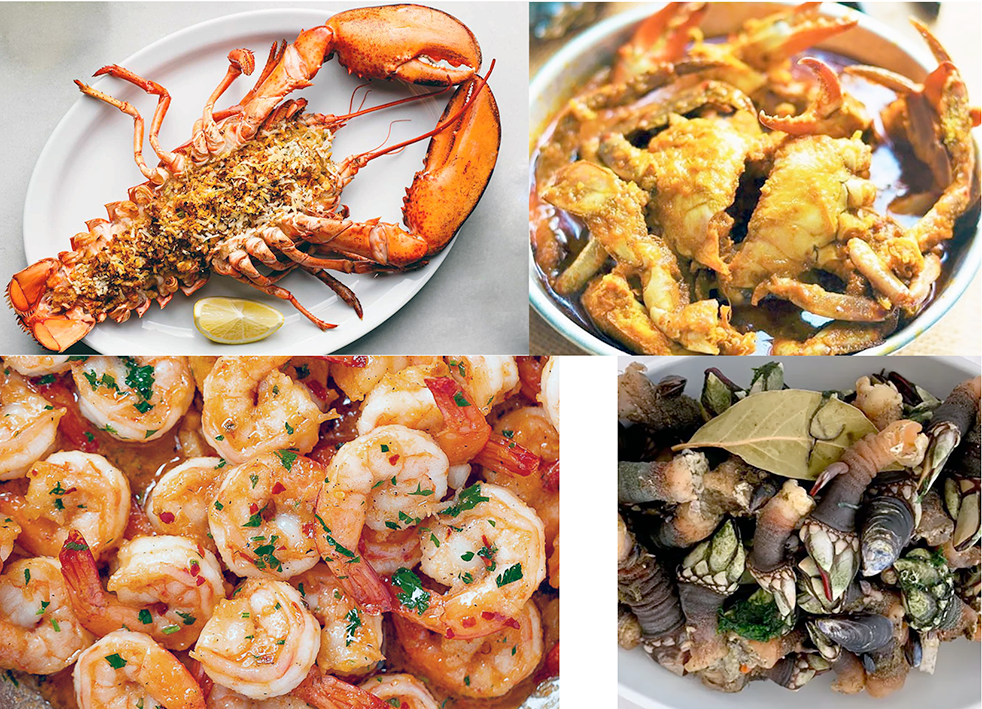 top: Grilled lobster, crab curry. Bottom: garlic prawns, boiled gooseneck barnacles.
Welcome to FabulousFusionFood's Crustacean-based Recipes Page —Crustaceans (from Latin meaning: "those with shells" or "crusted ones") are invertebrate animals that constitute one group of arthropods that are traditionally a part of the subphylum Crustacea (/krəˈsteɪʃə/), a large, diverse group of mainly aquatic arthropods including decapods (shrimps, prawns, crabs, lobsters and crayfish), seed shrimp, branchiopods, fish lice, krill, remipedes, isopods, barnacles, copepods, opossum shrimps, amphipods and mantis shrimp. The crustacean group can be treated as a subphylum under the clade Mandibulata. It is now well accepted that the hexapods (insects and entognathans) emerged deep in the crustacean group, with the completed pan-group referred to as Pancrustacea. The three classes Cephalocarida, Branchiopoda and Remipedia are more closely related to the hexapods than they are to any of the other crustaceans (oligostracans and multicrustaceans).
Most crustaceans are free-living aquatic animals, but some are terrestrial (e.g. woodlice, sandhoppers), some are parasitic (e.g. Rhizocephala, fish lice, tongue worms) and some are sessile (e.g. barnacles). The group has an extensive fossil record, reaching back to the Cambrian. More than 7.9 million tons of crustaceans per year are harvested by fishery or farming for human consumption, consisting mostly of shrimp and prawns. Krill and copepods are not as widely fished, but may be the animals with the greatest biomass on the planet, and form a vital part of the food chain. The scientific study of crustaceans is known as carcinology (alternatively, malacostracology, crustaceology or crustalogy), and a scientist who works in carcinology is a carcinologist.
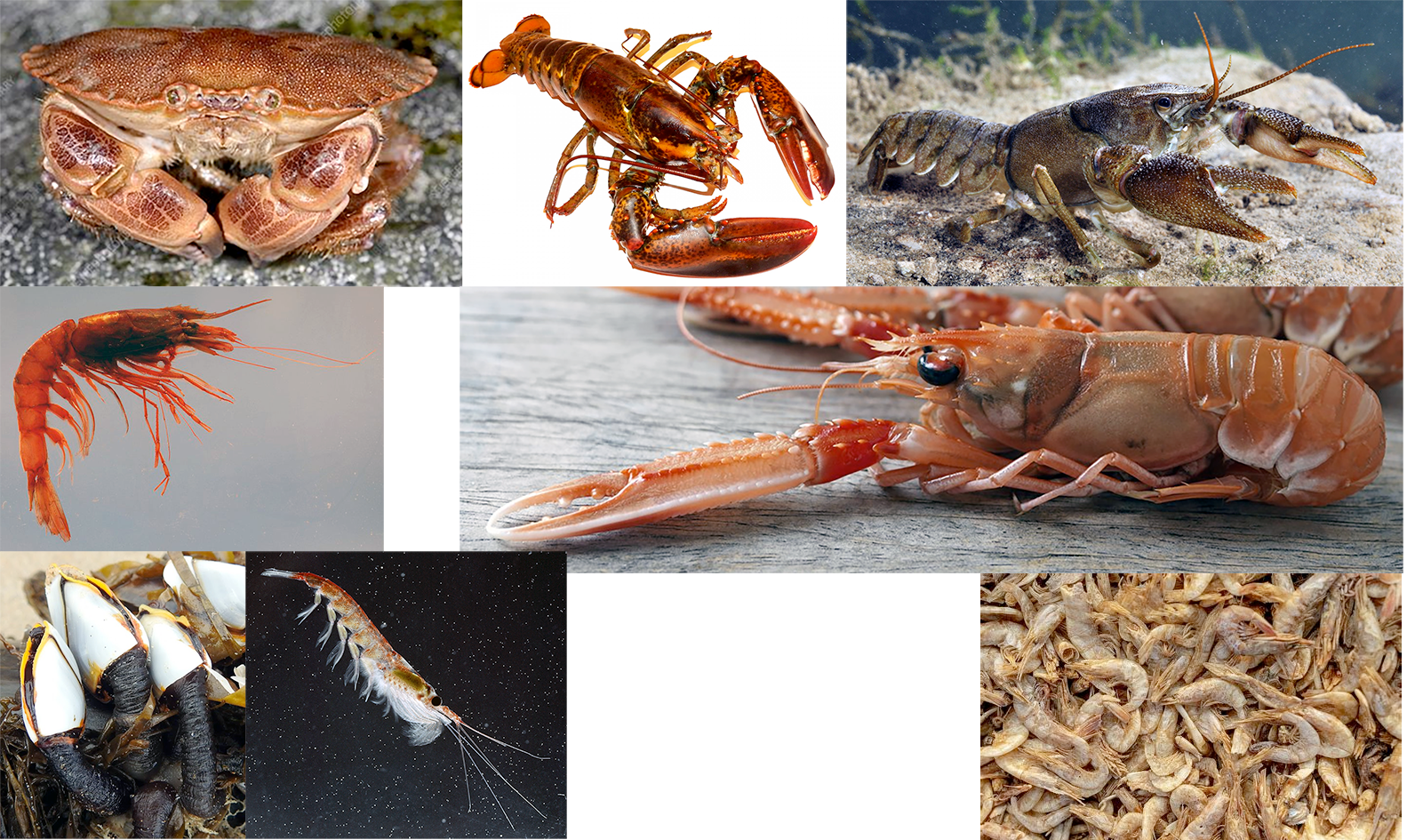 top l to r: edible brown crab, lobster. crayfish/crawfish; centre l to r: prawn/shrimp. langoustine;
bottom l to r: gooseneck barnacle, krill and West African dried prawns.
The name "crustacean" dates from the earliest works to describe the animals, including those of Pierre Belon and Guillaume Rondelet, but the name was not used by some later authors, including Carl Linnaeus, who included crustaceans among the "Aptera" in his Systema Naturae. The earliest nomenclatural valid work to use the name "Crustacea" was Morten Thrane Brünnich's Zoologiæ Fundamenta in 1772, although he also included chelicerates in the group.
The traditional classification of Crustacea based on morphology recognised four to six classes. Bowman and Abele (1982) recognised 652 extant families and 38 orders, organised into six classes: Branchiopoda, Remipedia, Cephalocarida, Maxillopoda, Ostracoda, and Malacostraca. Martin and Davis (2001) updated this classification, retaining the six classes but including 849 extant families in 42 orders. Despite outlining the evidence that Maxillopoda was non-monophyletic, they retained it as one of the six classes, although did suggest that Maxillipoda could be replaced by elevating its subclasses to classes. Since then phylogenetic studies have confirmed the polyphyly of Maxillopoda and the paraphyletic nature of Crustacea with respect to Hexapoda. Recent classifications recognise ten to twelve classes in Crustacea or Pancrustacea, with several former maxillopod subclasses now recognised as classes (e.g. Thecostraca, Tantulocarida, Mystacocarida, Copepoda, Branchiura and Pentastomida).
Many crustaceans are consumed by humans, and nearly 10,700,000 tons were harvested in 2007; the vast majority of this output is of decapod crustaceans: crabs, lobsters, shrimp, crayfish, langoustine and prawns. Over 60% by weight of all crustaceans caught for consumption are shrimp and prawns, and nearly 80% is produced in Asia, with China alone producing nearly half the world's total. Non-decapod crustaceans are not widely consumed, with only 118,000 tons of krill being caught, despite krill having one of the greatest biomasses on the planet. Krill are, however, a speciality in China and Japan and are used pickled in Korea. They are also consumed in Artic regions and are being introduced to new consumers as fusion recipes using frozen and tinned krill. Gooseneck barnacles (Pollicipes pollicipes) are a speciality of Spanish cuisine (recipes including krill and gooseneck barnacles can be found in the links below). The Pacific goose barnacle, Pollicipes elegans is also consumed, particularly in Alaska. The Japanese goose barnacle, Capitulum mitella is eaten in Japan. The Chilean giant barnacle or picoroco (Austromegabalanus psittacus) is routinely fished for food. Woodlice are sometimes consumed by foragers. Dried prawns (locally known as crawfish) are used as a flavouring and thickener in West African stews.
The alphabetical list of all the Crustacean-based recipes on this site follows, (limited to 100 recipes per page). There are 712 recipes in total:
Page 7 of 8
| Shacha Sauce Origin: Taiwan | Spring Rolls Origin: Fusion | Thai Yellow Curry Paste Origin: Thailand |
| Shito (Dark Chilli Sambal) Origin: Ghana | Spring Rolls with Pork and Shrimp Origin: China | Thai-style Red Seafood Curry Origin: Fusion |
| Shito (Ghanaian Black Chilli Sauce) Origin: Ghana | St Helena Crab Soup Origin: St Helena | Thiebou Kéthiakh (Rice with Dried Fish, Seafood and Vegetables) Origin: Senegal |
| Shitor Din Origin: Ghana | Steamed Black-eyed Bean Dumplings Origin: Ghana | To Dress Crab Origin: Britain |
| Shorshe Chingri (Bengali Prawns and Sea Blite) Origin: Bangladesh | Steamed Crawfish Origin: Liberia | To make Verjuyce. Origin: Britain |
| Shrimp and Corn Chowder Origin: American | Steamed Prawns with Wolfberries Origin: Singapore | Tobago Curry Crab and Dumplings Origin: India |
| Shrimp Sauce Origin: Britain | Stiw Pysgotwr (Fisherman's Stew) Origin: Welsh | Tom Yam Goong 1 Origin: Thailand |
| Shrimp Sauce Origin: Britain | Street Food Pad Thai Origin: Thailand | Tom Yam Goong 2 Origin: Thailand |
| Sierra Leonean White Okra Draw Soup Origin: Sierra Leone | Stufato del Pescatore (Italian Fisherman's Stew) Origin: Italy | Tom Yam Goong Maenam Origin: Thailand |
| Sigá (Prawn and Okra Stew) Origin: Guinea-Bissau | Stuffed Morels Origin: American | Tom Yum Talay (Fish Stew) Origin: Thailand |
| Simple Prawn Laksa Origin: Fusion | Surf and Turf Kebabs Origin: Britain | Toshikoshi Soba (New Year's Eve Soba) Origin: Japan |
| Singapore Hokkien Mee Origin: Singapore | Surinamese Nasi Goreng Origin: Suriname | Trassie Trafasie (Suriname Shrimp Paste Sauce) Origin: Suriname |
| Sint Maarten Crab Backs Origin: Sint Maarten | Tähroro (Fermented Coconut Sauce) Origin: Rotuma | Traybake Keralan Fish Curry Origin: Fusion |
| Smoked haddock with Potato Mash Origin: Ireland | Tai Monomono (Fermented Coconut Sauce) Origin: Cook Islands | Trini Curried Shrimp Patty Origin: Trinidad |
| Smoky Fish Skewers Origin: Britain | Taioro Origin: Tahiti | Trinidad Crab and Callaloo Origin: Trinidad |
| Smoky Prawn Jollof Rice Origin: Nigeria | Taiwanese Hot Pot Origin: Taiwan | Trinidadian Crab Backs Origin: Trinidad |
| Smoky Prawns with Tomato and Coriander Origin: Fusion | Tam Mak Hoong (Laotian Papaya Salad) Origin: Laos | Trinidadian Fried Wontons Origin: Trinidad |
| Smörgåstårta (Swedish Savoury Sandwich Cake) Origin: Sweden | Tam Som (Lao Green Papaya Salad) Origin: Laos | Trout Kedgeree Origin: Britain |
| Smørbrødterte (Norwegian Savoury Sandwich Cake) Origin: Norway | Tandoori King Prawns Origin: India | Turkey and Yam Pepper Soup Origin: Nigeria |
| Sneezewort Arroz de Jambú Origin: Britain | Tandoori King Prawns Origin: Britain | Tuvaluan Crab Curry Origin: Tuvalu |
| Soft-wrapped Pork and Prawn Rolls Origin: Fusion | Tapado (Seafood Soup) Origin: Guatemala | Udang Masak Lemak Nenas (Pineapple Prawn Curry) Origin: Malaysia |
| Sole avec La Sauce Joinville (Sole with Joinville Sauce) Origin: France | Taro aux Fruits de Mer (Taro with Seafood) Origin: Cote dIvoire | Ukaeb (Minced Crab with Coconut Cream) Origin: Palau |
| Sole Fillets Stuffed with Mixed Wild Mushrooms and Ricotta Cheese Origin: Britain | Teisennau Cranc wedi'u Grilio (Barbecued Crab Cakes) Origin: Welsh | Ukwa (Breadfruit Porridge) Origin: Nigeria |
| Som Tam (Thai Green Papaya Salad) Origin: Thailand | Terung Saus Santan (Fried Aubergines with Coconut Milk) Origin: Papua | Ulkoy (Palauan Shrimp Patties) Origin: Palau |
| Somlar Kari Saek Mouan (Chicken Red Curry) Origin: Cambodia | Thai Crab and Sea-blite Curry Origin: Thailand | Ulkoy (Filipino Shrimp Patties) Origin: Philippines |
| Soupe Kandja Origin: Mali | Thai Green Curry of Prawn and Fish Origin: Thailand | Urap (Steamed Vegetables with Coconut) Origin: Brunei |
| Spanish Prawns Origin: Britain | Thai Green Curry Paste Origin: Thailand | Vary sy laoka malagasy (Malagasy Prawn Curry with Vanilla Rice) Origin: Madagascar |
| Special Efo Riro Origin: Nigeria | Thai Green Curry Paste II Origin: Thailand | Victorian Green Saag with Prawns Origin: Anglo-Indian |
| Spiced Crab Apples Origin: Britain | Thai Hake Bites Origin: South Africa | West African-style Barbecue Sauce Origin: African Fusion |
| Spiced Guinea Fowl Peppersoup Origin: Nigeria | Thai Mango Fish Curry Origin: Thailand | White Crab and Cabbage Shanghai Buns Origin: China |
| Spicy Cranberry Shrimp Origin: America | Thai Pork Curry in the Burmese Style Origin: Myanmar | Whitebeam Berry Jelly Origin: Britain |
| Spicy Prawns and Green Lentils Origin: Fusion | Thai Red Curry Paste Origin: Thailand | Wildberry Crisp Origin: Britain |
| Spider Crab Casserole Origin: Britain | Thai Red Curry Paste Origin: Thailand | |
| Spider-crab Salad with Cornish Earlies Origin: Britain | Thai Shrimp Soup Origin: Thailand |
Page 7 of 8