FabulousFusionFood's Crustacean-based Recipes 5th Page
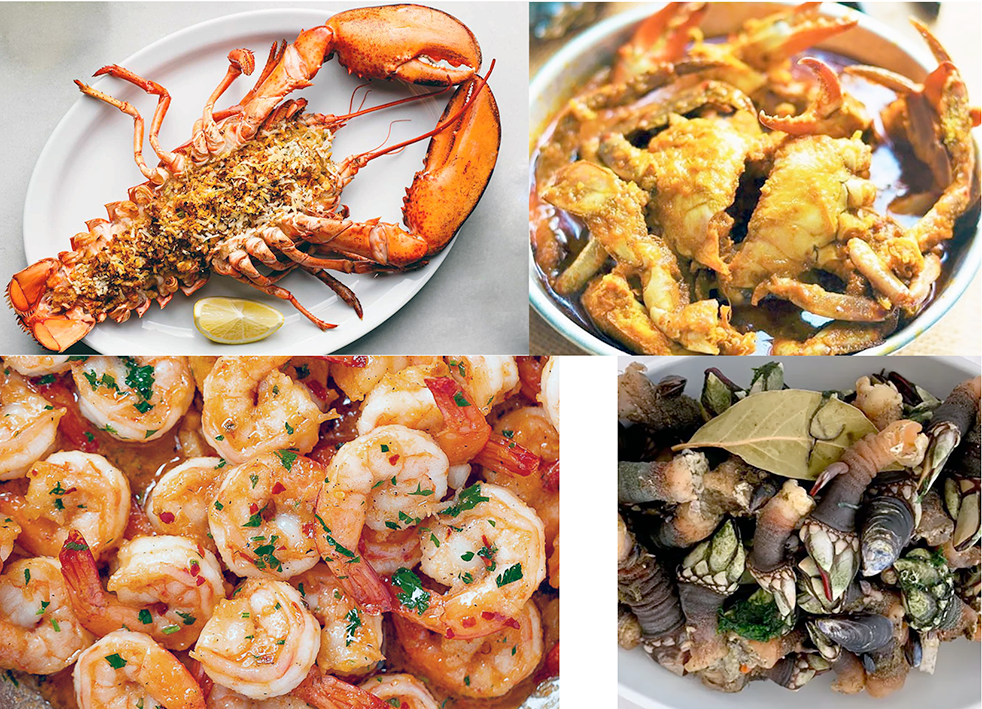 top: Grilled lobster, crab curry. Bottom: garlic prawns, boiled gooseneck barnacles.
Welcome to FabulousFusionFood's Crustacean-based Recipes Page —Crustaceans (from Latin meaning: "those with shells" or "crusted ones") are invertebrate animals that constitute one group of arthropods that are traditionally a part of the subphylum Crustacea (/krəˈsteɪʃə/), a large, diverse group of mainly aquatic arthropods including decapods (shrimps, prawns, crabs, lobsters and crayfish), seed shrimp, branchiopods, fish lice, krill, remipedes, isopods, barnacles, copepods, opossum shrimps, amphipods and mantis shrimp. The crustacean group can be treated as a subphylum under the clade Mandibulata. It is now well accepted that the hexapods (insects and entognathans) emerged deep in the crustacean group, with the completed pan-group referred to as Pancrustacea. The three classes Cephalocarida, Branchiopoda and Remipedia are more closely related to the hexapods than they are to any of the other crustaceans (oligostracans and multicrustaceans).
Most crustaceans are free-living aquatic animals, but some are terrestrial (e.g. woodlice, sandhoppers), some are parasitic (e.g. Rhizocephala, fish lice, tongue worms) and some are sessile (e.g. barnacles). The group has an extensive fossil record, reaching back to the Cambrian. More than 7.9 million tons of crustaceans per year are harvested by fishery or farming for human consumption, consisting mostly of shrimp and prawns. Krill and copepods are not as widely fished, but may be the animals with the greatest biomass on the planet, and form a vital part of the food chain. The scientific study of crustaceans is known as carcinology (alternatively, malacostracology, crustaceology or crustalogy), and a scientist who works in carcinology is a carcinologist.
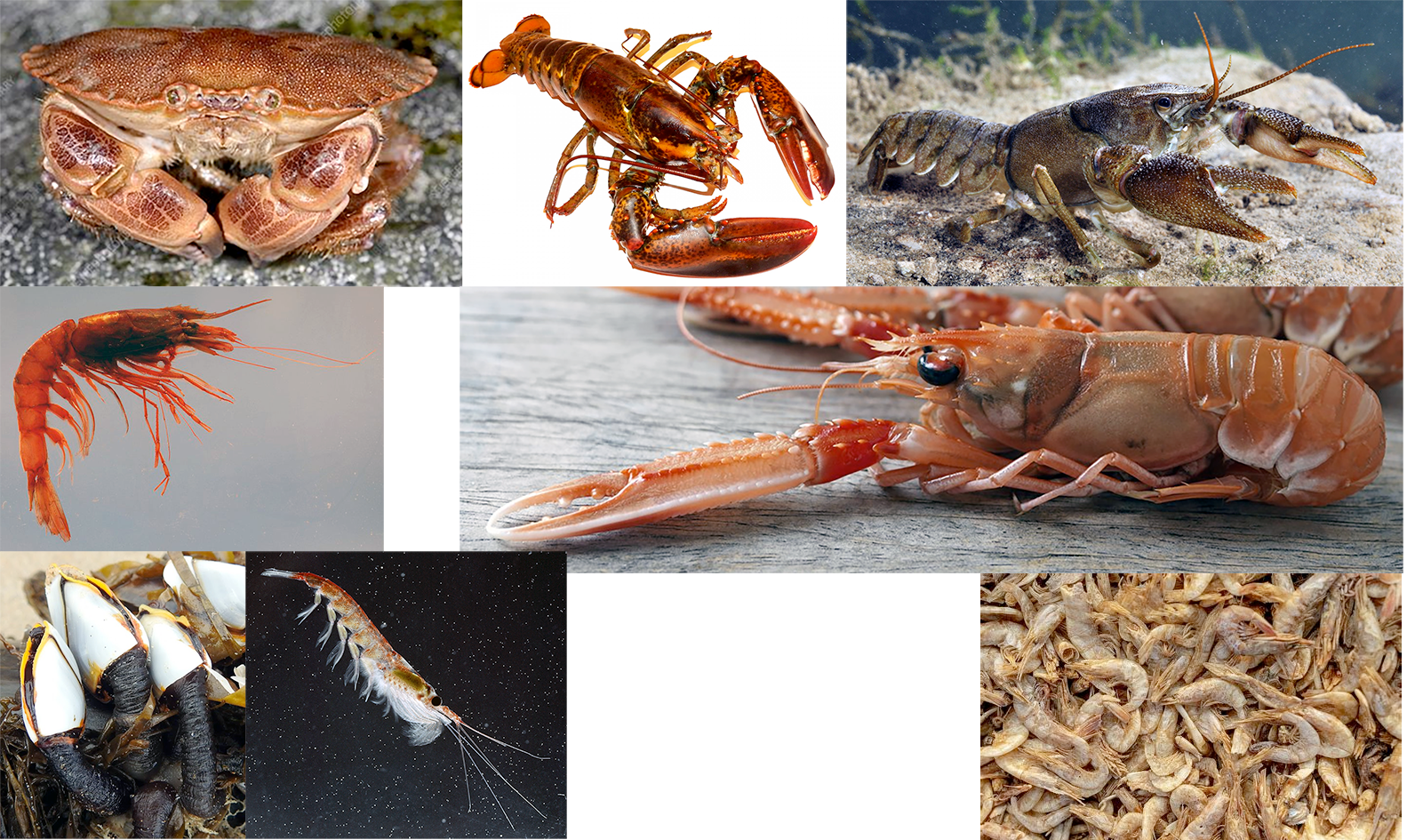 top l to r: edible brown crab, lobster. crayfish/crawfish; centre l to r: prawn/shrimp. langoustine;
bottom l to r: gooseneck barnacle, krill and West African dried prawns.
The name "crustacean" dates from the earliest works to describe the animals, including those of Pierre Belon and Guillaume Rondelet, but the name was not used by some later authors, including Carl Linnaeus, who included crustaceans among the "Aptera" in his Systema Naturae. The earliest nomenclatural valid work to use the name "Crustacea" was Morten Thrane Brünnich's Zoologiæ Fundamenta in 1772, although he also included chelicerates in the group.
The traditional classification of Crustacea based on morphology recognised four to six classes. Bowman and Abele (1982) recognised 652 extant families and 38 orders, organised into six classes: Branchiopoda, Remipedia, Cephalocarida, Maxillopoda, Ostracoda, and Malacostraca. Martin and Davis (2001) updated this classification, retaining the six classes but including 849 extant families in 42 orders. Despite outlining the evidence that Maxillopoda was non-monophyletic, they retained it as one of the six classes, although did suggest that Maxillipoda could be replaced by elevating its subclasses to classes. Since then phylogenetic studies have confirmed the polyphyly of Maxillopoda and the paraphyletic nature of Crustacea with respect to Hexapoda. Recent classifications recognise ten to twelve classes in Crustacea or Pancrustacea, with several former maxillopod subclasses now recognised as classes (e.g. Thecostraca, Tantulocarida, Mystacocarida, Copepoda, Branchiura and Pentastomida).
Many crustaceans are consumed by humans, and nearly 10,700,000 tons were harvested in 2007; the vast majority of this output is of decapod crustaceans: crabs, lobsters, shrimp, crayfish, langoustine and prawns. Over 60% by weight of all crustaceans caught for consumption are shrimp and prawns, and nearly 80% is produced in Asia, with China alone producing nearly half the world's total. Non-decapod crustaceans are not widely consumed, with only 118,000 tons of krill being caught, despite krill having one of the greatest biomasses on the planet. Krill are, however, a speciality in China and Japan and are used pickled in Korea. They are also consumed in Artic regions and are being introduced to new consumers as fusion recipes using frozen and tinned krill. Gooseneck barnacles (Pollicipes pollicipes) are a speciality of Spanish cuisine (recipes including krill and gooseneck barnacles can be found in the links below). The Pacific goose barnacle, Pollicipes elegans is also consumed, particularly in Alaska. The Japanese goose barnacle, Capitulum mitella is eaten in Japan. The Chilean giant barnacle or picoroco (Austromegabalanus psittacus) is routinely fished for food. Woodlice are sometimes consumed by foragers. Dried prawns (locally known as crawfish) are used as a flavouring and thickener in West African stews.
The alphabetical list of all the Crustacean-based recipes on this site follows, (limited to 100 recipes per page). There are 712 recipes in total:
Page 5 of 8
| Locustam et Scillas (Lobsters and Prawns) Origin: Roman | Mines Frites Origin: Mauritius | Nyeleng (Beef and Peanut Gumbo) Origin: Senegal |
| Locustas Assas sic Facies (Roast Lobster is Made Thus) Origin: Roman | Mini Crab Cakes Origin: Fusion | Nyona Penang Assam Laska Origin: Malaysia |
| Logosta Assada (Roasted Lobster) Origin: Guinea-Bissau | Miti Hue (Fermented Coconut Sauce) Origin: Tahiti | Nyonya Curry Paste Origin: Singapore |
| Lourenço Marques Prawns Origin: South Africa | Monkfish Skewers with Coconut and Coriander Origin: Britain | Oat-crusted Fish Pie Origin: Scotland |
| Lucky Prawns and Lotus Seeds Origin: China | Monlar Oo Chin Ye Hin (Myanmar Tangy Soup) Origin: Myanmar | Obe Ata Dindin (Nigerian Red Sauce) Origin: Nigeria |
| M'Boa com Xima (Pumpkin Leaves in Peanut Sauce with Prawns) Origin: Mozambique | Monterey Jack Cheese, Olive and Prawn Dip Origin: American | Ocopa de Camarones (Prawn Ocopa) Origin: Peru |
| Maelgi Rhost a Saws Bara Lawr (Roast Monkfish and Laverbread Sauce) Origin: Welsh | Montserrat Jerk Prawns Origin: Montserrat | Ofada-Ugba Jollof (Fermented Jollof Rice) Origin: Nigeria |
| Maffi Hakko Bangtura (Sweet Potato Leaf Sauce) Origin: Guinea | Moqueca de Camarão (Prawn Stew) Origin: Angola | Ofe Ugba (Ugba Soup) Origin: Nigeria |
| Mala Long Xia (Chinese Spicy Crayfish) Origin: China | Moyin-Moyin Origin: Nigeria | Ofe-Owerri Soup Origin: Nigeria |
| Mala Long Xia (Chinese Spicy Crayfish) Origin: China | Mozambique Prawns Origin: Mozambique | Ogbono Soup Origin: Nigeria |
| Malaysian Goat Rendang Origin: Malaysia | Mrs Beeton's Shrimp Sauce Origin: British | Ogbono Soup with Ugwu Origin: Nigeria |
| Malaysian Kapitan Chicken Origin: Malaysia | N'dolé (Bitterleaf Stew) Origin: Cameroon | Ogbono Soup with Waterleaf Origin: Nigeria |
| Malaysian Laksa Origin: Malaysia | N'dolé avec Poulet (Chicken N'Dolé) Origin: Cameroon | Ojojo Origin: Nigeria |
| Malaysian Lamb Rendang Origin: Malaysia | Nam Prig Pow (Roasted Chilli Paste) Origin: Thailand | Ojojo II Origin: Nigeria |
| Mallow Leaf Gumbo Origin: Britain | Nam Prig Pud (Fried Chill Paste) Origin: Thailand | Okro Soup Origin: Nigeria |
| Mandarin Prawns Origin: Fusion | Nam Prik Pao (Thai Chilli Paste) Origin: Thailand | Otong Soup Origin: Nigeria |
| Mangalorean Prawn Sukka Origin: India | Nasi Goreng Istimewa (Fried Rice Breakfast) Origin: Indonesia | Ouassous dans la nage (Ouassous in the swim) Origin: Guadeloupe |
| Mangoé Rafalari (Spicy Mango Stew) Origin: Guinea | Nasi Lemak Origin: Malaysia | Pâtissons Farcis (Stuffed Squash) Origin: Mauritius |
| Manhattan Seafood Stew Origin: American | Nasi Lemak Origin: Cocos Islands | Pè Thee Thoke (String Bean Salad) Origin: Myanmar |
| Masak Lemak (Cabbage in Coconut Milk Gravy) Origin: Malaysia | Nasi Lemak Origin: Singapore | Pèpè Soup du Cameroun (Cameroonian Pepper Soup) Origin: Cameroon |
| Massaman Curry Paste Origin: Thailand | Nasi Lemak Origin: Christmas Island | Pad Thai Origin: Thailand |
| Matapa Origin: Mozambique | Ndolé à la Viande (Bitterleaf with Meat) Origin: Cameroon | Paella de Carne de Caza (Bushmeat Paella) Origin: Equatorial Guinea |
| Matapa de Abóbora (Pumpkin Matapa) Origin: Mozambique | Ndomba de Poisson (Fish Cooked in Banana Leaves) Origin: Cameroon | Paella Valencia Origin: Spain |
| Matsavo (Pumpkin Leaf and Peanut Flour Stew) Origin: Mozambique | Nettle Greens and Peanut Stew Origin: African Fusion | Palaver 'Sauce' Origin: West Africa |
| Mauritian Prawn Curry Origin: Mauritius | Nigerian Beans Porridge Origin: Nigeria | Palm Butter Soup Origin: Liberia |
| Mazavaroo Origin: Mauritius | Nigerian Fresh Fish Pepper Soup Origin: Nigeria | Pan-fried Squat Lobsters Origin: England |
| Mbanga Soup (Palm Nut Soup) Origin: Cameroon | Nigerian Groundnut Soup Origin: Nigeria | Panang Curry Paste Origin: Thailand |
| Mbolo Origin: Equatorial Guinea | Nigerian Guineafowl Pepper Soup Origin: Nigeria | Partan Bree Origin: Scotland |
| Mchuzi wa Kamba (Zanzibar Prawn Curry) Origin: Tanzania | Nigerian Pancakes with Prawns Origin: Nigeria | Pawpaw Stew Origin: Ghana |
| Megrim Sole Olives with Squat Lobster Stuffing Origin: Britain | Nigerian Spiced Chicken Pepper Soup Origin: Nigeria | Pazun Hin (Prawn Curry) Origin: Myanmar |
| Meygoo Dopiyazeh (Persian Prawn, Pepper and Onion Curry) Origin: Iran | Nigerian Spiced Goat Meat Pepper Soup Origin: Nigeria | Pe Kyar Zan Thoke (Glass Noodle Salad) Origin: Myanmar |
| Microwave Jambalaya Origin: Britain | Nigerian Spiced Grasscutter Pepper Soup Origin: Nigeria | Peanut Soup Origin: West Africa |
| Microwave Prawn Gumbo Origin: Britain | Njandu Curry (Kerala Crab Curry) Origin: India | |
| Microwave Three Fish Soup Origin: Britain | Njanga Rice Origin: Cameroon |
Page 5 of 8