FabulousFusionFood's Bonairean Recipes Home Page
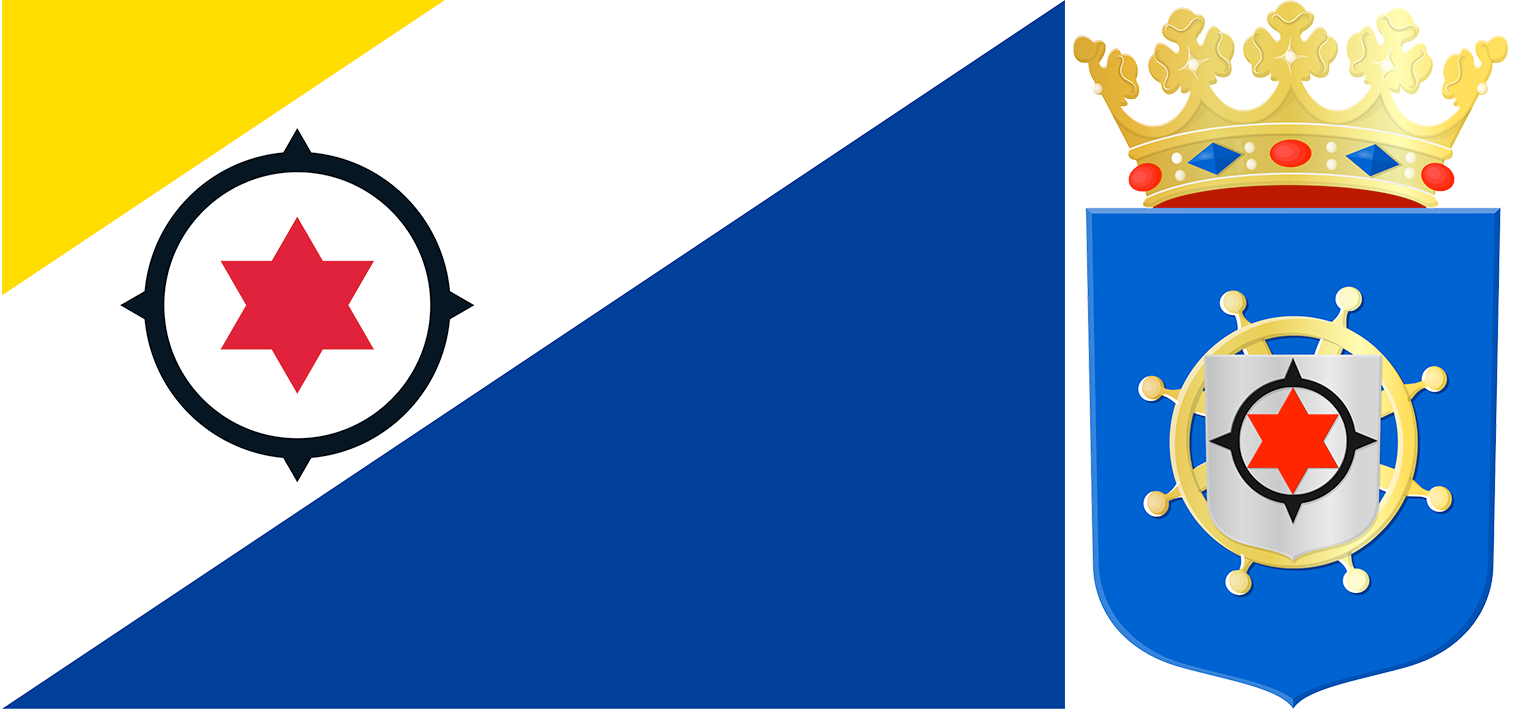 The flag of Bonaire (left) and the coat of
arms of Bonaire (right).
Welcome to the summary page for FabulousFusionFood's Bonairean recipes, part of the Caribbean. This page provides links to all the Bonaire recipes presented on this site, with 20 recipes in total.
This is a continuation of an entire series of pages that will, I hope, allow my visitors to better navigate this site. As well as displaying recipes by name, country and region of origin I am now planning a whole series of pages where recipes can be located by meal type and main ingredient. This page gives a listing of all the Bonairean recipes added to this site.
Bonaire is a Caribbean island in the Leeward Antilles, and is a special municipality (officially "public body") of the Netherlands. Its capital is the port of Kralendijk, on the west (leeward) coast of the island.
Local Bonairean food is called Krioyo (pronounced the same as criollo, the Spanish word for "Creole") and boasts a blend of flavours and techniques best compared to Caribbean cuisine and Latin American cuisine. Dishes common in Bonaire are found in Aruba and Curaçao as well. Popular dishes include stobá (a stew made with various ingredients such as papaya, beef or goat), Guiambo (soup made from okra and seafood), kadushi (cactus soup), sopi mondongo (intestine soup), funchi (cornmeal paste similar to fufu, ugali and polenta) and fish and other seafood. The ubiquitous side dish is fried plantain.
Bonaire (Boneiru in Papiamento) is a Caribbean island in the Leeward Antilles, and is a special municipality (officially 'public body') of the Netherlands. Its capital is the port of Kralendijk, on the west (leeward) coast of the island. Aruba, Bonaire and Curaçao form the ABC islands, 80 km (50 miles) off the coast of Venezuela. The islands have an arid climate that attracts visitors seeking warm, sunny weather all year round, and they lie outside the Main Development Region for tropical cyclones. Bonaire is a popular snorkeling and scuba diving destination because of its multiple shore diving sites, shipwrecks and easy access to the island's fringing reefs.
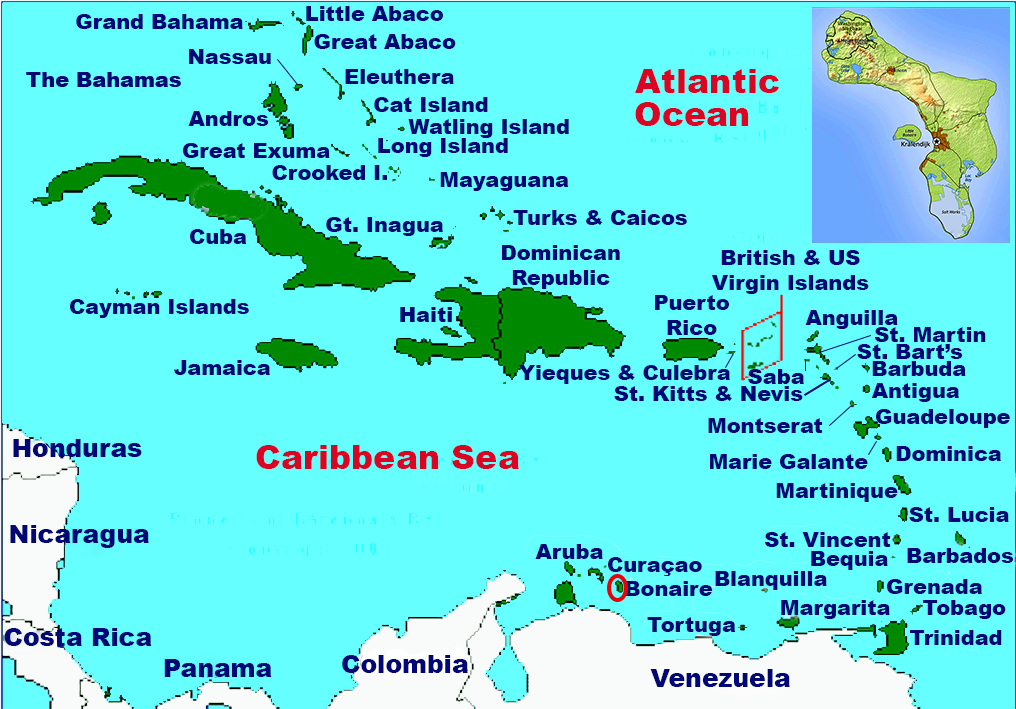 Image of the Caribbean with the location of Bonaire picked out
and circled, a blow-up map of Bonaire is show, inset.As of 1 January 2025, the island's population total 26,552 permanent residents, an increase of 10,011 since 2012. The island's total land area is 288km2; it is 38.6 kilometres (24.0 mi) long from north to south, and ranges from 5–8 km (3–5 mi) wide from east to west. A short 800 metres (0.50 mi) west of Bonaire across the sea is the uninhabited islet of Klein Bonaire with a total land area of 6 km2. Klein Bonaire has low-growing vegetation including cactus (Papiamentu: kadushi), with sparse palm trees near the water and is bordered by white sandy beaches and a fringing reef. The reefs, beaches and on-island reserves located on both Bonaire and Klein Bonaire are under the protection of the Bonaire National Marine Park, and managed by STINAPA Bonaire.
Bonaire was part of the Netherlands Antilles until the country's dissolution in 2010, when the island became a special municipality (officially, a 'Caribbean public body') within the country of the Netherlands.[16] It is one of three special municipalities in the Caribbean; the others are Sint Eustatius and Saba. 80% of Bonaire's inhabitants are Dutch nationals, and nearly 60% of its residents were born in the former Netherlands Antilles and Aruba.
Etymology: The name 'Bonaire' is thought to be derived from the Caquetio word 'Bonay', meaning 'low country'. The early Spanish and Dutch modified its spelling to Bojnaj and also Bonaire. French influence, while present at various times, was never strong enough to make the assumption that the name means 'good air'. According to another theory, the name might be derived from the Spanish phrase 'buen aire', which does mean 'good air', as the Spanish were the first Europeans to colonise the island.
This is a continuation of an entire series of pages that will, I hope, allow my visitors to better navigate this site. As well as displaying recipes by name, country and region of origin I am now planning a whole series of pages where recipes can be located by meal type and main ingredient. This page gives a listing of all the Bonairean recipes added to this site.
Bonaire is a Caribbean island in the Leeward Antilles, and is a special municipality (officially "public body") of the Netherlands. Its capital is the port of Kralendijk, on the west (leeward) coast of the island.
Local Bonairean food is called Krioyo (pronounced the same as criollo, the Spanish word for "Creole") and boasts a blend of flavours and techniques best compared to Caribbean cuisine and Latin American cuisine. Dishes common in Bonaire are found in Aruba and Curaçao as well. Popular dishes include stobá (a stew made with various ingredients such as papaya, beef or goat), Guiambo (soup made from okra and seafood), kadushi (cactus soup), sopi mondongo (intestine soup), funchi (cornmeal paste similar to fufu, ugali and polenta) and fish and other seafood. The ubiquitous side dish is fried plantain.
Bonaire (Boneiru in Papiamento) is a Caribbean island in the Leeward Antilles, and is a special municipality (officially 'public body') of the Netherlands. Its capital is the port of Kralendijk, on the west (leeward) coast of the island. Aruba, Bonaire and Curaçao form the ABC islands, 80 km (50 miles) off the coast of Venezuela. The islands have an arid climate that attracts visitors seeking warm, sunny weather all year round, and they lie outside the Main Development Region for tropical cyclones. Bonaire is a popular snorkeling and scuba diving destination because of its multiple shore diving sites, shipwrecks and easy access to the island's fringing reefs.
Image of the Caribbean with the location of Bonaire picked outand circled, a blow-up map of Bonaire is show, inset.
Bonaire was part of the Netherlands Antilles until the country's dissolution in 2010, when the island became a special municipality (officially, a 'Caribbean public body') within the country of the Netherlands.[16] It is one of three special municipalities in the Caribbean; the others are Sint Eustatius and Saba. 80% of Bonaire's inhabitants are Dutch nationals, and nearly 60% of its residents were born in the former Netherlands Antilles and Aruba.
Etymology: The name 'Bonaire' is thought to be derived from the Caquetio word 'Bonay', meaning 'low country'. The early Spanish and Dutch modified its spelling to Bojnaj and also Bonaire. French influence, while present at various times, was never strong enough to make the assumption that the name means 'good air'. According to another theory, the name might be derived from the Spanish phrase 'buen aire', which does mean 'good air', as the Spanish were the first Europeans to colonise the island.
Bonairean Cuisine:
Local food is called Krioyo (pronounced the same as criollo, the Spanish word for 'Creole') and boasts a blend of flavours and techniques best compared to Caribbean cuisine and Latin American cuisine. Dishes common in Bonaire are found in Aruba and Curaçao as well. Popular dishes include stobá (a stew made with various ingredients such as papaya, beef or goat), Guiambo (soup made from okra and seafood), kadushi (cactus soup), sopi mondongo (intestine soup), funchi (cornmeal paste similar to fufu, ugali and polenta) and fish and other seafood. The ubiquitous side dish is fried plantain. Local bread rolls are made according to a Portuguese recipe. The island also has a number of Chinese restaurants that serve mainly Indonesian dishes such as satay, nasi goreng and lumpia (which are all Indonesian names for the dishes). Dutch specialties such as croquettes and oliebollen are widely served in homes and restaurants.Bonaire's National Dishes:
Below are listed the dishes considered to be Bonaire's national foods along with links to the recipes for those dishes:| Kabritu Stoba (Goat Stew) Origin: Bonaire |
The alphabetical list of all the Bonairean recipes on this site follows, (limited to 100 recipes per page). There are 20 recipes in total:
Page 1 of 1
| Kabritu Stoba (Goat Stew) Origin: Bonaire | Funchi (Polenta) Origin: Bonaire | Mankaron (Antillean Macaron) Origin: Bonaire |
| Arepa di Pampuna (Pumpkin Pancakes) Origin: Bonaire | Ham di Pasku (Easter or Holiday Ham) Origin: Bonaire | Saté ku batata (Satay with Potatoes) Origin: Bonaire |
| Bakiou Stobá (Salt Cod Stew) Origin: Bonaire | Igra Stobá (Liver Stew) Origin: Bonaire | Siboyo den pika (Onions in Hot Sauce) Origin: Bonaire |
| Bonaire Green Seasoning Origin: Bonaire | Jambo (Okra Soup) Origin: Bonaire | Sopa di Bonchi Korá (Red Kidney Bean Soup) Origin: Bonaire |
| Caribische kruidenmix (Caribbean Spice Blend) Origin: Bonaire | Kabritu Stoba (Goat Stew) Origin: Bonaire | Sopi di Piská (Fish Soup) Origin: Bonaire |
| Cheese Pastechi Origin: Bonaire | Karko Stobá (Queen Conch Stew) Origin: Bonaire | Stroopwafels Origin: Bonaire |
| Coconut Tart Origin: Bonaire | Kokada (Bonaire Coconut Candy) Origin: Bonaire |
Page 1 of 1