Alexis Soyer's Part 23: Conversation on Household Affairs
Conversation on Household Affairs.
Mrs. L. After all the receipts and information which you have given me, there is one which you have not touched upon yet, which, perhaps, is of more importance than all the rest, it is the management of servants.
Mrs. B. You are right, my dear, it is of great importance, and more so than many of us imagine; as for myself I do not consider that I am a good manager, being perhaps of too forgiving a disposition; but there is one good quality which I possess which makes up for the want of others, that is exactitude; by enforcing this it causes all to know their place, and perform their work.
Mrs. L. But what surprises me is to see everything so well done and clean with so few servants; you seem to have but two maid servants, a cook, a housemaid, and a coachman.
Mrs. B. Yes, that is all, and I generally find that they are enough for the work, unless I have a dinner party, and then of course, as you know, I have extra men; but I will tell you how I pass the day, and then you will be able to judge.
We are what are called early risers, that is, Mr. B. is obliged to leave home every work day at twenty minutes past nine; our breakfast is on the table at half-past eight; the breakfast parlour having previously been got ready, as the servants rise at seven. When we have no visitors, our two selves, the three children, and the governess, form the breakfast circle. The children, in summer time, have a walk before breakfast, but before leaving their room they uncover their beds, and if fine, open the windows, if a wet morning about two inches of the top sash is pulled down. The servants get their breakfast at the same time as we do, as we require hardly any or no waiting upon, everything being ready on the table. In a former letter I told you what was our breakfast some years since when in business, now we have placed on the table some brown bread, rolls, and dry toast; the butter is in a glass butter-dish, and the eggs are brought up when we have sat down to table. The urn is placed on the table, as I make my own tea and coffee; the cocoa is made down stairs.
I lately purchased a coffee-pot which enables me to do it in the very best manner, with no more trouble than I have in making the tea. It is called Cary's Hecla. Its great excellence is that it is so very easy to use. It makes the very best coffee at one short operation, and is so contrived as to produce it almost boiling hot, without ever permitting the great mistake of boiling the coffee at all.
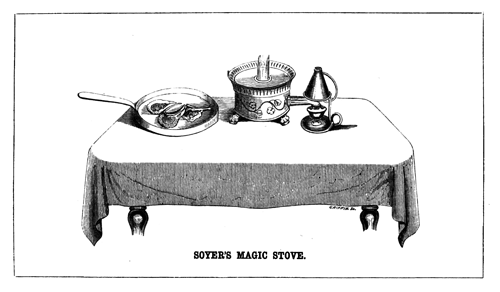
In addition to the eggs we often have cold meat, and sometimes Mr. B. has a cutlet or any other nick-nack, which I always cook myself on the breakfast table with my newly-invented Magic lamp-stove.*
With this I cook all light things, such as cutlets, poached eggs, ham, bacon, &c, and in many respects it is very convenient.
Mr. B. generally leaves home in the brougham, which is returned in time for me, in case I should be going out; and he returns in a cab or omnibus. Whilst we are at breakfast, I generally consult Mr. B. what he would like for dinner, and if he is likely to invite any friend to dine with him. The fishmonger has previously sent his list and prices of the day. I then write with a pencil on the slip of paper the bill of fare for the nursery dinner, luncheon, should any be required, and our dinner, which I send to the cook. At ten o'clock I go down stairs into the kitchen and larder, when the cook gives me her report, that is, everything that is required for the next twenty-four hours' consumption, including the servants' dinner, which report is filed in the larder and made to tally with the week's list, for I must tell you that the weeks' consumption of all things that will not spoil is had in on the Saturday, on which day the larder is properly scoured out, and everything put again into its proper place, there being bins for all kinds of vegetables, he. The larder is generally kept locked, the cook and I only having keys, because it is in fact a larder, and not, as in many houses, full of emptiness; this occupies about half an hour, during which time the chambermaids have been attending to the bed-rooms and drawing-room, &c. If I go out or not, I always get my toilet finished by twelve o'clock; I thus have one hour to write notes, or see tradesmen or my dressmaker, and Monday mornings check and pay my tradesmen's accounts, and to dress. If I stop at home I amuse myself by reading, or going to see the children in the nursery, or sometimes go again into the kitchen and assist the cook on some new receipt or preparation, and often have several calls; during the course of the morning the two maids scour out alternately one or two of the rooms, according to size, except on Wednesdays, when one of them is otherwise engaged.
Mr. B. arrives home at twenty minutes to five, and at half-past five we dine; the cloth is laid, and everything prepared as if we had company; it may be a little more trouble to the servants; but when we do have any friends they find it less so; besides it is always uncertain but what Mr. B. may bring somebody home with him, and it prevents slovenly habits; the two maids, with the exception of Wednesdays, are always ready to attend on us. I never allow the coachman to defile our carpets with his stable shoes; all his duties in the house are—the first thing in the morning to clean the knives and forks for the day, for enough are kept out for that purpose, clean the boots and shoes, and those windows the maids cannot easily get at, and assist in the garden if required. Many have made the remark to me, that as you have a male servant why not have him wait at table. I reply that the duties of the stable are incompatible with those of the table, and if he does his duty properly he has enough to do. The servants dine at one—the nursery dinner is at the same hour—and have tea at a quarter to five, by which time the cook has the dinner ready, all but to take it from the fire, and the maids the dining-room ready. After dinner, should we be alone, we have the children and the governess down; if we have company we do not see them; they go to bed at a quarter to eight, and we have tea and coffee at eight; the governess pomes and passes the rest of the evening with us; eleven is our usual hour of retiring, before which Mr. B. likes his glass of negus, a biscuit, or a sandwich, which is brought upon a tray.
Mrs. L.—What you have described to me is all very well, yet I am certain, that if I go and try to do the same to-morrow, I shall not succeed; how is it that you have everything in its place, and I never hear a word said to the servants?
Mrs. B.—It is because they all know their duties, and if they should in any way neglect them, I think of the maxim, bear and forbear, for none of us are perfect, and I take an opportunity when I may be alone with them to tell them quietly of their faults. Some mistresses will go into the kitchen and be angry with them before the other servants; the consequence is, that as soon as her back is turned they all begin to laugh. A ridiculous incident of this kind occurred the other evening at Mrs. G.'s. We missed her out of the drawing-room just before tea, and it appeared that her young boy Fred followed her; whilst we were at tea he was very communicative, as children sometimes will be (l'enfant terrible), and said, "We have been having such fun in the kitchen." On inquiry he said, "My mother has been down stairs scolding Jane, and I hid myself behind the door; and when my mother had gone up, Betsy the cook spoke and moved her hands just like mamma; it made us all laugh so, it was such fun." I need not tell you it was no fun for Mrs. G—— , who looked rather annoyed. We should ever remember, that we have our feelings, and should also think that others have theirs: and I think it as much the mistress's fault when anything goes wrong in the house as the servants'. I only lose my servants when they get married, or from ill health, and the only thing that I find bad, is, that they quarrel amongst themselves; but should this occur thrice with the same two, I dismiss them both. I am certain, that if you teach your servants to take care of themselves, they are certain to take care of you. I continually hear Mrs. M. complaining of changing her servants, and that seems to be her sole occupation. Poor thing, she has no children, and nothing to occupy her mind, and without occupation the mind becomes diseased, and the least action throws it into fever. Mrs. N. complains of the extravagance of her servants; it is her own extravagance, or, more properly speaking, her want of management, which causes all; but this I really think, that if everybody were more cautious in receiving and giving characters to servants than what they are, we should not hear the continual complaint we do when often assembled in the drawing-room after dinner, when, perhaps, some dear old lady complains of the education given to young people of the present day, and that, in time, there will be no such thing as servants. To some extent I am of her opinion, and consider that the education given by all classes to their children is a great deal more ornamental than useful. I would rather see the child taught some of the accomplishments of housekeeping, than that she should be considered as the mere ornament of the drawing-room. It is for that reason I patronise that institution in this metropolis, which stands almost alone in the education of those entrusted to its care. I became acquainted with it from Mr. B. serving as steward at its anniversary festival, and inscribing my name as a life governess. (It is the Freemasons' Girls' School.) There is no servant kept, and the duties of the house are performed by the children in classes, taking it in turns a week each ; and thus with a good and useful education, they are taught all those duties which devolve upon them when they increase in years; and when we see that several of the parents of those children at the time of their birth have kept their carriages and establishments, I think it is the bounden duty of every mother, where the income of the husband may be dependent on trade or profession, to give them that education which even the most adverse of circumstances may call upon them to assume; and the more so, as at the present day talent requires to be beyond mediocrity, and to possess genius; for, from the liberality of England and her institutions, the genius of the world has sought it for a home, and in it may be found a versatility of talent unknown in any other country, and no child should be educated for a profession unless showing a decided predilection for it, which predilection may always be known at an early age, when its innate mind shows itself unwarped by education. Look at the advertisements which appear in the public press every day !—Young girls offering themselves as governesses, to be remunerated by their board; whereas, if they had been educated with a knowledge of the duties of the household, they would have made good ladies' maids or housekeepers, or useful wives to tradesmen.
Mrs. L.—It seems, my dear, that one of the maids is engaged upon some other work on Wednesday; you have not told me for what purpose.
Mrs. B.—I have not, and I know you will laugh at me when I tell you that we wash at home.
Mrs. L.—Wash at home! my dear Mrs. B.! im-pos-si-ble! where? how?—
Mrs. B.—It is a fact, I have done so for some time past; as regards the where and how, to morrow being Wednesday, you shall see; but I will now take and show you the laundry, and tell you why I did it. We formerly sent our washing to a large laundry some little distance from London, where it was beautifully got up; but noticing one day some of my cambric handkerchiefs with the name in marking ink nearly obliterated; and the place where it was very thin, I could not account for it; on further examination of the sheets and pillow-cases I found that the place where the mark ought to have been was a long hole, exactly as if it had been cut out. I was certain it could not have been done on purpose, and it occurred to me that it might be some preparation used in the washing, which had an effect on the caustic or acid used in the ink which rotted the linen round it. It being a fine day, I drove off at once to the laundry, and a most excellent establishment it is; and I must say that the proprietress had no idea of the harm she was doing in using the kind of alkali she did, but this I was also convinced of, that she would never be able to clean the variety of articles sent to her without it. But I have since found out that it was the peculiar nature of the ink which was used.
On my way home I reflected seriously on the matter, and happening to pass the baths and washhouses in the New Road, I stopped and examined them, which gave me those ideas I have since carried out.—In regard to the choice of the day, it is one that ever since I have been married, Mr. B. considered his own in dining out or going to the play, and it is very rarely either of us dine at home on that day.
One of the maids take it in turns along with a charwoman, and they manage to get all washed and mangled on the Wednesday, and the charwoman irons alone on the Thursday.
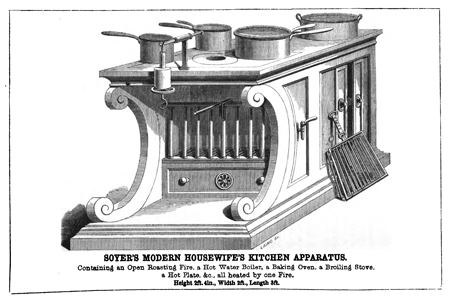
As you have now descended into the lower regions of my establishment, I must show you the improvements I have made in the kitchen since you were here last. In consequence of the introduction of my new apparatus, or stove, I have entirely done away with the kitchen range; its place, as you perceive, being closed; and I have likewise done away with the hot plate and the charcoal stove, which we only used once or twice a-year, and in its place I have got a gas stove, which is a great economy, and the fire in the new stove is left to go out after dinner, and some days is not even lit; and it is also exceedingly clean, but not having gas near your cottage you cannot adopt it. You see, here is the new stove in the middle of the kitchen; it combines a roasting fire, circulating hot water boiler oven, and hot plate, all heated by one fire; the boiler heats the water at the top of the house for the baths, and which can be laid on into any room; the advantage is that it gives more room in the kitchen, in being able to walk all round it; there is also different degrees of heat on the hot plate, and room for the bain-marie pan: the smoke goes under the floor into the old chimney. It was made for me by Messrs. Bramah and Prestage, of Piccadilly. There is the drawing; it is, as you perceive, exceedingly novel in appearance, and I feel confident, if known, would come into general use, even from the cottage to the largest establishment; it could be fitted with a steam-boiler if required; and would, I am certain, be most valuable in hotels and taverns: in a cottage the linen could be dried around it without danger from fire; and it also cures smoky chimneys. Mr. B.'s brother, who, you know, is in the Navy, has got one for his vessel, with which he is delighted; there is very little heat arising from it; my kitchen, as you perceive, being small, only twelve by eighteen feet, it would be felt; but in order to take off all vapour, I have had made, as you perceive, an opening in the ceiling, from which a pipe passes between the joist to the outside. There is nothing else very novel in the kitchen, being taken, as you perceive, from the plan of that of the one "At Home," in Soyer's Regenerator. There is the small mortar, the dressers are made with drawers and slides, which is a very great improvement, as anything that is dirty is placed upon it, and thus saves the cloth. The rail above contains all the copper stewpans. This other dresser is used for placing the dishes on when sending up the dinner; it has the covers over it, and underneath the dripping-pan, frying-pan, gridiron, so that nothing is hid from the sight, therefore they cannot but be clean.
Mrs. L.—I perceive it, and a very good system it is, for at home, when I open one of those mysterious closets, I find them full of dirt, broken plates, old towels, and everything that is wanted to be hid from sight. I shall certainly make that reform immediately.
Mrs. B.—There is a little sink with hot and cold water. But this small room is what I call the scullery; it is, as you see, supplied with hot and cold water, and has a sink, in which are washed the plates, dishes, coppers, &c, or anything else, so that all dirt is kept out of the kitchen; and you see this is every bit as clean as the kitchen. We will now go into the little room which I pride myself upon, it is the larder; it is but small, being only ten feet by eight—paved and lined with slate, and the window, which is protected by wire, opens to the North. Under the window is the pastry-slab, with ice drawer under that; in this corner is the meat block and table with scales to weigh all that comes into the larder. Here is the safe with a sliding door on pulley, and- in which are the vegetable bins, and here is one of Ling's patent ice-safes. The meat is, as you perceive, hanging from tin hooks: these two boxes I have latterly had made; this one contains powdered herbs of all kinds (Makepeaces), and also essences for confectionery, and as they get empty I have them re-filled at the Italian warehouse; this more especially belongs to the kitchen; and is what I call the housewife's box. But its contents must at present remain a secret, as I intend to give you a little surprise; they are both absolutely requisite in a house, and it is surprising what a deal of labour and time is saved by having them always ready. Here is the week's file of the tradesmen's bills; and this is a list of the kitchen stock, which, together with that of china, glass, and linen, is taken every three months.*
When I was first married and commencing business, our means were limited: the following was our system of living:—
Sunday's Dinner.—Roast Beef, Potatoes, Greens, and Yorkshire Pudding.
Monday.—Hashed Beef and Potatoes.
Tuesday.—Broiled Beef and Bones, Vegetables, and Spotted Dick Pudding.
Wednesday.—Fish, if cheap, Chops, and Vegetables.
Thursday.—Boiled Pork, Peas Pudding, and Greens.
Friday.—Peas Soup, remains of Pork.
Saturday.—Stewed Steak with Suet Dumpling
The Sunday's dinner I used to vary; one time Beef, another Mutton, another Pork or Veal, and sometimes a Baked Sucking Pig; our living then, including a good Breakfast and Tea, cost us about 32s. per week for six persons.
In case we had a few friends, we used to make an addition by having Fish, Leg of Mutton, Roast Fowls, Pickled Pork, and Peas Pudding, with a Mould Pudding, Fruit Tart, and a little dessert.
This was for the first two years; our means and business then increasing, and having the three young men to dine with us, we were of course obliged to increase our expenditure, and to alter our mode of living, besides which I had accompanied Mr. B. to France, where my culinary ideas received a great improvement.
The following is the plan we then adopted:—
Sunday.—Pot-au-Feu, Fish—Haunch of Mutton, or a quarter of Lamb, or other good joint—Two Vegetables—Pastry and a Fruit Pudding— A little Dessert.
Monday.—Vermicelli Soup made from the Pot-au-Feu of the day previous—The Bouilli of the Pot-au-Feu—Remains of the Mutton—Two Vegetables—Fruit Tart.
Tuesday.—Fish—Shoulder of Veal stuffed—Roast Pigeons, or Leveret or Curry—Two Vegetables—Apples with Rice, and light Pastry.
Wednesday.—Spring Soup—Roast Fowls, Remains of Veal minced, and poached Eggs—Two Vegetables—Rowley Powley Pudding.
Thursday.—Roast Beef—Remains of Fowl—Two Vegetables—Sweet Omelet.
Friday.—Fish—Shoulder of Lamb—Miroton of Beef—Two Vegetables— Baked Pudding.
Saturday.—Mutton Broth—Boiled Neck of Mutton—Liver and Bacon—Two Vegetables—Currant Pudding.
Our parties then, when we had them, never consisted of more than ten. We had: Julienne Soup—Fish—A Quarter of Lamb—Vegetables, Cutlets —Vegetables, Bacon and Beans—Boiled Turkey—Pheasant—Jelly or Cream —Pastry—Lobster Salad—Omelet or Souffle—Dessert, &c.
At present, though the number of our establishment is not greater, yet the style and manner of our living have changed. We dine alone, except when Mr. B. invites somebody to dine with him, which is most generally the case; our daily bill of fare consists of something like the following:
One Soup or Fish, generally alternate—One Remove, either Joint or Poultry—One Entree—Two Vegetables—Pudding or Tart—A little Dessert.
This may seem a great deal for two persons; but when you remember that we almost invariably have one or two to dine with us, and the remains are required for the breakfast, lunch, nursery and servants' dinners, you will perceive that the dinner is the principal expense of the establishment, by which means you are enabled to display more liberality to your guests, and live in greater comfort without waste. Our parties at present, to many of which you have frequently been, and therefore know, vary according to the season: here are a few bills of fare of them; the following is one for twelve persons :—
One soup, say Puree of Artichokes—One Fish, Cod Slices in Oyster Sauce —Remove with Smelts or White Bait.
Removes.—Saddle of Mutton—Turkey in Celery Sauce.
Two Entrées.—Cutlets à la Provençale—Sweetbreads larded in any White Sauce.
Two Vegetables.—Greens—Kale—Potatoes on the Sideboard.
Two Roasts—Partridges—Wild Ducks.
Jelly of Fruit—Cheesecakes—Meringue a la Creme—Vegetable —
French Salad on the Sideboard.
Removes.—Ice Pudding—Beignet Soufflé.
Dessert of eleven dishes.
The following is one for a birthday party, which generally consists of twenty persons:—
Two Soups—Two Fish.
Removes.—Haunch of Mutton—Boiled Capons a l'Ecarlate.
Flancs.—Fricandeau of Veal—Currie of Fowl.
Entrées.—Fillets of Beef, Sauce Tomate—Cutlets Soubise—Oyster Patties, or
Little Vol-au-Vent; Croquettes of Veal or Fowl.*
WildDucks—Guinea Fowl larded—Charlotte Russe—Punch Jelly
Crusts of Fruit—Flanc Meringue—Apple with Rice—Scolloped
Oysters—Mayonnaise of Fowl—Sea Kale or Asparagus.
Removes.—Turban of Condé Glacée—Cheese Souffle a la Vanille.
Dessert of nineteen dishes.
The bills of fare for our small evening parties, say thirty persons, are as follows; everything is cold, although I know that the fashion has been progressing towards having hot removes.
Our table on those occasions is, as you know, in the form of a horseshoe, which, in my opinion, is the most sociable after that of a round one, and upon the sociability of the supper depends in a great measure the success of the party. In the centre, and at the head of the table, I place a large Grouse-pie the same as Nos. 530, 654, of which, by my recommendation, everybody partakes; I then on each of the wings have Fowls, Lobster Salads, Mayonnaises of Fowl, Ham, Tongue, cut in slices, and dished over parsley, ornamented with Aspic jelly; and on the sideboard I have a fine piece of Sirloin of beef, plain roasted, or an Aitch-bone of Beef, or Fillet of Veal. Should there be no game, I have a Turkey or Fowls en Galantine, instead of the Grouse-pie, or if game is plentiful, I have less poultry, and add roast Pheasants —mind, not fowls with black legs larded, and a pheasant's tail put to them, but real ones,—or Partridges or Grouse, or a fine Salad of Game.
With the Sweets I generally place about twelve—four on each table, that is, 4 Jellies, 2 Creams, 2 Bavaroises, 4 Iced Cabinet Puddings, and 4 Raised Dishes of small pastry, all of which are artistically disposed upon the table.
The fruits are likewise placed on the table; they consist of simple Compotes, 6 of various kinds and 6 of Dried Fruit, Biscuits, Wafers, and Cossacks, which last are getting much out of fashion, but are very amusing.
The following is the bill of fare for Mr. B.'s Birthday Party, for which he allows me £15, with which I find everything in the shape of refreshments, with the exception of wine? it is
One Raised Pie—Two Mayonnaises of Fowl—Two Lobster Salads—One Piece of Roast Beef—Four Dishes of Fowl—Two Dishes of Pheasant—Four Dishes o f Tongue—Four Dishes of Ham—Four Jellies with Fruit—Two Creams with Noyeau—Two Flancs with Apple Meringue—Two Iced Cabinet Puddings—Two Puddings a la Eloise—Six Various Pastry—Eight Various Compotes—Four Pieces Montees in China with Bonbons, Cossacks, &c.—Four of Fruit, as Pears, Grapes, &C.— Four of Dried Fruit, &C.— Four of Biscuits, &c.
This perhaps may appear extravagant, but we always have them, some country friends stopping a few days with us, so that I manage to make the best of everything, and make my week's account look very well. We sometimes have as many as sixty on an evening.
Our Children's Parties are as follow, there are generally about 50 present:
| 16 Dishes of Sandwiches. | 4 Dishes of Lamb. | 4 Dishes of Ham. |
| 4 do. of Slices of Beef. | 4 do. of Tongue. | 6 do. of Fowls. |
| 10 Dishes of Slices of Galantine of Veal. | 1 Dish of Dressed Beef. | 24 Dishes of Various Pastry, Custards, Jellies, Bonbons, &c. |
But I remember when in business, on those occasions we only used to have a large quantity of Sandwiches and Patties, and used to amuse the children by labelling the Dishes as Sandwiches of Peacock's Tongues, Patties of Partridges' Eyes, &C., and also a large quantity of plain Sweets; and at that period Mr. B. 's birthday party was not so extensive or recherché as at present. It consisted of something like the following:
A Roast Turkey—2 Dishes of Fowls—1 Ham—2 Pigeon Pies—1 Piece of Boiled Beef—4 Lobsters—4 Salads—4 Jellies—4 Tarts—i of Preserved Fruit, &c.—4 of Pastry; with about 12 of various kinds of Fruit, &c.
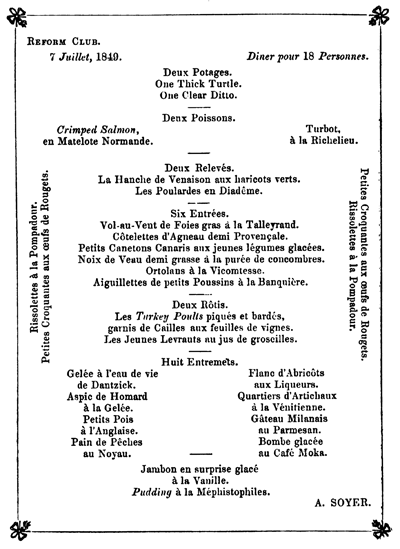
You will have seen by the previous Bills of Fare that I have not at all encroached upon the high-class cookery, they being selected from the receipts I have given you; in order that you may see the difference, I inclose the Bill of Fare of a dinner given by — Bass, Esq., M.P., at the Reform Club, the other day, and a copy of yesterday's Post, containing one given in the country. You will find that the dishes mentioned in these Bills of Fare are not to be found in our receipts.
"A series of festivities are taking place at the seat of Sir George Chefrwynd, Bart., Grendon Hall, Atherstone, Warwickshire, to celebrate the christening of Sir George's infant grandson. The christening took place on Tuesday, at Grendon church, and in the evening a grand dinner was given in celebration of the event, under the able superintendence of M. Alexis Soyer. As the dinner, which was provided for twenty persons, was of a very recherche description, we subjoin the bill of fare.
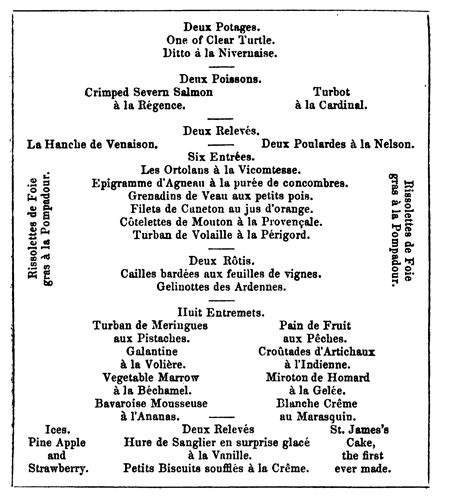
'' After dinner M. Boyer had the honour of presenting the youthful heir the proof copy of his new work on Cookery."
Morning Post, July 26, 1849.
Dear Eloise,—Since our little labours first went to press, I have received several kind notes from various persons requiring information on various points. To give all the information sought would make this volume double the size; but amongst others, there is a very polite one from a young bachelor, who states that finding we have so well described a dinner party as it ought to be, with ladies, he should like to know how one ought to be managed when gentlemen only are present, he being a young gentleman, and having no female relatives and acquaintances—a class which, he adds, is, unfortunately, numerous in England—and that it would be a boon for them to receive some information on the subject. I declare, my dear Eloise, that the style of his writing is so graceful and pleasing, that I should, if possible, like to gratify his wish.—Your ever grateful pupil,
Hohtense.
LETTER No. XXIV.
My Dear Hortense,—Our labours will never cease, if we are to answer all the questions and correspondence submitted to us; but as you seem to have a fancy for this young bachelor, we will endeavour to gratify his wish, although I assure you it is what we ought not to do, for I cannot conceive why men wish to dine together without the company of ladies. Our friend M. Soyer, in his Gastronomic Regenerator, has very justly stated that a gastronomic reunion without ladies appeared to his eyes "a flower-bed without flowers, an ocean without waves, a vessel without sails ;" and I think it is bad taste in us ladies to assist these bachelors to enjoy their entertainments better than at present, without us; and if I agree to your request, it is with the hope that in following our counsel, they will find their dinners improved, and thus see the necessity of following it still further, by admitting ladies to their banquets.
I can well imagine that some men enjoy the science of eating better when ladies are not present than when they are; but, as I said in my former letter, the dinner ought only to be the means of enjoyment, and not the act. But still, when men of wit and talent meet together around a table, upon which the viands are well chosen and artistically prepared, I can imagine that the mind of man is more amiably disposed than in ordinary times, and ready to impart the talent which he possesses in bright corruscations of wit or new flights of genius to those around him. And, perhaps, after all, we ladies are not such great losers as we might at first imagine; although we do not immediately enjoy the wit and talent thus improvisatised, yet we may receive it second-hand; as an instance, there is Mrs. &2014;—, she knows the sayings and doings of Mr. ——, the witty member of her husband's club, just as if she was a member herself.
Now for the point. What ought a bachelor's dinner to be? In the first place, the number of guests ought not to consist of more than eight, with the table nicely arranged and set out, with all that is required in its proper place, napkins nicely folded, glasses of unrivalled crystal, and the groom of the chamber in his last new attire, assisted by one more au fait in the matter, with the lights nicely disposed, and the room an agreeable temperature,— say 63°.
The guests all seated, with good appetites, and six delicate oysters upon the plate before each of them, and a few hors-d'œuvres, such as a small dish of sardines, some slices of Lyons sausages, a little cavaire on toast, and two bottles of Chablis. This is an excellent beginning: it does not stop the appetite, and merely clears the road. Some persons go too long without eating, and the moment they begin, eat with an avidity which spoils their taste for the after part of the dinner, and during which time the whole mind is absorbed upon the plate before them, and until they are satisfied, no words escape their lips, and when at last they come forth, they do so with a heaviness and dulness which belongs not to the person who utters them, but to the inartistic manner of eating. Some of the greatest wits, from going too long without eating previous to dinner, become the dullest guests; whilst some, who from want of thought thus begin their meal, find themselves, before dessert is on the table, in the arms of Morpheus, instead of enjoying the gifts of Bacchus.
The pleasure of eating requires an appetite, but the pleasures of the table require that the appetite should not be appeased until it is time to arise from it. The mind should never give way to any great intensity of feeling, no ecstasy, no surprise, no transports, which would destroy that equilibrium which is so requisite for digestion.
If artistically partaken of, at the end of the repast the mind becomes exhilarated, the brain is refreshed, the physiognomy opens, the colour rises, the eyes become brilliant, and a warmth spreads over the whole body; the imagination glows, and wit sparkles and overflows, whereas, on the contrary, the mind becomes dull, the eyes heavy, and the body shuddering with cold.
The dinner having thus began with six oysters, a large glass of Chablis, or, if preferred, White Hermitage, or even Moselle, the soup is then placed upon the table. This ought to be of a light kind, and should turtle be preferred, it ought to be light and transparent. With the soup, a glass of Sherry or Madeira is the best accompaniment. At the same time as the soup is placed upon the table, so are the fish, the sauce, and the potatoes on the sideboard. The fish, if boiled, should be accompanied by Hock or white Burgundy, if baked or stewed, with Claret of a light kind.
The next course should consist of a boiled and roast Remove and two Entrees. To those who know artistically how to eat a dinner, it may appear strange when I tell them that I have known those who have considered themselves gourmets commence this course with the Entrees. The plan which ought to be followed is to begin with the boiled, and if your appetite is good, to slightly touch the roast, partaking of wines according to the nature of the dish; for instance, boiled poultry with oyster sauce, return to Chablis; lamb, with caper sauce, to Hock or Moselle; roast mutton, light Claret; roast beef, Sherry or Madeira. The two substantials having been disposed of, the palate has now arrived at that degree of perfection (supposing the wines partaken of to have been good of their kind, for nothing destroys the reputation of a good dinner more than bad wines), the art of the cook as displayed in his Entrées now engages the attention of the guests. These Entrées should be as different as possible, and also differ from the roast and boiled. With the Entrées, whatever their nature, it is generally the custom to partake of Champagne. This, when ladies are at the table, I do not object to, as they are not supposed to be professors in the science of eating, but with the real epicure it is a sin I cannot pardon. The wane to be partaken of depends upon the nature of the Entrée, but should never be of that luscious description as to overpower that delightful sensation of taste produced by the "plat."
These having been removed, and their places occupied by two dishes of nicely roasted game and four Entremets, as, for instance, woodcocks and pheasants, or even a fine larded capon and wild fowl, and one savory, one vegetable, and two sweets as Entremets. With the roasts I prefer Claret or red Burgundy; with the Entrémets may be served the Champagne.
These Entrémets should display the skill of the preparer, not in a way that anything about them cannot be partaken of, but that what they are made of may delight the sight as well as the taste. The roast should be removed with two dishes, containing either a souffle, a pudding, or a Charlotte, and a Nesselrode pudding, or something of that nature. These being disposed of, I would have the dessert placed upon the table, with the cheese handed round, and at the same time a loving cup, or if that is not to be obtained, a tankard full of the same liquid. Port wine may be partaken of with the dessert. The plates should be changed as often as required, and not left, as at present, to receive a collection of orange and apple peel an other refuse. During the time this is being partaken of—say twent minutes to half an hour, or even longer, so much depending upon the Amphitryon and his guests—the coffee ought to be introduced, and with a chasse cafe the table is cleared, or the guests go into the drawing-room, should the unhappy bachelor happen to have one, and the remainder of the evening may be passed according to the disposition and taste of the party, such as music, cards, &C. ; and I am afraid the enjoyment of the evening would not be complete without cigars.
Such, Hortense, is my humble opinion of what a bachelor's party should be, for in these enlightened times it is not drinking to excess, that constitutes the enjoyment of society, and a young man who gets inebriated is one to be shunned; so different from what it was some forty years since, when a four bottle man was one to be looked up to and followed.
A NEW ALIMENT.
LETTER XXV.
Bifrons Villa.
Here, dear Eloise, is an entirely new aliment, which has never yet been introduced into this country. A semi-epicure of our acquaintance, on returning from his visit to the National Guard of France, presented me with a pound of it, which he had purchased in Paris; but even there, said he, it is almost in its infancy: you may fancy, if I were not anxious of making an immediate trial of it; but before I give you the receipt how to use it, let me tell you I have found it most delicious. Mr. B. has not yet tasted it, being for a week in the country, but I am confident he will like it, especially for breakfast: but the puzzle is, after my pound is used, how we are to get more? Time, I suppose, will teach us. It appears that we are indebted for it to a celebrated French gentleman, M. le Docteur Lamolte, the inventor of the electric light, who ingeniously, though oddly, named it Cho-ca, being a scientific composition of chocolat and café, the alliance of which balancing admirably their excellence and virtue, and partly correcting their evils, the first being rather irritable, the second heavy. But I think, if my recollection serves me rightly, the idea of this compound must have originated from that great French philosopher, M. de Voltaire, who constantly, for his breakfast, partook of half cafe-au-lait and half chocolate, which were served at the same time in separate vessels in a boiling state, and poured from each slowly, about eighteen inches in elevation from his cup, which, he said, made it extremely light and digestible.
Years after, that still more extraordinary man, Napoleon Bonaparte, became so partial to it, that he made a constant use of it, and it has often been remarked by those who surrounded his person, that after the great excitement and fatigue of a battle, he has often partaken of two or three cups, which seemed to restore all the strength and energy which used to characterise that great man; on ordinary occasions one cup would suffice him, but served more à la militaire, not being poured so scientifically as did the Fernaise philosopher.
The approval of this mixed beverage by two such eminent characters speaks volumes in favour of the Cho-ca, which ought to be immediately introduced in England. It will also, no doubt, interest you to learn that the first cup of coffee ever introduced in Europe was made and presented to Louis XIV., at his magnificent palace of Versailles, by the Ambassador from the Sublime Porte in the year 1664, when the noble potentate, whose palate was as delicate as he was himself great, pronounced it excellent; and immediately perceived the immense advantage it would be to introduce such a delicacy into France as food, which a short time after took place, and was very successfully received there; also the chocolate, which is made from cacao, was first introduced to the Cardinal Mazarin, who having partook of the first cup like Louis XIV. did of the coffee, and not a worse judge than his illustrious master, remunerated with a handsome reward its inventor. It is much to be regretted that such interesting and useful subjects have never yet attracted the attention of our great Painters, instead of continually tracing on innumerable yards of canvass the horrors of war, the destruction of a fleet by fire and water, the plague, the storm, the earthquake, or an eruption and destruction of a city by an avalanche or an inundation; if we cannot do without those painful historical reminiscences, why not add to those mournful collections a group of Louis XIV. and his court of Versailles, where he, magnificently dressed, was receiving from the hands of the said Pacha, not a cup of coffee, but a branch of that plant covered with its precious berries; and why not also, as a pendant, Mazarin surrounded by his satellites, taking the first cup of chocolate; or the characteristic Voltaire pouring a cup of Cho-ca to Frederic the Great in his tent on the field of Potsdam? These subjects seem to have been entirely neglected in being immortalised on canvass—why? because they have never done harm or evil to any one; but, on the contrary, have, are, and ever will prove to be, among the greatest boons ever conferred upon humanity: it would also engrave in our minds, as well as in our history, to what mortals we are indebted for the importation and introduction of such important productions, which daily constitute a part of our comforts, and have conferred an everlasting benefit on mankind; but, as usual, dear Eloise, you will no doubt reproach me for having so much enthusiasm; however, as on this subject you have been tolerably quiet lately, I not only here inclose you the receipt, but also two of the thin round cakes of this new aliment, the Cho-ca, which will produce two cups by making it as follows:—
959. CHO-CA.— Scrape or grate it; put a pint of milk in a stewpan or chocolate pot, and place it on the fire, with two ounces of sugar; boil it, put the Cho-ca in it, and stir it well for two minutes, and serve.
Notes:
[*] This is, as you see by the engraving, a very neat and portable cooking apparatus; the heat is given by the vapour of spirits of wine passing through a name: it will cook cutlets or boil water in as short a time as the best of charcoal, and to the sportsman on the moors must be of great utility; with the saute pan everything can be cooked as on a charcoal fire, and with a small saucepan anything that may be required in the room of the invalid, where the heat of a fire would not be allowed. For further particulars see advertisement.
[*] The following are the Utensils that I use in the kitchen, or, as the French call it, batterie de cuisine, which I flatter myself to be quite complete:— 8 copper stewpans, two larger ones, holding one gallon and a half, and the next one gallon, the others smaller by degrees to one pint; 1 oval fish-kettle, holding about one gallon and a half, but if by chance I have a turbot, I borrow a kettle from the fishmonger; 1 middle-sized braising-pan; 1 pre serving-pan; 1 round bowl for beating whites of eggs; 2 saucepans ; 1 omelette-pan; 1 frying-pan; 1 bain-marie; 6 saucepans for the sauce; 1middle-sized tin pie-mould; 2 tin jelly-moulds; 1 tin flanc-mould for fruit; 1 freezing-pot, with every requisite; 2 baking-sheets; 1 gridiron; 1 small salamander; 1 colander-spoon; 1 bottle-jack; 2 spits; 1 dripping-pan; 1 screen; 1 sugar-pan; 2 soup-ladles; 8 copper-spoons, 2 of them colanders;
2 wire baskets; 1 wire sieve; 2 hair sieves; 24 tartlet-pans; 2 tammies; 1 jelly-bag; 12 wooden spoons; 2 paste-brushes; 1 pair of scissors; 2 kitchen knives; 6 larding-needles; 1 packing-needle; 1 box of vegetable-cutters; 1 box of paste-cutters; 1 meat-saw; 1 cutlet chopper; 1 meat chopper; 6 meat hooks, tinned; 1 rolling-pin; 8 kitchen basins; 6 china pie-dishes; 6 earthen bowls for soups and gravies; 4 kitchen table-cloths; 18 rubbers; 12 fish napkins; 6 pudding-cloths; 4 round towels.
These utensils, no doubt, appear very numerous, but, at the same time, they are no more than are required, and it is only the first nine articles which are rather expensive; the others can be had at the cost of a few shillings.
The linen I place in the presses every week myself, and keep an exact account of it, for it is only by so doing that I keep so small a quantity in use. I have—12 pairs of sheets; 10 ditto pillow-cases; 3 dozen of napkins; 2 dozen and a half of various-sized table-cloths; including breakfast, dinner, &C. ; 6 servants' table-cloths; 3 dozen towels; 6 round towels; 3 dozen kitchen rubbers; 2 dozen napkins for fish, vegetables, and fruits; 6 pudding-cloths; 2 dozen damask d'oylies; 1 dozen Berlin wool ditto. I also have occasionally in the wash the cover of the carpet, the anti-macassars, which I have knitted at my leisure, and the netted window curtains. Of glass and china, I have the following; they are counted every month, and the broken ones replaced:—3 dozen wine-glasses; 2 dozen champagne ditto; 2 dozen claret ditto; 3 dozen goblets; 6 water caraffes; 6 decanters; 1 liqueur-stand; 12 liqueur-glasses; 2 glass jugs; 1 celery-glass; 1 trifle-bowl; 8 dessert-dishes. China: 1 full dinner service; 1 common set for kitchen; 1 common tea service for kitchen; 1 good tea service; 1 breakfast service; 1 good dessert service.
The following is my list of plate:—3 dozen of prongs; 2 ditto of tablespoons; 1 and a half ditto of dessert-spoons; 1 and a half ditto of dessertforks; 2 ditto of tea-spoons; 6 salt-spoons; 1 cheese knife; 4 butter knives; 1 asparagus-tongs; 2 sugar-tongs; 2 soup-ladles; 4 sauce ladles; 2 gravy spoons; 2 sugar-ladles; 2 salvers; 1 bread-basket; 4 candlesticks; 1 hot-water dish for haunch of mutton.
[*] These should be served on dishes with a napkin.