Alexis Soyer's Part 1: Breakfasts
Flancs and Entrées.
MADE DISHES OF BEEF. — The remainder of any cooked joints of beef may be advantageously and economically dressed in the following ways:
404. HASHED BEEF.—Cut the beef into small thin slices, which lay upon a plate, and to every pound of beef add half a tablespoonful of flour, a little chopped onion or eschalot, two saltspoonfuls of salt, and a half one of pepper, mix the whole well together, and put it into a saucepan, with half a pint of water, stir it over the fire until upon the point of boiling, when set it at the corner of the fire to simmer for ten minutes; it is then ready to serve. A great improvement to the appearance of hash may be effected by adding a few spoonfuls of brown gravy (No. 186), or a teaspoonful of colouring (No. 187), which might always be kept in a bottle. The flavour of any kind of hash may be varied, by adding a few sprigs of parsley, or thyme, or a couple of bay-leaves, or a little tarragon, or a few spoonfuls of catsup, Soyer's, Harvey's, Soho, or Reading sauce.
405. ANOTHER WAY.—Cut the meat into slices, put two tablespoonfuls of flour into a dish with a teaspoonful of salt, a saltspoonful of pepper, mix them together, rub the slices of meat with it. Place in a large but shallow stewpan a piece of butter the size of a walnut, and three small or one large onion cut into slices; put it on the fire until the onion is browned, then add the meat, which warm on one side, turn over, when warm through, pour over it a pint of hot water, add two pickled gherkins cut in slices, with a tablespoonful of the vinegar of the pickle, let it boil up, and serve; or place it by the side of the fire until wanted. A few mushrooms put in it is an improvement, or a tablespoonful of walnut catsup.
406. MIROTON OF BEEF.—Peel and cut into thin slices, two large onions, put them in a stewpan or saucepan, with two ounces of salt butter, place it over a slow fire, keeping the onions stirred round with a wooden spoon until rather brown, but not burnt in the least, then add a teaspoonful of flour, which mix well in and moisten with half a pint of water or broth if handy, season with three saltspoonfuls of salt, two of sugar, and one of pepper if water has been used, but if broth, diminish the quantity of salt, add a little colouring (No. 187), to improve its appearance; put in the beef, which you have previously cut into small thin slices, as free from fat as possible, let it remain a few minutes upon the fire to simmer, and serve upon a hot dish. To vary the flavour, a tablespoonful of vinegar might be added or half a glass of sherry. The above proportions are sufficient for one pound and a half of solid meat, and of course should be increased or diminished accordingly.
407. ANOTHER WAY.—Prepare the meat precisely as in the last, and when done put it into a pie-dish, sprinkle breadcrumbs lightly over, enough to cover the meat, upon which lay a small piece of butter, put the dish in the oven for half an hour, or before the fire, with a screen behind it, turning the dish round occasionally. By grating the crust of bread you would obtain some brown bread-crumbs, which would do equally as well as bread rubbed through a sieve.
Should you have any cold from the first receipt, it may be served as here directed; but being cold, would require to be no longer in the oven to become well hot through.
408. ANOTHER WAY.—If any left from a previous dinner, put it in a dish, placing the meat in the centre, rather higher, cover over with some delicate mashed potatoes, about two inches in thickness, to form a dome, rub some egg over with a paste-brush, and sprinkle crumbs of bread (either grated or otherwise) upon the top, and set in the oven until well browned, when serve.
409. A QUICKER WAY.—Cook a few slices of lean bacon in a frying-pan, but not too much, lay some of them in the bottom of the pie-dish, over which lay slices of beef cut thin, which season with a little pepper, salt, chopped parsley, and chopped eschalots (if not objectionable), sprinkle over a little flour, proceeding thus until the dish is pretty full, when pour over half a gill of broth or water, to which you have added a little colouring, No. 187, (more seasoning would be required if water was used,) set the dish in the oven (having previously covered the meat over with mashed potatoes) for about an hour.
By adding half the above quantity of liquor, the meat might be covered with a thin suet crust and served as a pie, as also might any of the former receipts, in which a bay-leaf, chopped parsley, or even chopped gherkins, might be served, being a great improvement.
410. REMAINS OF RIBS OF BEEF, if only the bones with a little meat on them. Divide and saw them into pieces of three inches each, put them in a stewpan with a tablespoonful of flour, some pepper and salt, two onions chopped fine, three turnips and one carrot cut into square pieces of a quarter of an inch and one inch long, nearly cover with water; add a spoonful of colouring, and place on the fire and simmer for about an hour, serve with the pieces tastefully laid in the dish, the vegetables and broth poured over.
411. BROILED BONES.—Divide them, rub with mustard, pepper, and salt, and broil over a clear fire, serve with fried potatoes; and a little gravy may be added.
412. BEEF PALATES.—Although this is an article very seldom used in small families they are very much to be commended; they may be dressed in various ways, and are not expensive, about four would be sufficient for a dish. Put them into a large stewpan of lukewarm water, where let them remain four or five hours to disgorge, after which pour off the water, cover again with fresh water, and place the stewpan upon the fire until the palates become hard, when take out one, which dip into cold water, scrape it with a knife, and if the skin comes off easily, take out the remainder; but if not, let them remain a short time longer: scrape them until you have got off all the skin, and nothing but the white half transparent substance remains. Then make a white stock as directed, No. 135, in which boil them three or four hours until very tender, which try with the point of a knife, then take them up, lay them flat upon a dish, covered with a little of the stock, and place another dish of the same size over, to keep them flat, let remain until cold, when they are ready to serve in either of the following ways:—
413. BEEF PALATES À LA BRETONNE.—Peel and cut two large onions into slices, which put into a stewpan, with an ounce of butter, stirring them over the fire until lightly fried, when add a teaspoonful of flour, which mix well in, and a gill of broth, season with a little pepper, salt, and sugar, add a few drops of brown gravy or browning, No. 186, and a spoonful of mustard; boil the whole, keeping it stirred until forming a thickish pulp; then cut the palates into square pieces, and put into it; when well hot through they are ready to serve.
414. BEEF PALATES À L'INDIENNE.—Having prepared the palates as in No. 412, make some curry sauce as No. 156, cut the palate into square pieces and warm in the sauce, serve with rice separate, and it is delicious.
415. BEEF PALATES À LA POULETTE.—Make a little white sauce as directed, No. 135; after having prepared the palates, cut them into square pieces, and put them into a stewpan, just covered with some of the white sauce, season with a little white pepper, salt, sugar, chopped parsley, and the juice of half a lemon; let them simmer about five minutes, when pour in a liaison of one yolk of egg, mixed with two tablespoonfuls of cream or milk, stir it in rather quickly, and not afterwards permitting it to boil, then turn it upon your dish, place sippets of toasted bread round, and serve: chopped parsley and a little lemon may be added.
416. BEEF PALATES À LA MAÎTRE D'HOTEL.— Proceed as above, using seasoned melted maître-d'hôtel butter.
417. TRIPE.—Select one pound of tripe, thick, fat, and white as possible, the honeycomb part is the most delicate; cut them in pieces of half a pound each, tie them together, put into a convenient-sized stewpan one pint of milk, one of water, put in the tripe, add six middle-size onions whole, two teaspoonfuls of salt, half one of pepper, let it simmer till the onions are done, and the tripe is then ready, remove the string, dish broth and all in a tureen. A little nutmeg, thyme, and bay-leaf, added just before serving is an improvement. If any remains, warm in curry sauce.
417.* TRIPE, LYONS FASHION—When there is any remaining from a previous day, dry it on a clean cloth, cut them into pieces an inch square, put into an omelette or saute pan one or two ounces of butter, according to the quantity, slice thin a large onion, which fry in the pan, then add the tripe, saute them for five minutes, season with salt, pepper, and a spoonful of vinegar; serve very hot.
148. OX TAILS À LA JARDINIÈRE.—Cut and cook two ox tails as directed for soup, but just before they are done, skim well, and take out the pieces of tails, which put upon a dish, then in another stewpan put two ounces of butter, to which, when melted, add three ounces of flour, stirring it over the fire until forming a brownish roux (thickening), then mix by degrees two quarts of the stock the tails were boiled in, and boil altogether ten minutes, then put in the tails, with one carrot and two turnips (cut into small dice, or any other shape, with a vegetable cutter), and about thirty button onions; let the whole simmer very gently upon the corner of the fire, keeping it well skimmed, until the vegetables are tender, and the sauce sufficiently thick to adhere to the back of the spoon, dress the meat upon a dish, reduce the sauce, which pour over and serve.
419. OX TAILS AU GRATIN.—Cook two ox tails as before, and when cold, dry them upon a cloth, season with pepper and salt, have a couple of eggs well beaten upon a plate, into which dip each piece singly, afterwards throwing them into a dish of bread-crumbs, to cover every part, then beat them lightly with a knife, and again egg and bread-crumb them, broil them upon a gridiron, or place them in a very hot oven until of a brownish colour, when serve with any sauce you may fancy, or a little plain gravy.
420. OX TAILS, SAUCE PIQUANTE.—Cook the tails as before, and when done dress them upon your dish pyramidically, then make about a pint of sharp sauce, No. 140, but omitting half the quantity of vinegar, and reducing it until rather thick; season rather highly, add three or four gherkins chopped very fine, pour the sauce over, and serve. 421. OX HEART.—This dish, although not very recherche, is a good family one, and remarkable for its cheapness. Put it into lukewarm water, one hour to disgorge, then wipe it well with a cloth, and stuff the interior with a highly-seasoned veal stuffing, tie it up in paper, and pass a small spit through the sides, set it before a good fire for about two hours to roast, keeping it well basted—being almost deprived of fat, basting is thus required; when done, take off the paper, and serve with any sharp sauce, or a little plain gravy. Two hours would be sufficient to roast a large heart; but if smaller, of course less time in proportion would be required. I have also stuffed a heart with sage and onion, and even ventured the apple sauce: both succeeded admirably, and it can be baked as well as roasted.
I remember, when in business, upon one occasion, having a few friends pop in unexpectedly about luncheon-time upon a Saturday (which is a day I always contrive to keep my larder as short as possible), and having nothing but a heart as a meal to give them, I immediately gave orders to the cook to cut it into slices half an inch thick, dip each piece in flour, and afterwards egg and bread-crumb them, then to put four spoonfuls of oil in the frying-pan, lay part of the pieces in, and saute of a nice colour, then to keep them hot in a dish, and saute the remainder; and when all done, to pour off part of the oil, put a teaspoonful of flour in the pan, mixing it with the remaining oil and gravy, then pouring in a gill of water, season with a little pepper and salt, four spoonfuls of the vinegar from piccalilly, and a little of the pickle finely chopped; boil the whole a minute, pour over the heart, and serve very hot. It pleased very much, and they made a hearty meal from it; and I have since had some with the little plain gravy, and broiled bacon: in both instances it was very good.
422. POTATO SANDWICHES.—Sauté the slices of beef as directed for bubble and squeak, cover one side of each piece with mashed potatoes a quarter of an inch in thickness, egg and bread-crumb over, then proceed the same with the other sides, fry in hot fat of a light brown colour, as you would a sole, and serve. Any kind of fresh meat may be used the same way.
423. BUBBLE AND SQUEAK—I am certain you must know, as well as myself, our hereditary dish called bubble and squeak; but, like the preparation of other things, there is a good way and a bad; and, as you prefer the former to the latter, proceed as follows:—Boil a few greens, or a savoy cabbage (which has been previously well washed), in plain water until tender, which then drain quite dry in a colander or sieve, put it upon a trencher, and chop it rather fine with a knife, then for a pound of salt beef you have in slices, put nearly a quarter of a pound of butter into a frying-pan, in which saute the beef gently but not too dry; when done, keep it hot, put the cabbage in the frying-pan, season with a little salt and pepper, and when hot through, dress it upon a dish, lay the beef over, and serve. Endive or large cabbage-lettuces may be used instead of cabbage, but care must be taken to drain off all the water.
424. STEWED BEEF OR RUMP STEAK.—Have a steak weighing two pounds, and an inch and a half in thickness, then put two ounces of butter at the bottom of a stewpan, when melted lay in the steak, with a quarter of a pound of lean bacon cut into very small square pieces, place the stewpan over the fire, turning the steak over occasionally until a little browned, when lay it out upon a dish, then add a tablespoonful of flour to the butter in the stewpan, which continue stirring over the fire until forming a brownish roux; then again lay in the steak, add a pint of water, with a glass of sherry if handy, and a little pepper, salt, and a bay-leaf, let simmer slowly for one hour, skim off all the fat, and add twenty button onions, let it again simmer until the onions are very tender, as likewise the steak, which dress upon a dish, take the onions and bacon out with a colander-spoon, and lay them upon the steak, pour the sauce round, and serve. This slow process must not alarm you, as it is indispensable.
425. OX BRAINS are prepared exactly as directed for calf's brains, but being larger, require much longer to disgorge, as also a proportionate time longer to cook; when done, in addition to the sauce ordered for calf's brains, they may be served with strips of bacon broiled and dressed in a border round, sauce over with a highly-seasoned melted butter and parsley sauce. You must observe, that all such kind of dishes being of themselves naturally tasteless, require to be highly seasoned: any sharp sauce is good with it.
426. BEEF À-LA-MODE.—Procure a small piece of rump, sirloin, or ribs of beef, about twelve pounds in weight, take away all the bone, and lard the meat through with ten long pieces of fat bacon, then put it into a long earthen pan, with a calf's foot, four onions, two carrots, cut in slices if large, a bunch of parsley, two bay-leaves, two sprigs of thyme, two cloves stuck into one of the onions, half a teaspoonful of pepper, one of salt, four wine-glasses of sherry, four ditto of water, and a pound of streaked bacon cut in squares, place the cover over the pan with a piece of common flour and water paste round the edges to keep it perfectly air-tight, and place it in a moderate oven four hours, when take out of the pan, and dress upon a dish with the vegetables and bacon round, skim and pass the gravy through a hair sieve, which pour over and serve. But the above is best eaten cold, when it should not be taken from the pan, or the pan opened until nearly so.
A long brown earthen pan for the above purposes may be obtained at any china warehouse, but should you not be able to procure one, a stewpan must supply its place.
427. ANOTHER METHOD.—Have ready six pounds of rump of beef, cut into pieces two inches square, each of which lard through with two or three strips of bacon; have also two pounds of streaked bacon, which clear from the rind, and cut into squares half the size of the beef, put the whole into an earthen pan, with two calf's feet, (cut up small,) half a pint of sherry, two bay-leaves, a sprig of thyme, a bunch of parsley, four onions, with a clove stuck in each, a blade of mace, and half a pint of water, cover the pan as in the last, and put it in a moderate oven for three hours; when done, do not remove the lid until three parts cold, then take out the meat, lay some of the beef at the bottom of a stewpan, (not too large,) then a little bacon, then more beef, and so on alternately, press them lightly together, pass the gravy through a hair sieve over, and leave it until quite cold and set, when dip the stewpan into hot water, and turn it out upon a dish to serve. The calf's feet may be made hot in a little of the stock, to which add two pats of butter, with which you have mixed a teaspoonful of flour, season with a little chopped parsley and half a spoonful of vinegar, and serve as an entree. The above is excellent either hot or cold.
428. FILLET OF BEEF.—Procure a piece of a fillet of beef weighing about two or three pounds, which may be obtained at any butcher's, being cut from underneath the rump; trim off part of the fat, so as to round the fillet, which cut into slices the thickness of your finger, beat them lightly with a chopper, and cut the thin skin which covers the top of the fillet, to prevent their curling up whilst broiling; place them upon a gridiron over a sharp fire, seasoning with a little salt and pepper, and turning three or four times to preserve the gravy: about six or seven minutes will be sufficient to cook them. Three or four slices will be sufficient for a corner dish; but if for a principal dish, of course more would be required. Fillet of beef dressed as above may be rubbed over with maitre-d'hotel or anchovy butter, and serve very hot.
429. FILLET OF BEEF SAUTÉ.—After having cut the fillet in slices as in the last, put two ounces of butter into a clean frying-pan, which set upon the fire, and when melted, lay in the meat, seasoned with a saltspoonful of salt and half that quantity of pepper to each piece; turn them over three or four times whilst cooking, and, when done, dress upon your dish, with either of the butters mentioned in the last spread over.
430. ANOTHER METHOD.—When the fillets are dished up, put a tablespoonful of chopped onions into the pan they were cooked in, which cook for about a minute, but not letting them burn, then pour off part of the fat, if too much, and add two teaspoonfuls of flour; stir with a wooden spoon until becoming brownish, then add nearly a pint of water, a tablespoonful of vinegar, and a few drops of browning; let it boil a few minutes, seasoning with a little pepper, salt, and sugar; when of the consistency of a thin sauce, pour over the fillets and serve. A few chopped pickles of any description (but not too hot) might be introduced, but then half the quantity of vinegar would be sufficient. A spoonful of Harvey's sauce may be added, and a little glaze improves it.
Mutton, lamb, or pork chops, or veal-cutlets, may be dressed in a similar manner.
431. MINCED BEEF.—Cut a pound and a half of lean cooked beef into very small dice, which put upon a plate; in a stewpan put a good teaspoonful of finely-chopped onions, with a piece of butter of the size of a walnut, which stir over the fire until the onions become lightly browned, when stir in half a tablespoonful of flour, with which mix by degrees half a pint of broth (or water) to which you have added a few drops of browning and a teaspoonful of vinegar; let it boil five minutes, stirring it the whole time; then throw in the meat, season rather highly with a little pepper and salt, and, when hot pour it into a deep dish, and serve with sippets of toasted bread round, or poached eggs on it.
432. CROQUETTES OF BEEF.—Proceed precisely as in the last, but omitting the vinegar; when done, stir in two yolks of eggs quickly, stir another minute over the fire, then pour it upon a dish until cold; have a couple of eggs well beaten upon a plate, also some bread-crumbs in a separate dish, then divide the preparation into about a dozen pieces, which roll up into round balls, or any other shape, and throw them into the breadcrumbs, move them over until well covered, then roll them into the egg, then the bread-crumbs again, from which take them gently, patting the surface lightly with a knife, put them into very hot lard or fat to fry of a yellowish-brown colour, being careful not to break them whilst frying; when done drain them upon a cloth, and serve either upon a napkin or with fried parsley.
433. A FAMILY FRENCH SALAD FOR THE SUMMER.—I can assure you that when in France, during the hot weather, I used to enjoy the following salads immensely, having them usually twice a week for my dinner; they are not only wholesome, but cheap and quickly done. Cut up a pound of cold beef into thin slices, which put into a salad-bowl, with about half a pound of white fresh lettuce, cut into pieces similar to the beef, season over with a good teaspoonful of salt, half that quantity of pepper, two spoonfuls of vinegar, and five of good salad oil, stir all together lightly with a fork and spoon, and when well mixed it is ready to serve.
For a change, cabbage-lettuce may be used, or, if in season, a little endive (well washed), or a little celery, or a few gherkins; also, to vary the seasoning, a little chopped tarragon and chervil, chopped eschalots, or a little scraped garlic, if approved of, but all in proportion, and used with moderation. White haricot beans are also excellent with it. Remains of cold veal, mutton, or lamb, may be dressed the same way.
434. POTATOES AND MEAT SALAD.—Proceed as in the last, but omitting the lettuce; if any cold potatoes remain from a previous dinner, peel and cut them in halves if small, but in quarters if large, and then into pieces the size of a shilling, but four times the thickness; put them into a salad-bowl with the meat, seasoning as before, but using more oil and vinegar, and adding a teaspoonful of chopped parsley. A small quantity of any description of pickles might be added to this salad, as also some anchovies or olives. The remains of any fowls or turkey may be mixed in salads, but according to our habits, many persons would fancy they were not nutritious; of that I can assure them to the contrary.
The quantity of the meat and vegetable should pretty equally balance with each other; after such a meal, a man's appetite is perfectly satisfied, and he is ready for an afternoon's work if required. It also does not require the aid of any fire, which we so ungratefully abhor in hot weather. Mr. B. very much approves of this dish once a week in summer.
435. OX-KIDNEYS.—Cut a nice fresh ox-kidney into slices, each being about the size of a half crown piece, but double the thickness (avoiding the white part, or root, which is tough and indigestible), then put a quarter of a pound of butter into a stewpan upon the fire, and when very hot but not black, put in the pieces of kidney, stirring them round with a wooden spoon three minutes over a brisk fire; then add for each pound weight of kidney, half a tablespoonful of flour, half a teaspoonful of salt, half that quantity of pepper, and a little sugar, moisten with a gill of water and half a glass of sherry, add a little browning if handy, and let simmer gently for five minutes, stirring them round occasionally; if too thick, add a few drops more water, the same should be sufficiently thick to adhere to the back of the spoon, pour them out upon your dish, and serve very hot. Broth might be used instead of water if convenient, but then the seasoning should be a little diminished, a little chopped eschalot, parsley, or a few mushrooms, would be an improvement.
By cutting an ox-kidney lengthwise in three slices, it might be broiled or sauteed; if for gentlemen, season rather highly, but if ladies are to be the partakers, season more moderately; a little gravy may be served with it, to which you have added a little catsup; the root of the kidney must not be cut away in this case, although not eatable. Ox-kidneys are also an excellent addition to beef-steak puddings and pies.
436. OX-FEET or COW-HEELS are very nutritious, especially when well-boiled; they may be served in either of the methods directed for tripe, or with a plain parsley-and-butter sauce, to which, for a change, the juice of a lemon or a drop of vinegar may be added. Should any be left from the first day's dinner it may be served à la Lyonnaise, as directed for cold tripe.
437. REMAINS OF OX-TONGUE.—The remains of a tongue from a previous dinner may be again served thus:—Cut it into thin slices, put a small piece of butter into a frying-pan, lay the pieces of tongue over, which warm a few minutes in a saute-pan, and serve with veal or fowl if any; when at home alone, I frequently have it with mashed potatoes under; it makes a very good dish for luncheon. The pieces of tongue might also be egged and bread-crumbed previous to cooking as above, and served with a plain gravy, or any sharp sauce. (See Sauces.) Or should you have any tongue, and veal and beef remaining, sprinkle a little chopped eschalots at the bottom of a pie-dish, lay a layer of meat over, season with a little salt, pepper, and chopped parsley, then a layer of the tongue; have some yellowish crusts of bread grated, a teaspoonful of which sprinkle over the tongue, then again a layer of the meat, proceeding thus until the dish is nearly full, when sprinkle more of the brown bread-crumbs over the top, placing a small piece of butter here and there; pour in two wineglassfuls of water, set it in a warm oven half an hour, and serve very hot. Or instead of breadcrumbs, make a little good mashed potatoes, which spread over it smoothly with a spoon or knife, bake half an hour in a warm oven, and serve.
Should the remains of a tongue be but small, and if well pickled and boiled, the root and all would be excellent in any kind of beef, lamb, mutton, veal, or pork, hashed, or in pies or puddings made from these meats.
438. REMAINS OF SALT BEEF.—The remains of salt beef are very excellent served in the few following ways, no matter from what joint, or from what part of the joint: Cut as large and thin slices as possible, dip each slice into some vinegar from mixed pickles, previously poured upon a plate in small quantities; lay about a pound of the meat thus prepared upon a flat dish, pour a wineglassful of water over, warm it through in the oven, or before a slow fire, and serve. Another way is, after having dipped the beef in the vinegar, roll them in flour, and proceed as above, adding double the quantity of water. Another way is to saute the slices with a little butter in a frying-pan, have ready some nice mashed potatoes very hot, lay the beef over, and serve.
FRICANDEAU OF TEAL.—This is a very favourite dish of mine. It is generally considered an expensive one, but the way in which I do it is not so; besides, it gives a nice piece of veal at table, when a fillet would be too large. I proceed to prepare it thus:
439. I select a small leg of veal as white as possible, saw off the knuckle a good length, with which I make stock for sauce, broth, or glaze, and serve the meat as No. 184, then with a sharp knife open the skin under the fat part of the leg, without cutting through the solid meat, then with the hands open the fillet, and lay it quite flat to extract with the knife the middle bone, then let it lie flat lengthway on the skin side, and by placing the left hand on the thick part, (which is called in France "la noix,") with the knife cut two-thirds of it in a slanting direction, leaving from one to one and a half inch of flesh for the fillets (page 159); two fricandeaux may be made of the noix alone, two also of the part called the under noix, but it would destroy the fillets entirely. I then take a chopper dipped in cold water, and beat the veal with the flat part, so as to make it of an equal thickness; I then lard it.*
You may not succeed very well the first or second time, but now I am quite an artist in larding, as is also my cook, whom I taught, it being so much like sewing. But should you not be able to manage it, you must send it to the poulterer. The remains of the leg make an excellent fillet for another day's dinner. Having proceeded thus far, I then cook it, in the following manner:
440. I take a stewpan of a convenient size, and lay on the bottom six or eight thin slices of bacon, and place the fricandeau on them; I then take two onions, two small carrots cut in slanting slices which place round it; I then make a bouquet of ten sprigs of parsley, two of thyme, two of bay leaf, which I put in with two cloves, half a blade of mace, and about a pint of broth or water, so as as not to cover the larding; if no broth, use water and a teaspoonful of salt; cover it with a sheet of buttered paper, set it on a moderate fire; when on the point of boiling, put it in a slack oven, where let it remain for two or three hours; be careful every twenty minutes to moisten or baste the fricandeau with the gravy which is in the stewpan: the slower it is done the better. Ten minutes before it is removed from the oven, take off' the paper, in order that the top may obtain a nice yellow colour; if the oven should not be hot enough, place live coals on the lid of the stewpan until done, try also if it is tender with a pointed knife.
This dish may be carved with a spoon, being so tender; but I prefer to cut it with a very sharp knife, as it is more inviting in appearance; if you have no oven ready, stew gently on a hot plate, or by the side of the stove, with the lid on and live coals on the top. If you let it burn by any neglect or accident, do not tell your friends that I gave you the receipt, as it would eat so very badly, and I should lose my good name. It can be served with any sauce or puree, but the one I prefer is as follows: Take the gravy from the stewpan, which ought to be about half a pint, if not so much, add water, pass it through a fine sieve into a basin, remove the fat from the top, put it into a small stewpan, reduce it a little to a demi-glaze, mix half a teaspoonful of arrow-root in a cup, with a little water, put it in the gravy, boil two minutes; it ought to be of a bright yellow colour, and transparent; the fricandeau should be served with gravy under it. The following purees are excellent to serve with it: sorrel, endive, peas, beans, artichokes, and spinach; tomato, mushroom, and cucumber sauces, &c. If a piece of udder can be procured, stew it with the fricandeau, and serve it in the same dish. This receipt will well repay the trouble attending it. The following is very good, and more simple.
441. FRICANDEAU BOURGEOISE, in its Gravy.—Cut as before from the fillet, cut the bacon the same as for the neck, and lard with about thirty large pieces, but in a slanting direction, leaving but little of the bacon to be seen, as the object is to give all the advantage of the bacon to the meat; put it into a stewpan with a quarter of a pound of butter, a quarter of an ounce of salt, and one-tenth of that of pepper; set it on the fire for five minutes, turn it with a fork round and round, then rake some cinders over the coals or charcoal so as to make it go slow, and until it becomes of a nice yellow colour; then add a gill of water, a bay leaf, half an onion, stew until quite tender, turning it over and over, now and then; put it on a dish, skim the fat off the gravy, pour it over, and serve. It may also be served thus: by throwing into the stewpan about twenty mushrooms, well-washed about ten minutes before serving; if the gravy is too thin, add a little arrow-root, and serve: it can also be served with the sauces named in the former Receipt. Nothing is nicer cold than this; if required to be re-warmed, put it into a little broth or warm water, and heat slowly.
442. CALF'S LIVER SAUTÉ.—Cut it into slices, put a little butter in the sauté, or frying-pan, when melted, lay the liver in, season with salt, pepper, a teaspoonful of chopped eschalot, parsley, and grated nutmeg, saute on a sharp fire; when rather brown on both sides dredge a little flour, add a tablespoonful of French vinegar, or a glass of wine, stir it well, and boil for a few minutes; dish the liver in crowns; if the sauce is too pale, add a little mushroom catsup or colouring, and it had better be too thin than too thick; taste if well-seasoned, and serve. The above is for about two pounds of liver.
443. CALF'S LIVER, English way.—Cut the liver into thin slices, dip them in flour, and put it in a saute or frying-pan in which some slices of bacon have been previously cooked, with sufficient fat left in it; saute the liver until quite brown and rather crisp, when take out and place it upon a dish with the bacon, then dredge a spoonful of flour in the pan, or enough to absorb all the fat in it, then add a little broth or water so as make it a thinnish sauce, season it, and add two spoonfuls of Harvey's sauce or mushroom catsup. If the above is nicely done, and the pieces cut the size of cutlets, it will make a nice entrée for an ordinary dinner. It should be served immediately, and very hot.
444. CALF'S LIVER DRY.—The same may be served dry with the bacon, or with any sharp sauce.
445. STEWED CALF'S LIVER.—Choose a nice fat one rather white in colour, lard it through with bacon, put one quarter of a pound of butter in a pan, when melted, add a tablespoonful of flour, keep stirring until a nice yellow colour, then put in the whole of the liver, turn round now and then until it is a little firm, then add a pint of broth or water, and a glass of any kind of wine, a bouquet of parsley, thyme, bay leaves, a little salt, pepper, and sugar, thirty button onions, simmer one hour; take the fat off and the bouquet out, dish the liver with the onions around it, reduce the sauce, so that it adheres lightly to the back of the spoon, sauce over and serve. Any vegetables may be used, as carrots, turnips, peas, haricots; and if a little gelatine or isinglass is added to the sauce, and the liver with the sauce only put into a round basin and pressed down and left until cold, it will make a nice dish for supper, lunch or breakfast. If required to be rewarmed, cut into slices, put it in the pan with a drop of water added to the gravy.
446. CALF'S HEART ROASTED.—Proceed exactly the same as for ox's heart, only this being more delicate and smaller, requires less time to roast, from half an hour to one hour, depending on the size; it may also be cut in slices, and sauteed like the liver above; or, by having four for a large dish, they may be dressed exactly like the liver No. 443, but white instead of brown; stuff them, and saute' white in butter, which depends on a slow fire, and, adding the flour, just give a few turns and add the broth immediately; season as described in the liver, stew very gently for one hour, take out the hearts, skim off the fat, let it be thickish, boil down a little if required, prepare two yolks of eggs well beaten, with a quarter of a gill of milk, broth, or water, which pour into the same, stir quickly for half a minute, add the juice of half a lemon, trim the hearts, dish them in a dish with the points upwards, pour the sauce over, and serve.
447. ROAST SWEETBREADS—Take the sweetbreads and lay them in water at blood-heat, to disgorge, for three to four hours; then blanch them for two minutes in boiling water, put them into a stewpan with a few slices of carrot, onions, turnip, a little parsley, thyme, bay-leaf, six pepper-corns, a blade of mace, and a small piece of bacon, cover over with a little broth or water, and let it boil for twenty minutes; take them out and dry them in a cloth, egg and bread-crumb them, tie them on a spit, and roast a nice brown colour for ten to fifteen minutes; or they may be browned in an oven, or fried in very hot lard for ten minutes, in which case they should stew a little longer; they may be served with plain gravy and a piece of toasted bread under, or a little melted butter and some of either Harvey's Reading, or Soyer's sauce, and a little catsup added to it, boiled and poured round it; or with any of the sauces for fricandeau. The heart-bread being generally so expensive, I seldom make use of it, but it may be blanched, larded, cooked, and served like the fricandeau, diminishing the larding and cooking according to the size of the bread, or it may be dressed as above, or, if a large throat-bread, it may be larded.
448. SWEETBREADS SAUTÉ.—Blanch two throat sweetbreads as in the preceding receipt, cut them in slices, put some butter in a frying-pan, and melt; then put in the sweetbread, season over with salt, pepper, juice of a lemon, and a little chopped parsley, and a bay leaf; turn them until done, and serve very hot, with maitre-d'hotel sauce over.
449. ANOTHER WAY.—Prepare as above; add a little flour and a gill of broth, a few raw mushrooms, stir continually to prevent burning, add a few spoonfuls of cream, and serve. If any remain, do them au gratin, that is, put them in a pie-dish or flat plated dish, brown, bread-crumb over, add a little broth, put into an oven, and, when very hot, serve.
450. VEAL CUTLETS (old English method.)—Cut a steak half an inch thick from a leg of veal, egg and bread crumb it, put into a sautépan a piece of butter, and when hot lay in the veal, cook it quickly, turning occasionally, when done remove to a dish, put a little more butter into the sautépan with a little flour, when brown add a little water and the juice of half a lemon, pepper, and salt, let it boil up, pour over the cutlet, and serve with broiled or boiled ham or bacon.
451. VEAL CUTLETS AUX FINES HERBES.—Cut from the neck the same as you would from mutton, only, of course, larger; sprinkle with salt, pepper, and chopped eschalot, set them on a gridiron and broil like common chops; serve plain, or rub a little maître-d'hôtel butter over them, set in a hot place for a few moments, and serve. They may also be sautéed, by putting them into a sautépan, and sauté until of a nice colour, take them out and put in the pan a spoonful of chopped onions, parsley, and mushrooms (if at hand), stir until done, then add a teaspoonful of flour; when it is a little brown, add half a pint of water, two spoonfuls of Harvey's sauce and one of vinegar, stir well round, dish up the cutlets, sauce over, and serve. They may also be larded like the fricandeau, and served in the same way, and with the like sauces, only less time in cooking.
452. VEAL CUTLETS EN PAPILLOTE.—Prepare as the last, and put them in a pie-dish and pour the sauce over, and let them remain until cold; then cut a sheet of foolscap paper in the shape of a heart and oil or butter it; lay one of the cutlets with a little of the sauce on one half of the paper, turn the other half over, then turn and plait the edges of the paper over, beginning at the top of the heart and finishing with an extra twist at the bottom, which will cause the sauce to remain in it; broil slowly on a gridiron for twenty minutes on a very slow fire, or place it in the oven for that time, and serve.
453. HASHED CALF'S HEAD. —Put into a stewpan one tablespoonful of chopped onions, and three of vinegar, take the remains of the head which cut into slices, place them on a dish, add a tablespoonful of flour to them, a teaspoonful of salt, a quarter of one of pepper, put the stewpan on the fire to boil for one minute, add the pieces of head, and moisten with half pint of broth, water, or milk; let it simmer for ten minutes and serve on toast or plain, or with sippets round. The addition of a few gherkins sliced or any mixed pickle is an improvement. A little thyme or bay leaf, if at hand, may be added. If with water or gravy a little colouring will improve the appearance. This receipt is for one pound of meat. It may also be warmed in curry sauce, and is excellent.
454. A MADE DISH FROM VEAL JOINTS THAT HAVE BEEN PREVIOUSLY SERVED.—(If from braised veal, with vegetables, cut it into slices about a quarter of an inch in thickness, then put the remainder vegetables and gravy, if any, in a pan; if not, with water and a piece of glaze; season with a little salt, pepper, sugar, a bay-leaf, and the juice of a quarter of a lemon, simmer gently for twenty minutes on a slow fire, dish the slices in the form of a crown, lay the vegetables in the middle, pour gravy over, and serve. Should any remain, cut it into very small dice, leave none on the bones, put it in a pan, shake a little flour over, season with a litle salt, pepper, sugar, bay-leaf, and the juice of a quarter of a lemon, then moisten it with milk sufficient to make a sauce, warm it for ten minutes, add half an ounce of butter, stir it well, and serve very hot: or, if you prefer it brown, leave out the milk and throw a few chopped mushrooms and eschalots in, and moisten with a little water, to which add a few drops of browning, or a little catsup: it ought never to be too thick. Poached eggs may be served with it.
455. CALF'S BRAINS FRIED Prepare them as for calf's head, (p. 184;) cut them in pieces of about two inches square, as for boiling, dip them into batter, and fry them immersed in fat, and serve with fried parsley over. Season with a little salt, pepper, and vinegar.
456. CALF'S BRAINS À LA MAÎTRE-D'HÔTEL.— Prepare the brain as before, warm six spoonfuls of melted butter; when hot, add one ounce of maitre-d'hotel butter, and, when melted, pour it over.
457. SHEEP'S BRAINS.—Proceed as for calfs brains; these being smaller do not require so long to cook; though very good, they are not so delicate as calf's brains.
458. SHEEP'S KIDNEYS.—For a small dish, procure six fresh ones, take off the thin skin which covers them, and cut them into slices, put in a sautépan one ounce of butter; when melted and nearly brown, add the kidneys, with half a teaspoonful of salt, one quarter ditto of pepper, half a tablespoonful of flour, mix well together, add half a wine-glass of sherry and a gill of broth, simmer for a few minutes, and serve very hot; a nice crisp toast is an improvement placed under them; also, a few raw mushrooms, cut in slices, added when being sautéd, are excellent. For broiled kidney, (see Breakfast.) They can also be cut in half and cooked the same, and dished in a crown on a thin border of mashed potatoes.
459. SHEEP'S FEET, or TROTTERS.—Previous to visiting the Continent, I had quite a dislike to these unfortunate pied de mouton, whose blackish appearance in stall and market seemed to be only intended to satisfy the ravenous appetites of the gentlemen with the fan-tail hat. But I must say since I have tasted them in France, cooked a la poulette, I have become of quite another opinion; I have prepared them at home thus:—
I get a dozen of them from the tripe-butcher, all cleaned and ready, and beg of him to extract the long bone from them. I put a quarter of a pound of beef or mutton-suet in a stewpan, with two onions and one carrot sliced, two bay-leaves, two sprigs of thyme, one ounce of salt, a quarter of an ounce of pepper, put on the fire, and cook five minutes; add two tablespoonfuls of flour, and stir it round; add two quarts and a half of water, then put in the feet, stir till boiling, simmer for nearly three hours, or until the feet are perfectly tender; when done, take them out, and lay on a sieve, take a quarter of a pound of fresh butter, a teaspoonful of salt, the same of flour, a quarter of one of pepper, a little grated nutmeg, the juice of a lemon, mix all these well together on a plate with the back of a spoon; put the feet with a gill of milk in a stewpan on the fire; when very hot, put in the butter, stir continually till melted, having previously well mixed two yolks of eggs with five tablespoonfuls of milk, which put in the stewpan; keep moving the pan round over the fire continually for one minute, serve in a very hot dish with croutons of fried bread cut in triangular pieces round the dish. The stock may be used for any purée or thick soup.
460. FRENCH RAGOUT OF MUTTON.—Take about two pounds of the scrag of the neck, breast, chump, or any other part, with as little fat as possible, cut it into pieces of about two inches square, put into a pan two ounces of butter, or good fat ; when melted, add two tablespoonfuls of flour, stir with a wooden spoon till forming a brownish roux, add the meat, and stir it round for twenty minutes, add a little water, but not enough to cover the meat, one saltspoonful of pepper, four ditto of salt, and four ditto of sugar, a bouquet of six sprigs of parsley, stir till boiling, set it to simmer. Having previously peeled a few turnips, cut in large dice of one inch square, about thirty pieces, put some fat in the fryingpan, and fry the turnips until rather brown, take them out, and put them in a stewpan with the meat when it is done, which will be in about one hour from the time it was put on; when ready to serve, take out the meat and turnips, squeeze the bouquet, which throw away, skim off the fat; if too thick, add a little broth or water; or, if too thin, boil it a little more, dish it up by the placing pieces in a circle and the turnips in the centre, sauce over, and serve very hot—(if not, it is spoiled.) For those that like it, a small piece of scraped garlic may be added. Onions, carrots, peas, &C., may be used in place of the turnips.
This is a very favourite dish in France; I learnt it from an old French emigre, who used to visit us about ten years since. When I have company, I use the chops of the neck, dress them in a crown, placing the vegetables in the centre; I find them very much liked. I have at some houses partaken of harico-mutton which has been tolerably good, but nothing in flavour to this plan. If there is any left, it is good warmed again, or even cold.
461. IRISH STEW.—Cut up about two pounds of the neck of the mutton into small outlets, which put into a proper sized stewpan with some of the fat of the mutton, season it with half a tablespoonful of salt, a quarter of an ounce of pepper, the same of sugar, six middle-sized onions, a quart of water; set them to boil and simmer for half an hour, then add six middling-sized potatoes, cut them in halves or quarters, stir it together, and let it stew gently for about one hour longer; if too fat, remove it from the top, but if well done the potatoes will absorb all of it, and eat very delicate; any other part of the mutton may be served in the same way.
I hope, dearest ——, that you will not blame my apparent vulgar taste in saying that I am fond of an Irish stew, but I always recommend it to my friends; and often add a bay leaf to it, which varies the flavour.
LETTER No. XIV.
Dearest Eloise,—I certainly here must avail myself of M. Soyer's kind permission by taking from his "Gastronomic Regenerator" a very simple receipt, it is true, but one which, in my estimation, has a great deal more merit than that of a sumptuous dish—a new mutton chop; yes, Eloise, that is all. Many will very likely laugh at me, and think I am joking to take notice of a dish of such trifling importance, but, indeed, I assure you that I am far from that, because I have tried it for my dinner to-day, and in my opinion it is as far superior to the other as silver is to copper; and it is only in an enlightened era of wonders like ours, that such a novelty in the culinary department could have been produced; where steam, gas, railways, electric light, suspended bridges, which seem to fly like zephyrs across the bosom of our mighty, wealthy, old Father Thames, and the subterranean promenade under his gutta percha bed, where, as the French say, the fishes from their windows make faces at the English while walking below, as well as (and more wonderful still) the electric telegraph, which, even more freely than free-trade itself, carries like lightning the flashes of a genius of a Cobden from our great commercial town of Manchester to Printing-house Square and various offices, the sparks of whose speech, if printers were careless, might set the paper on fire, by acquainting the metropolis not only of his love for freedom, but of his enthusiastic action, motion, commotion, and almost his thoughts; even the cheerings of the convives are actually in print, and read with the greatest anxiety by the multitude in town, while the report of the last and most powerful line just put to press is still roaring with echo throughout the vast cupola of the Free Trade Hall as well as in the ears of thousands of guests present, who have been favoured by partaking of the monster banquet; and as well but not so wonderful, the invention, insurrection, and demolition of the Chartists—the last effected by special order and special constables; the Satanic bottle, double sight, and ethérienne suspension of the inimitable Robert le Diable, by mistake called Robert Houdin; Banvard's Yankee cabinet picture, 3000 miles long, out of which 2999 and three quarters are out of sight; more so than all, the discovery of rocky dust, called gold, in the barbarian land of California, where the humble and convalescent potato would be worth its weight of the precious metal, a loaf of bread three times as much, and a basin of poor man's soup a guinea instead of a penny as here. Have we not also heard of the great sea serpent, which a very serious American, who appears to have been in company with him, says, that he was so tarnation long, that whilst engaged in dining out upon 4000 or 5000 turtles in Honduras, the end of his tail was at the same time hunting the white bear in the crystallized mountains of the North Pole for his supper, being something of an epicure, and consequently fond of a change! These, dearest, are Facts that no one can deny, "I guess;" and still it was to be among all these marvellous wonders that the innovation of a new mutton chop should emanate from the brain of a simple individual, while, for a century previous, the ancestors of our great grandfathers were, as we were till the present day, often obliged to satisfy their voracious appetite with a fat and clumsy mutton chop. Even now, dear, you will hardly be able to comprehend the meaning of my enthusiasm for this simple innovation! it is then for its great simplicity and cheapness, and that if in general use (as I sincerely hope it will be), thousands will be able to partake of it and enjoy it, and probably will keep a friendly remembrance of the name of its inventor, because any one who invents, or tries so to do, attempts to conquer the greatest difficulty to obtain fame and wealth, and which by others is always envied and tried to be surpassed; such is the world. While here, the humble, unassuming, disinterested inventor of the said mutton chop will not even have the honour of opposition, though he may be copied. Believe me, dearest, that is the only cause of my admiration. Now for this wonder.
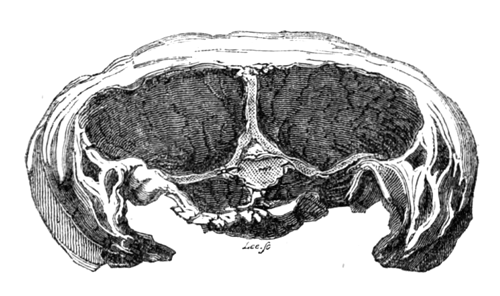
You must remark that, by this plan, the fat and lean are better divided, and you can enjoy both; whilst the other is a lump of meat near the bone and fat at the other end, which partly melts in cooking, and is often burnt by the flame it makes; the new one not being divided at the bone, keeps the gravy in admirably. If well sawed it should not weigh more than the ordinary one, being about half the thickness. Do try them, and let me know your opinion. Ever yours, Hortense.
Dear Hortense,—Yours of last night was received at our supper-table, which was surrounded by a few of our best friends, and I need not tell you the merriment it created respecting your fantastic ideas of this age of wonders. A very sedate old gentleman, who happened to have met you at Mr. H.'s party about a week or two ago, and wished to be very courteous to you, (perhaps you did not notice his compliments,) not only would he not give a smile to our hearty laugh, but actually swore that such comical nonsense was very dangerous to expose before the public, and especially if we intended to give publicity to it with the receipts, the last of which he very much approved of. But respecting your fun on the review of our century,—" A woman," said he, "ought never to interfere with politics!" "Politics!" we all exclaimed, "where do you see anything political in it?" "In almost every word," replied he. "But in what part?" said we; "explain yourself?" Unfortunately our hero stuttered very much. "Now, it-it-it is not one of-of-of you here, perhaps, who-who-who a-a-a-ve been in ann-y pu-pu-public office like me in ma-ma-my youth. I was cla-cla-cla-clerk of the second cla-cla-clerk of the first cla-cla-cla-clerk of the private secretary's cla-clacla-clerk of the Home of-of-of——l"Here, dear, we all burst out laughing, which made the old gentleman so mad, that he rushed from the room into the passage, to the street-door, and out of the house, without his hat, Welsh wig, great coat, and umbrella, while the servant had a regular race to get hold of him. She at last found him talking to himself under one of our willow-trees in the garden, coming back for his tackle with his two hands over his red wig, and his thick head underneath it. Being a wet night, after inquiring of the servant what he had said to her—"Ma-ma-ma-rie," said he, "you are a ve-ve-ve-very good girl indeed, very good girl, and I-I-I-I am ve-ve-ve-very sorry I have no money with me to gi-gi-gi-gi-give you something for your trouble, especially as you will ne-ne-ne-never see me here again—no, ne-nenever." "Never mind, sir, about the money," said she to him, "I am no more disappointed than usual. Good night, sir." "Mary, you are a ve-ve-very sau-saucy huzzy, a ve-very saucy huzzy," was his answer. He then gradually disappeared in the fog. In a few seconds after, she heard some one sneezing most fearfully in the direction he was gone, which she believed to be our stuttering friend. So you see, dear, there is quite an event on a mutton chop. But let me tell you that, though your receipt came rather late, we still had some for supper, and very good they were; every one was delighted with them; in fact, we eat hardly anything else, being so comically introduced to us. I had them brought up at three different times, broiling hot from the gridiron. I made twelve chops out of a middlesized saddle of mutton, weighing about seven pounds:—is that right? and I have about three pounds of chump remaining, which, of course, I intend making broth, Irish stew, or pies with. But, dearest, let us go through the remainder of the Receipts without any more interruption.
My husband begs to be kindly remembered to you both. Ever yours,
Eloise
463. MUTTON CUTLETS.—Trim a neck of mutton by cutting away the scrag and sawing off three inches of the ribbone, then cut about ten outlets out of the neck, shape them by chopping off the thick part of the chine-bone, beat them flat to about a quarter of an inch in thickness with a cutlet chopper, dipped in cold water, detach an inch of fat from the top of the rib-bone, and trim it like the engraving, season with a little salt and pepper, then well beat up one egg, dip a brush into it, and rub it lightly over the chop, dip it into bread crumbs, form it into shape again and dress in the following way:—
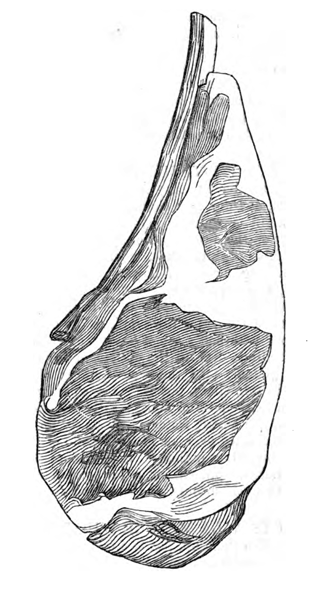
464. CUTLETS WITH MUSHROOMS.—If for ten or twelve cutlets take about twenty fresh mushrooms, cut off the tails, wash them, and dry on a cloth, put two pats of butter in a stewpan, half a gill of water, the juice of a lemon, a little salt and pepper; set on the fire; boil for a few minutes, then add two tablespoonfuls of white sauce, when very hot add a liaison of the yolk of an egg, made as follows:
Put the yolk in a cup, and mix well with two tablespoonfuls of milk, stir well for one minute, put it in the middle of your pan; if no white sauce, add a little milk to the mushrooms, and mix a little flour with half a pat of butter, and put it in; keep stirring until boiling; dish up the cutlets, and the liaison, and serve; or still plainer, take the same number of mushrooms, wash well, cut in thin slices, put into a stewpan, with two pats of butter, half a teaspoonful of flour, a little salt and pepper, the juice of a lemon, and a little water; stew gently for ten minutes, serve, pouring the sauce over, or in the middle of the cutlets.
They can be served as cutlets à la jardiniere, or with peas, tomatoes, artichokes, spinach, or à la poiverade, à la sauce piquante, with Brussels sprouts, and à la Soubise.
465. CUTLETS A LA MAÎTRE-D'HÔTEL.—When the cutlets are done, dish them up, put two ounces of maître-d'hôtel butter in a clean sautépan, keep it moving until melted; put two spoonfuls of cream when very hot, pour over, and serve with fried potatoes in the middle.
466. CUTLETS, PLAINER WAY.—Cut them from the neck, beat them down roughly without trimming, put them on the gridiron, when warm through, add salt, pepper, and very fine chopped onions, turn several times; they will take about ten minutes broiling; dish very hot, and serve. They may also be served on very white mashed potatoes.
467. SHEEP'S TONGUE DEMI-GLAZE.—For one dish, take six, put them in water to disgorge, then dry them, put them in a stewpan with two onions, half a large carrot, a bouquet of two bay leaves, one sprig of thyme, a quart of broth if handy, or water, half a spoonful of salt, put them on to boil, and simmer for two hours till done; try if tender with a pointed knife, if so take them out, skim them, trim out all the roots, cut the tongue in two, lengthwise, giving it a little the shape of cutlets, skim the fat from the stock, reduce the whole or part to a demi-glaze, put your pieces on a dish; when ready to serve, make a thin roll of mashed potatoes, and dish them round it, add a little sugar to the demi-glaze, and a small piece of butter, stir round till melted, add the juice of half a lemon, pour boiling hot over the tongue, the sauce ought to adhere thickly to the back of the spoon.
Observe, dear, how cheaply this dish may be procured, and I assure you it is very excellent; I have tried it with almost all the sauces I have described for cutlets, and have found it good with all; they are also very good
469. MINCE LAMB WITH REMAINS.—(See Veal.) Serve with poached eggs over.
470. REMAINS OF ROAST OR BOILED LAMB, WITH PEAS.—Cut up about two pounds, bones included, in rather small pieces, put into a convenient sized stewpan, add to it two teaspoonfuls of flour, one of chopped onions, one of salt, a quarter ditto of pepper, a pint of water, stir gently until near boiling, add one bay-leaf, and one pint of very green peas already boiled, simmer and serve. Half an hour is sufficient to prepare this dish; peas left from a previous day can be used, also cauliflower if not too much broken, and gently simmered, also a few mushrooms, or if no vegetables, add a little liaison, and the juice of half a lemon.
471. LAMB'S FEET are much more delicate than sheep's trotters, but they are cooked and dressed the same, only in less time. If there are any left cold, cut them in two, put them in a basin, pour over a glass of vinegar, half a ditto of oil, one onion sliced, salt, pepper, fry them for twenty minutes, dip each piece in a batter, and fry a nice yellow colour in fat; serve on a napkin.
472. LAMB'S HEART.—Six will make a nice dish; stuff like calf's heart, only adding to it some bits of ham or red tongue; stew and serve with any kind of sauce.
473. LAMB CUTLETS.—Ten outlets would be sufficient for a dish, for five persons, and might be cut from one neck, as described for mutton cutlets (page 247), but leaving them as large as possible; that is, about one third less than the mutton; season them lightly with salt and pepper, egg and bread-crumb them over, afterwards beating them gently with a knife, to put them again into shape; then have a little clarified butter upon a plate, into which dip each cutlet separately, afterwards throwing them into bread-crumbs, giving them another coat, and beat again. Then if wanted of a very nice colour, put four spoonfuls of salad oil into a sauté-pan, lay in the cutlets and set them over a sharp fire, turning when required; six or eight minutes would be sufficient to do them nicely; when done, lay them upon a cloth a moment to drain; glaze, and dish them upright, "en courrone," upon your dish, and serve with stewed cucumbers in the centre.
Lamb cutlets may also be served with stewed peas, French beans, spinach, asparagus, peas, sauce jardinière, reforme, poiverade, piquante, or maitre-d'hotel which will be found in the series of sauces; or lamb-cutlets may be broiled instead of sautéed, or served a la Maintenon, as directed for veal cutlets.
474. LAMB CHOPS, Select a fine loin of lamb with the kidney in it, trim off the flap, and with a very sharp knife cut your chops from half to three quarters of an inch in thickness, cutting about eight chops from the loin, three of which should have a piece of the kidney attached. I also cut two chops from the chump, which are very excellent eating, although clumsier in shape. Lay three of them upon a gridiron over a rather brisk but very clear fire, for, if smoky, it would entirely spoil the look and flavour of the lamb; and when just warmed through, season upon each side with a teaspoonful of salt, and a quarter of that quantity of pepper; broil of a nice yellow colour, and serve with fried parsley over if convenient; or lay some nice mashed potatoes upon your dish, and serve the chops upon it.
475. LAMB CHOPS IN PAPER WITH FINE HERBS. —Cut a piece of foolscap paper in the shape of a heart, (and sufficiently large to fold a lamb chop in,) rub a little oil over the paper, then season the chop with a teaspoonful of chopped eschalots, one of chopped parsley, a little pepper, salt, and grated nutmeg; wrap the chop in the paper, which plait down at the edges, lay it upon a gridiron over a slow fire, turning it frequently; it will take about twenty minutes to broil properly, when done serve in the paper very hot.
476. LAMB CHOPS SAUTÉ.—Put a piece of butter into a clean saute or frying-pan, and when melted lay in two chops rather highly seasoned with pepper and salt; saute it until thoroughly done and but lightly browned, and serve. Should gravy be required, pour off the greater part of the fat, and then stir in half a tablespoonful of flour, add a gill of broth or water, and a little colouring; stir with a wooden spoon, boiling five minutes, finish with an ounce of fresh butter and the juice of half a lemon; shake the pan over the fire until the sauce becomes rather thick, when pour over and serve.
477. PORK CUTLETS.—Choose a small neck, cut eight cutlets out of it of the same shape as the mutton, only leaving a little more fat on it, season, egg, and bread-crumb, sauté in pan, serve with either sauces Robert, poiverade, piquante, tartare.
478. PORK CUTLETS WITH PICKLE.—Sauté, broil, or fry the chops, as in the preceding; make about a gill of melted butter, add to it two tablespoonfuls of liquor of piccalilly, and six or eight pieces of the pickle cut small; when very hot put on your dish, and dress your cutlets over, or if for a large dish, dress cutlets in a crown, and sauce in the middle.
479. PORK CUTLETS SAUTÉ.—Cut six or eight goodsized outlets from the neck of the same shape as the mutton, lay them in a buttered saute-pan, season well with pepper and salt, place over the fire; when done, lay them upon a plate, pour some of the fat from the saute-pan, add a good tablespoonful of chopped onions, pass over the fire a minute, then add a teaspoonful of flour; moisten with half a pint of broth or water, with a piece of glaze added, season a little more, add a bay-leaf and a teaspoonful of vinegar, with one of mustard, mix well, lay in the cutlets until quite hot, when dress upon a dish, sauce over, and serve. This sauce is good with any kind of outlets, but especially pork.
480. PORK CUTLETS AUX CORNICHONS.—Cut six or eight outlets from a middling-sized neck of pork, season well with pepper and salt, dip in eggs well beaten upon a plate, and then into grated crust of bread (not too brown), put two ounces of lard or butter into a saute or frying-pan, lay in the cutlets and saute very slowly; when done, place them upon a dish; keep hot, pour some of the fat from the pan, add a good teaspoonful of flour, mix well, moisten with half a pint of broth or water with a piece of glaze, add half a wineglassful of vinegar, a little salt, pepper, and six gherkins in slices, place the cutlets in the pan to warm gently in the sauce, then dress them upon a dish, sauce over, and serve.
481. PORK CUTLETS SAUCE DEMI-ROBERT.—Cut eight cutlets from a neck as before, season well with pepper and salt, sprinkle chopped onions and parsley over upon both sides, beating the cutlets lightly to make them adhere, then dip them into eggs well beaten upon a plate, and then into bread-crumbs; pat them lightly, have some clarified butter in a stewpan, into which dip the cutlets, and again into bread-crumbs, well covering them, place them upon a gridiron over a moderate fire, broiling a nice light brown colour; when done, dress them upon a dish. Have ready the following sauce: Demi-robert, cut two large onions into very small dice, put them into a stewpan with an ounce of butter, fry of a light yellow colour, add a teaspoonful of flour, mix well, moisten with half a pint of broth and a spoonful of vinegar, season well, let boil, skim, and reduce until rather thick, when add a spoonful of mixed mustard, a little colouring; sauce in the centre of the cutlets, and serve.
482. EXCELLENT SAUSAGE CAKES—Chop some lean pork very fine, having previously detached all the skin and bone, and to every pound of meat add three quarters of a pound of fat bacon, half an ounce of salt, a saltspoonful of pepper, the quarter of a nutmeg grated, six young green chopped onions, and a little chopped parsley; when the whole is well chopped, put into a mortar and pound well, finishing with three eggs; then have ready a pig's caul, which cut into pieces large enough to fold a piece of the above preparation the size of an egg, which wrap up, keeping the shape of an egg, but rather flattened, and broil very gently over a moderate fire.
483. PIGS' FEET.—Procure six pigs' feet nicely salted, which boil in water, to which you have added a few vegetables, until well done, cut each one in halves, take out the long bone, have some sausage-meat as in the last, and a pig's caul, which cut into pieces each large enough to fold half a foot, well surrounded with sausage-meat; when well wrapped up broil slowly half an hour over a moderate fire, and serve. Or, when the pigs' feet are well broiled, egg over, and throw them into some grated crust of bread, with which you have mixed a little parsley, broil a nice colour, and serve with a little plain gravy. This is called à la Ste. Menehould.
484. PIGS' KIDNEYS.—Cut them open lengthwise, season well with pepper and salt, egg over with a paste brush, dip into bread crumbs, with which you have mixed some chopped parsley and eschalot, run a skewer through to keep them open, and broil for about a quarter of an hour over a good fire; when done, place them upon a dish, have ready an ounce of butter, with which you have mixed the juice of a lemon, a little pepper and salt, and a teaspoonful of French or common mustard; place a piece upon each of the kidneys, place in the oven for one minute, and serve. Pigs' kidneys may also be sautéd as directed for ox kidneys.
485. HASHED PORK—Put two spoonfuls of chopped onions into a stewpan, with a wineglassful of vinegar, two cloves, a blade of mace, and a bay-leaf; reduce to half, take out the spice and bay-leaf, add half a pint of broth or water, cut some pork previously cooked into thin, small slices, season well upon a dish with pepper and salt, shake a good teaspoonful of flour over, mix altogether, and put into the stewpan; let simmer gently ten minutes, pour out upon your dish, and serve with slices of gherkins in it; a little mustard may be added, if approved of, or a little piccalilly with the vinegar is excellent.
The remains of salt pork, though very palatable cold, if required hot may be cut into large thin slices, and placed in a buttered saute or frying-pan, with a little broth, or merely fried in the butter, and served with a purée of winter peas, made by boiling half a pint of peas until tender (tied up in a cloth); when done, put them into a stewpan with two ounces of butter; season with pepper and salt, add a gill of milk or cream, pour into the dish, and dress the pork over.
It may also be cut into thin slices and put into a soup plate, and pour some catsup or Harvey sauce over it, and let it remain for half an hour; butter the inside of a pudding basin, and lay some of the remains of pease pudding round it, and then place in the pork, cover it with some of the pudding, place it in a saucepan with a little water to get hot, for about half an hour, and then turn it out and serve. Should you not have quite pork enough, you may make it up with a little sausage-meat or any other kind of meat.
486. FRITADELLA (twenty receipts in one.)—Put half a pound of crumb of bread to soak in a pint of cold water, take the same quantity of any kind of roast or boiled meat, with a little fat, chop it up like sausage meat, then put your bread in a clean cloth, press it to extract all the water, put into a stewpan two ounces of butter, a tablespoonful of chopped onions, fry for two minutes, then add the bread; stir with a wooden spoon until rather dry, then add the meat, season with a teaspoonful of salt, half the same of pepper, a little grated nutmeg, the same of lemon peel, stir continually until very hot; then add two eggs, one at a time, well mix together, and pour on a dish to get cold. Then take a piece as big as a small egg, and roll it to the same shape, flatten it a little, egg and bread-crumb over, keeping the shape; do all of it the same way, then put into a saute-pan a quarter of a pound of lard, or clean fat, or oil; when hot, but not too much so, put in the pieces, and saute a very nice yellow colour, and serve very hot, plain, on a napkin, or on a border of mashed potatoes, with any sauce or garniture you fancy. These can be made with the remains of any kind of meat, poultry, game, fish, and even vegetables; hard eggs, or cold mashed potatoes may be introduced in small quantities, and may be fried instead of sautéd, in which case put about two pounds of fat in the frying-pan, and if care is used it will do several times.— (See Frying, p. 70.) This is an entirely new and very economical and palatable dish, and fit for all seasons, and if once tried would be often repeated; the only expense attending it is the purchase of a small wire sieve for the bread-crumbs. The reason I call it twenty receipts in one is, that all kinds of food may be used for it, even shrimps, oysters, and lobsters.
487. RAMIFOLLE.—These are a little more expensive than the fritadella, and worthy the table of a crowned head. The flesh of fowls instead of lamb or veal, with the addition of one or two fat livers cut in dice. Proceed as in the former receipt, using the crumb of French rolls, and one or two truffles cut fine: then make some pancake batter, and sauté two pancakes about one-eighth of an inch thick, cover one with the meat, &C., and lay the other over, and put by until cold; when so, cut them to any shape you like, but if like cutlets add the small bone of fowl or pigeon, or the stalk of a sprig of parsley, egg and breadcrumb them, and sauté them in oil or lard of a nice yellow colour, and dish them like cutlets, with any of the sauces or garnitures described for mutton cutlets; or if plain, with fried parsley. They may be made of any kind of meat, fish, or poultry. I have latterly had them sent up to table when we have had a few friends, and they have been very much liked; and, on inquiring the name, I baptized them Ramifolle, without any particular meaning, which name having pleased as much as the dish, therefore let them be called Ramifolles.
They may be made a plainer way with various meats or liver, and spread over one pancake, which roll over, and when cold cut it into three equal lengths, egg, bread-crumb, and sauté as above.
488. PRUSSIAN CUTLETS.—Take a piece of veal, say one pound, from any part of the calf, free from nerve, with a little fat, chop it up, but not too fine, add to it two teaspoonfuls of chopped eschalot, one of salt, half a one of pepper, little grated nutmeg, chop it a little more, and make it into pieces of [the size of two walnuts, to which give the shape of a cutlet; egg and bread-crumb each; insert a small bone at the small end, sauté it in fat, oil, lard, or butter, give it ten minutes on a slow fire till a nice brown colour, dish and serve with demi-glaze sauce, in which you have put a spoonful of Harvey's, and serve with any brown or white sauce of stewed vegetables you like. Any kind of meat may be used.
469. CUTLETS À LA VICTIME, or Victimized Cutlets. —Here, ma belle amie, is a terrific title for a receipt; but do not fear it, as the time of the Inquisition is past, and you are not likely to become one in partaking of it. I do not recommend it to you on the score of economy, as it is the tip-top of extravagance, but forward it as a curiosity; and also in case similar circumstances should happen which caused its invention, which I must tell you was done by a culinary artist of Louis XVIII., of France, at the palace of the Tuileries, and first partaken of by that intellectual monarch and gourmet, who, at the end of his stormy reign, through a serious illness, was completely paralysed, and, at the same time, the functionary organs of his digestion were much out of order; being a man of great corpulence, and a great admirer of the festive board, much food was required to satisfy his royal appetite: and the difficulty which his physicians experienced was to supply this want of food in the smallest compass. The head-cook, on being consulted, begged a few hours for reflection before he could give an answer to so important a question, as nothing but mutton entirely deprived of fat was to compose his Majesty's meal. After profound study by the chief and his satellites, a voice was heard from the larder, which was a considerable distance from the kitchen, crying, "I have found it, I have found it." It was that of a young man of the name of Alphonse Pottier, who, in saying so, made his appearance in the kitchen with three beautiful mutton cutlets, tastefully trimmed and tied together; he then, with a small skewer, fastened them to a spit, and placed them, to the astonishment of all present, close to the bars of the grate: two of the outlets soon got brown (observe, not a word was to be said until the trial was made), from brown they soon turned black; every one gazed at each other in astonishment, whilst Pottier, with quite a composed countenance, terminated his scientific experiment, took them off the spit, drew the skewer out, cut the string, threw the two burnt cutlets away, and merely served the middle one, which seems to have received all the nutriment of the other two; it was served and greatly approved of by the physicians, as well as by the gourmet potentate, who, in consequence of two being sacrificed for one, named it "Cutlet à la Victime," and often afterwards used to partake of them when in the enjoyment of health.
Cut three outlets; from the neck of mutton, about half an inch thick, trim one very nicely, free from fat, leave the other two as cut off, put the trimmed one between the two, flatten them together, so that the fat of the outside ones meet over the middle one; tie them together thus, and broil over a very strong fire for ten minutes; remove it from the fire, cut the string, and dish up the middle one only on a very hot dish, with a little salt sprinkled over it. If wanted roasted, proceed as above.
490. ROAST AND BRAISED CHICKEN, for Entrées. —Have a chicken trussed for boiling; put it on a spit, envelope it as for turkey (No. 381), roast half the time or little less, depending on the fire and the size of the chicken; when done, remove it from the spit, and take off the envelope, and serve with any of the following garniture:—jardinière, green peas, oysters, cucumbers, Jerusalem artichokes, white mushroom sauce, ragout of quenelles, juice of tarragon (No. 386), Dutch sauce, with a few heads of cauliflower well boiled, and cut small.
491. BRAISED CHICKEN.—If not convenient to roast, put a little bacon in a stewpan, then a chicken, a large onion, half a carrot, half a head of celery, two bay leaves, two cloves, one peppercorn, one and a half tablespoonful of salt, a little pepper, a bouquet garni, and a quart of water, let simmer till tender; dish up, after having well drained it, take the string off, pour any of the sauces named in the foregoing receipt, over or under them; when the chicken is done, you can make, with the addition of a little more water, a very good puree, and even sauces, and by adding some trimmings of beef, veal, lamb, or mutton, it will make a first-rate clear broth, after being clarified, giving it a proper colour.
492. CHICKEN PLAIN BOILED.—Put two quarts of water into a stewpan, on the fire, or two ounces of butter, and a tablespoonful of salt and a few vegetables; when boiling, rub the breast of the chicken with half a lemon, and put it in to simmer from a quarter of an hour to twenty minutes; if a large fowl, increase the quantity of water, and boil longer; sauce over with parsley and butter, or celery sauce, or any of those for the foregoing: use the broth.
The remains of any of the above, or of turkey, capon, guineafowl, or other poultry, may be dressed as hash, by cutting them into neat pieces; put them into a stewpan, put to it half a tablespoonful of salt, one of flour, half a one of chopped onions, ditto of parsley, a bay-leaf, half a pint of water, a few drops of colouring; set to simmer for twenty minutes, and serve; the addition of a few mushrooms is excellent.
493. POULTRY EN CAPILOTADE.—Put with the pieces of fowl a tablespoonful of oil, and one glass of sherry, into a pan, and proceed as above; when ready to serve, chop a few gherkins, and put in.
494. INDIAN HASH FOWL.—Make a pint of sauce (p. 81), warm, put into it your pieces of fowl, and serve with rice, plain boiled.
495. FRIED FOWL.—When you have cut the pieces as before, put them into a basin with a little salt and pepper, a spoonful of oil, and two of vinegar, and a little chopped eschalot, stir them well in it, and let remain for half an hour, have ready a quantity of batter, and take a fork and dip each piece one after the other into it, and then let it drop into the frying-pan, in which is sufficient hot fat to cover them; fry a nice colour, and serve in the form of a pyramid, with fried parsley over, or any sauce you like under.
496. BLANQUETTE OF FOWL.—Put half a pint of white sauce in a stewpan, with six tablespoonfuls of broth or milk, let it boil; having cut up about a pound of the remains of any kind of poultry, put it in the sauce, warm it, and add two spoonfuls of liaison to it; season with a little salt, pepper, the juice of half a lemon, stir it, and serve. Do not let it boil, or it will curdle, and be unsightly and unpalatable; a little cooked ham or tongue is good in it, also oysters, and served with bread sippets round. A little chopped parsley sprinkled over makes it look very inviting.
497. MINCED FOWL.—Cut the remains into small dice, with a little ham or tongue, add thick white sauce, season mildly; it can be served with poached eggs over.
498. SAUTÉ OF FOWL.—See the article Sauté, which is applicable to all kinds of poultry; if the fowl be old, it should be previously stewed.
499. BROILED FOWL WITH SAUCE.—Have a fowl ready plucked and drawn, open the back from one end to the other with a sharp knife, having previously cut the feet off at the second joint; make an incision in the skin, and pass the bone through to fix it internally; lay the fowl on the table, breast down, beat it as flat as possible with a chopper, take out the breastbone, and also the rough part of the interior of the back, especially if a large or old fowl; after you have it in a nice shape, season all over with a teaspoonful of salt and half one of pepper, put it on a gridiron, over a slow fire, turning it every five minutes until done; if a young one, twenty-five minutes ought to do it well, but by trying with the finger on the thick part it will easily be known by even an inexperienced hand; if firm under the finger it is done, or by pressing the wing, if tender it is also done; put it on dish, and pour over a brown mushroom sauce, or the following: put two spoonfuls of Chili vinegar, two of Harvey's sauce, two of catsup, one of chopped eschalot, ten of plain melted butter, in a stewpan, and boil for twenty minutes; skim, and serve it under or over.
500. ANOTHER WAY.—When the fowl is ready for broiling, put four tablespoonfuls of oil or fat, or one ounce of butter, into a saute pan, lay in the fowl, and saute' it gently until a nice yellow colour, and then broil as above; or egg and bread-crumb it over, melting a little butter, and drop a little now and then when on the fire, and with care it will be gold colour; serve with either sharp, mushroom, tomato, or poiverade sauce on it and under.
501. À LA TARTARE.—By making about half a pint of sauce a la tartare, and ornament an oval dish by placing on the border cut gherkins, beetroot, olives, place the sauce on it, and lay the fowl very hot over it; thus the fowl is hot and the sauce cold, but together very good.
502. CROQUETTES OF FOWL.—Take the lean of the remains of a fowl from a previous dinner, and chop it up in small pieces, then put into a stewpan a teaspoonful of chopped eschalots, with half an ounce of butter, pass them for about three minutes over the fire, add a teaspoonful of flour, mix well, then add the fowl, and a gill of white sauce, or more if not sufficiently moist; season with pepper, salt, and sugar; then stir in the yolks of two eggs very quickly, stir it a little longer on the fire, and turn it out on a dish to cool; when cold, take twelve pieces, each the size of a walnut, roll them out an inch and a half in length, and bread-crumb twice over; fry a good colour, dress them on a napkin, or a border of mashed potatoes. Every kind of remains of game, meat, poultry, and fish, may be made the same way: if no sauce, add a little more flour, and use milk or broth.
503. FRICASSEE OF FOWL.—Divide a fowl into eight pieces, as No. 504, wash it well, put the pieces into a stewpan, and cover with boiling water, season with a teaspoonful of salt, a little pepper, a good bouquet of parsley, four cloves, and a blade of mace; let it boil twenty minutes; pass the stock through a sieve into a basin; take out the pieces of fowl, trim nicely, then put into another stewpan two ounces of butter, with which mix a good spoonful of flour, moisten with stock, put in the pieces of fowl, stir occasionally until boiling, skim well, add twenty button onions, let simmer until the onions are tender, when add a gill of cream, with which you have mixed the yolks of two eggs, stir it quickly over the fire, but do not let it boil; take out the pieces, dress in form of pyramid upon the dish, and serve.
If you require to warm up the remainder of the above, put it into a basin, which stand in a stewpan in which you have placed a little water, put the cover over, and let it boil gently, by which means the contents of the basin will get warm without turning the sauce; when hot, dish up and serve. The same plan ought to be adopted to warm up any remains of dishes in which a liaison has been introduced; it prevents its turning, which is unavoidable in any other way.
504. FOWL SAUTÉ.—Pluck and draw a fowl, cut it into pieces, seven or eight, as you like, that is, the two French wings, the two legs, the breast in one or two pieces, and the back in two; trim nicely, put into a sautépan two ounces of butter, put it on the fire; when hot, lay in your pieces, add a teaspoonful of salt, a quarter ditto of pepper, saute gently, turn over; when of a nice gold colour and tender, pour the fat out of the pan, add a glass of sherry and ten spoonfuls of brown sauce, and six of broth, boil ten minutes longer, but very slowly, skim, and serve in form of pyramid; sauce over.
505. THE SAME, A PLAINER WAY.—When prepared and cooked as above, instead of the sauce, which may not be handy, add a spoonful of flour, which dredge over till it is well mixed, then add half a pint of boiling water, a few drops of colouring or some mushroom catsup, two teaspoonfuls of salt, and a half of pepper, add a bouquet of parsley, let it simmer for twenty minutes, skim, taste if your sauce is well seasoned, dish your fowl, reduce your sauce until adhering to the back of the spoon, add the juice of half a lemon, and serve. A few mushrooms or English truffles may be added to it, which is a great improvement; the colour of the sauce ought to be brownish; take out the bouquet, which you have previously squeezed.
506. SAUTÉ OF FOWL WITH VEGETABLES.—Proceed exactly as above, only omitting the wine, add to the sauce fifty heads of young green scallions, or some small pieces of carrot and turnip, or a pint of green peas, or cucumbers cut in nice pieces, stew till tender, add a spoonful of powdered sugar, dish the fowl, skim the sauce, take out the parsley; when your sauce is thickish and of a nice colour, pour over the fowl, and serve very hot.
507. FOWL SAUTÉ MARENGO, PARISIAN.—Cut a fowl (like No. 504), which put into a stewpan, with three tablespoonfuls of salad-oil, over a moderate fire, shaking the stewpan round occasionally, until the pieces of fowl are rather browned, when mix in a tablespoonful of flour, which moisten with a pint of stock or water, let it simmer at the corner of the fire twenty minutes, skimming off the oil as it rises to the surface; add a few blanched mushrooms in slices, season with a little salt, pepper, sugar, and a piece of scraped garlic the size of a pea; take out the fowl, which pile upon your dish, laying the worst pieces at the bottom; reduce the sauce over the fire, keeping it stirred until sufficiently thick to adhere to the back of the spoon, when pour over the fowl and serve. Use brown sauce, No. 136, if handy.
508. BLANQUETTES OF TURKEY.—Cut off the flesh from the remainder of a roast or boiled turkey into as large thin slices as possible, then break up the bones, which put into a stewpan, with a little lean bacon and an onion, and a small bouquet of parsley, thyme, and bay-leaf, just cover them with water, and boil gently for three quarters of an hour, skim, and pass the stock through a cloth, and with it make a little white sauce, then put the meat into another stewpan lightly seasoned with a little pepper, salt, and grated nutmeg; just cover it with some of the sauce, and warm it gradually, not, however, permitting it to boil; when very hot, stir in three tablespoonfuls of cream, with which you have mixed the yolk of an egg, and when beginning to thicken, dress it upon a dish with toasted or fried sippets of bread around; cucumbers cut and dressed as directed p. 85, and added to the blanquette, are a very great improvement, as are likewise button mushrooms, or a few slices of cooked ham or tongue.
For a Blanquette of Fowl, proceed precisely the same.
509. BOUDINS OF FOWL OR TURKEY.—Cut up the remains of a turkey or fowls into very small dice, with a quarter of a pound of lean cooked ham to each pound of meat, make a stock with the bones as directed in the last; put a teaspoonful of chopped eschalots into a stewpan, with a piece of butter of the size of a walnut, which stir over the fire until the eschalots become a little yellowish, when stir in a good tablespoonful of flour, add the meat and about a pint of the stock, let boil gently a few minutes, season with a little pepper, salt, and sugar, stir the yolks of two eggs in quickly, and pour it out upon a dish until cold, when divide it into pieces of the size of eggs, which rub into long pieces of the shape and size of flat sausages, which egg and bread-crumb twice over, and fry of a nice brown colour in hot fat or dripping, drain upon a cloth, and serve very hot.
510. TURBAN OR CROQUETTES À L'EPIGRAMME. —Croquettes are made from the same preparation as the last, but made up into small pieces, two inches in length, and the thickness of your finger; egg, bread-crumb, and fry the same, dress in a circle upon a thin border of mashed potatoes, and serve with some blanquette of turkey or fowl in the centre.
511. HASHED GOOSE.—Put a spoonful of chopped onions into a stewpan with an ounce of butter, which fry over the fire until becoming rather browned, then stir a tablespoonful of flour, put in the remains of a goose, cut into neat pieces, and well seasoned with pepper and salt; add a pint of stock, let the whole simmer about ten minutes, and it is ready to serve. A little apple sauce may be served separately in a boat, or a couple of apples sliced; a few leaves of bruised dried sage may be stewed with the hash.
512. STEWED DUCK WITH PEAS.—Truss a duck with the legs turned inside, which put into a stewpan with two ounces of butter, and a quarter of a pound of streaked bacon, cut into small dice, set the stewpan over a moderate fire, occasionally stirring its contents until it becomes lightly browned, then add a good tablespoonful of flour, and when well mixed, a pint of stock or water, stir occasionally until boiling, when add twenty button onions and a bunch of parsley with a bay-leaf; let the whole simmer a quarter of an hour, keeping it well skimmed, then add a quart of young peas, and simmer half an hour longer, or until the peas are quite tender, when take out the duck, draw out the string, and dress it upon your dish; remove the parsley and bay-leaf, season the peas and sauce with a little pepper, salt, and sugar, pour over the duck, and serve.
513. STEWED DUCK WITH TURNIPS.—Proceed as in the last, but instead of peas, use about forty pieces of good turnips, cut into moderately-sized squares, and previously fried of a yellowish colour, in a little lard or butter, dress the duck upon your dish, season the turnips and sauce with a little salt, pepper, and sugar, and reduce it until thickish, not however to break the turnips; sauce over, and serve.
The remains of ducks left from a previous dinner may be hashed as directed for goose, but the sage and apple should in all cases be omitted; for variety, should peas be in season, a pint freshly boiled may be mixed with the hash at the time of serving.
514. FRICASSEE OF RABBIT.—Cut a nice young rabbit into neat joints, and put them into lukewarm water to disgorge for half an hour, when drain and put them into a stewpan, with a large onion cut into slices, two cloves, a blade of mace, a little parsley, one bay-leaf, and a quarter of a pound of streaky bacon cut into small dice; cover the whole with water, and let it simmer twenty minutes, keeping it well skimmed; then pass the stock through a sieve into a basin, take out the pieces of rabbit with the bacon, then in another stewpan have two ounces of butter, with which mix a good tablespoonful of flour, moisten with the stock, and stir over the fire until boiling; then trim, neatly the pieces of rabbit, which, with the bacon and twenty button onions, put into the sauce; let the whole simmer until the onions are tender, skimming off all the fat as it rises to the surface; then pour in a gill of cream, with which you have mixed the yolks of two eggs, leave it a moment upon the fire to thicken (but not to boil), take out the rabbit, which place piece upon piece upon your dish, sauce over and serve.
515. GIBELOTTE OF RABBIT.—Cut up a young rabbit into neat joints, as likewise a quarter of a pound of streaky bacon in small dice, put the bacon into a stewpan, with two ounces of butter, and when a little fried, put in the pieces of rabbit, which saute of a light brown colour, moving them round occasionally with a wooden spoon; then add a good tablespoonful of flour, working it well in, moisten with a pint of water, season with a little pepper and salt, and when beginning to simmer, skim off all the fat, and add thirty button onions, a few blanched mushrooms, and a little brown gravy or colouring; let simmer a quarter of an hour longer, when takeout the rabbit, which dress upon your dish; reduce the sauce until it adheres to the back of the spoon, when pour it over the rabbit, and serve.
516. COMPOTE OF PIGEONS.—Put a quarter of a pound of lean bacon cut into small dice into a stewpan, with half an ounce of butter, and fry a few seconds over the fire, then have three pigeons trussed, with their legs turned inside, which place in the stewpan breast downwards, setting them over the fire until of a light brown colour, moving them round occasionally; add a tablespoonful of flour, which work well in with a wooden spoon, until becoming browned, when moisten with a pint of water, add a good bunch of parsley, with a bay-leaf, and about thirty button onions, season with a little pepper and salt, let the whole simmer three quarters of an hour, keeping it well skimmed, then dress the pigeons upon a dish with the bacon and onions round, reduce the sauce to a proper consistency, take out the parsley and bay-leaf, sauce over, and serve.
517. STEWED PIGEON WITH PEAS. —Cook the pigeons precisely as described in the last, but omitting the onions and bay leaf, and adding a quart of fresh green peas; when done, dress the pigeons in a dish, pour the sauce and peas over, and serve. 518. HOT LAMB PIE (raised).—To make this an oval, a tin or copper pie mould would be required, which you would choose of a size most generally useful. Butter the interior of the mould, which stand upon a baking-sheet, then make the following paste: put a quarter of a pound of butter and the same of chopped suet into a stewpan, with three quarters of a pint of water, or more if required, and let the whole boil together one minute, when strain it through a sieve into a basin containing two pounds of flour, mixing it first with a spoon, and when cool enough with the hand, until forming a smooth paste; when partly cold roll it out into a sheet half an inch in thickness, with which line the mould, pressing the paste evenly at all parts; have ready cut sufficient small lamb chops from the loin, neatly cut away the bones, and lay them round the interior of the pie alternately with slices of raw potatoes (a quarter of an inch in thickness), season rather highly as you proceed, with pepper, salt, chopped onions, and parsley; make a neat cover with the trimmings of the paste, and bake it rather better than two hours in a moderate oven; when done lift the cover, pour out as much of the fat as possible, add a little gravy, and serve.
519. OTHER VARIOUS PIES.—Hot raised pies may also be made with mutton by following the above directions. They are also very good made with fillet of beef cut into thin slices of the size of the lamb chops, or of rump steak, by laying a piece at the bottom, seasoning and filling alternately with potatoes and the meat; veal and ham pies are also excellent, but the potatoes in them had better be omitted, the veal, however, seasoned and dipped in flour. Pies may also be made with veal sweetbreads and ham, but then about three parts of a pint of white sauce should be poured in after the pie is baked. Fowls or rabbits may likewise be cut into joints, and put into a stewpan, with a piece of butter, previously well seasoning them with pepper, salt, and chopped eschalots; cover the stewpan close, and leave it twenty minutes over a slow fire, add a pint of white sauce, and simmer ten minutes longer, when cold build them up in the interior of the pie, which cover and bake an hour in a warm oven. Pies of the above description can of course be made of any size, either large enough for a family meal, or very small and round, for a corner dish for a dinner party; most people who are in the habit of making them, keep two different-sized moulds for the purpose.
520. RUMPSTEAK PIE.—Procure two pounds of rumpsteaks, which cut into slices half-an-inch thick, and season well with pepper and salt, dip each piece into flour, and lay them in a small pie-dish, finishing the top in the form of a dome; add a wineglassful of water, then have ready half a pound of half-puff paste, cut off a small piece, which roll into a band, and lay round the edge of the dish, having previously wetted it with a paste-brush dipped in water, then roll out the remainder of the paste to about the size of the dish, damp the band of paste upon the dish, and lay the other piece over, make a hole with a knife at the top, press the edges evenly down with your thumbs, trim the pie round with a knife, egg over the top with a paste-brush, and ornament it with the trimmings of the paste, according to fancy; bake it rather better than an hour in a moderate oven, and serve either hot or cold.
521. VEAL AND HAM PIE.— Cut about a pound and a half of veal into thin slices, as also a quarter of a pound of cooked ham; season the veal rather highly with white pepper and salt, with which cover the bottom of the dish, then lay over a few slices of ham, then the remainder of the veal, finishing with the remainder of the ham, add a wineglassful of water, and cover and bake as directed for beefsteak pie: a bay-leaf will be an improvement.
522. MUTTON PIE.—Procure the chumps of three loins of mutton, from which cut the meat in moderately thin slices, put a layer at the bottom of the dish, which season well with chopped parsley, eschalots, pepper, and salt; then put a layer of slices of raw potatoes, and again a layer of mutton, seasoning as before, proceeding thus to the top, which form in a dome, finishing with mutton, cover with paste, and bake as directed for rumpsteak pie.
523. ANOTHER METHOD.—Cut six chops from a loin of mutton, from which trim as much of the fat as possible; season them well with salt and pepper, and lay them round in your pie-dish, the thick part uppermost; put two onions, in slices, in the centre, over which lay four middling sized potatoes, each cut in halves, pour in a wineglassful of water, cover with paste, and bake as the last.
524. LAMB PIE.—Cut a small neck of lamb into chops, which must not be too fat, season them lightly with pepper and salt, and lay them in your pie-dish, with a few new potatoes in slices, pour in a little water, then cover and bake as directed for rumpsteak pie.
525. CHICKEN PIE.—Cut up a nice plump chicken into joints, which lay upon a dish, and season lightly with chopped parsley, white pepper, and salt, then lay the back, cut into three pieces, at the bottom of a pie-dish with the two legs on either side; have half a pound of cooked ham or bacon in slices, a layer of which cover over, then lay in the two wings, and over them the breast, cut into two pieces, which, with the remainder of the ham or bacon, form into a dome in the middle, pour half a pint of white sauce over, if handy, or a little broth or water, cover with paste, and bake as directed for the last. If no white sauce, dip each piece lightly in flour.
526. GIBLET PIE.—When the giblets have been taken from the goose as directed in No. 393, place them, with the exception of the liver, but with the pinions, feet, head, and neck, into boiling water to blanch; remove the skin from the feet and beak, put into a stewpan a piece of butter the size of a walnut, one onion cut in slices, a bay-leaf, a little salt, pepper, and sugar: place it on the fire until the onion is brown, place in the giblets with the head cut in two, let them remain on the fire for about three minutes, stirring them round; then add one quart of boiling water and let them stew gently for two hours, remove from the fire and let them get cold. Take a pie-dish and place a piece of steak on the bottom, then place over that the giblets with the liver, and steak again over them, add the liquor the giblets were stewed in, season and cover with half puff paste.
527. RABBIT PIE.—Cut a nice rabbit into joints, splitting the head in halves, and lay them in lukewarm water half an hour to disgorge, then dry them upon a cloth, season well with pepper, salt, chopped eschalots, parsley, two bay-leaves, and a spoonful of flour; have also three-quarters of a pound of uncooked streaked bacon, cut into square pieces the size of walnuts, build up the pieces of rabbit and bacon together, in a pie-dish, commencing with the worst pieces, and forming a dome; pour in a little water, cover with paste, and bake as directed for rumpsteak pie.
528. PIGEON PIE.—Line the bottom of a pie-dish with a pound of rumpsteak, cut into slices not too thin, seasoned with a little salt, pepper, and cayenne, and dipped into flour; have ready pickled and drawn a couple of pigeons, cut off the feet, turn the legs in, fold up the pinions of the wings, and lay them breast to breast upon the meat, have the yolks of four hard boiled eggs, which put at the sides, sprinkle a little pepper and salt over the pigeons, lay a bay-leaf upon the top, pour in a little water, cover with paste, stick the feet in the top, and bake as directed for the last. The pigeons may be stuffed with a little veal stuffing, if handy.
529. PARTRIDGE PIE.—Line the bottom of a pie-dish with slices of veal, cut moderately thick, and rather lightly seasoned with white pepper and salt; have ready picked, drawn, and trussed, a couple of young partridges, pour one glass of sherry over the veal, one of water, and lay in the partridges breast to breast, laying a piece of fat bacon over each, cover with paste, sticking the feet of the partridges in the top of the pie, and bake as before.
530. GROUSE PIE.—Roast, very underdone, a couple of nice plump grouse; when cold, cut into joints, being the two wings, two legs, and the breasts into two pieces each, season them lightly, and lay them in a pie-dish, building them to form a dome, then break up the back-bone and other trimmings, which put into a stewpan, with a glass of sherry, a bay-leaf, an onion in slices, a few sprigs of parsley, three or four whole allspice, set the stewpan over the fire a few minutes until the wine boils, when add half a pint of brown sauce, and half a pint of broth, stir it over a fire until again reduced to half a pint, strain it through a sieve, over the grouse; when quite cold cover with paste, as directed for rumpsteak pie, and bake in a very hot oven; about half an hour would be sufficient, as the paste requires to be laid on thinner, the contents of the pie having been previously cooked.
Pies may be made from the remains of any poultry or game, in the same manner as here described; only, if poultry, use white sauce instead of brown, and omit the wine. If no sauce, roll each piece in flour, and make only the gravy, which place in it.
The remains of any joint of meat may likewise be served in a pie, by cutting the meat in slices, well seasoning, laying them in a pie-dish, and pouring half a pint of sharp sauce over; or use broth, or even water highly seasoned.
531. SEA PIE.—Put into a stewpan two pounds of beefsteak, season it with pepper and salt, a small bit of celery chopped up, or a pinch of ground celery seed, a pinch of pounded basil, a teaspoonful of chopped parsley, a small onion cut in slices; put on this six larks trussed for roasting, then make a piece of paste with suet, about one inch thick, and round like the stewpan; put half a pint of water or stock in the stewpan, and cover the larks with the paste, pressing it against the sides of the stewpan; simmer for one hour and serve, by putting a knife round the sides of the stewpan to detach the paste% and turn it over on a dish.
532. EEL PIE.—Skin and cleanse three good-sized eels, which cut into pieces about two inches in length, put a good-sized bunch of parsley, thyme, and three bay-leaves, all tied together into a stewpan, with an onion, into which you have stuck four cloves, a glass of port wine, and a pint of broth, lay in the pieces of eels, and set them upon the fire to simmer for ten minutes, take them out, laying them upon a cloth to drain, skim off all the fat from the stock the eels were cooked in, to which add rather more than half a pint of brown sauce, let the whole boil until reduced to three parts of a pint, when dress the pieces of eels up in a pie-dish, strain the sauce over through a sieve, and when cold, cover with paste, as directed for rumpsteak pie, and bake about an hour in a moderate oven; serve it hot. If for a small pie, they may be used raw, and season accordingly, after having rolled each piece in flour.
533. BEEFSTEAK PUDDING.—Put a pound of flour upon a dresser, with which mix half a pound of beef suet, very finely chopped, make a hole in the middle, into which put a teaspoonful of salt, and sufficient water to form a rather stiffish paste, mix it well together, using a little more flour to dry it and prevent its sticking; then lightly butter the interior of a round-bottomed pudding basin, roll out two-thirds of the paste to half an inch in thickness, with which line the basin; have ready cut into slices, about the size of the palm of the hand, and a quarter of an inch in thickness, two pounds of rumpsteak, with a little of the fat included, lay them upon a dish; season with two teaspoonfuls of salt and one of black pepper, sprinkle a little flour over, move them about a little until each piece is well covered with flour and seasoning; then lay them within the paste, also putting in whatever seasoning may remain upon the dish, (some add two dozen of oysters, blanched and bearded, which is excellent,) pour a gill of water over, moistening the edges of the paste; then roll out the remainder of the paste to form a lid, which place over, pressing it down with the thumb, then tie the basin in a pudding-cloth, and put into a saucepan containing about a gallon of boiling water, and keep continually boiling for nearly two hours, adding a little more water occasionally, to keep up the quantity; then take it up, untie the cloth, run a sharp-pointed knife into the pudding, and if the meat feels tender it is done (if not, it will require more boiling), turn it over upon your dish, lift the basin carefully from it, and serve, without opening the pudding to add gravy, as many persons do, for a pudding made as above ought to be full of gravy when cut at table.
534. MUTTON PUDDING.—Line a pudding-basin with paste, as directed in the last; then have ready cut into slices, the meat from two loin-chumps of mutton, which lay upon a dish, and season with a teaspoonful of chopped onions, the same of chopped parsley, rather more than half that quantity of black pepper, and salt in proportion; then put a layer of meat into the pudding, then a layer of raw potatoes cut into slices; proceeding thus until you have filled it up, but finishing with meat, cover it up as in the last, likewise tie it in a napkin, and boil, but rather better than two hours would be sufficient: serve as before directed.
535. LAMB PUDDING.—If convenient, procure the entire ribs of a lamb, sawing off the breast almost close to the lean part of the neck; the breast maybe cooked as directed (No. 351); cut the neck into rather thin cutlets, which season lightly with white pepper, salt, and a little chopped parsley and onions: you have previously lined a pudding-basin with paste as before, fill it with the meat thus prepared, intermixing a few new potatoes cut in slices, finish the pudding, boil, and serve as before directed.
536. VEAL PUDDING—Cut two pounds of veal from any part of the leg into slices, about the size of the palm of the hand, and a quarter of an inch in thickness, put two ounces of butter into a fryingpan, and when melted lay in the veal, and a few slices of streaked bacon, season the whole with pepper and a little salt, add one bay-leaf, and a few sprigs of thyme; place the pan over a slow fire, saute the veal gently for a quarter of an hour; then take it from the fire, and leave it in the pan until cold, then have a pudding-basin lined with paste as before, lay in the veal and bacon, pouring the gravy over, cover, and boil as before, but an hour would be sufficient.
536.* VEAL KIDNEY PUDDING.—Make the paste the same as for No. 533, using veal suet, line the basin with the paste, and then place a layer of slices of ham, then of veal kidney, and thus alternately until full, season with salt, pepper, and cover over with paste, and boil like the other puddings.
537. PORK PUDDING.—Line a pudding-basin with paste as before, and spread three-quarters of a pound of sausage-meat of an equal thickness over the interior, have a pound and a half of lean pork, from the leg if possible, cut into square pieces of the size of walnuts, which season rather highly with pepper, salt, a teaspoonful of chopped eschalots and half that quantity of dried sage; put the meat into the centre of the pudding, cover over with a quarter of a pound more sausage-meat, over which put on the cover of paste, tie it in a cloth, and boil two hours and a half, as directed for beefsteak pudding.
538. KIDNEY PUDDING.—Procure one ox or eight mutton kidneys, which cut into slices the thickness of half-a-crown piece; lay them upon a dish, seasoning well with black pepper and salt, and shaking one ounce of flour over, mix all well together, to absorb the flour and seasoning; then have a pudding-basin, lined as directed for beefsteak pudding, finish, boil, and serve as there directed.
A pudding made with one pound of steak and a beef kidney is also very excellent.
539. RABBIT PUDDING.—Cut a rabbit up in joints, (splitting the head in halves), and lay them in a basin of lukewarm water an hour to disgorge; line a pudding-basin with paste as directed for rumpstenk pudding, dry the pieces of rabbit upon a cloth, and lay them in the pudding with half a pound of streaked bacon cut into square pieces, and seasoning rather highly with chopped eschalots, salt, pepper, and chopped parsley; cover, tie it in a cloth, boil it two hours, and serve as before directed.
540. SUET PUDDING.—Put a pound of sifted flour in a basin, with half a pound of beef suet finely chopped, add two eggs with a pinch of salt, and a quarter of a pint of water, beat well together with a wooden spoon, making a rather thick batter, flour a pudding-cloth, which lay in a small round-bottomed basin, pour in the mixture, tie the cloth tightly, and put the pudding in to boil, with a joint of salt beef, if you have one, to serve the pudding with, or if not, in boiling water; an hour and a quarter would be sufficient to cook it; when done, untie the cloth, turn the pudding over upon your dish, and serve very hot.
541. YORKSHIRE PUDDING.—Put six tablespoonfuls of flour into a basin, with six eggs, a pinch of salt, and a quarter of a pint of milk, mix well together with a wooden spoon, adding the remaining three-quarters of a pint of milk by degrees; you have previously set a shallow tin dish under a piece of roasting beef before the fire; an hour before serving pour in the batter, leaving it under the meat until quite set and rather browned upon the top, when turn the pudding over upon the dish you intend serving it upon, and again place it before the fire until the other side is rather browned, when it is ready to serve with the meat.
This pudding is very excellent baked under a small piece of beef of about five or six pounds. It is also frequently baked beneath a shoulder of mutton; and sometimes in an oven separate, if the fire is not large enough, (with a few spoonfuls of gravy added).
542. TOAD IN A HOLE.—Make a batter as directed for the Yorkshire pudding, but with the addition of a spoonful more flour and six ounces of chopped beef suet; butter a rather deep baking dish, into which pour the batter, lay a solid piece of lean gravy beef about three pounds, in the centre, or a beef skirt, and bake it an hour and a half in a hot oven.
Another method is to cut up about three pounds of rumpsteaks into about six pieces, and putting them in the batter at various distances apart, but the former method is most common.
Any remains of cooked beef, veal, mutton, pork, roasted or boiled, salt or fresh, or game and fowl, cut in pieces, and seasoned to taste, may be used in this dish, by adding it to the batter when in the dish.
543. FISH PUDDING.—Cut a slice of salmon half an inch thick, and weighing about one pound; remove the skin and bone, mix a saltspoonful of salt, half one of pepper, one of finely chopped onions and parsley, and a spoonful of flour in a plate, and rub the fish with it,; make half a pound of flour into paste, roll it half an inch thick, place a pudding-cloth in a middle size basin, flout the cloth, lay the paste in it, place in the salmon with a little water and white wine, and a bay-leaf, bring the paste over so that the edges meet in the middle, having reserved a small piece which you have rolled out to place over the joint, after having wetted it. Tie the cloth, but not too tight, round the paste; place it in a gallon of boiling water, let it simmer for one hour and a half, take it out, remove the cloth, and serve it with shrimp sauce over or separate. Fillets of soles, mackerel, turbot, or other fish, may be used.
544. PEASE PUDDING.—Tie a pint of split peas in a cloth, leaving them room to swell, but not more; put them into a stewpan of cold water, where let them boil nearly half an hour until tender, but not at all watery (which they would not be if allowed only sufficient room to swell, and no more); then turn them out of the cloth, rub them through a hair sieve into a basin, after which add a quarter of a pound of butter, season with a little white pepper and salt, and mix all well together, with three yolks and one whole egg; lightly flour a pudding cloth, which lay in a small round-bottomed basin, pour in the mixture, tie up the cloth, and put the pudding to boil for an hour in a saucepan of boiling water; when done, turn it from the cloth upon a dish, and serve with a joint of boiled pork.
545. FOWL PILLAU.—Put one pound of the best Patna rice* into a fryingpan with two ounces of butter, which keep moving over a slow fire, until the rice is lightly browned; then have ready a fowl trussed as for boiling, which put into a stewpan, with five pints of good broth; pound in a mortar about forty cardamom seeds with the husks, half an ounce of coriander seeds, and sufficient cloves, allspice, mace, cinnamon, and peppercorns, to make two ounces in the aggregate, which tie up tightly in a cloth, and put into the stewpan with the fowl; let it boil slowly until the fowl is nearly done, then add the rice, which let stew until quite tender and almost dry; have ready four onions, which cut into slices, the thickness of half-crown pieces, sprinkle over with flour, and fry, without breaking them, of a nice brown colour, have also six thin slices of bacon, curled and grilled, and two eggs boiled hard; then lay the fowl upon your dish, which cover over with the rice, forming a pyramid, garnish with the bacon, fried onions, and the hard-boiled eggs cut into quarters, and serve very hot.
The bag of spice must be preserved, as it will answer the same purpose half a dozen times.
Fowl pillaus are frequently served with two ounces of Malaga raisins, which are added at the same time and stewed with the rice.
546. MUTTON PILLAU.—Trim a neck of mutton, by sawing off the tips of the ribs and taking away the chine bone; then lay it in a stewpan, with a bag of spice, as in the last, and cover with three quarts of stock, let it simmer very gently two hours; then take out the mutton, which keep hot upon a dish, skim off all the fat from the stock it was boiled in, to which add a pound of Patna rice, which stew until tender and very dry; then lay it over the mutton, garnish with fried onions and hardboiled eggs, as in the last, and serve very hot.
547. CHICKEN CURRY.—Cut up a chicken into ten pieces, that is, two wings, two pieces of the breast, two of the back, and each leg divided into two pieces at the joints; then cut up a middling-sized onion into very small dice, which put into a stewpan, with an ounce of butter and a very small piece of garlic, stir them over the fire until sauteed well; then add two teaspoonfuls of curry powder and one of curry paste, which well mix in; then add half a pint of good broth, let it boil up; then lay in the pieces of chicken, cover it over, and put to stew very gently for half an hour, stirring it round occasionally; if getting too dry add a little more broth (or water); when done, the flesh should part easily from the bones, and the sauce should adhere rather thickly; season with the juice of half a lemon and a pinch of salt, and serve, with plain boiled rice upon a separate dish.
Ducklings can be cooked in the same way.
548. CHICKEN CURRY WITH PASTE.—Cut a chicken up as described in the last, which put into a stewpan, with two ounces of clarified butter, put it over the fire, stirring occasionally until the pieces of the chicken are lightly browned, then pour off the butter and fat from the chicken, add three teaspoonfuls of curry paste and a pint of good broth, mix all well together, place the stewpan again upon the fire, stewing its contents slowly for about twenty minutes, when serve, as directed in the last.
549. RABBIT CURRY.—Cut up a rabbit into smallish pieces, splitting the head in halves, cut up two large onions and one apple into very small dice, which fry in a stewpan with two ounces of butter; when nicely browned, add a good tablespoonful of curry powder, a teaspoonful of curry paste, half one of flour, and a pint of stock, mix well together, then put in the rabbit, with half a pound of streaked bacon, cut into square pieces the size of filbert-nuts, let the whole stew very gently upon a very slow fire (or put the stewpan closely covered down into a warm oven) three-quarters of an hour; when done, which you may ascertain by trying with the point of a knife if the flesh will leave the bone easily, pour off as much of the fat as possible, and turn it out upon your dish; serve with rice separately.
The curry sauce should be sufficiently thick to envelope each piece of the rabbit.
550. VEAL CURRY.—Cut up about two pounds of lean veal into small square pieces, half the size of walnuts, then put a large onion cut into small dice in a stewpan, with a clove of garlic and one apple cut into slices, and one ounce of butter; keep them stirred over a moderate fire, until lightly browned, when stir in a good tablespoonful of mild curry powder, half one of flour, mix well, then add a pint of water, let it just boil up, put in the veal, which stir round two or three times, to mix with the curry, and put the stewpan over a slow fire, or in a warm oven for an hour and a half; when done (which you may ascertain by pressing a piece between the finger and thumb, if done it would be quite tender and separate), add the juice of a lemon and a little salt, stir the whole round three or four times, very gently, to mix, and turn it out upon your dish, serve with rice separately.
Should you require a veal curry made in less time, the better plan would be to saute the veal in butter previously, then putting it with its own gravy to the curry, and boiling the whole gently a quarter of an hour.
To make a veal curry with curry paste, sauté the veal in butter; when becoming slightly browned, add a good tablespoonful of the paste, with half a pint of water, leave it to stew about half an hour, when it will be ready to serve.
Beef, mutton, lamb, and pork curries are made precisely the same as directed for veal curries.
551. BREAST OF VEAL CURRY.—Procure a piece of breast of veal about three pounds in weight, with the bones and tendons attached, which chop into about twenty square pieces, and put into a stewpan, with two quarts of water, and a bunch of parsley, thyme, and bay leaves; let it simmer three hours at the corner of the fire, skimming off all the fat, then take out the meat and strain the broth into a basin; in another stewpan have a middling-sized onion (cut into small dice), with an ounce of butter, saute them rather brown, then add a good tablespoonful of curry powder, mix well, and pour in the broth, then add the meat, which let stew in the curry one hour longer, until the meat is very tender, and the sauce becomes rather thick; pour off as much fat as possible, season with a little salt and the juice of a lemon, which stir in very gently, take the meat out as whole as possible, dress them upon your dish, pour the sauce over and serve; rice separately.
552. BREAST OF MUTTON CURRY.—Cut up a breast of mutton, bones and all, into pieces about two inches in length and one in width, which put into a stewpan with two quarts of water, to simmer for about two hours, when proceed precisely as directed in the last.
553. BREAST OF LAMB CURRY is made very similar to the preceding, and is considered a great treat to those who are fond of curries. Curry paste may be used to advantage, either by itself, or mixed equally with the powder. There being a great quantity of fat in the breast, great care should be taken to remove it from the curry every available opportunity. I always use Captain White's curry paste.
554. LAMB'S HEAD CURRY.—Procure a lamb's head, which split in halves, break the bones at the nostrils, and put into lukewarm water an hour to disgorge, previously taking out the brains, which likewise disgorge in the water, then put the head into a stewpan well covered with water, let it boil two hours, when take it out, separate the bones from the flesh, which cut into small pieces. In another stewpan have a middling-sized onion cut into small dice, which set upon the fire, adding two ounces of butter, and sauté them a light-brown colour, when add a tablespoonful of curry powder, and half that quantity of curry paste, mix well together, then put in the pieces of head with half a pint of broth, and stew gently for half an hour. Whilst the curry is stewing, take the brains from the water, and put them into a stewpan of boiling water, let simmer five minutes, after which chop very fine, and put them into a basin with a good handful of bread-crumbs, a little white pepper, salt, and chopped parsley, mix well together with an egg, and form it into six little round balls, which egg and bread-crumb twice over, and fry in a little hot lard, of a very light brown colour, then dress the curry upon a dish, lay the brain-croquets round, and serve with rice separately.
555. CALF'S HEAD CURRY is usually made with the remains left from a previous dinner; if about two pounds of meat remaining upon the bone, cut it whilst cold into thin slices, then cut two onions and two apples into small dice, which put into a stewpan with an ounce of butter and half a clove of garlic, cut in slices, stir with a wooden spoon over the fire until sauteed nice and brown, when add a tablespoonful of curry powder, half one of flour, mix well, then pour in a pint of broth, add a little salt, and boil twenty minutes, keeping it well stirred; then put in the calf's head, and let it remain upon the fire until quite hot through; add the juice of half a lemon, which stir in very gently without breaking the meat, dress it upon a dish, and serve with rice separately. Curry sauce may be passed through a sieve previously to putting the head in.
556. CALF'S FEET CURRY.—After boiling a set of feet for calf' s feet jelly, the feet may be served in curry as follows: separate the feet from the bones whilst the feet are warm; when cold, cut them into small square pieces, and proceed exactly as in the last; or use curry sauce.
557. CALF'S TAIL CURRY—Cut up calves' tails into joints, which put into a stewpan, with a small piece of lean ham and a bunch of parsley, thyme, and bay-leaf; cover them with three pints of cold water, and let simmer about two hours, until tender, keeping them well skimmed; when done, strain the stock through a hair sieve into a basin, and put the tails upon a plate; then proceed as directed for calf's head curry, but using the stock from the tails, and reducing the curry until rather thickish before adding the tails.
558. OX TAIL CURRY is made precisely as in the last, but one tail would be sufficient, and it would require double the time to stew; or use curry sauce.
559. TRIPE CURRY.—Cut two large onions into very small dice, which put into a stewpan, with two ounces of butter, and stir over the fire until brown, when well mix in a tablespoonful of curry powder and half that quantity of paste; add a pint of broth, and two pounds of double tripe cut into strips; let the whole stew very slowly one hour, keeping it well skimmed, when dress it upon a dish, and serve with rice separately.
560. LOBSTER CURRY.—Procure a large boiled lobster, break the shell, and take out the flesh in as large pieces as possible, cutting the tail into about six pieces, and the claws of a proportionate size; then cut two onions into small slices, which put into a stewpan, with an ounce of butter, fry them of a light yellow colour, then mix in a good tablespoonful of mild curry paste (or half powder and half paste), and add a pint of good broth, then boil it up over the fire until becoming a little thickish, when put in the lobster, stir the whole round, then cover the stewpan closely, and put it into a moderate oven half an hour, by which time the curry would be of a proper consistency, and the lobster very delicately tender; add the juice of half a lemon, and serve with rice separately. If no oven, it may be very gradually stewed over a slow fire, in which case it might want moistening occasionally.
561. CRAB CURRY. — Prepare the onions and curry precisely as in the last, but adding the flesh of a crab (broken small) instead of a lobster; let it stew over the fire about twenty minutes, add the juice of half a lemon, and serve as before.
562. OYSTER CURRY—Blanch and beard six dozen of oysters, leaving the oysters in their own liquor; then cut two middling-sized onions into small dice, and saute it in a stewpan, with an ounce of butter; when done, mix in two teaspoonfuls of curry powder and one of curry paste, and pass it through a tammy—it ought to be thick; then add the oysters with their liquor, and keep stirring over the fire until the oysters become enveloped in a thick sauce, which ought to be in two minutes, when turn them out upon your dish, and serve with rice separately.
563. PRAWN CURRY. — Procure sufficient prawns to weigh about a pound when picked; put half of a small onion chopped very fine into a stewpan, with half an ounce of butter, stir them over the fire until becoming rather yellowish; then add two teaspoonfuls of mild but rather piquant curry paste, mixing the whole gradually with half a pint of good broth; then put in the prawns, and stew gently about a quarter of an hour, when they will be ready to serve; rice separate.
If no curry paste, powder may be used, but the paste is far preferable.
Shrimps may also be carried in the same way, but they are in general so very salt, that they require to be well soaked.
564. SALMON CURRY. —Have two slices of salmon, weighing about a pound each, which cut into pieces of the size of walnuts, cut up two middling-sized onions, which put into a stewpan, with an ounce of butter and a clove of garlic, cut in thin slices, stir over the fire until becoming rather yellowish; then add a tablespoonful of curry powder and half that quantity of curry paste, mix all well together with a pint of good broth, beat up and pass though a tammy into a stewpan, put in the salmon, which stew about half an hour, pour off as much of the oil as possible; if too dry, moisten with a little more broth, mixing it gently, and serve as usual, with rice separate.
Salmon curry may also be made with the remains left from a previous dinner, in which case reduce the curry sauce until rather thick before putting in the salmon, which only requires to be made hot in it.
The remains of a turbot may also be carried in the same way, and also any kind of fish.
565. FILLET OF SOLE CURRY.—Fillet two nice soles, and cut each fillet into five pieces (slantwise); then in a stewpan have a small onion chopped fine and fried; to which add a tablespoonful of curry paste, or an equal quantity of paste and powder; when well mixed, put in the fillets of soles, with just sufficient broth to cover them; let it boil rather fast for ten minutes, when the sauce will become sufficiently thick to envelop the fish, season with the juice of half a lemon, and serve with rice separately.
Fillets of haddocks or whitings are curried precisely the same.
566. SKATE CURRY.—Plain boil about two pounds of skate with a piece of the liver, which put upon a dish without a napkin, previously well draining off the water; whilst the fish is boiling cut two onions in slices, which put into a stewpan, with an ounce of butter, and fry of a lightish brown colour; then mix in a tablespoonful of curry powder with a teaspoonful of flour, and a pint of good broth, set it upon the fire, keeping it stirred, and when boiling, put in a good-sized apple cut into slices, let boil until it is reduced to about half, when rub it through a tammy or hair sieve, pour it again into a stewpan, and when hot, pour over the fish, and serve with rice separately. This being so very delicate, requires great care in cooking it, or it will get very unsightly.
567. BROILED PHEASANT.—Having drawn a pheasant, lay it upon its breast, and pass a knife down the backbone, upon each side, taking it entirely out, then cut off the feet at the knuckle, break the leg and thigh-bones, turning the leg inside, separate the breast joint of the wing, pressing the bird quite flat, then saute' it in a sautépan, with a little lard or dripping, and when browned on both sides, and about half done, place it upon a plate, season well with salt and pepper, egg and bread crumb over, and broil it upon a gridiron over a moderate fire until sufficiently done, which would be in about a quarter of an hour, when serve with game, mushroom, or any piquant sauce. The advantage of broiling or sautéing game or poultry is, that when you are alone, you need only cook the half of any large bird at one time.
568. GAME CURRIES.—I have also made very good game curries, but not too hot with curry, as that would entirely destroy the flavour of the game.
569. PHEASANT STEWED WITH CABBAGE.—The following is an excellent method for dressing a pheasant which should prove to be rather old, although a young one would be preferable. Procure a large savoy cabbage, which cut into quarters, and well wash in salt and water, after which boil it five minutes in plain water, then drain it quite dry, cut off the stalk, season rather highly with pepper and salt, have ready a middling-sized onion, and half a pound of streaky bacon, which, with the cabbage, put into a stewpan, covering the whole with a little good broth; let it simmer at the corner of the fire three-quarters of an hour, then put the pheasant (previously three parts roasted) into the cabbage, and let them stew nearly three-quarters of an hour longer, or until the stock has partly reduced to glaze, and adheres thickly to the cabbage, when dress the cabbage in a mound upon your dish, with the bacon, cut into slices, around, and the pheasant upon the top, half way buried in the cabbage; have a little game sauce, which pour round and serve.
570. JOE MILLER'S STEWED PHEASANT.—Roast a pheasant as directed (No. 614), but previously dip it into flour, and occasionally butter and flour over whilst roasting, thus making the exterior very crisp, and keeping it nearly white, then put the crumb of two French rolls into a stewpan, with half a pint of milk, a small eschalot, a bay-leaf, an ounce of butter, and a little pepper and salt; let the whole boil a few minutes, when take out the eschalot and bay-leaf, place a piece of buttered toast upon your dish, pour the above over, dress the pheasant upon the top, and serve.
571. HASHED PHEASANT. —Should you have any remains of pheasants from a previous day, cut them into as neat pieces as possible, then put an ounce of butter into a stewpan, with half an ounce of flour, which stir two or three minutes over the fire, until becoming slightly browned; then add a glass of port wine, half a pint of water, season highly, boil at the corner of the stove, stirring and skimming occasionally, until sufficiently thick to adhere to the back of the spoon; then put in the pieces of pheasant, with a little colouring, let it remain ten minutes at the corner of the stove, but not to boil, dress the meat upon your dish, pass the sauce over through a sieve, and serve.
572. A PLAIN SALMI OF PHEASANT.—Or, should you have a pheasant left that little has been cut from, cut and trim it into neat joints, which put into a stewpan, then in another stewpan put the bones and trimmings, chopped up very small, with an onion in slices, a little parsley, thyme, and bayleaf, four peppercorns, and a glass of sherry, boil altogether two minutes, then add three parts of a pint of brown sauce and half a pint of broth; (if no brown sauce add a spoonful of flour, and a quart of broth or water and some colouring;) let the whole boil until reduced to half, skimming it occasionally; place a fine hair sieve over the stewpan containing the pieces of pheasant, through which pass the sauce, warm altogether gently, without boiling, and when quite hot dress the pieces neatly upon a dish, pour the sauce over, and serve with sippets of fried or toasted bread (cut into the shape of hearts) around.
The remains of pheasant, or any other game may also be minced and warmed in a little of the above sauce, and served with poached eggs upon the top, or likewise made into boudins and croquettes, as directed for turkey.
573. GROUSE.—The Scotch method is to plain roast the grouse rather underdone, butter and flour while roasting, dress it upon toast, and pour plain melted butter over.
But they may be dressed in any of the ways directed for pheasants, with the exception of being stewed with cabbage, as may be likewise every description of black game.
574. STEWED PARTRIDGES WITH CABBAGE.— Have two nice partridges trussed as for boiling, and run five or six slices of fat bacon, of the thickness of a quill, lengthwise through the breast, but not to protrude, and roast them fifteen minutes before a moderate fire; have some cabbage stewed as directed for pheasant with cabbage, but stewed nearly dry before thrusting in the partridges, keep the whole hot, but not boiling, for about an hour; have ready two pork sausages, nicely broiled, dress the cabbage, which must be quite dry, upon your dish in a mound, with the partridges at the top, half buried in it, cut the bacon in halves, placing a piece at each end, with a sausage at each side; pour half a pint of game sauce round and serve; good plain gravy is also very nice.
575. PARTRIDGE SAUTÉ WITH MUSHROOMS.— Have two young partridges, each of which cut in halves, and lay in a convenient sized stewpan, into which you have previously poured two or three tablespoonfuls of salad oil, first season them lightly with a little white pepper, and salt, and a sprinkle of chopped eschalots; put a cover upon the stewpan, which place over a moderate fire, until one side of the partridges is browned, turn them over, proceed the same way until browned on both sides; pour off part of the oil, and add half a tablespoonful of flour, which well mix in, then add a glass of sherry, a pint of broth, and twenty small button mushrooms (previously blanched); let it simmer, skimming off all the oil which rises to the surface, until the partridges are tender, and the sauce thick enough to adhere to them; season the sauce a little if required, dress the partridges upon a dish, sauce over and serve.
The remains of partridges may likewise be hashed or served in a plain salmi as directed for pheasants.
576. WOODCOCKS À LA LUCULLUS.—Plain roast the woodcocks as directed in Koasts, catching their trails upon toast, upon which, when done, dress the birds on a dish; have ready a little thick melted butter, with which mix the yolk of an egg and a little cream, pour this over the woodcocks, sprinkle lightly with bread-crumbs, salamander of a light brown colour, and serve with a little gravy round.
577. WOODCOCKS,
578. HASHED WOODCOCK.—Should you have any remaining from a previous dinner, cut each one in four (or if not whole, into neat pieces), chop all the interior rather fine, which mix with a small piece of butter, a spoonful of bread-crumbs, and a little chopped parsley; make six croutons in the shape of hearts, from a piece of toasted bread spread a piece of the above preparation upon each, and put them in a warm oven for a short time; hash the pieces of woodcock as directed for pheasant, and serve with the croutons roasted.
579. SNIPES A LA MINUTE.—Put a quarter of a pound of butter into a stewpan, over which lay six snipes, breasts downwards, add a spoonful of chopped onions, the same of chopped parsley, a little grated nutmeg, half a teaspoonful of salt, and a saltspoonful of white pepper; set the stewpan over a brisk fire for seven or ten minutes (according to the size of the birds), stirring them round continually; then add the juice of one lemon, two glasses of sherry, the same of broth, and a spoonful of finely-grated crust of bread; let the whole simmer a few minutes longer, dress the birds upon a dish, stir the sauce well together, pour it over the snipes, and serve; a little glaze is an improvement.
580. PLOVER SAUTÉ WITH ENGLISH TRUFFLES. —Procure four plovers,which lay breasts downwards in a stewpan, containing a quarter of a pound of butter, to which add eight raw truffles, well washed, peeled, and cut into very thin slices, two cloves, a bay-leaf, half a teaspoonful of salt, and a saltspoonful of pepper, pass the whole ten minutes over a sharp fire, stirring them round occasionally; then well mix in half a tablespoonful of flour, which moisten with a pint of broth and a glass of white wine; let the whole simmer at the corner of the fire twenty minutes longer, keeping it well skimmed, dress the birds upon a dish, reduce the sauce to a proper consistency, season with a little sugar and the juice of a lemon, and pour it over the birds; serve very hot. A few drops of colouring may be added.
581. WILD DUCK WITH ORANGE SAUCE.—Having trussed your duck as for roasting, rub it all over with the liver until quite red; then put it down before a good fire to roast for twenty minutes, after which make eight incisions down the breast, and have ready the following preparation: put an ounce of butter into a stewpan, with a quarter of a saltspoonful of cayenne, the rind of an orange (free from pith, previously cut into strips, and blanched in boiling water, and well drained upon a sieve), and the juice of a lemon, warm all together, and when melted, but not oily, pour over the duck and serve.
582. HASHED WILD DUCK Cut up the remains of a duck or ducks into neat pieces, and put into a stewpan with half or a tablespoonful of flour, (depending on the quantity), mix well, moisten with a glass or two of wine, and sufficient broth or water to make a thickish sauce, season well, add a little Harvey sauce, mushroom catsup, a little sugar, and cayenne pepper; let simmer, but not boil, take out the pieces, which dress upon toast, reduce the sauce, pour over and serve. A little colouring may be added if approved.
583. WIDGEONS.—Rub the breast of a widgeon over with a part of the liver, chop up the remaining part, to which add a few bread-crumbs, a little chopped lemon-peel, chopped parsley, and a raw egg, with which stuff the interior, roast nearly as long as for the wild duck before a very sharp fire, dress upon toast on a dish, having ready the following sauce: put half a glass of port wine into a stewpan, with a teaspoonful of chopped eschalots, a little salt, pepper, and cayenne, boil a few minutes, add the juice of a lemon, and two ounces of fresh butter, sauce over, and serve. Widgeons are hashed the same as wild duck.
584. TEAL, A NEW METHOD.—Procure four, draw them; then put half a pound of butter upon a plate, with a little pepper, grated nutmeg, chopped parsley, a spoonful of grated crust of bread, the juice of a lemon, and the liver of the teal; mix well together, and with it fill the interior of the teal; cover them with slices of lemon, over which fold thin slices of bacon, and envelope them in paper, roast twenty minutes before a sharp fire; take off the paper, brown the bacon, dress them upon a slice of thick toast, letting the butter from the teal run over it, and serve very hot.
585. TEAL À LA SANS FACON.—Roast four teal quite plain, prepare a quarter of a pound of butter as above, with the omission of the livers, which place in a stewpan over the fire, stirring quickly, until forming a kind of sauce, add some fillets from the pulp of a lemon, sauce over, and serve. The remains of teal also make excellent hash.
586. LARKS À LA MINUTE.—Proceed as directed for snipes a la minute, previously stuffing them with their livers as directed for widgeons, adding a few raw mushrooms at the commencement; but do not let them stew too quickly, or the bottom will brown and give a bad flavour to the sauce; seven minutes are quite sufficient to stew them.
587. LARK PIE,—Cover the bottom of a pie-dish with thin slices of beef and fat bacon, over which lay ten or twelve larks previously rolled in flour, stuffed as above, season with a teaspoonful of say a quarter ditto of pepper, one of chopped parsley, and one of chopped eschalot, lay a bay-leaf over, add a gill of broth, and cover with three-quarters of a pound of half-puff paste, bake one hour in a moderate oven, shake well to make the gravy in the pie form a kind of sauce, and serve quite hot.
588. JUGGED HARE.—Put a quarter of a pound of butter, with a pound of bacon cut into dice, and the hare cut into pieces, in a stewpan; set upon a moderate fire until the pieces of hare are becoming firm, when add six ounces of flour, mix well, and moisten with sufficient water to cover it; add two glasses of any kind of wine and one of vineger, season high with pepper and salt, let simmer until tender, keeping well skimmed; when done, and the sauce becoming rather thick, dress upon your dish and serve.
589. JUGGED HAKE (another way).—Put about half a pound of butter, with ten ounces of flour, into a stewpan, put it on the fire and keep stirring it round until it has a yellow tinge; then add a pound of bacon cut in square pieces, stir it a little longer on the fire; the hare having been previously cut up, put it into the stewpan and stir it about until it becomes firm, when add four glasses of port wine and sufficient water to cover it; season, and add two bay-leaves, and four cloves, and, when half done, about fifty button onions, or ten large ones in slices, a tablespoonful of brown sugar, let it simmer until it is well done and the sauce rather thick; dress up, sauce over and serve. If an old one, it will take about four hours; consequently, add water in proportion.
590. PLAIN BAKED EGGS.—Butter with one ounce a plated or common tart-dish, that will bear the heat of the oven; break carefully six eggs in it, season with one pinch of pepper, half a spoonful of salt, the juice of half a lemon, and add half an ounce of butter in small pieces over, put in a slack oven until set, and serve.
591. BAKED EGGS WITH ASPARAGUS.—Cut twenty heads of sprue into small pieces; keeping only the tender part, boil them for fifteen minutes, put them into a stewpan, with half an ounce of butter, set them on the fire for three minutes, season with a little pepper, salt, and sugar; when done, put them in the dish you intend to serve it in, break six eggs over, which season as above, put it into the oven until it sets, and serve; in case the oven is not sufficiently hot, place a salamander over the eggs.
592. MASHED EGGS.—Break four eggs into a stewpan, with one ounce of butter, half a teaspoonful of salt, and a pinch of pepper, put it on the fire; stir continually, and as soon as delicately set, serve.
These can be served with either green peas, sprue grass, or mushrooms, which must be stewed and prepared as if ready to serve; put some in the stewpan with the eggs, and proceed as before. If meagre, use cream instead of butter.
593. EGGS WITH BURNT BUTTER.—Put into a frying-pan two ounces of butter, which melt; as soon as it is on the point of browning, put in the eggs, which have been previously broken in a basin, and seasoned with pepper and salt; when well set, serve, with a teaspoonful of vinegar over the eggs.
594. EGGS À LA TRIPE.—Cut about two onions each into thin slices, put them in a saucepan, with half an ounce of fresh butter, and set them on a slow fire; when warmed through, put half a teaspoonful of salt, quarter ditto of pepper, a teaspoonful of flour, half a pint of milk, and a little sugar; let, it boil, put in six hard eggs cut in quarters, and serve, after a little ebullition.
595. SNOW EGGS Take half a pint of milk and a little sugar, and flavour it with orange-flower water, or any other essence, and put it in a stewpan on the fire, having previously beaten up the whites of six eggs to a stiff froth; if very hot weather, you must place the basin they are in on ice, or in cold water; whilst beating, add some powdered sugar lightly; when the milk is boiling, take the white up with a tablespoon, and drop it, one tablespoonful at a time, into the stewpan to poach, keeping the shape of an egg, which turn over when set; when done, remove with a colander on to a sieve, and dress them in a crown on the dish you intend to serve them on; when all done, beat up the yolks of four of the eggs in a stewpan, with a little sugar and a few drops of orange-flower water, pour part of the boiling milk out of the stewpan into it, sufficient to make a good stiff custard, put it on the fire until rather thick, and pour over the white, and serve either hot or cold: the last is preferable.
596. EGGS WITH CHEESE.—Put into a stewpan about two ounces of grated Parmesan, or Gruyere, or old Cheshire, with one ounce of butter, two sprigs of parsley, two spring onions chopped up, a little grated nutmeg, and half a glass of sherry; put it on the fire, and keep stirring until the cheese is well melted; break six eggs in a basin, put them in the stewpan, stir and cook them on a slow fire; when done, serve with fried sippets of bread round. Or,
597. ANOTHER WAY.—Put into a flat dish that will bear the oven a piece of butter the size of a walnut, the same of grated cheese, the yolks of two eggs, some grated cinnamon and nutmeg, mix these on the dish, put it either in the oven or on the hot plate, or, from want of either, before the fire, until it sets, then gently break six eggs on the dish, and cover with grated cheese, and salamander until a nice brown, or for want of one, keep it before the fire until it is so, and serve.
598. EGGS IN CASES.—Cut up a sheet of paper into pieces of three inches square, turn up half an inch all round so as to form a kind of square case, there will then remain but two inches square in the inside. Take a small piece of butter, a pinch of fine bread crumbs, a little fine chopped parsley, spring onions, salt, and pepper, and mix them together, put a little into each case, then break one egg into each, put them on a gridiron over a slow fire, and do them gently, or place them in a dish in an oven; when well set, serve. Small round paper cases may be procured very cheap at any oilman's.
599. OMELETTE WITH HERBS.—Break six eggs in a basin or stewpan, and add to it a teaspoonful of chopped parsley, and one of chopped eschalot or spring onions, half ditto of salt, and a pinch of pepper, and beat it well up together. Put into an omelette-pan, that is, a small frying-pan six inches in diameter, two ounces of butter, which melt, then pour in the eggs, stir round with a spoon; as soon as it begins to set, lightly move it to that part of the pan opposite the handle, so that it occupies only one third, hold it so that that part of the pan is the lowest, move with a spoon the outside edges over, and let it remain half a minute, so that it obtains a good colour, turn it over on to the dish so that the bottom is at the top. They must not be too much done, and served very hot. They may be served plain, or with the addition of any gravy.
Omelettes of Ham, Oysters, &c, are all made as the above, with the addition that these articles must have been properly cooked previously, and well chopped up, so as to mix well with the eggs, beat them up well together, and cook in a pan the same way, or a little grated cheese may be added. This I beg of you to practise; though simple, there is great art in making it.
600. ASPARAGUS, PEAS, AND GREEN PEAS.—Put in a stewpan three spoonfuls of plain boiled sprue-grass that has previously been cut up, add to it half an ounce of butter, a little salt, pepper, and sugar, warm it on the fire, moving it continually; when warm, put it with a spoon , in the centre of the omelette, turn over, and serve; the same with peas; rather thin melted butter or white sauce may be served round it.
601. OYSTERS.—Open and blanch delicately twelve middle-sized oysters, and put them in a stewpan with their own gravy, after having bearded them, add a tablespoonful of milk or cream, and give it a boil, then add half an ounce of butter in which you have mixed a saltspoonful of flour, stir it in without breaking the oysters, put over the centre of your omelette, and proceed as before.
602. LOBSTER.—Cut half or a small one in thin slices, put four tablespoonfuls of melted butter in a stewpan, a few drops of essence of anchovies, and a little cayenne; put in your lobster, warm it well, and put it in the middle of the omelette, as above.
603. KIDNEYS.—Cook two kidneys as No. 458; when done, serve in centre of omelette, as above.
604. MUSHROOMS.—Wash about ten small fresh mushrooms, cut in slices, put in a stewpan, with half an ounce of butter, a little salt, pepper, and the juice of a quarter of a lemon, simmer for a few minutes on the fire till tender; if too liquid, add a little flour, place in centre of omelette, and proceed as above.
605. BACON.—Cut two ounces of good lean bacon in small dice, put in pan to fry with a pat of butter for one minute, then mix with the eggs prepared as for omelette of herbs, omitting the salt, and cook the same way. This omelette is in great repute in France, especially among the epicures of the Barrières, outside of Paris. It prepares the palate to receive with pleasure the cheap and acid wines sold there, which must have been invented by Bacchus when in a sour humour.
Notes:
[*] LARDING, (How to cut the Bacon for it.)—Choose a piece of firm fat bacon not too thick, cut a piece crossways two inches wide if for larding fillets of beef or loin of veal; one and a half wide if for fricandeau or poultry; and one inch wide if for sweetbreads or fillets of game or poultry: lay it on the table with the rind under, press it flat, remove the lean part, then cut it in slices across four lines thick and as deep as the rind; when done, press them close together, then cut a slice four lines thick right through, drawing the knife from the handle towards the point, and proceed thus with all the piece, it will thus make every piece of bacon of the same size.
Then proceed to lard as follows ,—Having the fricandeau trimmed as No. 439, lay it lengthwise upon a clean napkin across your hand, forming a kind of bridge with your thumb at the part you are about to commence at, then with the point of the larding-needle make three distinct lines across, half an inch apart, run the needle into the third line (at the further side of the fricandeau) and bring it out at the first, placing one of the lardons in it, draw the needle through, leaving out a quarter of an inch of the bacon at each line: proceed thus to the end of the row; then make another line half an inch distant, stick in another row of lardons, bringing them out at the second line, leaving the ends of the bacon out all the same length; make the next row again at the same distance, bringing the ends out between the lardons of the first row, proceeding in like manner until you have larded the whole surface in chequered rows: proceed in a similar way with everything you lard; and in case of poultry hold the breast over a charcoal fire for one minute, or dip it into boiling water in order to make the flesh firm. By following these directions, any cook may be able to lard, if not well, sufficient for general use.
[*] All rice should be well washed before using.