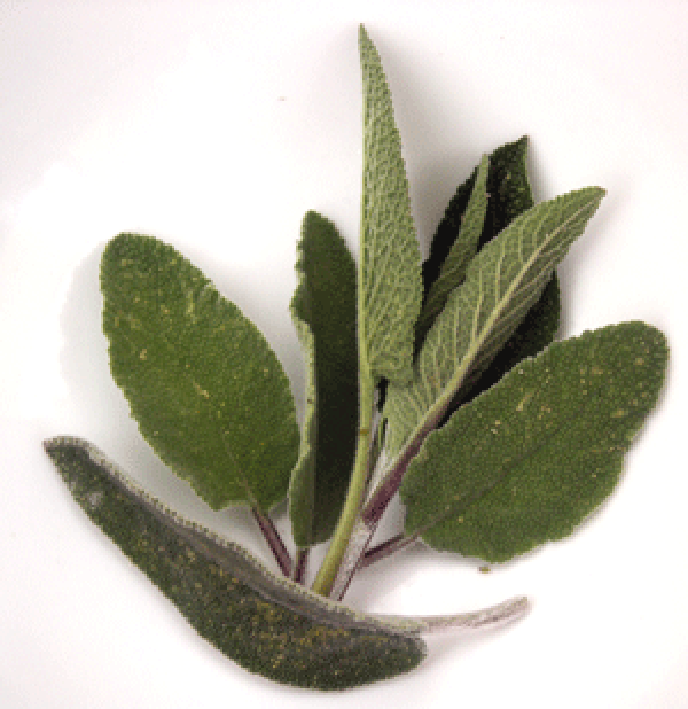
 Sage leaves from
Salvia
officinalis..
Sage leaves from
Salvia
officinalis..
Welcome to the summary page for FabulousFusionFood's Herb guide to Sage along with all the Sage containing recipes presented on this site, with 416 recipes in total.
This is a continuation of an entire series of pages that will, I hope, allow my visitors to better navigate this site. As well as displaying recipes by name, country and region of origin I am now planning a whole series of pages where recipes can be located by meal type and main ingredient. This page gives information about Sage and a listing of all the Sage-based recipes added to this site.
These recipes, all contain Sage as a major herb flavouring.
Common Sage, Salvia officinalis (also known as common sage, garden sage, golden sage, kitchen sage, true sage, culinary sage, Dalmatian sage, and broadleaf sage) is an evergreen subshrub with woody stems belonging to the Lamiaceae or mint family. It is a very common plant in the herb garden and is a native of Southern Europe and the Mediterranean.
There are numerous cultivars of common sage which can vary in leaf size and colour, flower colour and foliage pattern. The wild type has silvery-green leaves with lavender flowers but cultivars range in colour from pale green to red with many variegated leaves. Typically garden sage grows to about 60cm tall (though there are dwarf varieties) and about 60cm in diameter with silvery-green leaves that are oblong and grow up to 6.5cm long and 2.5cm wide. The leaves are rugose on the upper side, and nearly white underneath due to the many short soft hairs. The flowers, which are most commonly lavender coloured, appear in late spring and summer (and are edible).
Sage leaves have a characteristic aromatic aroma with a bitter overtone. The leaves typically contain 1 to 2.5% essential oil, which can be very variable in constituents but which typically contains mostly thujone (up to 60%), 1,8-cineol, camphor, borneol, bornyl esters, α-pinene and salvene. Sage leaves also contain tannic acid, oleic acid, ursonic acid, ursolic acid, cornsole, cornsolic acid, fumaric acid, chlorogenic acid, caffeic acid, niacin, nicotinamide, flavones, flavonoid glycosides, and estrogenic substances.
The English name, sage ultimately derives from the Classical Latin name of the plant, salvia which, itself is derived from the Latin salvere (literally, 'to save') referring to the healing properties long attributed to the various sage species. Indeed, the plant has commonly been recommended at one time or another for virtually every ailment by various herbals.
It is believed that the Romans brought common sage to Europe from Egypt as a medicinal plant. It was one of the plants that Charlemagne, during the 9th century recommended be grown in all royal gardens. Subsequently it was grown in monastery gardens and spread from the Mediterranean to Northern Europe. The plant had a high reputation throughout the Middle Ages, with many sayings referring to its healing properties and value
As well as the European sages (Salvia officinalis, Dalmatian Sage Salvia officinalis ssp minor, Spanish Sage Salvia officinalis ssp lavandulifolia and Greek Sage Salvia triloba [which is not used culinarily outside Greece]), there are also members of the sage that are native in Central America. These tend to have leaves with fruitier aromas that are typically variants of S greggii or S rutilans (eg Pineapple Sage, Peach Sage, Tangerine Sage, Honey Melon Sage, Blackcurrant Sage and Lemon Sage). There is also Guava Sage S darcyi and fruit sage Salvia dorisiana. Typically these are used as ornamental aromatic plants and apart from Pineapple Sage (where the leaves and flowers are eaten) they tend not to be used culinarily, though they are sometimes used to make decoctions in vodka.
Sage leaves can be used either fresh or dried and may also be used as an infusion to make a tea. Sage is also used as a cheese flavouring (eg Sage Derby) though probably it's commonest use is as the dried leaves employed in sage and onion stuffing. The leaves have a slightly peppery flavour and they go well as a flavouring to fatty meats though it can also be fried fresh to make a dressing for oily fish.
Indeed, the usage of sage is very much dependent on culture and in Britain it is mostly used as a constituent of bread-based stuffings for fowl or as a flavouring for fatty mats. In French cuisine it is used for cooking white meats and for giving body to vegetable soups. Whilst in Germany it is used in sausage dishes. Traditionally it is used as a flavouring whilst roasting mutton both in the Balkans and the Middle East. Due to its bitter overtones sage also works well with tomato-based sauces. Sage is also one of the classic herbs in the British 'savoury herb' mix of herbs used in flavouring stews (along with parsley, thyme, savory and rosemary).
The recipes given below contain sage as an important or dominant component. However, you can also access all the recipes on this site that contain sage as an ingredient.
This is a continuation of an entire series of pages that will, I hope, allow my visitors to better navigate this site. As well as displaying recipes by name, country and region of origin I am now planning a whole series of pages where recipes can be located by meal type and main ingredient. This page gives information about Sage and a listing of all the Sage-based recipes added to this site.
These recipes, all contain Sage as a major herb flavouring.
Common Sage, Salvia officinalis (also known as common sage, garden sage, golden sage, kitchen sage, true sage, culinary sage, Dalmatian sage, and broadleaf sage) is an evergreen subshrub with woody stems belonging to the Lamiaceae or mint family. It is a very common plant in the herb garden and is a native of Southern Europe and the Mediterranean.
There are numerous cultivars of common sage which can vary in leaf size and colour, flower colour and foliage pattern. The wild type has silvery-green leaves with lavender flowers but cultivars range in colour from pale green to red with many variegated leaves. Typically garden sage grows to about 60cm tall (though there are dwarf varieties) and about 60cm in diameter with silvery-green leaves that are oblong and grow up to 6.5cm long and 2.5cm wide. The leaves are rugose on the upper side, and nearly white underneath due to the many short soft hairs. The flowers, which are most commonly lavender coloured, appear in late spring and summer (and are edible).
Sage leaves have a characteristic aromatic aroma with a bitter overtone. The leaves typically contain 1 to 2.5% essential oil, which can be very variable in constituents but which typically contains mostly thujone (up to 60%), 1,8-cineol, camphor, borneol, bornyl esters, α-pinene and salvene. Sage leaves also contain tannic acid, oleic acid, ursonic acid, ursolic acid, cornsole, cornsolic acid, fumaric acid, chlorogenic acid, caffeic acid, niacin, nicotinamide, flavones, flavonoid glycosides, and estrogenic substances.
The English name, sage ultimately derives from the Classical Latin name of the plant, salvia which, itself is derived from the Latin salvere (literally, 'to save') referring to the healing properties long attributed to the various sage species. Indeed, the plant has commonly been recommended at one time or another for virtually every ailment by various herbals.
It is believed that the Romans brought common sage to Europe from Egypt as a medicinal plant. It was one of the plants that Charlemagne, during the 9th century recommended be grown in all royal gardens. Subsequently it was grown in monastery gardens and spread from the Mediterranean to Northern Europe. The plant had a high reputation throughout the Middle Ages, with many sayings referring to its healing properties and value
As well as the European sages (Salvia officinalis, Dalmatian Sage Salvia officinalis ssp minor, Spanish Sage Salvia officinalis ssp lavandulifolia and Greek Sage Salvia triloba [which is not used culinarily outside Greece]), there are also members of the sage that are native in Central America. These tend to have leaves with fruitier aromas that are typically variants of S greggii or S rutilans (eg Pineapple Sage, Peach Sage, Tangerine Sage, Honey Melon Sage, Blackcurrant Sage and Lemon Sage). There is also Guava Sage S darcyi and fruit sage Salvia dorisiana. Typically these are used as ornamental aromatic plants and apart from Pineapple Sage (where the leaves and flowers are eaten) they tend not to be used culinarily, though they are sometimes used to make decoctions in vodka.
Sage leaves can be used either fresh or dried and may also be used as an infusion to make a tea. Sage is also used as a cheese flavouring (eg Sage Derby) though probably it's commonest use is as the dried leaves employed in sage and onion stuffing. The leaves have a slightly peppery flavour and they go well as a flavouring to fatty meats though it can also be fried fresh to make a dressing for oily fish.
Indeed, the usage of sage is very much dependent on culture and in Britain it is mostly used as a constituent of bread-based stuffings for fowl or as a flavouring for fatty mats. In French cuisine it is used for cooking white meats and for giving body to vegetable soups. Whilst in Germany it is used in sausage dishes. Traditionally it is used as a flavouring whilst roasting mutton both in the Balkans and the Middle East. Due to its bitter overtones sage also works well with tomato-based sauces. Sage is also one of the classic herbs in the British 'savoury herb' mix of herbs used in flavouring stews (along with parsley, thyme, savory and rosemary).
The recipes given below contain sage as an important or dominant component. However, you can also access all the recipes on this site that contain sage as an ingredient.
The alphabetical list of all Sage recipes on this site follows, (limited to 100 recipes per page). There are 416 recipes in total:
Page 1 of 5
| Abbacchio alla Cacciatora Origin: Italy | Bolo de Carne (Brazilian Rolled Meatloaf) Origin: Brazil | Chakchouka Origin: Tunisia |
| Air Fryer Liver and Sausage Curry Origin: Britain | Bolo do Caco com Chouriço (Madeira Island Bread Stuffed with Chouriço) Origin: Portugal | Chanterelle and Mascarpone Sauce Origin: Britain |
| Air Fryer Meat-stuffed Mushrooms Origin: Britain | Bonfire Bangers and Beans Origin: British | Char-grilled Turkey with Cheesy Pockets Origin: Britain |
| Air Fryer Quesadillas Origin: Britain | Bosanski Sarma (Stuffed Cabbage Leaves) Origin: Bosnia | Cheshire Pork Pye Origin: England |
| Air Fryer Sage and Onion Stuffing Balls Origin: Britain | Botellum (Small Black Puddings) Origin: Roman | Chestnut and Bacon Stuffing Origin: Scotland |
| Air Fryer Sausage Rolls Origin: Britain | Boudin Créole (Creole Black Pudding) Origin: French Guiana | Chestnut Fazzoletti Origin: Italy |
| Air Fryer Stuffed Mushrooms Origin: Britain | Boudin Créole Rouge (Creole Black Pudding) Origin: Guadeloupe | Chestnut Stuffing Origin: Britain |
| Air Fryer Whole Chicken or Guinea Fowl Origin: Britain | Boudins (Boudin Sausage) Origin: France | Chicago-style Stuffed Pizza Origin: American |
| Aliter Isicia (Another Sausage) Origin: Roman | Bouneschlupp (Green Beans Soup) Origin: Luxembourg | Chicken Kebabs with Stuffing and Bell Pepper Sauce Origin: Britain |
| Aliter Isicia II (Another Sausage II) Origin: Roman | Braised Golden Plover Origin: British | Chicken Potjie with Dumplings Origin: Botswana |
| Amêijoas na Cataplana (Steamed Clams and Sausage in Tomato Sauce) Origin: Portugal | Braised Grouse Origin: Britain | Chicken-Sausage Jambalaya Origin: Cajun |
| Appetizer Pate Cheesecake Origin: American | Bratwurst im Bier, Berin-art (Bratwurst in Beer, Berlin Style) Origin: Germany | Chilli Dogs Origin: Britain |
| Arroz com Mariscos (Rice with Shellfish) Origin: Mozambique | Breakfast Pizza Origin: British | Chipolata Ragôut Origin: British |
| Arroz con Cerdo (Mexican Rice and Pork) Origin: Mexico | Breakfast Pizza 2 Origin: British | Chorizo and Spinach Linguine Origin: American |
| Arroz con Chorizo (Rice with Chorizo) Origin: Ecuador | Brochettes à la Normande (Normandy Brochettes) Origin: France | Christmas Goose Origin: British |
| Azinkokoui aux Bloms (Azinkokoui with Blom Sausages) Origin: Togo | Brôn (Brawn) Origin: Welsh | Chykenys in hocchee (Stuffed Chickens Cooked in Broth) Origin: England |
| Bableves (Hungarian Bean Soup) Origin: Hungary | Brown Sugar Brine for Turkey Origin: Britain | Circellos Isiciatos (Round Sausage) Origin: Roman |
| Bacon and Cabbage Origin: British | Bruine Bonen (Suriname-style Kidney Bean Stew) Origin: Suriname | Civet de Sanglier aux Champignons, Châtaignes et Chorizo (Wild Boar Stew with Mushrooms, Chestnuts and Chorizo Sausage) Origin: France |
| Baked Butternut Squash with Cranberries Origin: American | Bruine Bonen met Rijst (Brown Beans with Rice) Origin: Suriname | Classic Southern Cornbread Stuffing Origin: American |
| Balloc Broth Origin: England | Bukkeande Origin: England | Cobnut Stuffing Origin: Britain |
| Ballotine of Turkey Origin: Britain | Cachupa Rica Origin: Cape Verde | Coca-Cola Ham Origin: American |
| Bandeja Paisa (Paisa Platter) Origin: Colombia | Cachupa Rica II Origin: Cape Verde | Collared Eel Origin: British |
| Bangers and Beans Supper Origin: British | Cachupinha Origin: Cape Verde | Collared Pig's Face Origin: British |
| Bara Pot Clai Bacheldre (Bacheldre Clay-pot Bread) Origin: Welsh | Cajun Brew Pork'n'Beans Origin: American | Conchiclam Apicianam (Dried Peas à la Apicius) Origin: Roman |
| Barbecued Plum and Nut Stuffed Pork Chops Origin: British | Cajun Fried Rice Origin: Cajun | Conchiclatus Pullus vel Porcellus (Chicken or Suckling Pig Stuffed with Legumes) Origin: Roman |
| Basic Cajun Jambalaya Origin: Cajun | Cajun Spicy Barbecued Chicken Origin: American | Conger in sawce (Conger Eels in Sauce) Origin: England |
| Basic Irish Sausages Origin: Ireland | Caldo Verde (Green Soup) Origin: Portugal | Congre à la bretonne (Breton-style Conger Eel) Origin: France |
| Bay Boletes with Veal and Sage Origin: Britain | Canja de Gahlinha (Cape Verdean Chicken Stew) Origin: Cape Verde | Coniglio in Porchetta (Rabbit Stuffed with Pork) Origin: San Marino |
| Bedfordshire Clanger Origin: England | Cannellini alla Catania Origin: Italy | Cornbread Stuffed Mussels Origin: South Africa |
| Beef and Pistachio Terrine Origin: Britain | Carlin pea, kale and chorizo one pot Origin: Britain | Cornish Hog's Pudding Origin: England |
| Bermuda Peas n' Rice Origin: Bermuda | Casserol Ceredigion (Cardiganshire Casserole) Origin: Welsh | Cornish Nettle Soup Origin: England |
| Bigos (Polish Hunter's Stew) Origin: Poland | Cassoulet à Moda Brasileira (Brazilian-style Cassoulet) Origin: Brazil | Cornish Pig's Head Pudding Origin: England |
| Bigos (Lithuanian Hunter's Stew) Origin: Lithuania | Cassoulet Mauricien (Mauritian Cassoulet) Origin: Mauritius | |
| Black Eyed Beans Jambalaya Recipe Origin: American | Celtic Pork and Apple Stew Origin: Ancient |
Page 1 of 5