FabulousFusionFood's Ni-Vanuatu Recipes Home Page
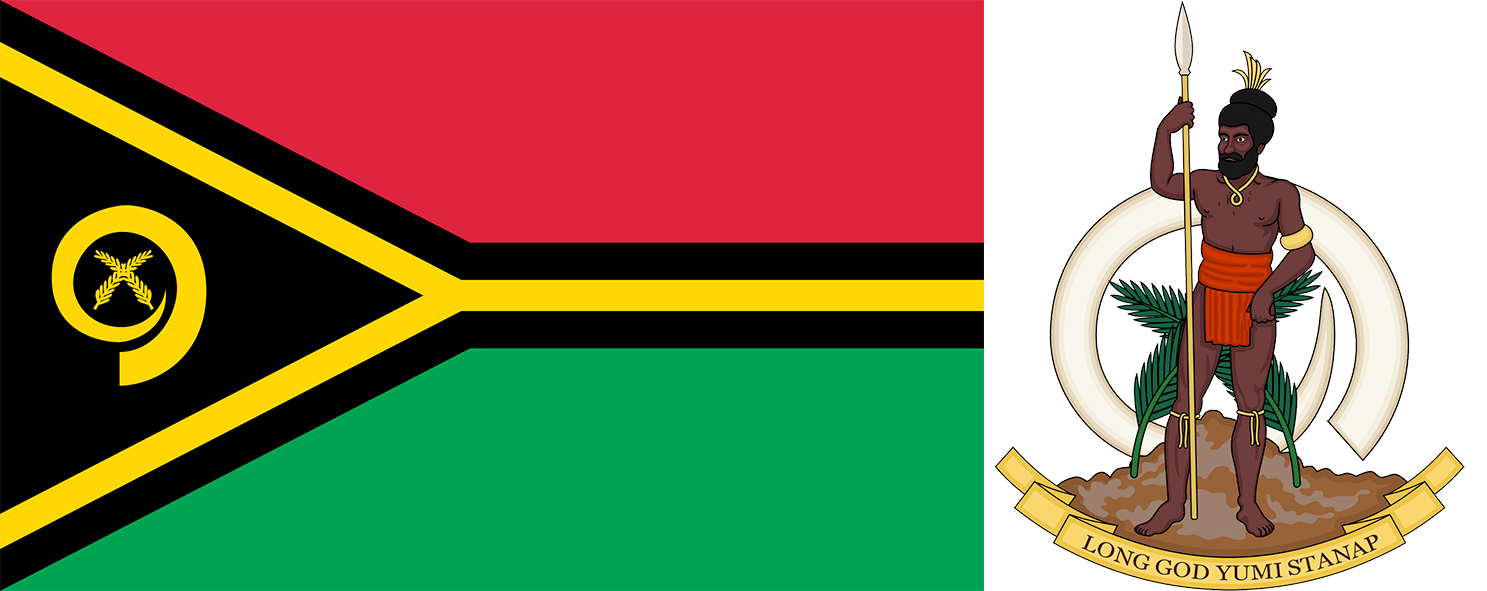 The flag of Vanuatu (left) and the coat of arms of Vanuatu (right).
Welcome to the summary page for FabulousFusionFood's Vanuatu recipes, part of Oceania. This page provides links to all the Ni-Vanuatu recipes presented on this site, with 11 recipes in total.
This is a continuation of an entire series of pages that will, I hope, allow my visitors to better navigate this site. As well as displaying recipes by name, country and region of origin I am now planning a whole series of pages where recipes can be located by meal type and main ingredient. This page gives a listing of all the Ni-Vanuatu recipes added to this site.
The cuisine of Vanuatu (aelan kakae) incorporates fish, root vegetables such as taro and yams, fruits, and vegetables. Most island families grow food in their gardens, and food shortages are rare. Papayas, pineapples, mangoes, plantains, and sweet potatoes are abundant through much of the year. Coconut milk and coconut cream are used to flavour many dishes. Most food is cooked using hot stones or through boiling and steaming; very little food is fried.[
These recipes, for the major part, originate in the Vanuatu. Otherwise they are fusion recipes with major Ni-Vanuatu influences.
Vanuatu, officially the Republic of Vanuatu (French: République de Vanuatu; Bislama: Ripablik blong Vanuatu), is an island country in Melanesia located in the South Pacific Ocean. The archipelago, which is of volcanic origin, is 1,750 km (1,090 mi) east of northern Australia, 540 km (340 mi) northeast of New Caledonia, east of New Guinea, southeast of Solomon Islands, and west of Fiji.
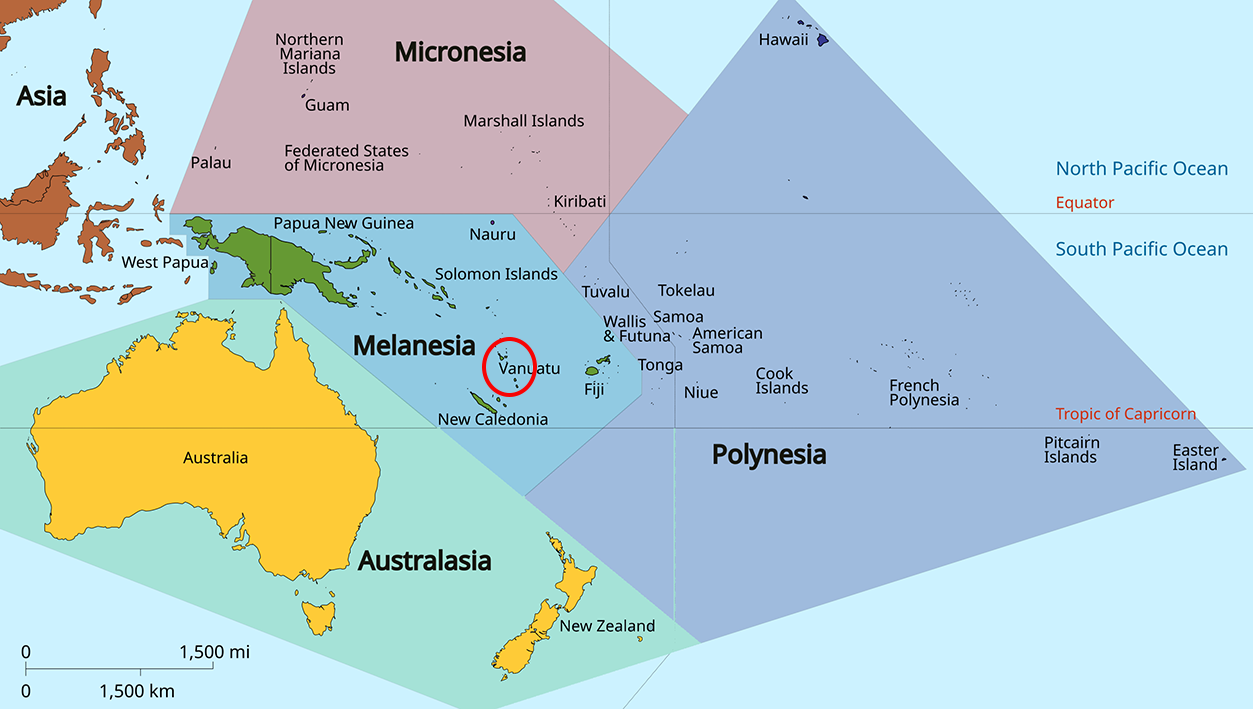 The image above shows Vanuatu (in red) in relation to Oceania.Vanuatu was first inhabited by Melanesian people. The first Europeans to visit the islands were a Spanish expedition led by Portuguese navigator Fernandes de Queirós, who arrived on the largest island, Espíritu Santo, in 1606. Queirós claimed the archipelago for Spain, as part of the colonial Spanish East Indies and named it La Austrialia del Espíritu Santo.
In the 1880s, Republic of France and the United Kingdom claimed parts of the archipelago, and in 1906, they agreed on a framework for jointly managing the archipelago as the New Hebrides through an Anglo-French condominium.
An independence movement arose in the 1970s, and the Republic of Vanuatu was founded in 1980. Since independence, the country has become a member of the United Nations, the Commonwealth of Nations, the Organisation internationale de la Francophonie, and the Pacific Islands Forum.
Etymology: Vanuatu's name derives from the word vanua ('land' or 'home'), cognates of which occur in several Austronesian languages, combined with the word tu, meaning 'to stand' (from Proto-Oceanic *tuqur). Together, the two words convey the independent status of the country.
Vanuatu foods have several core ingredients used such as yam, taro, banana, coconut, sugarcane, tropical nuts, pigs, greens, fowls and seafood. Native people in Vanuatu usually grow most of their food except luxury foods such as rice or tinned fish.
The national dish of Vanuatu is lap lap. Lap lap is a baked pudding. It is made up of grated yam, banana, manioc, or taro that is mixed with coconut milk and salt, wrapped up in banana leaves, then baked in an earth oven or hot volcanic stones. There is a variety of lap lap styles from island to island. Malekula has a unique technique in the way they bake their Lap lap, specifically called 'Sosor', where they place a glowing hot volcanic stone in the center of the unbaked pudding, with chicken wings, onion and tomato on top of the stone. They then squeeze coconut milk over the whole pudding, wrap it up and bake it. Once baked, the Sosor is opened, the stone removed and all the meat is cooked (steamed from the coconut milk), a well is made in the centre of the pudding and more coconut milk is squeezed out as a dipping sauce. The local markets often have stall hawkers selling local lap-lap with various toppings e.g. chicken, beef, octopus or fried fish.
This is a continuation of an entire series of pages that will, I hope, allow my visitors to better navigate this site. As well as displaying recipes by name, country and region of origin I am now planning a whole series of pages where recipes can be located by meal type and main ingredient. This page gives a listing of all the Ni-Vanuatu recipes added to this site.
The cuisine of Vanuatu (aelan kakae) incorporates fish, root vegetables such as taro and yams, fruits, and vegetables. Most island families grow food in their gardens, and food shortages are rare. Papayas, pineapples, mangoes, plantains, and sweet potatoes are abundant through much of the year. Coconut milk and coconut cream are used to flavour many dishes. Most food is cooked using hot stones or through boiling and steaming; very little food is fried.[
These recipes, for the major part, originate in the Vanuatu. Otherwise they are fusion recipes with major Ni-Vanuatu influences.
Vanuatu, officially the Republic of Vanuatu (French: République de Vanuatu; Bislama: Ripablik blong Vanuatu), is an island country in Melanesia located in the South Pacific Ocean. The archipelago, which is of volcanic origin, is 1,750 km (1,090 mi) east of northern Australia, 540 km (340 mi) northeast of New Caledonia, east of New Guinea, southeast of Solomon Islands, and west of Fiji.
The image above shows Vanuatu (in red) in relation to Oceania.In the 1880s, Republic of France and the United Kingdom claimed parts of the archipelago, and in 1906, they agreed on a framework for jointly managing the archipelago as the New Hebrides through an Anglo-French condominium.
An independence movement arose in the 1970s, and the Republic of Vanuatu was founded in 1980. Since independence, the country has become a member of the United Nations, the Commonwealth of Nations, the Organisation internationale de la Francophonie, and the Pacific Islands Forum.
Etymology: Vanuatu's name derives from the word vanua ('land' or 'home'), cognates of which occur in several Austronesian languages, combined with the word tu, meaning 'to stand' (from Proto-Oceanic *tuqur). Together, the two words convey the independent status of the country.
Ni-Vanuatu Cuisine:
The cuisine of Vanuatu (Bislama: aelan kakae, lit. 'island food') incorporates fish, root vegetables such as taro and yams, fruits, and vegetables. Most island families grow food in their gardens, and food shortages are rare. Papayas, pineapples, mangoes, plantains, and sweet potatoes are abundant through much of the year. Coconut milk and coconut cream are used to flavour many dishes. Most food is cooked using hot stones or through boiling and steaming; little food is fried. Since Vanuatu is one of the few South Pacific regions influenced by the outside world, Vanuatu's food has a multicultural nature.Vanuatu foods have several core ingredients used such as yam, taro, banana, coconut, sugarcane, tropical nuts, pigs, greens, fowls and seafood. Native people in Vanuatu usually grow most of their food except luxury foods such as rice or tinned fish.
The national dish of Vanuatu is lap lap. Lap lap is a baked pudding. It is made up of grated yam, banana, manioc, or taro that is mixed with coconut milk and salt, wrapped up in banana leaves, then baked in an earth oven or hot volcanic stones. There is a variety of lap lap styles from island to island. Malekula has a unique technique in the way they bake their Lap lap, specifically called 'Sosor', where they place a glowing hot volcanic stone in the center of the unbaked pudding, with chicken wings, onion and tomato on top of the stone. They then squeeze coconut milk over the whole pudding, wrap it up and bake it. Once baked, the Sosor is opened, the stone removed and all the meat is cooked (steamed from the coconut milk), a well is made in the centre of the pudding and more coconut milk is squeezed out as a dipping sauce. The local markets often have stall hawkers selling local lap-lap with various toppings e.g. chicken, beef, octopus or fried fish.
Vanuatu's National Dishes:
Below are listed the dishes considered to be Vanuatu's national foods along with links to the recipes for those dishes:| Laplap Origin: Vanuatu |
The alphabetical list of all the Ni-Vanuatu recipes on this site follows, (limited to 100 recipes per page). There are 11 recipes in total:
Page 1 of 1
| Laplap Origin: Vanuatu | Lafet Time (Honey-glazed Pork with Salad) Origin: Vanuatu | Poi (Fermented Taro) Origin: Vanuatu |
| Beef Curry with Taro Origin: Vanuatu | Laplap Origin: Vanuatu | Simboro (Meat with Taro Leaves and Coconut Milk) Origin: Vanuatu |
| Cassava Pudding Origin: Vanuatu | Nalot (Root Vegetable Mash) Origin: Vanuatu | Tunu Supu (Tuna Soup) Origin: Vanuatu |
| Coconut Crab Curry Origin: Vanuatu | Pit Pit in Coconut Cream Origin: Vanuatu |
Page 1 of 1