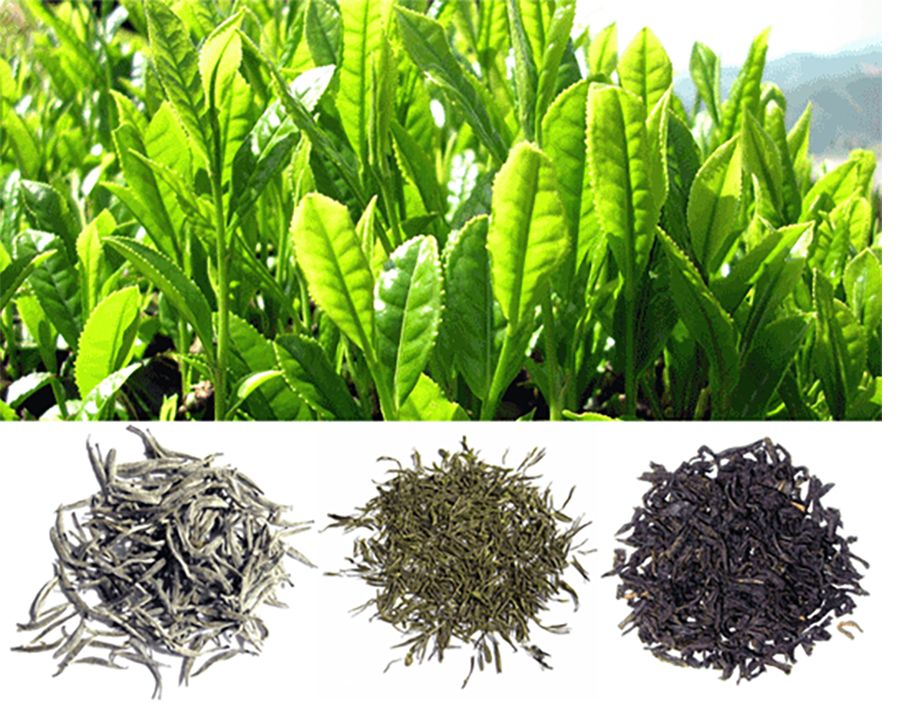
 Fresh tea tips on
the tree with dried
white tea, green tea
and black tea
(Camellia
sinensis).
Welcome to the summary page for FabulousFusionFood's Herb guide to Tea along with all the Tea containing recipes presented on this site, with 316 recipes in total.
This is a continuation of an entire series of pages that will, I hope, allow my visitors to better navigate this site. As well as displaying recipes by name, country and region of origin I am now planning a whole series of pages where recipes can be located by meal type and main ingredient. This page gives information about Tea and a listing of all the Tea-based recipes added to this site.
These recipes, all contain Tea as a major herb flavouring.
Tea, Camellia sinensis (also known as China Tea, Assam Tea, Green Tea, Black Tea, Tea Plant, Tea Tree, Tea Shrub, White Tea) is a herb produced by curing the leaves and leaf-buds of the tea plant Camellia sinensis that is a member of the Theaceae (tea plant) family of flowering shrubs.
The tea tree is an evergreen shrub or small tree that is native to China and grows mainly in tropical and sub-tropical climates. However, there are varieties that are tolerant to both cold and marine environments and tea is grown as far north as Pembrokeshire in Wales. Typically, however, tea trees require high elevations and high rainfall (at least 127cm per annum).
The plant is a perennial, low-growing mat that spreads out to 180cm in diameter. The bright-green, velvety, rounded leaves have tiny scallops along their margins and a pronounced spearmint-like fragrance. The leaves are ovate to ob-ovate and are dotted with oil glands on the bottom surface and are toothed along the leaf edges. The tiny, white flowers are two-lipped and borne in the leaf axils.
Tea trees are typically propagated either from seeds or by cuttings. It takes approximately 4 to 12 years for a tea plant to bear seed, and about 3 years before a new plant is ready for harvesting. Typically, only the top 1-2 inches of the mature plant are picked. These buds and leaves are called flushes and a typical plant will grow a new flush every seven to fifteen days during the growing season.
In its natural state, a tea plant will develop into a tree of up to 16 metres, but in cultivation plants are usually pruned down to waist height for ease of picking the flushes. Two principal varieties are used: the China plant (C sinensis sinensis), used for most Chinese, Formosan and Japanese teas and the clonal Assam tea plant (C sinensis assamica), used in most Indian and other teas (but not Darjeeling).
It is often forgotten that tea is an herb, mostly because it is used to make a drink by infusing the leaves in hot water (just as it's forgotten that coffee and cocoa are spices because they are also made into drinks). But tea is a herb and it is used flavouring foods as a herb by use as an infusion or by direct addition (cakes made from a tea base are popular in Britain). It is also used for flavouring meats and fish by smoking.
However, tea itself is often processed to make a specific type of tea. Teas can generally be divided into categories based on how they are processed. There are at least six different types of tea: white, yellow, green, oolong, black, and post-fermented teas; of which the most commonly found on the market are white, green, oolong, and black.
After picking, the leaves of Camellia sinensis soon begin to wilt and oxidize, unless they are immediately dried. The leaves turn progressively darker as their chlorophyll breaks down and tannins are released. This enzymatic oxidation process, known as fermentation in the tea industry, is caused by the plant's intracellular enzymes and causes the tea to darken. In tea processing, the darkening is stopped at a predetermined stage by heating, which deactivates the enzymes responsible. In the production of black teas, the halting of oxidization by heating is carried out simultaneously with drying.
The different grades of tea are defined by the techniques used to produce it and are listed below:
White tea: Wilted and unoxidized
Yellow tea: Unwilted and unoxidized, but allowed to yellow
Green tea: Unwilted and unoxidized
Oolong: Wilted, bruised, and partially oxidized
Black tea: Wilted, sometimes crushed, and fully oxidized
Post-fermented tea: Green tea that has been allowed to ferment/compost
For use as a drink, tea is different tea types are typically blended to yield the desired aromatic qualities and blends of tannins.
Tea plants are native to East and South Asia and probably originated around the point of confluence of the lands of northeast India, north Burma and southwest China. The first recorded drinking of tea is in China, dating back to the 10th century BEC. Though no one is quite certain of the exact place where tea was first drunk. However, the drinking of tea as an infusion of leaves in boiling water is also a means of rendering water safe to drink. In China it was tea drinking that gave a safe drink, whilst in Europe, Africa and the near east it was brewing and wine-making that led to the same result. This is why it's believed that the lack of alcohol dehydrogenase (the liver enzyme that breaks down alcohol) is far more common in the Far East than in Europe.
By the Qin Dynasty (3rd century BCE) tea drinking was quite common and it became widely popular during the Tang Dynasty, when it was spread to Korea and Japan. Trade of tea by the Chinese to Western nations in the 19th century spread tea and the tea plant to numerous locations around the world.
Tea was first imported to Europe during the Portuguese expansion of the 16th century, at which time it was termed chá. In 1750, tea experts traveled from China to the Azores Islands, and planted tea, along with jasmines and mallows, to give the tea aroma and distinction. Both green tea and black tea continue to grow in the islands, which are the main suppliers to continental Portugal. It was the marriage of Catherine of Braganza to Charles II of England that first brought the tea habit to Great Britain during the 1660s, but it was not until the 19th century that tea became as widely consumed in Britain as it is today. This was due in part to the Industrial Revolution, the establishment of tea plantations in India and Sri Lanka and the development of cheap cups (indeed the practice of adding milk to tea was developed to reduce the temperature of tea to prevent cheap crockery from cracking).
The traditional method of making a cup of tea is to place loose tea leaves, either directly or in a tea infuser, into a tea pot or teacup and pour freshly boiled water over the leaves. After a few minutes the leaves are usually removed again, either by removing the infuser, or by straining the tea while serving.
Most green teas should be allowed to steep for about two or three minutes, although some types of tea require as much as ten minutes, and others as little as thirty seconds. The strength of the tea should be varied by changing the amount of tea leaves used, not by changing the steeping time. The amount of tea to be used per amount of water differs from tea to tea but one basic recipe may be one slightly heaped teaspoon of tea (about 5ml) for each teacup of water (200–240ml) prepared as above. Stronger teas, such as Assam, to be drunk with milk are often prepared with more leaves, and more delicate high grown teas such as a Darjeeling are prepared with somewhat fewer (as the stronger mid-flavours can overwhelm the champagne notes).
The alphabetical list of all Tea recipes on this site follows, (limited to 100 recipes per page). There are 316 recipes in total:
Page 1 of 4
| Achu and Ndza Nikka (Cameroonian Achu Yellow Soup) Origin: Cameroon | Beef and Stout Stew Origin: Ireland | Boatman's Curry Origin: India |
| Adobo Valentine Lamb Origin: American | Beef Braised in Rooibos Tea with Sweet Potatoes Origin: South Africa | Boeuf Bourguignon Origin: France |
| Agnum Simplicem (Plain Lamb) Origin: Roman | Beef Cameroon Origin: Cameroon | Boiled Cake Origin: Ireland |
| Air Fryer Baby Potatoes Origin: Britain | Beef Curry with Sweet Potato Noodles Origin: Fusion | Boozy Barbecued Beef Steaks Origin: Britain |
| Air Fryer Steak Origin: Britain | Beef in Adobo Sauce Origin: America | Botswanan Barbecue Beef Origin: Botswana |
| Air Fryer Steak and Fries Meal Origin: America | Beef in Bitter Origin: Britain | Bourbon Flank Steak Origin: American |
| Ajiaco Criollo (Cuban Creole Stew) Origin: Cuba | Beef in Claret Origin: Scotland | Braaied Coffee-spiced Steak Origin: South Africa |
| Aliter In Struthione Elixo (Of Boiled Ostrich, Another Way) Origin: Roman | Beef in Stout Origin: Ireland | Bragoli (Maltese Beef Rolls) Origin: Malta |
| Alligator in Sauce Piquante Origin: Cajun | Beef Like Game Origin: British | Brambrack Origin: Ireland |
| Amaranth Porridge with Fruity Green Tea Compote Origin: Fusion | Beef Noodles with Oyster Sauce Origin: China | Broiled Beef Origin: British |
| Angolan Prego no Pão (Angolan Prego Rolls) Origin: Angola | Beef Olives I Origin: British | Broiled Beef Steak Origin: British |
| Arán Breac (Speckled Bread) Origin: Ireland | Beef Pockets Stuffed with Wild Mushrooms Origin: Scotland | Cacen De (Tea loaf) Origin: Welsh |
| Atay (Mint Tea) Origin: Western Sahara | Beef Steak à la Française Origin: British | Cajun-style Rib-eye Steak Origin: American |
| Atay (Mint Tea) Origin: Morocco | Beef Steak and Kidney Pudding Origin: Britain | Cake aux Raisins Sec (Sweet Raisin Buns) Origin: Senegal |
| Aussie Grilled Fish Steaks Origin: Australia | Beef Steak in Mushroom Sauce Origin: Britain | Camel Steak with Allspice Origin: Fusion |
| Autumnal Chestnut Banana Spice Cake Origin: British | Beef Steak Pie Origin: British | Carbonade Flamande Origin: Belgium |
| Awaze Tibs (Ethiopian Beef and Peppers) Origin: Ethiopia | Beef Steak Pudding Origin: British | Cari Poisson (Fish Curry) Origin: Reunion |
| Bò Tái Chanh (Lemon-cured Beef with Rice Paddy Herb) Origin: Vietnam | Beef Steak with Cucumbers Origin: British | Caribbean-style Fish Kebabs Origin: Fusion |
| Bajan Pepperpot Origin: Barbados | Beef Steak with Potatoes Origin: British | Caril de Tubarão (Azorean Tope Shark Curry) Origin: Portugal |
| Baked Beef Steak Pudding Origin: British | Beef Steaks and Oyster Sauce Origin: British | Carne Asada Origin: Mexico |
| Baked Beefsteak Pudding Origin: British | Beef Steaks with Fried Potatoes Origin: British | Carne Desmechada Origin: Colombia |
| Bara Brith Origin: Welsh | Beef Strips in a Whisky Sauce Origin: Scotland | Carne Gisada con Plantanos (Beef and Plantains) Origin: Cuba |
| Bara Brith #3 Origin: Welsh | Beef with Wild Mushrooms Origin: Britain | Carne Mechada Origin: Venezuela |
| Bara Brith Banana (Spiced Banana Bread Teabread) Origin: Welsh | Beef, Tomato and Olive Kebabs Origin: Britain | Carne Mechada (Venezuelan Shredded Beef) Origin: Venezuela |
| Bara Brith Hydref (Autumnal Bara Brith) Origin: Welsh | Beef-steak Pudding Origin: British | Cazuela Fiestera (Festival Casserole) Origin: Ecuador |
| Bara Brith Pentref (Village Bara Brith) Origin: Welsh | Beefsteak Mushroom and Hen of the Woods Risotto Origin: Britain | Century Eggs Origin: China |
| Barbecue Sauce Origin: American | Beijino (Coconut Kisses) Origin: Brazil | Century Eggs Origin: Christmas Island |
| Barbecue Steaks with Red Onion Marmalade Origin: Britain | Bermuda Onion and Potato Salad Origin: Bermuda | Châteaubriand Steaks with Châteaubriand Sauce Origin: Britain |
| Barbecued Flank Steak with Chimichurri Sauce Origin: American | Bifes com Molho de Amendoim (Veal Steaks with Peanut Sauce) Origin: Mozambique | Châteaubriand with a Shallot Red Wine Reduction Origin: France |
| Barbecued Stuffed Tomatoes Origin: Britain | Bifes de Vitela com Molho de Amendoim (Veal Steaks with Peanut Sauce) Origin: Mozambique | Châteaubriand with Portobello Mushrooms and Madeira Wine Jus Origin: France |
| Barm Brack Origin: Ireland | Big Bowl Chili Origin: American | Chai Origin: East Africa |
| Basic Home-made Pineapple Kombucha Origin: Britain | BIR Lamb Rogan Josh Origin: Britain | Char-grilled Venison Steaks Origin: Britain |
| Bavaroise (Bavarian Tea) Origin: France | Bistec Encebollado Salvadoreño (Salvadorean Steak and Onions) Origin: El Salvador | |
| Beef and Coconut Cream Curry Origin: Fusion | Bistecca di San Marino (Steak San Marino) Origin: San Marino |
Page 1 of 4