FabulousFusionFood's Pickle Recipes Home Page
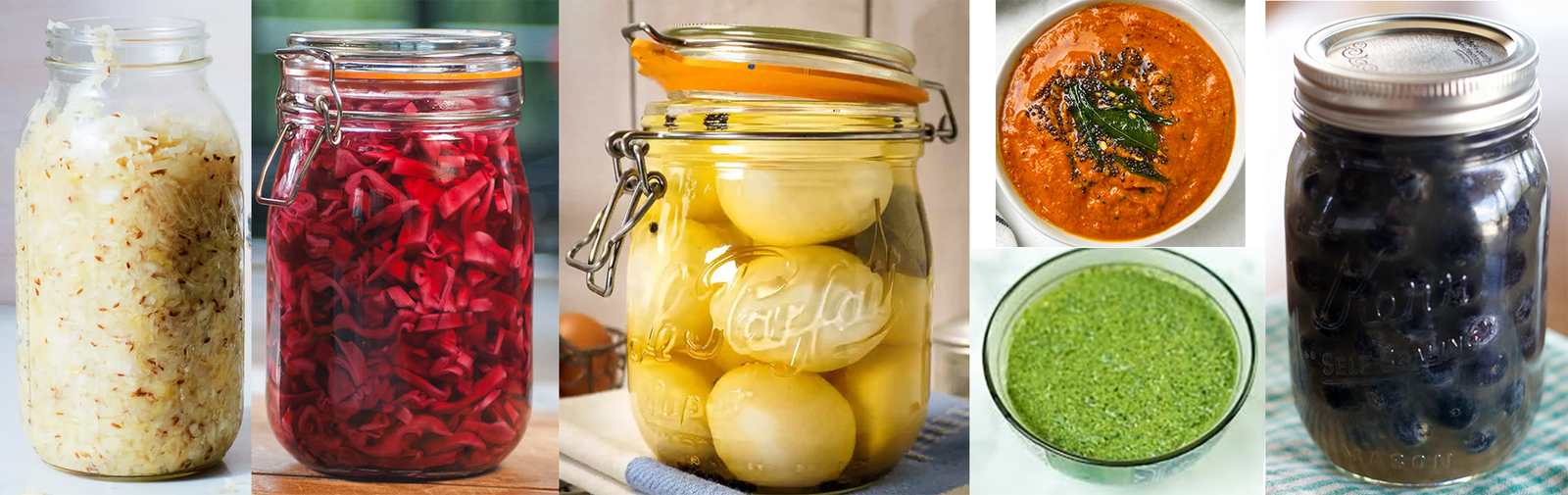 Four different fruit preserve types. Left to right: sauerkraut, pickled red cabbage,
pickled eggs, Indian tomato and coriander chatnis and sweet pickled bilberries.
Welcome to FabulousFusionFood's Pickled Recipes Page — Pickling is the process of preserving or extending the shelf life of food by either anaerobic fermentation in brine or immersion in vinegar. The pickling procedure typically affects the food's texture and flavour. The resulting food is called a pickle, or, if named, the name is prefaced with the word pickled". Foods that are pickled include vegetables, fruit, mushrooms, meats, fish, seafood, dairy and eggs.
Pickling solutions are typically highly acidic, with a pH of 4.6 or lower, and high in salt, preventing enzymes from working and micro-organisms from multiplying. Pickling can preserve perishable foods for months, or in some cases years. Antimicrobial herbs and spices, such as mustard seed, garlic, cinnamon or cloves, are often added. If the food contains sufficient moisture, a pickling brine may be produced simply by adding dry salt. For example, sauerkraut and Korean kimchi are produced by salting the vegetables to draw out excess water. Natural fermentation at room temperature, by lactic acid bacteria, produces the required acidity. Other pickles are made by placing vegetables in vinegar. Like the canning process, pickling (which includes fermentation) does not require that the food be completely sterile before it is sealed. The acidity or salinity of the solution, the temperature of fermentation, and the exclusion of oxygen determine which microorganisms dominate, and determine the flavour of the end product.
Pickling with vinegar likely originated in ancient Mesopotamia around 2400 BCE. There is archaeological evidence of cucumbers being pickled in the Tigris Valley in 2030 BCE. Pickling vegetables in vinegar continued to develop in the Middle East region before spreading to the Maghreb, to Sicily and to Spain. From Spain it spread to the Americas. On the other hand, fermented salt pickling reportedly has its origins in China.
The English term "pickle" first appears around 1400 CE. It is from Middle English pikel, a spicy sauce served with meat or fish, borrowed from Middle Dutch or Middle Low German pekel ("brine") but later referred to preserving in brine or vinegar. Pickle recipes in English were first published in the middle ages, with an example being a mixed pickle from the 15 century found in Curye on Inglysch, IV. 103.
In Britain, pickled onions and pickled eggs are often sold in pubs and fish and chip shops. Pickled beetroot, walnuts, and gherkins, and condiments such as Branston Pickle and piccalilli are typically eaten as an accompaniment to pork pies and cold meats, sandwiches or a ploughman's lunch. Other popular pickles in the UK are pickled mussels, cockles, red cabbage, mango chutney, sauerkraut, and olives. Rollmops are also quite widely available under a range of names from various producers both within and out of the UK
In traditional pickling, fruit or vegetables are submerged in brine (20–40 grams/L of salt (3.2–6.4 oz/imp gal or 2.7–5.3 oz/US gal)), or shredded and salted as in sauerkraut preparation, and held underwater by flat stones layered on top. Alternatively, a lid with an airtrap or a tight lid may be used if the lid is able to release pressure which may result from carbon dioxide buildup. Mold or (white) kahm yeast may form on the surface; kahm yeast is mostly harmless but can impart an off taste and may be removed without affecting the pickling process.
In chemical pickling, the fruits or vegetables to be pickled are placed in a sterilized jar along with brine, vinegar, or both, as well as spices, and are then allowed to mature until the desired taste is obtained.
The food can be pre-soaked in brine before transferring to vinegar. This reduces the water content of the food, which would otherwise dilute the vinegar. This method is particularly useful for fruit and vegetables with a high natural water content.
'Refrigerator pickles' are unfermented pickles made by marinating fruit or vegetables in a seasoned vinegar solution. They must be stored under refrigeration or undergo canning to achieve long-term storage.
South Asia has a large variety of pickles (known as achar (अचार, اچار) in Nepali, Assamese, Bengali, Hindi (अचार), Punjabi, Gujarati, Urdu (اچار) uppinakaayi in Kannada, lonacha (लोणचं) in Marathi, uppilittathu or achar in Malayalam, oorukai in Tamil, pacchadi(పచ్చడి) or ooragaya(ఊరగాయ) in Telugu, which are mainly made from varieties of mango, lemon, lime, gongura (a sour leafy shrub), tamarind, Indian gooseberry (amla), and chilli. Vegetables such as eggplant, carrots, cauliflower, tomato, bitter gourd, green tamarind, ginger, garlic, onion, and citron are also occasionally used. These fruits and vegetables are mixed with ingredients such as salt, spices, and vegetable oils. The pickling process is completed by placing filled jars in the sun where they mature in the sun. The sun's heat destroys moulds and microbes which could spoil the pickles.
Singapore, Indonesian and Malaysian pickles, called acar are typically made out of cucumber, carrot, bird's eye chilies, and shallots, these items being seasoned with vinegar, sugar and salt. Fruits, such as papaya and pineapple, are also sometimes pickled. In the Philippines, pickling is a common method of preserving food, with many commonly eaten foods pickled, traditionally done using large earthen jars. The process is known as buro or binuro. Pickling was a common method of preserving a large variety of foods such as fish throughout the archipelago before the advent of refrigeration, but its popularity is now confined to vegetables and fruits. Atchara is primarily made out of julienned green papaya, carrots, and shallots, seasoned with cloves of garlic and vinegar; but could include ginger, bell peppers, white radishes, cucumbers or bamboo shoots. Pickled unripe mangoes or burong mangga, unripe tomatoes, guavas, jicama, bitter gourd and other fruit and vegetables still retain their appeal. Siling labuyo, sometimes with garlic and red onions, is also pickled in bottled vinegar and is a staple condiment in Filipino cuisine.
In Iran, Turkey, Arab countries, the Balkans, and the South Caucasus, pickles (called torshi in Persian, turşu in Turkish language and mekhallel in Arabic) are commonly made from turnips, peppers, carrots, green olives, cucumbers, eggplants, cabbage, green tomatoes, lemons, and cauliflower. Sauerkraut, as well as cabbage pickled in vinegar, with carrot and other vegetables is commonly consumed as a kosher dish in Israel and is considered pareve, meaning that it contains no meat or dairy so it can be consumed with either.
In Spain, pickles, known as 'encurtidos, are mainly made with olives, cucumbers, onions and green peppers ('guindillas' or 'piparras'). 'Banderillas' are small pieces of pickled cucumber and green pepper, along with olives and anchovies, mounted into toothpicks, and are very popular as Tapas.
In the United States and Canada, pickled cucumbers (most often referred to simply as 'pickles'), olives, and sauerkraut are most commonly seen, although pickles common in other nations are also very widely available. In Canada and the US, there may be a distinction made between gherkins (usually smaller), and pickles (larger pickled cucumbers).
Sweet pickles made with fruit are more common in the cuisine of the American South. The pickling 'syrup' is made with vinegar, brown sugar, and whole spices such as cinnamon sticks, allspice and cloves. Fruit pickles can be made with an assortment of fruits including watermelon, cantaloupe, Concord grapes and peaches
Canadian pickling is similar to that of Britain. Through the winter, pickling is an important method of food preservation. Pickled cucumbers, onions, and eggs are common. Pickled egg and pickled sausage make popular pub snacks in much of English Canada. Chow-chow is a tart vegetable mix popular in the Maritime Provinces and the Southern United States, similar to piccalilli. Pickled fish is commonly seen, as in Scotland, and kippers may be seen for breakfast, as well as plentiful smoked salmon. Meat is often also pickled or preserved in different brines throughout the winter, most prominently in the harsh climate of Newfoundland.
The alphabetical list of all the Pickle recipes on this site follows, (limited to 100 recipes per page). There are 504 recipes in total:
Page 1 of 6
| Étendre chocolat et noisettes (Chocolate and Hazelnut Spread) Origin: France | Basic Pickled Chillies Origin: Australia | Catwad Ffa Dringo (Runner Bean Chutney) Origin: Welsh |
| Aam Ka Meetha Achaar (Sweet Mango Chutney) Origin: India | Batingan Mekhali (Pickled Aubergines) Origin: Egypt | Catwad Pwmpen (Marrow Chutney) Origin: Welsh |
| Acar (Indonesian cucumber pickles) Origin: Indonesia | Beech Mast Oil Origin: Britain | Catwad Tomatos Gwyrdd (Green Tomato Chutney) Origin: Welsh |
| Achards de Legumes (Vegetable Achards) Origin: New Caledonia | Beef, Tomato and Olive Kebabs Origin: Britain | Cayenne Vinegar or Essence of Cayenne Origin: Britain |
| Achards de papaye verte (Green Papaya Pickles) Origin: Mayotte | Beetroot and Celeriac with Pickled Blackberries Origin: Britain | Cayman Mango Chutney Origin: Cayman Islands |
| Afalau Sur Bach wedi Piclo (Pickled Crabapples) Origin: Welsh | Beetroot Relish Origin: Britain | Chatini Pomme d'Amour (Fresh Tomato Chutney) Origin: Mauritius |
| Air-dried Chillies Origin: Mexico | Beetroot, Orange and Pumpkin Sambal Origin: Lesotho | Chatpate Neebu (Lemon Sour Pickle) Origin: India |
| Air-dried Green Chillies Origin: Mexico | Belfast Potted Herring Origin: Northern Ireland | Chemmeen Achar (Kerala-style Pickled Prawns) Origin: Britain |
| Alaskan Spruce Tip Syrup Origin: Britain | Black Bean Sauce Origin: China | Cherokee Origin: British |
| Alexanders Chutney Origin: Britain | Blackberry Leather Origin: Britain | Cherry Blossom Jam Origin: Japan |
| Algerian Dried Apricots in Syrup Origin: Algeria | Blackberry Stem Candies Origin: Britain | Cherry Blossom Jam II Origin: Britain |
| Almond Curd Origin: Britain | Boogong Alamang (Fermented Krill) Origin: Philippines | Chilero Chilli Pickle Origin: Costa Rica |
| Aloobukhara Chutney (Prune Chutney) Origin: Pakistan | Boscastle Marinated Mackerel Origin: England | Chiles Toreados (Mexican Blistered Peppers) Origin: Mexico |
| Am Ke Achar (Fijian Mango Pickle) Origin: Fiji | Bricyll wedi Piclo (Pickled Apricots) Origin: Welsh | Chilli Chow-Chow Origin: African Fusion |
| Amb Halad Ka Achar (Zedoary Pickle) Origin: India | Brine-pickled Himalayan Balsam Pods Origin: American | Chilli Jam Origin: South Africa |
| Ambul Thial (Pickled Fish Curry) Origin: Sri Lanka | Brine-pickled Mushrooms with Herbs Origin: Britain | Chinese Pickled Cabbage Origin: China |
| Ambul Thial (Pickled Fish) Origin: Sri Lanka | Brine-pickled Radish Pods Origin: American | Chinese-style Pickled Chillies Origin: Fusion |
| Anchovy Paste Origin: Britain | Briwfwyd (Mincemeat) Origin: Welsh | Chipotles in Adobo Sauce Origin: Mexico |
| Angelica Candy Origin: Britain | Briwfwyd â Brandi (Brandy Mincemeat) Origin: Welsh | Chow-Chow Origin: American |
| Apple and Lemon Fruit Leather Origin: Britain | Briwfwyd Nadolig (Christmas Mincemeat) Origin: Welsh | Christmas Island Pickled Eggs Origin: Christmas Island |
| Apple and Tamarillo Compote Origin: British | Brown Sauce Origin: Britain | Chytni Betys (Beetroot Chutney) Origin: Welsh |
| Apple Butter Origin: Britain | Brown Sugar Brine for Turkey Origin: Britain | Chytni Betys II (Beetroot Chutney II) Origin: Welsh |
| Apple Marmalade Origin: Britain | Burdock Pickles Origin: Britain | Chytni Ffa Dringo (Runner Bean Chutney) Origin: Welsh |
| Apple Preserve Origin: Britain | Cabiche de Pescado (Fish Ceviche) Origin: Ecuador | Chytni Tomato (Tomato Chutney) Origin: Welsh |
| Apricot Blatjang Origin: South Africa | Cadw Ffrwythau Drwy Dinio (Preserving Wild Fruit by Canning) Origin: Welsh | Citrusy Mincemeat Origin: Britain |
| Apricot Chutney Origin: Britain | Candied Angelica Origin: Britain | Classic American Hot Dog Origin: America |
| Argentinian Salsa Criolla Origin: Argentina | Candied Borage Flowers Origin: Britain | Cocos Potiedig (Potted Cockles) Origin: Welsh |
| Aruba Mango Chutney Origin: Aruba | Candied Elcampane Origin: Britain | Comfiture de Noix de Coco (Coconut Preserve) Origin: Senegal |
| Augurken (Dutch Lunch Pickles) Origin: Netherlands | Candied Grapefruit Peel Origin: Britain | Common Daisy Capers Origin: Britain |
| Avocado Leaf Flavoured Pickle Origin: Fusion | Candied Pointed Grouds Origin: Anglo-Indian | Compost Origin: England |
| Baked Salmon Fillet with Pickled Cranberries, Parsley and Pistachios Origin: Britain | Candied Primrose Flowers Origin: Britain | Confit d'Oie (Confit of Goose) Origin: France |
| Banana Curry Chutney Origin: South Africa | Candied Violet Flowers Origin: Britain | Confit of Duck Tostadas Origin: Fusion |
| Barbecued Spiral Wrack Capers Origin: Britain | Cape Malay Pickled Fish Origin: South Africa | |
| Barberries Preserved in Bunches Origin: Britain | Câpres de sureau verte (Green Elderberry Capers) Origin: France |
Page 1 of 6