FabulousFusionFood's Pickle Recipes 3rd Page
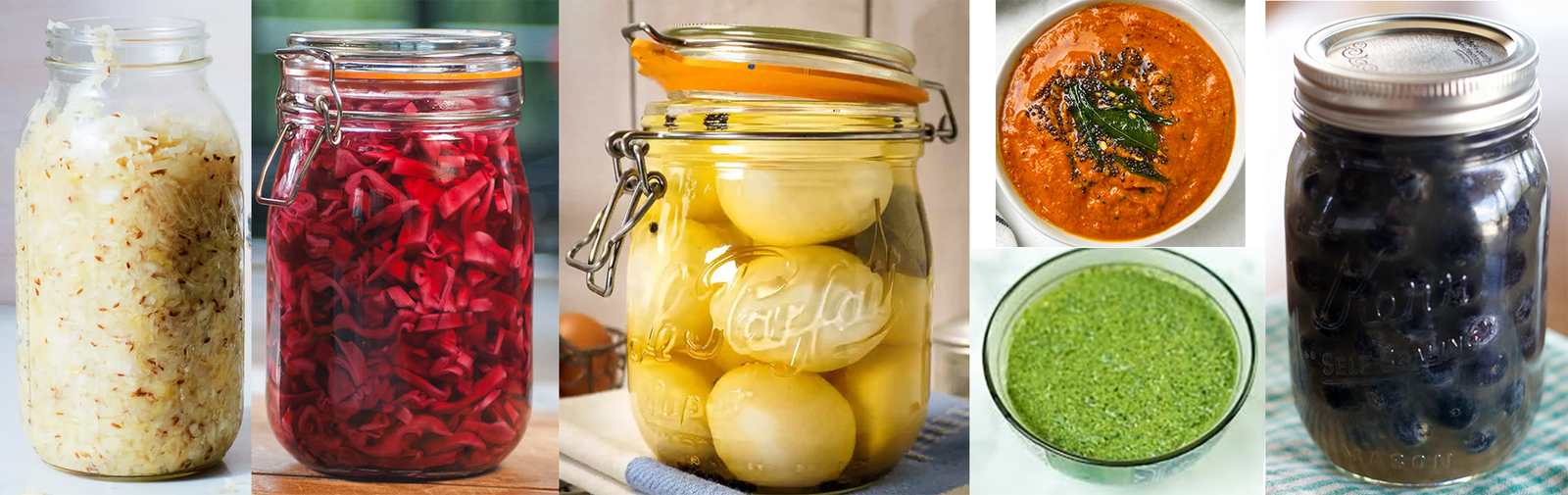 Four different fruit preserve types. Left to right: sauerkraut, pickled red cabbage,
pickled eggs, Indian tomato and coriander chatnis and sweet pickled bilberries.
Welcome to FabulousFusionFood's Pickled Recipes Page — Pickling is the process of preserving or extending the shelf life of food by either anaerobic fermentation in brine or immersion in vinegar. The pickling procedure typically affects the food's texture and flavour. The resulting food is called a pickle, or, if named, the name is prefaced with the word pickled". Foods that are pickled include vegetables, fruit, mushrooms, meats, fish, seafood, dairy and eggs.
Pickling solutions are typically highly acidic, with a pH of 4.6 or lower, and high in salt, preventing enzymes from working and micro-organisms from multiplying. Pickling can preserve perishable foods for months, or in some cases years. Antimicrobial herbs and spices, such as mustard seed, garlic, cinnamon or cloves, are often added. If the food contains sufficient moisture, a pickling brine may be produced simply by adding dry salt. For example, sauerkraut and Korean kimchi are produced by salting the vegetables to draw out excess water. Natural fermentation at room temperature, by lactic acid bacteria, produces the required acidity. Other pickles are made by placing vegetables in vinegar. Like the canning process, pickling (which includes fermentation) does not require that the food be completely sterile before it is sealed. The acidity or salinity of the solution, the temperature of fermentation, and the exclusion of oxygen determine which microorganisms dominate, and determine the flavour of the end product.
Pickling with vinegar likely originated in ancient Mesopotamia around 2400 BCE. There is archaeological evidence of cucumbers being pickled in the Tigris Valley in 2030 BCE. Pickling vegetables in vinegar continued to develop in the Middle East region before spreading to the Maghreb, to Sicily and to Spain. From Spain it spread to the Americas. On the other hand, fermented salt pickling reportedly has its origins in China.
The English term "pickle" first appears around 1400 CE. It is from Middle English pikel, a spicy sauce served with meat or fish, borrowed from Middle Dutch or Middle Low German pekel ("brine") but later referred to preserving in brine or vinegar. Pickle recipes in English were first published in the middle ages, with an example being a mixed pickle from the 15 century found in Curye on Inglysch, IV. 103.
In Britain, pickled onions and pickled eggs are often sold in pubs and fish and chip shops. Pickled beetroot, walnuts, and gherkins, and condiments such as Branston Pickle and piccalilli are typically eaten as an accompaniment to pork pies and cold meats, sandwiches or a ploughman's lunch. Other popular pickles in the UK are pickled mussels, cockles, red cabbage, mango chutney, sauerkraut, and olives. Rollmops are also quite widely available under a range of names from various producers both within and out of the UK
This page is a continuation of the list of recipes from the Pickling process held on the FabulousFusionFood site. If you are specifically looking for this site's brief information about pickling then please go back to the First Page of the Pickles Recipes entry on this site.
The alphabetical list of all the Pickle recipes on this site follows, (limited to 100 recipes per page). There are 504 recipes in total:
Page 3 of 6
| Inglad Sill (Swedish Pickled Herring) Origin: Sweden | Lasary Manga (Mango Condiment) Origin: Madagascar | Moungra (Pickled Cauliflower) Origin: Cyprus |
| IPA-pickled Hop Stoots Origin: Britain | Lashun ka Achar (Indian Garlic Pickle) Origin: India | Muqmad (Djibouti Preserved Meat) Origin: Djibouti |
| Jam Cwrens Duon (Blackcurrant Jam) Origin: Welsh | Latvian Pickled Beetroot Origin: Latvia | Mushroom Ketchup Origin: Britain |
| Jam Damson (Damson Jam) Origin: Welsh | Lemon-brined Turkey Origin: Fusion | Mushroom Pickle Origin: Britain |
| Jam Eirin Gwyllt (Bullace Jam) Origin: Welsh | Lightly-brined Turkey Origin: Britain | Mwtrin Eirin Mair (Gooseberry Compôte) Origin: Welsh |
| Jam Eirin Gwyllt (Bullace (Wild Plum) Jam) Origin: Welsh | Lilac Sugar Origin: Britain | Mwtrin Rhiwbob (Rhubarb Compôte) Origin: Welsh |
| Jam Eirin Mair (Gooseberry Jam) Origin: Welsh | Lime Pickle Origin: India | Naga Mircha Pickle (Naga Chilli Pickle) Origin: India |
| Jam Llus (Bilberry Jam) Origin: Welsh | Lime Pickle Origin: India | Nasi Lemak Origin: Malaysia |
| Jam Mafon Gwyllt (Wild Raspberry Jam) Origin: Welsh | Limoo Amani (Persian Dried Limes) Origin: Iran | Nasi Lemak Origin: Cocos Islands |
| Jam Mefus Gwyllt (Wild Strawberry Jam) Origin: Welsh | Lithuanian Pickled Beetroot Origin: Lithuania | Nasi Lemak Origin: Singapore |
| Jam Rhiwbob (Rhubarb Jam) Origin: Welsh | Luk Marinovannyi Origin: Georgia | Nasi Lemak Origin: Christmas Island |
| Jam Tomato Coch (Red Tomato Jam) Origin: Welsh (Patagonia) | Luss-Ny-Greg Saillt (Pickled Samphire) Origin: Manx | Nasturtium Leaf Pesto Origin: Britain |
| Jam Tomato Gwyrdd (Green Tomato Jam) Origin: Welsh (Patagonia) | Luumuhilloa (Finnish Prune Jam) Origin: Finland | Natural Red Tomato Chutney Origin: Britain |
| Japanese Knotweed and Apple Chutney Origin: Britain | Malawian Biltong Origin: Malawi | New Zealand Norfolk Fruit Chutney Origin: New Zealand |
| Japanese Knotweed and Ginger Jam Origin: Britain | Malosolʹnye Sgurcy (Russian Salted Pickles) Origin: Russia | Nicaraguan Salsa Criolla Origin: Nicaragua |
| Japanese Knotweed and Pineapple Marmalade Origin: Britain | Mango and Aniseed Toadstool Chutney Origin: Fusion | Nypon och Lingonsylt (Rose-hip and Lingonberry Jam) Origin: Sweden |
| Japanese Knotweed Chutney Origin: Britain | Mango Atjar Origin: South Africa | Octapodhi Ksydhato (Pickled Octopus) Origin: Cyprus |
| Japanese Knotweed Curd Origin: Britain | Mango Chutney Origin: Anglo-Indian | Ogórki kiszone (Polish Pickled Cucumbers) Origin: Korea |
| Japanese Knotweed Jelly Origin: Britain | Mango wedi Piclo (Pickled Mangoes) Origin: Welsh | Oil-pickled Scarlet Elf Cups Origin: Britain |
| Japanese Knotweed Sorbet Origin: Britain | Manitaria Krasata (Mushrooms in Wine) Origin: Cyprus | Ojinguh Jut (Korean Pickled Squid) Origin: Korea |
| Kaapse Kerrievis (Cape Malay Pickled Fish) Origin: South Africa | Manx Potted Herring Origin: Manx | Old-fashioned Brined Mushrooms Origin: British |
| Kaapse Kerrievis (Cape Malay Pickled Fish) Origin: South Africa | Marinated Chile Güerito Peppers Origin: Mexico | Old-fashioned Home-made Sauerkraut Origin: Germany |
| Kapari (Pickled Capers) Origin: Cyprus | Marmalêd Eirin Gwyrdd (Greengage Marmalade) Origin: Welsh | Old-fashioned Sweet Pickled Sea Sandwort Origin: Britain |
| Karry-remoulade (Danish Curry Remoulade) Origin: Denmark | Mazavaroo Origin: Mauritius | Oodkac (Somali Preserved Meat) Origin: Somalia |
| Kasundi Origin: Bangladesh | Mebos (Preserved Apricot Spheres) Origin: South Africa | Oregon Grape and Lemon Curd Origin: America |
| Khiar Shoor (Persian Fermented Gherkins) Origin: Iran | Medlar Cheese and Medlar Purée Origin: Britain | Ox-eye Daisy Capers Origin: Britain |
| Kimchi Origin: Korea | Medlar Chutney Origin: Britain | Oxeye Daisy Capers Origin: Britain |
| Kiseli Kupus Origin: Croatia | Microwave Lemon Curd Origin: Britain | Papaya Chutney Origin: Namibia |
| Knotweed and Apple Fruit Leather Origin: Britain | Miel de Pissenlits (Dandelion Petal Honey) Origin: Switzerland | Pastırma Origin: Turkey |
| Krækiberjasaft Chatni (Crowberry Chutney) Origin: Iceland | Mint Chutney Origin: Britain | Patna or Bombay Pickled Onions Origin: Anglo-Indian |
| La Niere Beurre (Jersey Black Butter) Origin: Jersey | Mixed Vegetable Pickle Origin: India | Pau-Pau Chatni (Papaya Chutney) Origin: Seychelles |
| Lacto-fermented Japanese Knotweed Pickles Origin: Britain | Momos Chutney Origin: India | Peruvian Salsa Criolla Origin: Peru |
| Lacto-fermented Sea Sandwort Origin: Britain | Montserratian Mango Chutney Origin: Montserrat | |
| Lasary Citron (Lemon Condiment) Origin: Reunion | Montserratian Souse Origin: Montserrat |
Page 3 of 6