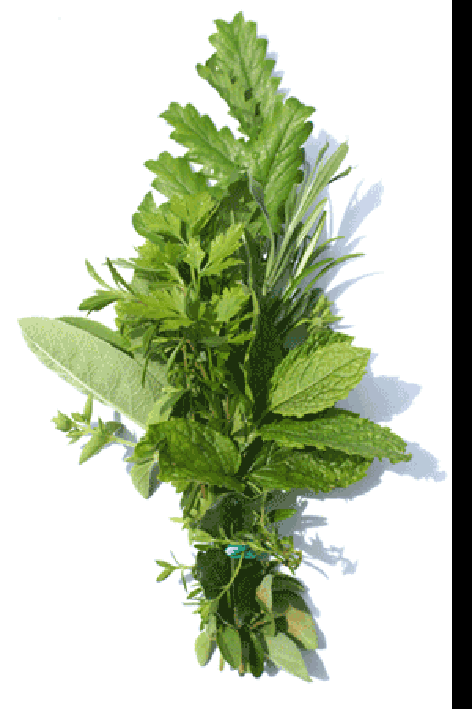
 Bunch of mixed herbs.
Welcome to the summary page for FabulousFusionFood's Cook's Guide entry for Sweet Herbs along with all the recipes employing Sweet Herbs presented on this site, with 1996 recipes in total.
This is a continuation of an entire series of pages that will, I hope, allow my visitors to better navigate this site. As well as displaying recipes by name, country and region of origin I am now planning a whole series of pages where recipes can be located by meal type and main ingredient. This page gives a listing of all the Sweet Herbs recipes added to this site.
These recipes, all contain Sweet Herbs as a major wild food ingredient.
Sweet Herbs This is a term used frequently in Georgian and Victorian cookery books, where a bunch or faggot of sweet herbs is frequently called for as an ingredient. This represents typically soft-leaved herbs used in enhancing the flavour of a dish, as opposed to Savoury Herbs (which are strong, penetrating, herbs used to flavour stews). Those herbs deemed 'sweet' tend to be annual in nature (though this is not always the case), are not woody and have aromatic oils that lend them a particular, pleasant, fragrance when crushed. Sweet herbs break down into the stock and do not need to be removed. Quite often, sweet herbs can be eaten raw and are often added to salads to improve the flavour.
In her Book of Household Management, Mrs Beeton defines sweet herbs as:
SWEET HERBS.—Those most usually employed for purposes of cooking, such as the flavouring of soups, sauces, forcemeats, &c., are thyme, sage, mint, marjoram, savory, and basil. Other sweet herbs are cultivated for purposes of medicine and perfumery: they are most grateful both to the organs of taste and smelling; and to the aroma derived from them is due, in a great measure, the sweet and exhilarating fragrance of our "flowery meads." In town, sweet herbs have to be procured at the greengrocers' or herbalists', whilst, in the country, the garden should furnish all that are wanted, the cook taking great care to have some dried in the autumn for her use throughout the winter months.
It is interesting that 'savory' is mentioned in the list above there are two types. Summer savory, an annual, that was a 'sweet' herb and winter savory which is perennial and was classed as a 'savoury' herb. The obvious herb missing from this list is parsley, which was a 'sweet' herb but which was also commonly used in savoury herb bouquets. Today we would also add coriander (cilantro) to this list and I would include oregano, dill, fennel and chervil. Most herbs that are used to flavour fish can be considered 'sweet'.
Originally, however (in Medieval and Tudor times) the term 'sweet' herbs referred to those herbs that could be eaten raw or could be added directly to stews and pottages. All other herbs were 'potherbs' and required blanching before consumption.
This is a continuation of an entire series of pages that will, I hope, allow my visitors to better navigate this site. As well as displaying recipes by name, country and region of origin I am now planning a whole series of pages where recipes can be located by meal type and main ingredient. This page gives a listing of all the Sweet Herbs recipes added to this site.
These recipes, all contain Sweet Herbs as a major wild food ingredient.
Sweet Herbs This is a term used frequently in Georgian and Victorian cookery books, where a bunch or faggot of sweet herbs is frequently called for as an ingredient. This represents typically soft-leaved herbs used in enhancing the flavour of a dish, as opposed to Savoury Herbs (which are strong, penetrating, herbs used to flavour stews). Those herbs deemed 'sweet' tend to be annual in nature (though this is not always the case), are not woody and have aromatic oils that lend them a particular, pleasant, fragrance when crushed. Sweet herbs break down into the stock and do not need to be removed. Quite often, sweet herbs can be eaten raw and are often added to salads to improve the flavour.
In her Book of Household Management, Mrs Beeton defines sweet herbs as:
SWEET HERBS.—Those most usually employed for purposes of cooking, such as the flavouring of soups, sauces, forcemeats, &c., are thyme, sage, mint, marjoram, savory, and basil. Other sweet herbs are cultivated for purposes of medicine and perfumery: they are most grateful both to the organs of taste and smelling; and to the aroma derived from them is due, in a great measure, the sweet and exhilarating fragrance of our "flowery meads." In town, sweet herbs have to be procured at the greengrocers' or herbalists', whilst, in the country, the garden should furnish all that are wanted, the cook taking great care to have some dried in the autumn for her use throughout the winter months.
It is interesting that 'savory' is mentioned in the list above there are two types. Summer savory, an annual, that was a 'sweet' herb and winter savory which is perennial and was classed as a 'savoury' herb. The obvious herb missing from this list is parsley, which was a 'sweet' herb but which was also commonly used in savoury herb bouquets. Today we would also add coriander (cilantro) to this list and I would include oregano, dill, fennel and chervil. Most herbs that are used to flavour fish can be considered 'sweet'.
Originally, however (in Medieval and Tudor times) the term 'sweet' herbs referred to those herbs that could be eaten raw or could be added directly to stews and pottages. All other herbs were 'potherbs' and required blanching before consumption.
The alphabetical list of all Sweet Herbs recipes on this site follows, (limited to 100 recipes per page). There are 1996 recipes in total:
Page 1 of 20
| 2-Minute Lemon Cheesecake Origin: Britain | Alitas de pollo picante (Spicy Chicken Wings) Origin: Ecuador | Amia (Roman Fish in Vine Leaves) Origin: Roman |
| Aam Aur Podina ki Chatni (Mango and Mint Chutney) Origin: India | Aliter Bulbos (Bulbs, Another Way) Origin: Roman | Amiæ (Barbecued Fish) Origin: Roman |
| Abbacchio alla Cacciatora Origin: Italy | Aliter Bulbos (Bulbs, Another Way II) Origin: Roman | Anamikto Siropi (Mixed Fruit Squash) Origin: Cyprus |
| Abbacchio alla scottadito (Barbecued Milk-fed Lamb Chops) Origin: Vatican City | Aliter carduos (Artichokes with Herbs) Origin: Roman | Anguilla Green Seasoning Origin: Anguilla |
| Accent Herbs Origin: Caribbean | Aliter cucumeres (Cucumber with Fennel Seed) Origin: Roman | Anguilla Habanero Hot Sauce Origin: Anguilla |
| Accras de Morue (Salt Cod Fritters) Origin: Saint Barthelemy | Aliter In Aprum Assum Iura Ferventia Facies Sic (Hot Sauce for Roast Wild Boar, Another Way) Origin: Roman | Anguilla Wet Rub Origin: Anguilla |
| Accras de Morue (Salt Cod Fritters) Origin: Sint Maarten | Aliter in Echino (Sauce for Sea Urchin) Origin: Roman | Anguillan Barbecue Sauce Origin: Anguilla |
| Accras de Morue (Salt Cod Fritters) Origin: Saint-Martin | Aliter in Grue vel Qnate Elixa (Sauce for Boiled Crane or Duck, Another Way II) Origin: Roman | Antigua and Barbuda Jerk Chicken Origin: Antigua |
| Ackee and Saltfish Origin: Jamaica | Aliter in Gruem vel Anatem Elixam (Sauce for Boiled Crane or Duck, Another Way) Origin: Roman | Antiguan Curry Goat Origin: Antigua |
| Ad Aves Hircosas Omni Genere (How to Prepare 'High' Birds of Any Kind) Origin: Roman | Aliter in Locusta (Another Sauce for Lobster) Origin: Roman | Antiguan Green Seasoning Origin: Antigua |
| Adjika (Abkhazian Paprika Sauce) Origin: Abkhazia | Aliter In Struthione Elixo (Of Boiled Ostrich, Another Way) Origin: Roman | Antiguan Hot Sauce Origin: Antigua |
| Advieh-spiced Persian Meatballs Origin: Iran | Aliter Isicia (Another Sausage) Origin: Roman | Antiguan Jerk Seasoning Origin: Antigua |
| African All Purpose Seasoning Origin: Nigeria | Aliter Isicia II (Another Sausage II) Origin: Roman | Antiguan Pepper Shrimp Origin: Antigua |
| Agneau Provençal au Jus Menthe Verte (Roast Lamb Provençal with Mint Gravy) Origin: France | Aliter ius candidum in copadiis (White Sauce for Choice Cuts, Another Way) Origin: Roman | Antiguan Rice and Peas Origin: Antigua |
| Ai Manas (Chilli Sauce with Eggs) Origin: East Timor | Aliter ius candidum in elixam (Another White Sauce for Boiled Meats) Origin: Roman | Antiguan Rice Pudding Origin: Antigua |
| Ailes de raie sauce au beurre noir (Skate wings with black butter sauce) Origin: France | Aliter Ius Frigidum in Aprum Elixum (Cold Sauce for Boiled Wild Boar, Another Way) Origin: Roman | Antiguan Tomato Sauce Origin: Antigua |
| Air Fried Beef Brisket Origin: Britain | Aliter Ius in Avibus (Sauce for Birds, Another Way) Origin: Roman | Antillean Barbecue Sauce Origin: Sint Maarten |
| Air Fryer Beef Wellington Origin: Britain | Aliter Ius in Mugile Salso (Another Sauce for Salted Grey Mullet) Origin: Roman | Antillean Barbecue Sauce Origin: Guadeloupe |
| Air Fryer Lamb Chops Origin: Britain | Aliter Ius in Mullos Assos (Another Sauce for Baked Red Mullet) Origin: Roman | Antillean Barbecue Sauce Origin: Martinique |
| Air Fryer Liver and Sausage Curry Origin: Britain | Aliter Ius in Murena Assa II (Sauce for Grilled Moray Eel, Another Way II) Origin: Roman | Antillean Barbecue Sauce Origin: Saint-Martin |
| Air Fryer Meat-stuffed Mushrooms Origin: Britain | Aliter Ius in Murena Elixa II (Another, Sauce for Poached Moray Eel II) Origin: Roman | Antillean Barbecue Sauce Origin: Saint Barthelemy |
| Air Fryer Pancakes Origin: Britain | Aliter Laseratum (Another Hing Sauce) Origin: Roman | Antipasto Chef's Salad Origin: Britain |
| Air Fryer Quesadillas Origin: Britain | Aliter Lenticulam (Lentils, Another Way) Origin: Roman | Antipasto di Funghi e Gamberetti (Mushroom and Prawn Antipasto) Origin: Italy |
| Air Fryer Sage and Onion Stuffing Balls Origin: Britain | Aliter Leporem Elixum (Another, Boiled Hare) Origin: Roman | Antipasto Rice Origin: Italy |
| Air Fryer Sausage Rolls Origin: Britain | Aliter Leporem ex Suo Iure (Another, Hare in its Own Gravy) Origin: Roman | Apelsin och timjansfisk (Orange and Thyme Fish) Origin: Sweden |
| Air Fryer Stuffed Mushrooms Origin: Britain | Aliter Phoenicoptero (Flamingo, Another Way) Origin: Roman | Apelsinfisk (Fish with Orange) Origin: Sweden |
| Air Fryer Tomato or Marinara Sauce Origin: Britain | Aliter Sala cattabia (Another Cattanian Salad) Origin: Roman | Appetizer Pate Cheesecake Origin: American |
| Air Fryer Whole Chicken or Guinea Fowl Origin: Britain | Aliter Sepias (Cuttlefish, Another Way) Origin: Roman | Apple and Mint Jelly Origin: Britain |
| Ají de Tamarillo (Ecuadorian Tree Tomato Hot Sauce) Origin: Ecuador | Aliter Tubera III (Truffles, Another Way III) Origin: Roman | Apple, Chestnut and Mugwort Stuffing for Roast Goose Origin: Britain |
| Al Mechoui (Spit-roasted Baby Lamb) Origin: Mauritania | Aliter Tubera V (Truffles, Another Way V) Origin: Roman | Apple, Cider and Onion Soup Origin: Britain |
| Al Mechoui (Spit-roasted Baby Lamb) Origin: Western Sahara | Aljota (Fish Soup) Origin: Malta | Apricot and Bergamot Chicken Origin: Britain |
| Algerian Saffron and Raisin Couscous Origin: Algeria | Aloo Chaat (Savoury Potato Snack) Origin: India | Arancini di Riso (Rice 'Oranges') Origin: Italy |
| Aliater ius in mullos assos (Red Mullet in Fennel and Mint Sauce) Origin: Roman | Amatriciana Chicken Traybake Origin: Britain | |
| Alicam vel sucum tisanae (Spelt or Barley Gruel) Origin: Roman | Amêijoas na Cataplana (Steamed Clams and Sausage in Tomato Sauce) Origin: Portugal |
Page 1 of 20