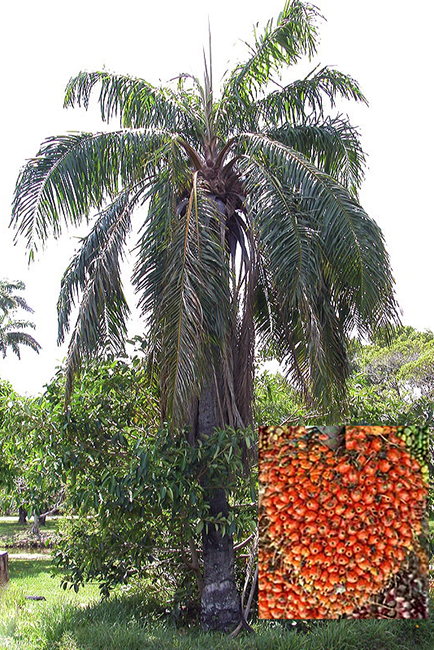
 African oil palm Elaeis guineensis with cluster of palm
nuts, inset.
Welcome to the summary page for FabulousFusionFood's Cook's Guide entry for Oil Palm along with all the recipes employing Oil Palm presented on this site, with 258 recipes in total.
This is a continuation of an entire series of pages that will, I hope, allow my visitors to better navigate this site. As well as displaying recipes by name, country and region of origin I am now planning a whole series of pages where recipes can be located by meal type and main ingredient. This page gives a listing of all the Oil Palm recipes added to this site.
These recipes, all contain Oil Palm as a major wild food ingredient.
The African Oil Palm Elaeis guineensis originates in Guinea, but is now naturalized throughout West Africa. It is a tall monocotyledonous flowering plant that's a member of the Arecaceae (Palm) family. Typically it will grow to 20m in height and bears long pinnate leaves at its crown, each between 3–5m in length. Flowers are produced in dense clusters, with each individual flower being small and bearing three sepals and three petals. The fruit is reddish and shiny (about the size of a Brazil nut) and develops in large bunches (which can weigh up to 30kg in total). The fruit takes five to six months to mature from pollination to maturity; it comprises an oily, fleshy outer layer (the pericarp), with a single whitish seed (kernel), which is also rich in oil. Both the pulp and seeds produce oil, with 22 kilograms of palm oil and 1.6 kilograms of palm kernel oil typically being extracted for each 100kg of fruit.
The tree is highly productive and can yield as much as 7,250 litres per hectare per year; which has made this tree the primary source of vegetable oil in many tropical countries. The pericarp oil is mainly used for cooking and the kernel oil is used for processed foods and cosmetics.
In West Africa, however, kernel oil is produced by hand. The fruit is often sold in markets (this being the whole fruit) and is boiled in water until the water part evaporates. The residue is then pressed to extract a reddish-orange oil known as 'red palm oil'. This is a very important part of West African cookery that's used more as a flavouring than a cooking oil (it can be bought in just about any market). It is also used as a condiment poured over simple meals such as fried fish and boiled rice.
The flavour is rich and interesting and certainly lifts the flavour of just about any meal.
This is a continuation of an entire series of pages that will, I hope, allow my visitors to better navigate this site. As well as displaying recipes by name, country and region of origin I am now planning a whole series of pages where recipes can be located by meal type and main ingredient. This page gives a listing of all the Oil Palm recipes added to this site.
These recipes, all contain Oil Palm as a major wild food ingredient.
The African Oil Palm Elaeis guineensis originates in Guinea, but is now naturalized throughout West Africa. It is a tall monocotyledonous flowering plant that's a member of the Arecaceae (Palm) family. Typically it will grow to 20m in height and bears long pinnate leaves at its crown, each between 3–5m in length. Flowers are produced in dense clusters, with each individual flower being small and bearing three sepals and three petals. The fruit is reddish and shiny (about the size of a Brazil nut) and develops in large bunches (which can weigh up to 30kg in total). The fruit takes five to six months to mature from pollination to maturity; it comprises an oily, fleshy outer layer (the pericarp), with a single whitish seed (kernel), which is also rich in oil. Both the pulp and seeds produce oil, with 22 kilograms of palm oil and 1.6 kilograms of palm kernel oil typically being extracted for each 100kg of fruit.
The tree is highly productive and can yield as much as 7,250 litres per hectare per year; which has made this tree the primary source of vegetable oil in many tropical countries. The pericarp oil is mainly used for cooking and the kernel oil is used for processed foods and cosmetics.
In West Africa, however, kernel oil is produced by hand. The fruit is often sold in markets (this being the whole fruit) and is boiled in water until the water part evaporates. The residue is then pressed to extract a reddish-orange oil known as 'red palm oil'. This is a very important part of West African cookery that's used more as a flavouring than a cooking oil (it can be bought in just about any market). It is also used as a condiment poured over simple meals such as fried fish and boiled rice.
The flavour is rich and interesting and certainly lifts the flavour of just about any meal.
The alphabetical list of all Oil Palm recipes on this site follows, (limited to 100 recipes per page). There are 258 recipes in total:
Page 1 of 3
| Aadun Origin: Nigeria | Burundian Isombe (Cassava Leaf Stew) Origin: Burundi | Efere Usung Udia Origin: Nigeria |
| Abacha Ncha (Dried Cassava with Garden Eggs) Origin: Nigeria | Cabri aux Gombos et Patates Douces (Goat with Okra and Sweet Potatoes) Origin: Senegal | Efo Riro Origin: Nigeria |
| Abenkwan (Palm Oil Soup) Origin: Ghana | Calalu Origin: Benin | Efo-riro (Vegetable Stew) Origin: Nigeria |
| Adalu (Bean and Sweetcorn Pottage) Origin: Nigeria | Caldo de Bicuda (Barracuda Stew) Origin: Guinea-Bissau | Ekoki Origin: Cameroon |
| Adun Origin: Nigeria | Caldo de Chabéu (Palm Nut Stew) Origin: Guinea-Bissau | Ekpang Nkukwo Origin: Nigeria |
| Afang Soup Origin: Nigeria | Caldo de Citi (Red Palm oil Stew) Origin: Guinea-Bissau | Ekpang Nkukwo (Cocoyam Pottage) Origin: Nigeria |
| Agushi Soup (Ghanaian Egusi Soup) Origin: Ghana | Caldo de Peixe de Guiné-Bissau (Guinea-Bissau Style Fish Stew) Origin: Guinea-Bissau | Ekuru with Ata Sauce (Steamed Savoury Beans with Ata Sauce) Origin: Nigeria |
| Akara (Black-eyed Pea Fritters) Origin: Nigeria | Calulu Origin: Sao Tome | Ekwang Origin: Cameroon |
| Akume with Ademe Sauce Origin: Togo | Calulu Carne Seca (Dried Meat Calulu) Origin: Angola | Eru avec Garri (Eru with Garri) Origin: Cameroon |
| Alapa (Palm-oil Stew) Origin: Nigeria | Calulu de Cabara (Goat Meat Calulu) Origin: Angola | Fúti (Mixed Fula Dish) Origin: Guinea-Bissau |
| Alloco de Cameroun (Cameroonian Alloco) Origin: Cameroon | Calulu de Peixe (Fish Calulu) Origin: Angola | Fante-Fante (Ghanaian Fisherman's Stew) Origin: Ghana |
| Aloco Camerounais (Cameroonian Aloco) Origin: Cameroon | Camel Meat Patties Origin: Mauritania | Faten Doya (Nigerian Yam Pottage) Origin: Nigeria |
| Aloko Origin: Cote dIvoire | Cameroon Fried Rice Origin: Cameroon | Feijao de Oleo de Palma (Palm Oil Beans) Origin: Angola |
| Amashaza mu gitoke (Peas with Plantains) Origin: Uganda | Capitaine and Pili-Pili in Palm Oil Origin: Congo | Feijoada à Angolana (Angolan Feijoada) Origin: Angola |
| Ampesi with Kontomire Stew Origin: Ghana | Cassava Bread Origin: Burundi | Feuilles de Manioc (Central African Cassava Leaves) Origin: Central Africa |
| Asaro (Special Yam Pottage) Origin: Nigeria | Cassava Leaf Soup Origin: Liberia | Fonio, Sauce Gombo et Crevettes (Fonio, Okra Sauce and Prawns) Origin: Mali |
| Asaro II (Yam Porridge) Origin: Nigeria | Cassava Leaf Stew Origin: Sierra Leone | Foufou de Banane à la Sauce Claire (Plantain Fufu with Clear Sauce) Origin: Mali |
| Bananas with Split Green Peas Origin: Rwanda | Cassava Life Origin: Sierra Leone | Fouti Lafidi Origin: Guinea |
| Banankou Fida (Sokossoko with Kidneys) Origin: Guinea | Chabéu de Carne (Meat with Palm Oil) Origin: Guinea-Bissau | Frango com Bagique (Chicken with Spinach) Origin: Guinea-Bissau |
| Barokhé (Beef and Fish with Cassava Leaves) Origin: Mali | Chabéu de Tainha (Palm Soup of Mullet) Origin: Guinea-Bissau | Fried Ata Sauce Origin: Nigeria |
| Baru Fida (Spinach Sauce with Peanuts and Beef Shank) Origin: Guinea | Chadian Mouloukhiyé (Jute Mallow Soup) Origin: Chad | Fruit Risshews Origin: England |
| Beans and Bananas Origin: Burundi | Chew Dewtirr Kong (Smoked Catfish Stew) Origin: Gambia | Fryplantain and Beans Origin: Ghana |
| Beans Gravy Origin: Liberia | Cocodrilo en su Salsa (Crocodile in Sauce) Origin: Equatorial Guinea | Galo Soup Origin: Liberia |
| Beef and Mushrooms in Peanut Sauce Origin: Central African Republic | Cocoyam Eto Origin: Ghana | Gambian-style Okro Soup Origin: Gambia |
| Beef with Calabash Nutmegs Origin: Nigeria | Cofnchaff Origin: Cameroon | Garden Eggs Stew Origin: Ghana |
| Black Fungus Okra Soup Origin: Nigeria | Collards and Cabbage Origin: Liberia | Gbegiri (Bean Stew) Origin: Nigeria |
| Black-eyed Beans and Plantain Pottage Origin: Nigeria | Concoction Rice Origin: Nigeria | Ghanaian Cabbage Stew Origin: Ghana |
| Bobó Frito (Sao Tomean Chicken Croquettes) Origin: Sao Tome | Coupé Coupé Gabonnaise Origin: Gabon | Ghanaian Etor Origin: Ghana |
| Boeuf aux Chocolat Gabonnaise (Beef with Gabon Chocolate) Origin: Gabon | Courgettes à la Monégasque (Monaco-style Courgettes) Origin: Monaco | Goat Meat Suya Origin: Nigeria |
| Boeuf aux Graines de Courge (Beef with Egusi Seeds) Origin: Cameroon | Curried Rice with Beef Origin: Ghana | Green Stew Origin: Nigeria |
| Borokhé Origin: Mali | Dahomey Fish Stew Origin: Benin | Guinean Fish Grill with Three Sauces Origin: Equatorial Guinea |
| Burundi Beans and Plantains Origin: Burundi | Dry Rice and Fish Origin: Liberia | Guinean Spinach Sauce Origin: Equatorial Guinea |
| Burundi Brochettes Origin: Burundi | Edikang Ikong Soup Origin: Nigeria | |
| Burundian Beef and Greens in Peanut Sauce Origin: Burundi | Editan Soup II Origin: Nigeria |
Page 1 of 3