FabulousFusionFood's Channel Islands Recipes Home Page
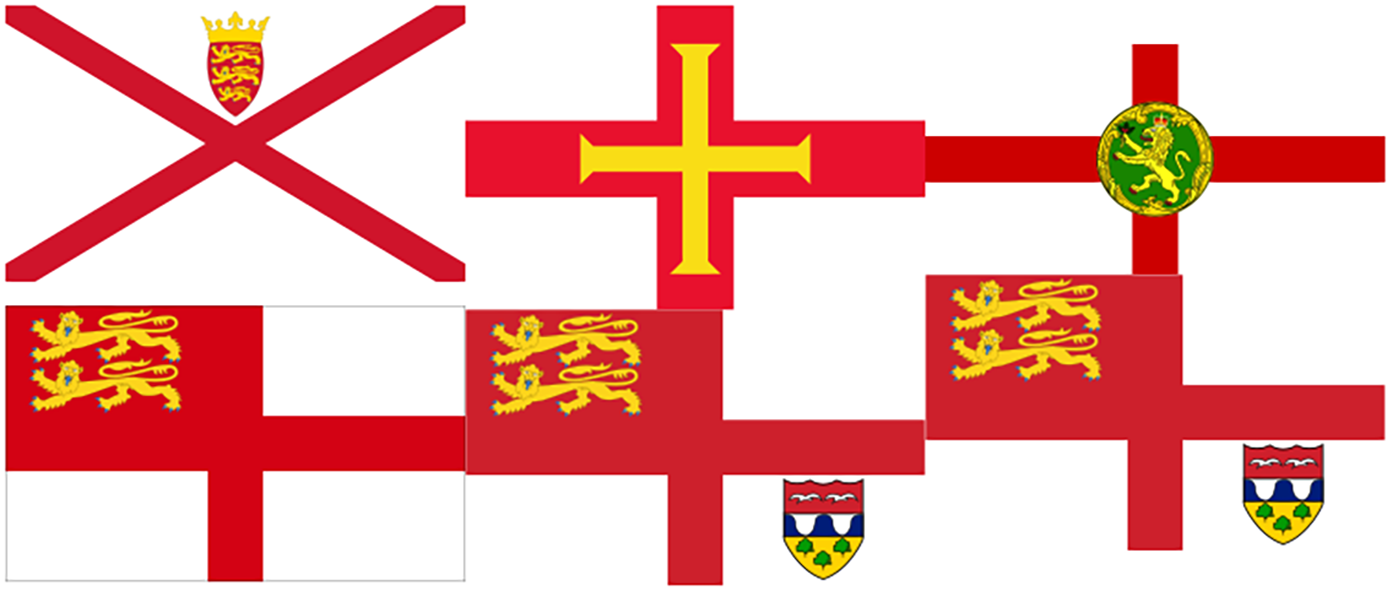 The flag of the major channel islands (clockwise from top left): Jersey,
Guernsey, Alderney, Brecqhou, Herm and Sark.
Welcome to the summary page for FabulousFusionFood's Channel Islands recipes, part of Europe. This page provides links to all the Channel Islands recipes presented on this site, with 13 recipes in total.
This is a continuation of an entire series of pages that will, I hope, allow my visitors to better navigate this site. As well as displaying recipes by name, country and region of origin I am now planning a whole series of pages where recipes can be located by meal type and main ingredient. This page gives a listing of all the Channel Islands recipes added to this site.
Locally-caught seafood has traditionally been important to the cuisines of both Guernsey and Jersey: mussels (called moules locally), scallops, oysters, lobster and crabs — especially spider crabs which are considered a particular delicacy. Ormers are conserved and fishing is restricted; they were made into Ormer casserole. A speciality is conger eel soup.
These recipes, for the major part, originate in the Channel Islands. Otherwise they are fusion recipes with major Channel Islands influences.
The Channel Islands are an archipelago in the English Channel, off the French coast of Normandy. They are divided into two Crown Dependencies: the Bailiwick of Jersey, which is the largest of the islands; and the Bailiwick of Guernsey, consisting of Guernsey, Alderney, Sark, Herm and some smaller islands. Historically, they are the remnants of the Duchy of Normandy.
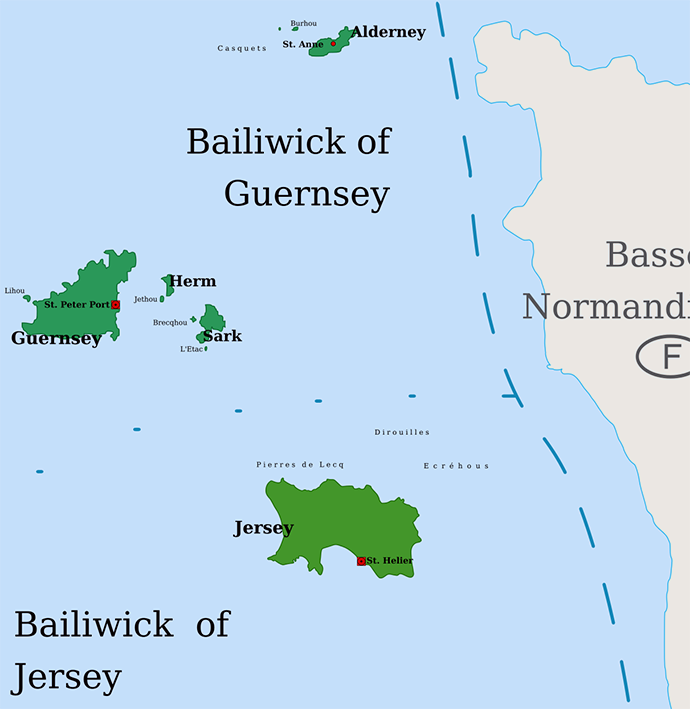 The image above shows The Bailiwicks of Guernsey and Jersey in relation to Normandy in France.Although they are not part of the United Kingdom, the UK is responsible for the defence and international relations of the islands as it is for the other Crown Dependency, the Isle of Man, and the British Overseas Territories. The Crown Dependencies are neither members of the Commonwealth of Nations, nor part of the European Union. They have a total population of about 171,916, and the bailiwicks' capitals, Saint Helier and Saint Peter Port, have populations of 33,500 and 18,207 respectively.
'Channel Islands' is a geographical term, not a political unit. The two bailiwicks have been administered separately since the late 13th century. Each has its own independent laws, elections, and representative bodies (although in modern times, politicians from the islands' legislatures are in regular contact). Any institution common to both is the exception rather than the rule.
The Bailiwick of Guernsey is divided into three jurisdictions – Guernsey, Alderney and Sark – each with its own legislature. Although there are a few pan-island institutions (such as the Channel Islands Brussels Office, the Director of Civil Aviation and the Channel Islands Financial Ombudsman, which are actually joint ventures between the bailiwicks), these tend to be established structurally as equal projects between Guernsey and Jersey. Otherwise, entities whose names imply membership of both Guernsey and Jersey might in fact be from one bailiwick only. For instance, The International Stock Exchange is in Saint Peter Port and therefore is in Guernsey.
The term 'Channel Islands' began to be used around 1830, possibly first by the Royal Navy as a collective name for the islands.: The term refers only to the archipelago to the west of the Cotentin Peninsula. Other populated islands located in the English Channel, and close to the coast of Britain, such as the Isle of Wight, Hayling Island and Portsea Island, are not regarded as 'Channel Islands'.
In official Jersey Standard French, the Channel Islands are called 'Îles de la Manche', while in France, the term 'Îles Anglo-normandes' (Anglo-Norman Isles) is used to refer to the British 'Channel Islands' in contrast to other islands in the Channel. Chausey is referred to as an 'Île normande' (as opposed to Anglo-normande). 'Îles Normandes' and 'Archipel Normand' have also, historically, been used in Channel Island French to refer to the islands as a whole.
In 933, the islands were granted to William Longsword by Raoul, the King of Western Francia, and annexed to the Duchy of Normandy. In 1066, William II of Normandy invaded and conquered England, becoming William I of England, also known as William the Conqueror. In the period 1204–1214, King John lost the Angevin lands in northern France, including mainland Normandy, to King Philip II of France, but managed to retain control of the Channel Islands. In 1259, his successor, Henry III of England, by the Treaty of Paris, officially surrendered his claim and title to the Duchy of Normandy, while retaining the Channel Islands, as peer of France and feudal vassal of the King of France. Since around 1290, Otto de Grandson split the Channel Islands into two separate bailiwicks which were never absorbed into the Kingdom of England nor its successor kingdoms of Great Britain or the United Kingdom. During the Hundred Years' War, the Channel Islands were part of the French territory recognizing the claims of the English kings to the French throne.
The Channel Islands fall into two separate self-governing bailiwicks, the Bailiwick of Guernsey and the Bailiwick of Jersey. Each of these is a British Crown Dependency, and neither is a part of the United Kingdom. They have been parts of the Duchy of Normandy since the 10th century, and Queen Elizabeth II was often referred to by her traditional and conventional title of Duke of Normandy. However, pursuant to the Treaty of Paris (1259), she governed in her right as the Queen (the 'Crown in right of Jersey', and the 'Crown in right of the république of the Bailiwick of Guernsey'), and not as the Duke. This notwithstanding, it is a matter of local pride for monarchists to treat the situation otherwise: the loyal toast at formal dinners was to 'The Queen, our Duke', rather than to 'Her Majesty, The Queen' as in the UK. The Queen died in 2022 and her son Charles III became the King.
Locally-caught seafood has traditionally been important to the cuisines of both Guernsey and Jersey: mussels (called moules locally), scallops, oysters, lobster and crabs — especially spider crabs which are considered a particular delicacy. Ormers are conserved and fishing is restricted; they were made into Ormer casserole. A speciality is conger eel soup.
Dishes traditional in Guernsey cuisine are the Guernsey gâche, a rich fruit bread, gâche mêlaïe, a dense apple cake, and Guernsey bean jar, a type of cassoulet of pork and beans.
Bean crock (les pais au fou) can best be described as a sort of Norman cassoulet. It is a slow-cooked pork and bean stew, most authentically containing a pig's trotter, water and onions. Cabbage loaf is the traditional Jersey bread baked between two cabbage leaves, while Jersey wonders are a kind of doughnut, not filled with jam. Jersey Royal potatoes are the local variety of new potato, and the island is famous for its early crop of small, potatoes from the south-facing côtils (steeply-sloping fields).
This is a continuation of an entire series of pages that will, I hope, allow my visitors to better navigate this site. As well as displaying recipes by name, country and region of origin I am now planning a whole series of pages where recipes can be located by meal type and main ingredient. This page gives a listing of all the Channel Islands recipes added to this site.
Locally-caught seafood has traditionally been important to the cuisines of both Guernsey and Jersey: mussels (called moules locally), scallops, oysters, lobster and crabs — especially spider crabs which are considered a particular delicacy. Ormers are conserved and fishing is restricted; they were made into Ormer casserole. A speciality is conger eel soup.
These recipes, for the major part, originate in the Channel Islands. Otherwise they are fusion recipes with major Channel Islands influences.
The Channel Islands are an archipelago in the English Channel, off the French coast of Normandy. They are divided into two Crown Dependencies: the Bailiwick of Jersey, which is the largest of the islands; and the Bailiwick of Guernsey, consisting of Guernsey, Alderney, Sark, Herm and some smaller islands. Historically, they are the remnants of the Duchy of Normandy.
The image above shows The Bailiwicks of Guernsey and Jersey in relation to Normandy in France.'Channel Islands' is a geographical term, not a political unit. The two bailiwicks have been administered separately since the late 13th century. Each has its own independent laws, elections, and representative bodies (although in modern times, politicians from the islands' legislatures are in regular contact). Any institution common to both is the exception rather than the rule.
The Bailiwick of Guernsey is divided into three jurisdictions – Guernsey, Alderney and Sark – each with its own legislature. Although there are a few pan-island institutions (such as the Channel Islands Brussels Office, the Director of Civil Aviation and the Channel Islands Financial Ombudsman, which are actually joint ventures between the bailiwicks), these tend to be established structurally as equal projects between Guernsey and Jersey. Otherwise, entities whose names imply membership of both Guernsey and Jersey might in fact be from one bailiwick only. For instance, The International Stock Exchange is in Saint Peter Port and therefore is in Guernsey.
The term 'Channel Islands' began to be used around 1830, possibly first by the Royal Navy as a collective name for the islands.: The term refers only to the archipelago to the west of the Cotentin Peninsula. Other populated islands located in the English Channel, and close to the coast of Britain, such as the Isle of Wight, Hayling Island and Portsea Island, are not regarded as 'Channel Islands'.
In official Jersey Standard French, the Channel Islands are called 'Îles de la Manche', while in France, the term 'Îles Anglo-normandes' (Anglo-Norman Isles) is used to refer to the British 'Channel Islands' in contrast to other islands in the Channel. Chausey is referred to as an 'Île normande' (as opposed to Anglo-normande). 'Îles Normandes' and 'Archipel Normand' have also, historically, been used in Channel Island French to refer to the islands as a whole.
In 933, the islands were granted to William Longsword by Raoul, the King of Western Francia, and annexed to the Duchy of Normandy. In 1066, William II of Normandy invaded and conquered England, becoming William I of England, also known as William the Conqueror. In the period 1204–1214, King John lost the Angevin lands in northern France, including mainland Normandy, to King Philip II of France, but managed to retain control of the Channel Islands. In 1259, his successor, Henry III of England, by the Treaty of Paris, officially surrendered his claim and title to the Duchy of Normandy, while retaining the Channel Islands, as peer of France and feudal vassal of the King of France. Since around 1290, Otto de Grandson split the Channel Islands into two separate bailiwicks which were never absorbed into the Kingdom of England nor its successor kingdoms of Great Britain or the United Kingdom. During the Hundred Years' War, the Channel Islands were part of the French territory recognizing the claims of the English kings to the French throne.
The Channel Islands fall into two separate self-governing bailiwicks, the Bailiwick of Guernsey and the Bailiwick of Jersey. Each of these is a British Crown Dependency, and neither is a part of the United Kingdom. They have been parts of the Duchy of Normandy since the 10th century, and Queen Elizabeth II was often referred to by her traditional and conventional title of Duke of Normandy. However, pursuant to the Treaty of Paris (1259), she governed in her right as the Queen (the 'Crown in right of Jersey', and the 'Crown in right of the république of the Bailiwick of Guernsey'), and not as the Duke. This notwithstanding, it is a matter of local pride for monarchists to treat the situation otherwise: the loyal toast at formal dinners was to 'The Queen, our Duke', rather than to 'Her Majesty, The Queen' as in the UK. The Queen died in 2022 and her son Charles III became the King.
Channel Islands Cuisine:
Among the islands' specialities are locally-caught seafood, rich Channel Island milk, Guernsey Bean Jar, and Jersey cabbage loaf (the recipes for which are linked to below).Locally-caught seafood has traditionally been important to the cuisines of both Guernsey and Jersey: mussels (called moules locally), scallops, oysters, lobster and crabs — especially spider crabs which are considered a particular delicacy. Ormers are conserved and fishing is restricted; they were made into Ormer casserole. A speciality is conger eel soup.
Dishes traditional in Guernsey cuisine are the Guernsey gâche, a rich fruit bread, gâche mêlaïe, a dense apple cake, and Guernsey bean jar, a type of cassoulet of pork and beans.
Bean crock (les pais au fou) can best be described as a sort of Norman cassoulet. It is a slow-cooked pork and bean stew, most authentically containing a pig's trotter, water and onions. Cabbage loaf is the traditional Jersey bread baked between two cabbage leaves, while Jersey wonders are a kind of doughnut, not filled with jam. Jersey Royal potatoes are the local variety of new potato, and the island is famous for its early crop of small, potatoes from the south-facing côtils (steeply-sloping fields).
Channel Islands' National Dishes:
Below are listed the dishes considered to be the Channel Islands' national foods along with links to the recipes for those dishes:| Des Mervelles (Jersey Wonders) Origin: Jersey | Jersey Royal Potatoes with Black Butter Origin: Jersey |
| Guernsey Bean Jar Origin: Guernsey | La Niere Beurre (Jersey Black Butter) Origin: Jersey |
The alphabetical list of all the Channel Islands recipes on this site follows, (limited to 100 recipes per page). There are 13 recipes in total:
Page 1 of 1
| Des Mervelles (Jersey Wonders) Origin: Jersey | Du Pain Sus Eune Fielle de Chour (Jersey Cabbage Loaf) Origin: Jersey | Jersey Bean Soup Origin: Jersey |
| Guernsey Bean Jar Origin: Guernsey | Gâche Mélée (Spiced Apple Cake) Origin: Guernsey | Jersey Fried Conger Eel Origin: Jersey |
| Jersey Royal Potatoes with Black Butter Origin: Jersey | Guernsey Bean Jar Origin: Guernsey | Jersey Ormer Casserole Origin: Jersey |
| La Niere Beurre (Jersey Black Butter) Origin: Jersey | Guernsey Conger Soup Origin: Guernsey | Jersey Royal Potatoes with Black Butter Origin: Jersey |
| Des Mervelles (Jersey Wonders) Origin: Jersey |
Page 1 of 1