FabulousFusionFood's Nut-based Recipes 35th Page
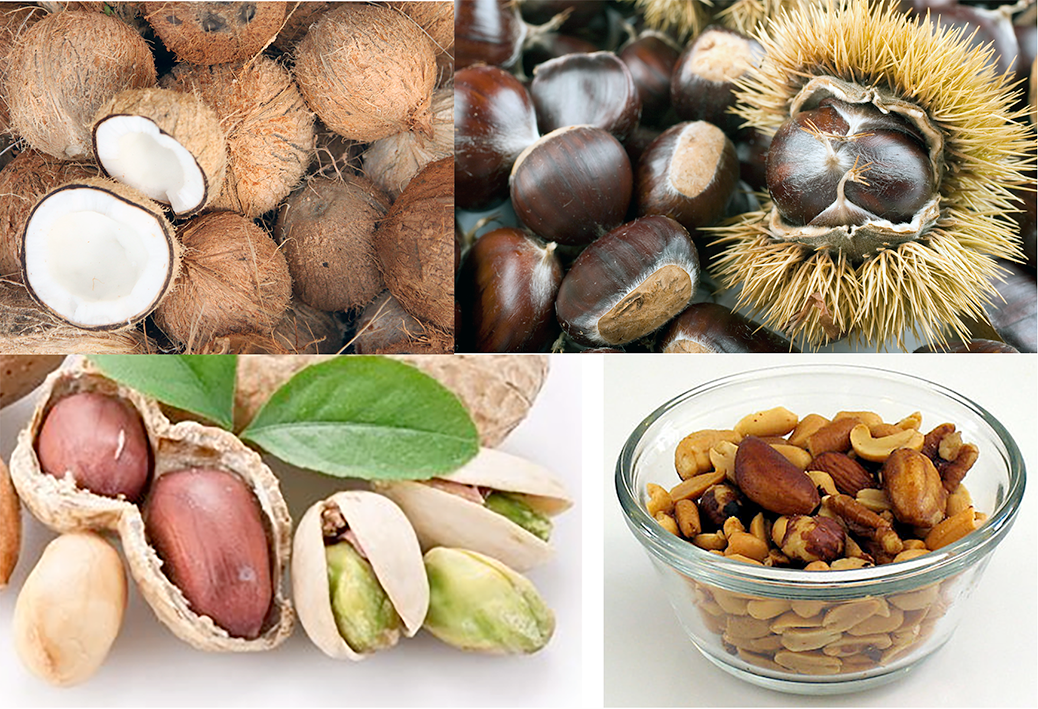 Different nuts. Clockwise: coconuts, sweet chestnuts, bowl of mixed nuts,
peanuts and pistachios.
Welcome to FabulousFusionFood's Nut-based Recipes Page —A nut is a fruit consisting of a hard or tough nutshell protecting a kernel which is usually edible. In general usage and in a culinary sense, many dry seeds are called nuts. In a botanical context, "nut" implies that the shell does not open to release the seed (indehiscent).
Most seeds come from fruit that naturally free themselves from the shell, but this is not the case in nuts such as hazelnuts, chestnuts, and acorns, which have hard shell walls and originate from a compound ovary. The general and original usage of the term is less restrictive, and many nuts (in the culinary sense), such as almonds, pistachios, and Brazil nuts, are not nuts in a botanical sense. Common usage of the term often refers to any hard-walled, edible kernel as a nut. Nuts are an energy-dense and nutrient-rich food source.
Botanically, a nut is a fruit with a woody pericarp developing from a syncarpous gynoecium. True nuts include, for example, chestnut, hazelnut and filbert. Culinarily, the term 'nut' is used much more widely, and includes examples of drupes (such as pecans and almonds) or seeds (such as pine nuts and peanuts).
Also widely known as nuts are dry drupes, which include pecans, almonds, macadamia (Macadamia integrifolia), candlenut (Aleurites moluccanus) and the water caltrop (Trapa bicornis). A drupe is an indehiscent fruit that has an outer fleshy part consisting of the exocarp, or skin, and mesocarp, or flesh, which surround a single pit or stone, the endocarp with a seed (kernel) inside. In a dry drupe, the outer parts dry up and the remaining husk is part of the ovary wall or pericarp, and the hard inner wall surrounding the seed represents the inner part of the pericarp.
Walnuts and hickories (Juglandaceae) have fruit that are difficult to classify. They are considered to be nuts under some definitions but are also referred to as drupaceous nuts.
In common use, a "tree nut" is, as the name implies, any nut coming from a tree. This most often comes up regarding food allergies; a person may be allergic specifically to peanuts (which are not tree nuts but legumes), whereas others may be allergic to the wider range of nuts that grow on trees.
The sweet potato arrived in Europe with the Columbian exchange. It is recorded, for example, in Elinor Fettiplace's Receipt Book, compiled in England in 1604.
Nuts are eaten by humans and wildlife. Because nuts generally have a high oil content, they are a significant energy source. Many seeds are edible by humans and used in cooking, eaten raw, sprouted, or roasted as a snack food, ground to make nut butters, or pressed for oil that is used in cooking and cosmetics.
Nuts used for food are a common source of food allergens. Reactions can range from mild symptoms to severe ones, a condition known as anaphylaxis, which can be life-threatening. The reaction is due to the release of histamine by the body in response to an allergen in the nuts, causing skin and other possible reactions. Many experts suggest that a person with an allergy to peanuts should avoid eating tree nuts, and vice versa.
The nuts linked to from this page are: acorn; almond; beech nuts; betel nut; brazil nut; bush mango; filbert; ginkgo nut; kola nut; candlenut; cashew; chestnut; coconut; hazelnut; macadamia; ogbono; palm nut; peanut; pecan; pine nut; pistachio; walnut.
The alphabetical list of all the nut-based recipes on this site follows, (limited to 100 recipes per page). There are 4553 recipes in total:
Page 35 of 46
| Purée of Carrots Origin: British | Queijada de Coco (Baked Coconut Custard) Origin: Cape Verde | Rasmalai Origin: India |
| Purée of Celery Origin: British | Queijadinhas Crioulas (Creole Cheesecakes) Origin: Cape Verde | Raspberry and White Chocolate Tray Bake Origin: Britain |
| Purée of Chestnuts Origin: British | Queki Biscuits Origin: Panama | Raspberry Jam Shortbreads Origin: Britain |
| Purée of Game Origin: British | Quemadmodum Sinapis Facias (How to Make Mustard) Origin: Roman | Raspberry Smoothie Origin: American |
| Purée of Potatoes Origin: British | Quenelle Forcemeat of Veal Origin: British | Ratafia Biscuits Origin: Scotland |
| Purée of Poultry Origin: British | Quenelle Forcemeat of Whitings Origin: British | Ravigotte Sauce Origin: British |
| Purée of Sorrel Origin: British | Quenelles Origin: British | Raviolis Soup Origin: British |
| Purée of Turnips Origin: British | Quenelles for Turtle Soup Origin: British | Ravitoto sy Voanjo (Cassava Leaves with Peanuts) Origin: Madagascar |
| Pure Chocolate Smoothie Origin: American | Queque de Zanahoria (Chilean Carrot Cake) Origin: Chile | Raw Peanut Rougail Origin: Madagascar |
| Puri (Indian Balloon Bread) Origin: India | Quiche au thon et légumes (Tuna and Vegetable Quiche) Origin: Saint Pierre | Raw Seaweed Salad Origin: Fusion |
| Putóg bhán (Irish White Pudding) Origin: Ireland | Quiche Dent-de-Lion (Swiss Dandelion Quiche) Origin: Switzerland | Reading Sauce Origin: British |
| Pwdin Bara (Bread Pudding) Origin: Welsh | Quick-as-a-Bunny Easter Egg Nests Origin: American | Red Chicken Mole Origin: Mexico |
| Pwdin Bara Marmalêd (Marmalade Bread and Butter Pudding) Origin: Welsh | Quin's Sauce Origin: British | Red Clover and Almond Biscuits Origin: Britain |
| Pwdin Bara Menyn (Bread and Butter Pudding) Origin: Welsh | Quin's Sauce Origin: British | Red Curry Cambogee with Meat Origin: Cambodia |
| Pwdin Berw Bara Lawr (Laverbread Suet Pudding) Origin: Welsh | Quince and Chestnut Crumble Cake Origin: Britain | Red Curry Dipping Sauce Origin: Thailand |
| Pwdin Bricyll Siocled (Chocolate Apricot Pudding) Origin: Welsh | Quizaca (Cassava Leaf Stew) Origin: Angola | Red Curry Risotto with Prawns Origin: Fusion |
| Pwdin Bricyll Siocled (Chocolate Rhubarb Pudding) Origin: Welsh | Qumbe (Coconut Squares) Origin: Somalia | Red Mullets in Papers Origin: British |
| Pwdin Briwfwyd (Mincemeat Pudding) Origin: Welsh | Quzi (Iraqi Lamb over Rice) Origin: Iraq | Red Mullets with Fine Herbs Origin: British |
| Pwdin Eirin Mair Siocled (Chocolate Gooseberry Pudding) Origin: Welsh | Rüeblitorte (Swiss Carrot Cake) Origin: Switzerland | Red snapper with Coconut Curry Sauce Origin: Kiribati |
| Pwdin Eirin Melyn Siocled (Chocolate Greengage Pudding) Origin: Welsh | Rad Na Moo (Pork with Noodles in Gravy) Origin: Thailand | Red-red with Spiced Plantains Origin: Ghana |
| Pwdin Ffrwythau'r Berllan (Orchard Fruit Pudding) Origin: Welsh | Ragi Rava Ladoo Origin: India | Redbush Stewed Beef and Potatoes Origin: South Africa |
| Pwdin Reis Mam (Mum's Rice Pudding) Origin: Welsh | Ragoût aux épinards (Spinach Stew) Origin: Central African Republic | Redcurrant Cobbler Origin: America |
| Pwdin Rhiwbob ac Afal Siocled Origin: Welsh | Ragoût de Chévre au Riz (Goat Stew with Rice) Origin: DR-Congo | Redcurrant Muffins Origin: Britain |
| Pyi-gi Nga Kazun Ywet (Squid and Dandelions) Origin: Myanmar | Ragu alla Bolognese (Traditional Bolognese Sauce) Origin: Italy | Reform Cake with Almonds Origin: Serbia |
| Pynnonade (A Dish of Pine Nuts) Origin: England | Rahat Lokum Origin: Bosnia | Relajo (Salvadorean Red Chilli Sauce) Origin: El Salvador |
| Qabooli Rice Origin: Oman | Raj Beef Curry Origin: Anglo-Indian | Rendang Curry Paste Origin: Fusion |
| Qatar Baharat Spice Blend Origin: Qatar | Rangeenak (Persian Date Dessert) Origin: Iran | Rendang Daging (Malaysian Beef Rendang) Origin: Malaysia |
| Qatari Sago Pudding Origin: Qatar | Rapa Nui Dumplings Origin: Easter Island | Rendang Fish Curry Origin: Fusion |
| Quaking Pudding Origin: Britain | Rapeseed and Peanut Butter Cupcakes Origin: British | Resalsike (Royal Fruit Stew) Origin: England |
| Quamar-el-Deen Dessert (Dried Apricot Leather Dessert) Origin: Bahrain | Raro Tarati Salad Origin: Cook Islands | Resmolle Origin: England |
| Quarktorte mit Agar-agar (No-bake Quark Cheesecake with Agar-agar) Origin: Switzerland | Ras el hanout Origin: North Africa | Restaurant-style Butter Chicken Origin: India |
| Quatre Epices Origin: France | Ras Malai Origin: India | Restaurant-style Monkfish Curry Origin: Britain |
| Qubbajt (Maltese Nougat) Origin: Malta | Rasabali Origin: India | |
| Queen of Oude Sauce Origin: Britain | Rasam Origin: Southern India |
Page 35 of 46