FabulousFusionFood's Nut-based Recipes 33rd Page
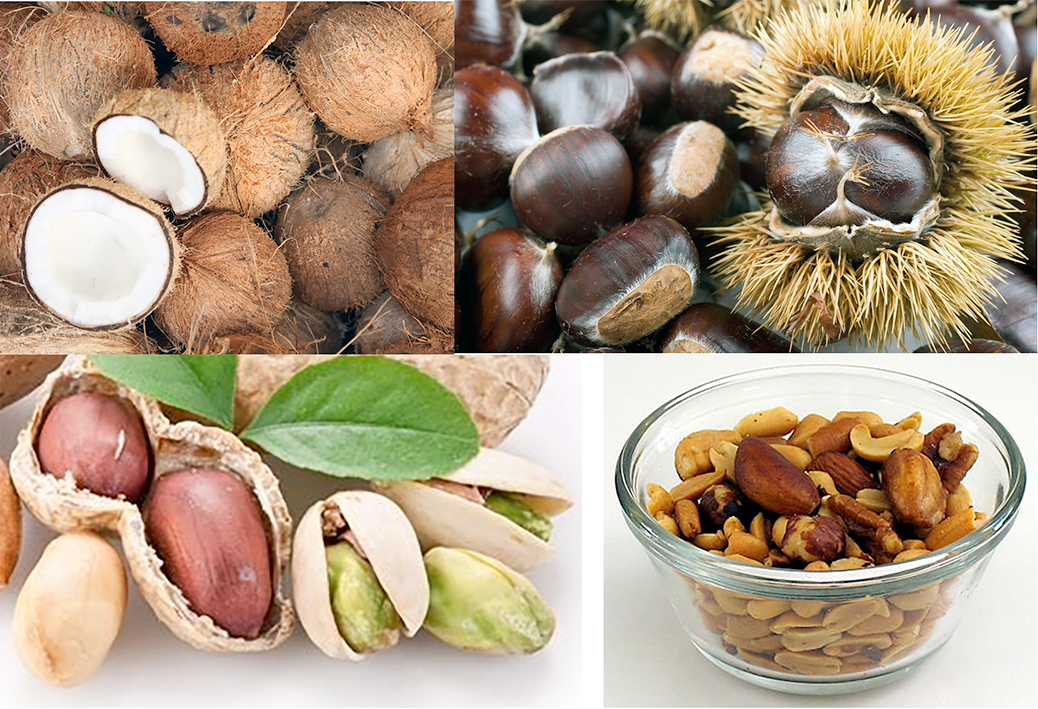 Different nuts. Clockwise: coconuts, sweet chestnuts, bowl of mixed nuts,
peanuts and pistachios.
Welcome to FabulousFusionFood's Nut-based Recipes Page —A nut is a fruit consisting of a hard or tough nutshell protecting a kernel which is usually edible. In general usage and in a culinary sense, many dry seeds are called nuts. In a botanical context, "nut" implies that the shell does not open to release the seed (indehiscent).
Most seeds come from fruit that naturally free themselves from the shell, but this is not the case in nuts such as hazelnuts, chestnuts, and acorns, which have hard shell walls and originate from a compound ovary. The general and original usage of the term is less restrictive, and many nuts (in the culinary sense), such as almonds, pistachios, and Brazil nuts, are not nuts in a botanical sense. Common usage of the term often refers to any hard-walled, edible kernel as a nut. Nuts are an energy-dense and nutrient-rich food source.
Botanically, a nut is a fruit with a woody pericarp developing from a syncarpous gynoecium. True nuts include, for example, chestnut, hazelnut and filbert. Culinarily, the term 'nut' is used much more widely, and includes examples of drupes (such as pecans and almonds) or seeds (such as pine nuts and peanuts).
Also widely known as nuts are dry drupes, which include pecans, almonds, macadamia (Macadamia integrifolia), candlenut (Aleurites moluccanus) and the water caltrop (Trapa bicornis). A drupe is an indehiscent fruit that has an outer fleshy part consisting of the exocarp, or skin, and mesocarp, or flesh, which surround a single pit or stone, the endocarp with a seed (kernel) inside. In a dry drupe, the outer parts dry up and the remaining husk is part of the ovary wall or pericarp, and the hard inner wall surrounding the seed represents the inner part of the pericarp.
Walnuts and hickories (Juglandaceae) have fruit that are difficult to classify. They are considered to be nuts under some definitions but are also referred to as drupaceous nuts.
In common use, a "tree nut" is, as the name implies, any nut coming from a tree. This most often comes up regarding food allergies; a person may be allergic specifically to peanuts (which are not tree nuts but legumes), whereas others may be allergic to the wider range of nuts that grow on trees.
The sweet potato arrived in Europe with the Columbian exchange. It is recorded, for example, in Elinor Fettiplace's Receipt Book, compiled in England in 1604.
Nuts are eaten by humans and wildlife. Because nuts generally have a high oil content, they are a significant energy source. Many seeds are edible by humans and used in cooking, eaten raw, sprouted, or roasted as a snack food, ground to make nut butters, or pressed for oil that is used in cooking and cosmetics.
Nuts used for food are a common source of food allergens. Reactions can range from mild symptoms to severe ones, a condition known as anaphylaxis, which can be life-threatening. The reaction is due to the release of histamine by the body in response to an allergen in the nuts, causing skin and other possible reactions. Many experts suggest that a person with an allergy to peanuts should avoid eating tree nuts, and vice versa.
The nuts linked to from this page are: acorn; almond; beech nuts; betel nut; brazil nut; bush mango; filbert; ginkgo nut; kola nut; candlenut; cashew; chestnut; coconut; hazelnut; macadamia; ogbono; palm nut; peanut; pecan; pine nut; pistachio; walnut.
The alphabetical list of all the nut-based recipes on this site follows, (limited to 100 recipes per page). There are 4134 recipes in total:
Page 33 of 42
| Rasmalai Origin: India | Ricciarelli (Sienese Christmas Biscuits) Origin: Italy | Roasted fish with Eluit el Tuu Origin: Palau |
| Raspberry and White Chocolate Tray Bake Origin: Britain | Rice and Peas Origin: Jamaica | Roasted Hazelnuts Origin: Britain |
| Raspberry Jam Shortbreads Origin: Britain | Rice and Peas Origin: Saint Kitts | Roasted Maize Origin: Nigeria |
| Ratafia Biscuits Origin: Scotland | Rice and Sesame Seed Soup Origin: Sierra Leone | Robinson Origin: Martinique |
| Ravitoto sy Voanjo (Cassava Leaves with Peanuts) Origin: Madagascar | Rice Cakes Origin: Federated States Micronesia | Rochers Congolaise (Congolese Rock Cakes) Origin: Congo |
| Raw Peanut Rougail Origin: Madagascar | Rice Flummery Origin: Britain | Rocoto Rellenos (Stuffed Rocoto Chillies) Origin: Peru |
| Raw Seaweed Salad Origin: Fusion | Rice Krispies Easter Eggs Origin: American | Rogan Josh Masala Origin: Britain |
| Red Chicken Mole Origin: Mexico | Rice Paper Wrappers Origin: Vietnam | Roman Gnocchi Origin: Britain |
| Red Clover and Almond Biscuits Origin: Britain | Rice Pudding Muffins (Rice Pudding Muffins) Origin: Britain | Roof Tile Crackers Origin: Britain |
| Red Curry Cambogee with Meat Origin: Cambodia | Rice Pudding Pasty Origin: England | Rooibos Poached Pears Origin: South Africa |
| Red Curry Dipping Sauce Origin: Thailand | Rice Pudding with Meadowsweet and Compote of Wild Cherries Origin: Britain | Rose and Pistachio Tres Leches Origin: Fusion |
| Red Curry Risotto with Prawns Origin: Fusion | Rice Sticks with Beef in Black Bean Sauce Origin: China | Rose Petal Drop Scones Origin: Britain |
| Red snapper with Coconut Curry Sauce Origin: Kiribati | Rice with Oil Origin: Zambia | Rosee (Rose Pudding) Origin: England |
| Red-red with Spiced Plantains Origin: Ghana | Rich and Dark Christmas Cake Origin: Britain | Roulade Sévigné (Sévigné Roulade) Origin: France |
| Redbush Stewed Beef and Potatoes Origin: South Africa | Rich Chocolate Cake Origin: Britain | Rourou Balls Origin: Fiji |
| Redcurrant Cobbler Origin: America | Rich Fruit Cake Origin: Britain | Royal Beef Biryani Origin: India |
| Redcurrant Muffins Origin: Britain | Rich Manx Bunloaf Origin: Manx | Ruggata (Almond Barley Water Cordial) Origin: Malta |
| Reform Cake with Almonds Origin: Serbia | Ris à l'Amande (Danish Almond Rice Pudding) Origin: Denmark | Rujak Brunei (Spiced Fruit Salad) Origin: Brunei |
| Relajo (Salvadorean Red Chilli Sauce) Origin: El Salvador | Risgrynsgröt (Swedish Rice Pudding) Origin: Sweden | Rukau Origin: Cook Islands |
| Rendang Curry Paste Origin: Fusion | Riskrem (Rice Cream) Origin: Norway | Rukau Origin: Tuvalu |
| Rendang Daging (Malaysian Beef Rendang) Origin: Malaysia | Risotto alla Arancia (Risotto with Orange) Origin: Italy | Rukau Origin: Tokelau |
| Rendang Fish Curry Origin: Fusion | Riz au Gras (Ivorian Fat Rice) Origin: Cote dIvoire | Rum and Chocolate Cupcakes Origin: Britain |
| Resalsike (Royal Fruit Stew) Origin: England | Riz au Gras Ivorienne (Ivorian Fat Rice) Origin: Cote dIvoire | Rum And Coconut Bread Pudding Origin: Cayman Islands |
| Resmolle Origin: England | Riz au Lait de Coco de Comores (Comorian Rice with Coconut Milk) Origin: Comoros | Rum Balls Origin: Aruba |
| Restaurant-style Butter Chicken Origin: India | Riz au lait et caramel beurre salé (Rice pudding and salted butter caramel) Origin: Senegal | Rum Raisin Cheesecake Origin: Britain |
| Restaurant-style Monkfish Curry Origin: Britain | Riz aux Oignons (Rice with Onions) Origin: Congo | Russian Sauce Origin: Britain |
| Rhiwbob wedi Piclo (Pickled Rhubarb) Origin: Welsh | Riz Jollof du Niger (Niger-style Jollof Rice) Origin: Niger | Rwandan Beef Stew Origin: Rwanda |
| Rhubarb and Apple Crumble with Toasted Nuts Origin: Britain | Roast Chestnuts Origin: Britain | Rwlâd Bara Lawr (Laverbread Roulade) Origin: Welsh |
| Rhubarb and Elderflower Cake Origin: Britain | Roast Lamb with Pesto Stuffing Origin: Britain | Rygh in sauce (Ruffe in Sauce) Origin: England |
| Rhubarb and Ginger Crumble Origin: Italy | Roast Pheasant with Cobnut Butter Origin: Britain | Rys (Rice) Origin: England |
| Rhubarb and Walnut Muffins Origin: American | Roast Potato Gnocchi Origin: Britain | Ryse of Flesh (Rice Accompaniment) Origin: England |
| Rhubarb Crumble Origin: Britain | Roast Quince Fool with Madeira Origin: South Africa | Saagwala Murg (Chicken Saagwala) Origin: India |
| Rhubarb-Pecan Muffins Origin: Britain | Roast Vegetables Origin: England | |
| Ribnoye Kharcho (Salmon and Walnut Soup) Origin: Georgia | Roasted breadfruit and smoked herring Origin: Saint Lucia |
Page 33 of 42