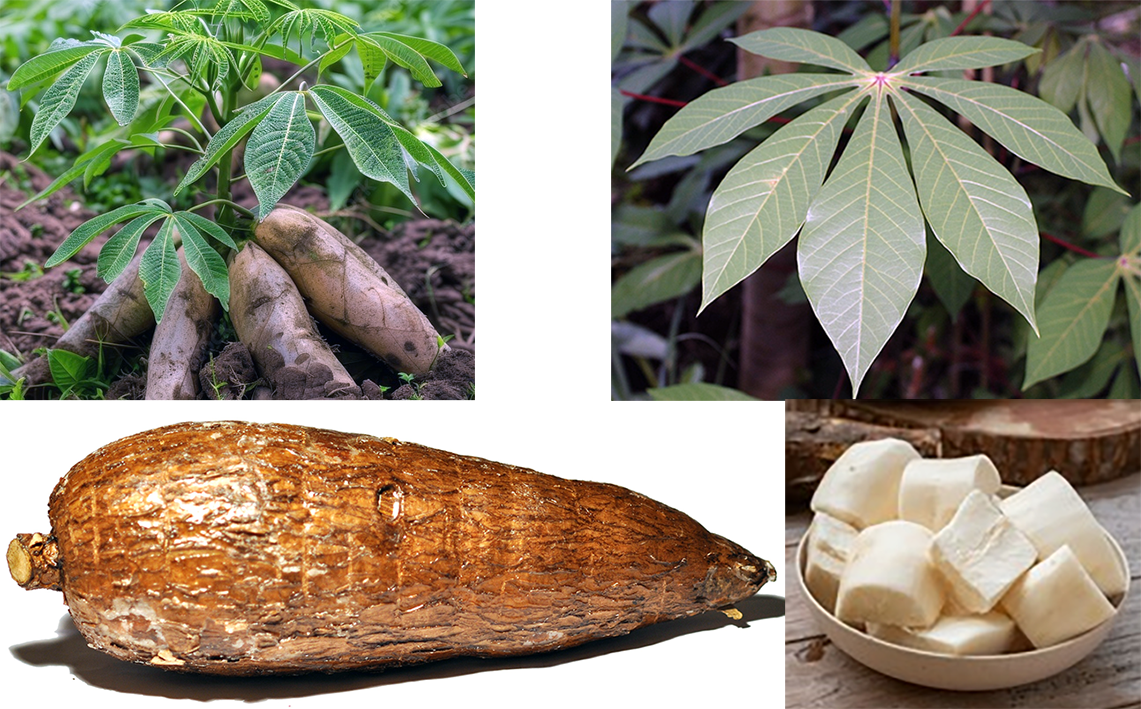
 The image above shows the cassava plant with storage roots
partially exposed, the cassava leaf (top) and a waxed cassava
storage root ready for market with a bowl of peeled and chopped
cassava root (bottom).
Welcome to the summary page for FabulousFusionFood's Cook's Guide entry for Cassava along with all the trcipes employing Cassava presented on this site, with 281 recipes in total.
This is a continuation of an entire series of pages that will, I hope, allow my visitors to better navigate this site. As well as displaying recipes by name, country and region of origin I am now planning a whole series of pages where recipes can be located by meal type and main ingredient. This page gives a listing of all the Cassava recipes added to this site.
These recipes, all contain Cassava as a major wild food ingredient.
Manihot esculenta, commonly called cassava, manioc, or yuca (among numerous regional names), is a woody shrub of the spurge family, Euphorbiaceae, native to South America, native to Brazil, Paraguay and parts of the Andes. Although a perennial plant, cassava is extensively cultivated in tropical and subtropical regions as an annual crop for its edible starchy tuberous root (and in some regions its leaves). Cassava is predominantly consumed in boiled form, but substantial quantities are processed to extract cassava starch, called tapioca, which is used for food, animal feed, and industrial purposes. The Brazilian farofa, and the related garri of West Africa, is an edible coarse flour obtained by grating cassava roots, pressing moisture off the obtained grated pulp, and finally drying and roasting it.
Cassava is the third-largest source of carbohydrates in food in the tropics, after rice and maize, making it an important staple; more than 500 million people depend on it. It offers the advantage of being exceptionally drought-tolerant, and able to grow productively on poor soil. The largest producer is Nigeria, while Thailand is the largest exporter of cassava starch.
Cassava is grown in both sweet and bitter varieties; both contain toxins, but the bitter varieties have them in much larger amounts. Cassava has to be prepared carefully for consumption, as improperly prepared material can contain sufficient cyanide to cause poisoning. The more toxic varieties of cassava have been used in some places as famine food during times of food insecurity. Farmers may also choose bitter cultivars to minimise crop losses.
The generic name Manihot and the common name 'manioc' both derive from the Guarani (Tupi) name mandioca or manioca for the plant. The specific name esculenta is Latin for 'edible'. The common name 'cassava' is a 16th century word from the French or Portuguese cassave, in turn derived from Taíno caçabi. The common name 'yuca' or 'yucca' is most likely also from Taíno, via Spanish yuca or juca.
Cassava is a perennial species that is usually harvested within one year after planting. The harvested part is the storage root, which is long and tapered, with an easily detached coarse and bark-like brown rind. The white or yellowish flesh is firm and even in texture. Commercial cultivars can be 5–10cm wide at the top, and some 15–30cm long, with a woody vascular bundle running down the middle. The tuberous roots are largely starch, with small amounts of calcium (16 milligrams per 100 grams), phosphorus (27 mg/100 g), and vitamin C (20.6 mg/100 g). Content of total pro-vitamin A carotenoids has been increased through conventional breeding from a maximum of 10.3 to 24.3 υg/g FW basis. Cassava roots contain little protein, whereas the leaves are rich in it, except for being low in methionine, an essential amino acid (this is why cassava staples like fufu are often accompanied by a stew containing cassava leaves, particularly in West Africa).
Wild populations of M. esculenta subspecies flabellifolia, shown to be the progenitor of domesticated cassava, are centred in west-central Brazil, where it was likely first domesticated no more than 10,000 years ago. Forms of the modern domesticated species can also be found growing in the wild in the south of Brazil. By 4600 BC, cassava pollen appears in the Gulf of Mexico lowlands, at the San Andrés archaeological site. The oldest direct evidence of cassava cultivation comes from a 1,400-year-old Maya site, Joya de Cerén, in El Salvador. It became a staple food of the native populations of northern South America, southern Mesoamerica, and the Taino people in the Caribbean islands, who grew it using a high-yielding form of shifting agriculture by the time of European contact in 1492. Cassava was a staple food of pre-Columbian peoples in the Americas and is often portrayed in indigenous art. The Moche people often depicted cassava in their ceramics.
Portuguese traders introduced cassava to Africa from Brazil in the 16th century. Around the same period, it was introduced to Asia through Columbian Exchange by Portuguese and Spanish traders, who planted it in their colonies in Goa, Malacca, Eastern Indonesia, Timor and the Philippines. Cassava has also become an important crop in Asia. Whilst it is a valued food staple in parts of eastern Indonesia, it is primarily cultivated for starch extraction and bio-fuel production in Thailand, Cambodia and Vietnam. Cassava is sometimes described as the 'bread of the tropics' but should not be confused with the tropical and equatorial bread tree (Encephalartos), the breadfruit (Artocarpus altilis) or the African breadfruit (Treculia africana). This description definitely holds in Africa and parts of South America; in Asian countries such as Vietnam fresh cassava barely features in human diets. Cassava was introduced to East Africa around 1850 by Arab and European settlers, who promoted its cultivation as a reliable crop to mitigate the effects of drought and famine.
Cassava is propagated by cutting the stem into sections of approximately 15cm, these being planted prior to the wet season. Optimal conditions for cassava cultivation are mean annual temperatures between 20 and 29°C, but it can tolerate temperatures as low as 12°C and as high as 40°C; optimal annual precipitation is between 100 and 250cm, and an annual growth period of no less than 240 days. These conditions are found, among other places, in the northern part of the Gulf Coastal Plain in Mexico.
Cassava deteriorates after harvest, when the tuberous roots are first cut. The healing mechanism produces coumaric acid, which oxidizes and blackens the roots, making them inedible after a few days. This deterioration is related to the accumulation of reactive oxygen species initiated by cyanide release during mechanical harvesting. Post-harvest deterioration is a major obstacle to the export of cassava. Fresh cassava can be preserved like potato, using thiabendazole or bleach as a fungicide, then wrapping in plastic, freezing, or applying a wax coating.
Cassava roots, peels and leaves are dangerous to eat raw because they contain linamarin and lotaustralin, which are toxic cyanogenic glycosides. These are decomposed by the cassava enzyme linamarase, releasing poisonous hydrogen cyanide. Cassava varieties are often categorized as either bitter (high in cyanogenic glycosides) or sweet (low in those bitter compounds). Sweet cultivars can contain as little as 20 milligrams of cyanide per kilogram of fresh roots, whereas bitter cultivars may contain as much as 1000mg/kg. Indeed, sweet cassava is sometimes eaten as a snack in West Africa after soaking in water over night. In this case it is often accompanied by coconut flesh. Cassavas grown during drought are especially high in these toxins. A dose of 25mg of pure cassava cyanogenic glucoside, which contains 2.5mg of cyanide, is sufficient to kill a rat. Excess cyanide residue from improper preparation causes goiters and acute cyanide poisoning, and is linked to ataxia (a neurological disorder affecting the ability to walk, also known as konzo). It has also been linked to tropical fibrocalcific pancreatitis in humans, leading to chronic pancreatitis.
In many West African regions, especially Nigeria, bitter cassava roots are traditionally detoxified in a lengthy process. The roots are peeled and grated. The moist pulp is soaked (or 'retted') in water for 48 to 72 hours to initiate spontaneous fermentation. During this period endogenous linamarase acts on linamarin and lotaustralin; the resulting hydrogen cyanide dissolves or volatilises, reducing the cyanogenic potential by 85–99%. After soaking, the mash is pressed to expel liquid and boiled, roasted, or toasted to make foods such as gari, fufu, and lafun, further lowering residual cyanide to within the WHO safe limit of 10 mg HCN kg⁻¹.
As well as cassava roots, cassava leaves are also commonly eaten in those regions where cassava is grown. They are typically finely shredded and sometimes pounded in a mortar before being added to soups or stews. They are prized for being high in protein, though it's not complete protein, as detailed above. In Brazil and West Africa cassava is also consumed as cassava meal or garri. Cassava can also be purchased as cassava flour for baking. In Côte d'Ivoire cassava is often consumed as Attiéké a kind of cassava couscous.
For other starchy staples see the entries on potatoes, sweet potatoes, yams, taro/eddoes/cocoyam, tannia, cassava, green banana/plantain and breadfruit.
This is a continuation of an entire series of pages that will, I hope, allow my visitors to better navigate this site. As well as displaying recipes by name, country and region of origin I am now planning a whole series of pages where recipes can be located by meal type and main ingredient. This page gives a listing of all the Cassava recipes added to this site.
These recipes, all contain Cassava as a major wild food ingredient.
Manihot esculenta, commonly called cassava, manioc, or yuca (among numerous regional names), is a woody shrub of the spurge family, Euphorbiaceae, native to South America, native to Brazil, Paraguay and parts of the Andes. Although a perennial plant, cassava is extensively cultivated in tropical and subtropical regions as an annual crop for its edible starchy tuberous root (and in some regions its leaves). Cassava is predominantly consumed in boiled form, but substantial quantities are processed to extract cassava starch, called tapioca, which is used for food, animal feed, and industrial purposes. The Brazilian farofa, and the related garri of West Africa, is an edible coarse flour obtained by grating cassava roots, pressing moisture off the obtained grated pulp, and finally drying and roasting it.
Cassava is the third-largest source of carbohydrates in food in the tropics, after rice and maize, making it an important staple; more than 500 million people depend on it. It offers the advantage of being exceptionally drought-tolerant, and able to grow productively on poor soil. The largest producer is Nigeria, while Thailand is the largest exporter of cassava starch.
Cassava is grown in both sweet and bitter varieties; both contain toxins, but the bitter varieties have them in much larger amounts. Cassava has to be prepared carefully for consumption, as improperly prepared material can contain sufficient cyanide to cause poisoning. The more toxic varieties of cassava have been used in some places as famine food during times of food insecurity. Farmers may also choose bitter cultivars to minimise crop losses.
The generic name Manihot and the common name 'manioc' both derive from the Guarani (Tupi) name mandioca or manioca for the plant. The specific name esculenta is Latin for 'edible'. The common name 'cassava' is a 16th century word from the French or Portuguese cassave, in turn derived from Taíno caçabi. The common name 'yuca' or 'yucca' is most likely also from Taíno, via Spanish yuca or juca.
Cassava is a perennial species that is usually harvested within one year after planting. The harvested part is the storage root, which is long and tapered, with an easily detached coarse and bark-like brown rind. The white or yellowish flesh is firm and even in texture. Commercial cultivars can be 5–10cm wide at the top, and some 15–30cm long, with a woody vascular bundle running down the middle. The tuberous roots are largely starch, with small amounts of calcium (16 milligrams per 100 grams), phosphorus (27 mg/100 g), and vitamin C (20.6 mg/100 g). Content of total pro-vitamin A carotenoids has been increased through conventional breeding from a maximum of 10.3 to 24.3 υg/g FW basis. Cassava roots contain little protein, whereas the leaves are rich in it, except for being low in methionine, an essential amino acid (this is why cassava staples like fufu are often accompanied by a stew containing cassava leaves, particularly in West Africa).
Wild populations of M. esculenta subspecies flabellifolia, shown to be the progenitor of domesticated cassava, are centred in west-central Brazil, where it was likely first domesticated no more than 10,000 years ago. Forms of the modern domesticated species can also be found growing in the wild in the south of Brazil. By 4600 BC, cassava pollen appears in the Gulf of Mexico lowlands, at the San Andrés archaeological site. The oldest direct evidence of cassava cultivation comes from a 1,400-year-old Maya site, Joya de Cerén, in El Salvador. It became a staple food of the native populations of northern South America, southern Mesoamerica, and the Taino people in the Caribbean islands, who grew it using a high-yielding form of shifting agriculture by the time of European contact in 1492. Cassava was a staple food of pre-Columbian peoples in the Americas and is often portrayed in indigenous art. The Moche people often depicted cassava in their ceramics.
Portuguese traders introduced cassava to Africa from Brazil in the 16th century. Around the same period, it was introduced to Asia through Columbian Exchange by Portuguese and Spanish traders, who planted it in their colonies in Goa, Malacca, Eastern Indonesia, Timor and the Philippines. Cassava has also become an important crop in Asia. Whilst it is a valued food staple in parts of eastern Indonesia, it is primarily cultivated for starch extraction and bio-fuel production in Thailand, Cambodia and Vietnam. Cassava is sometimes described as the 'bread of the tropics' but should not be confused with the tropical and equatorial bread tree (Encephalartos), the breadfruit (Artocarpus altilis) or the African breadfruit (Treculia africana). This description definitely holds in Africa and parts of South America; in Asian countries such as Vietnam fresh cassava barely features in human diets. Cassava was introduced to East Africa around 1850 by Arab and European settlers, who promoted its cultivation as a reliable crop to mitigate the effects of drought and famine.
Cassava is propagated by cutting the stem into sections of approximately 15cm, these being planted prior to the wet season. Optimal conditions for cassava cultivation are mean annual temperatures between 20 and 29°C, but it can tolerate temperatures as low as 12°C and as high as 40°C; optimal annual precipitation is between 100 and 250cm, and an annual growth period of no less than 240 days. These conditions are found, among other places, in the northern part of the Gulf Coastal Plain in Mexico.
Cassava deteriorates after harvest, when the tuberous roots are first cut. The healing mechanism produces coumaric acid, which oxidizes and blackens the roots, making them inedible after a few days. This deterioration is related to the accumulation of reactive oxygen species initiated by cyanide release during mechanical harvesting. Post-harvest deterioration is a major obstacle to the export of cassava. Fresh cassava can be preserved like potato, using thiabendazole or bleach as a fungicide, then wrapping in plastic, freezing, or applying a wax coating.
Cassava roots, peels and leaves are dangerous to eat raw because they contain linamarin and lotaustralin, which are toxic cyanogenic glycosides. These are decomposed by the cassava enzyme linamarase, releasing poisonous hydrogen cyanide. Cassava varieties are often categorized as either bitter (high in cyanogenic glycosides) or sweet (low in those bitter compounds). Sweet cultivars can contain as little as 20 milligrams of cyanide per kilogram of fresh roots, whereas bitter cultivars may contain as much as 1000mg/kg. Indeed, sweet cassava is sometimes eaten as a snack in West Africa after soaking in water over night. In this case it is often accompanied by coconut flesh. Cassavas grown during drought are especially high in these toxins. A dose of 25mg of pure cassava cyanogenic glucoside, which contains 2.5mg of cyanide, is sufficient to kill a rat. Excess cyanide residue from improper preparation causes goiters and acute cyanide poisoning, and is linked to ataxia (a neurological disorder affecting the ability to walk, also known as konzo). It has also been linked to tropical fibrocalcific pancreatitis in humans, leading to chronic pancreatitis.
In many West African regions, especially Nigeria, bitter cassava roots are traditionally detoxified in a lengthy process. The roots are peeled and grated. The moist pulp is soaked (or 'retted') in water for 48 to 72 hours to initiate spontaneous fermentation. During this period endogenous linamarase acts on linamarin and lotaustralin; the resulting hydrogen cyanide dissolves or volatilises, reducing the cyanogenic potential by 85–99%. After soaking, the mash is pressed to expel liquid and boiled, roasted, or toasted to make foods such as gari, fufu, and lafun, further lowering residual cyanide to within the WHO safe limit of 10 mg HCN kg⁻¹.
As well as cassava roots, cassava leaves are also commonly eaten in those regions where cassava is grown. They are typically finely shredded and sometimes pounded in a mortar before being added to soups or stews. They are prized for being high in protein, though it's not complete protein, as detailed above. In Brazil and West Africa cassava is also consumed as cassava meal or garri. Cassava can also be purchased as cassava flour for baking. In Côte d'Ivoire cassava is often consumed as Attiéké a kind of cassava couscous.
For other starchy staples see the entries on potatoes, sweet potatoes, yams, taro/eddoes/cocoyam, tannia, cassava, green banana/plantain and breadfruit.
The alphabetical list of all Cassava recipes on this site follows, (limited to 100 recipes per page). There are 281 recipes in total:
Page 1 of 3
| Abacha Ncha (Dried Cassava with Garden Eggs) Origin: Nigeria | Buñuelos (Sweet Fried Dough) Origin: Colombia | Cassave de manioc (Cassava Pancake) Origin: Guadeloupe |
| Agbeli Kaaklo (Sweet Cassava Fritters) Origin: Ghana | Buñuelos de yuca con queso (Cassava Fritters with Cheese) Origin: Venezuela | Cayman Cassava Cake Origin: Cayman Islands |
| Akoumé Origin: Togo | Buñuelos de yuca con queso (Cassava Fritters with Cheese) Origin: Nicaragua | Cazuela Fiestera (Festival Casserole) Origin: Ecuador |
| Akume with Ademe Sauce Origin: Togo | Burundian Isombe (Cassava Leaf Stew) Origin: Burundi | Chew Dewtirr Kong (Smoked Catfish Stew) Origin: Gambia |
| Alfajores de Mandioca (Cassava Alfajores) Origin: Argentina | Burundian Ubugali (Cassava Porridge) Origin: Burundi | Chikwangue (Gabonnaise Cassava Sticks) Origin: Gabon |
| Attiéké Origin: Cote dIvoire | Butter Cassava Origin: Trinidad | Chipa (Paraguayan Cheese and Cassava Bread) Origin: Paraguay |
| Attiéké de Poisson (Attieke with Fried Fish) Origin: Cote dIvoire | Cëebu Jen II Origin: Senegal | Chubolet (Fish Balls in Tomato Sauce) Origin: Gambia |
| Attiéké du Mali (Malian Attiéké) Origin: Mali | Calalou (Beninese Callaloo) Origin: Benin | Coconut Tapioca Pudding Origin: Tuvalu |
| Attiéké et Aloko Poisson (Attieke and Fish Aloko) Origin: Niger | Caldo de Bagre (Catfish Soup) Origin: Ecuador | Coconut, Cassava and Papaya Pudding Origin: Federated States Micronesia |
| Attiéké Origin: Cote dIvoire | Caldo de Camarâo de Cabo Verde (Cape Verdean Prawn Stew) Origin: Cape Verde | Croquette de poisson et manioc (Fish and Cassava Croquettes) Origin: New Caledonia |
| Attiéké et Aloko Poisson (Attiéké and Plantain with Fish) Origin: Cote dIvoire | Caldo de Chabéu (Palm Nut Stew) Origin: Guinea-Bissau | Croquettes de Manioc (Cassava Croquettes) Origin: Senegal |
| Avena de Gari (Gari Porridge) Origin: Equatorial Guinea | Caldo de Mondongo (Tripe Soup) Origin: Ecuador | Dakhine Origin: Senegal |
| Avgolemono (Egg and Lemon Soup) Origin: Greece | Cape Malay Seafood Curry Origin: South Africa | Daube de Manioc au Lait de Coco (Cassava Stew with Coconut Milk) Origin: Seychelles |
| Bánh lọt (Sweet Rice Pasta) Origin: Vietnam | Carne Gizado (Stewed Meat and Vegetables) Origin: Cape Verde | Dominica Cassava Bread Origin: Dominica |
| Bâton de Manioc (Cassava Sticks) Origin: Central Africa | Carne Recheada com Farofa (Meat Stuffed with Farofa) Origin: Brazil | Dominica Sancocho Origin: Dominica |
| Bâton de Manioc Camerounaise (Cameroonian-style Cassava Sticks) Origin: Cameroon | Cassareep Origin: Guyana | Dongo (Fish with Cassava Leaves) Origin: Congo |
| Bambam (Cassava Bread) Origin: Saint Vincent | Cassareep Origin: French Guiana | Dumboy Origin: Liberia |
| Bammies (Pan-fried Cassava Bread) Origin: Jamaica | Cassava and Banana Cake Origin: Fiji | Eba Origin: Nigeria |
| Bammy Origin: Jamaica | Cassava and Plantain Mash Origin: African Fusion | Eba (Garri Swallow) Origin: Nigeria |
| Bananes Plantain au Gari (Plantains with Gari) Origin: Togo | Cassava Bread Origin: Burundi | Eba Piron Rouge (Beef and Red Gari) Origin: Cameroon |
| Banankou Fida (Sokossoko with Kidneys) Origin: Guinea | Cassava Bread Origin: Sierra Leone | Encebollado Origin: Ecuador |
| Banku Origin: Ghana | Cassava Bread Origin: Guyana | Esparregados de Bacalhau (Cod Esparregados) Origin: Angola |
| Barokhé (Beef and Fish with Cassava Leaves) Origin: Mali | Cassava Cake Origin: Liberia | Fögnè Sourtinaadi (Fonio Couscous with Meatballs in Tomato Sauce) Origin: Guinea |
| Basbousa Origin: Somalia | Cassava Flour Bread Origin: Liberia | Faikai Malaulau (Tapioca dumplings in Caramel Sauce) Origin: Wallis Futuna |
| Batabate Origin: Mayotte | Cassava Flour Pancakes Origin: Britain | Fakalate (Coconut Dumplings) Origin: Tonga |
| Bean and Gari Loaf Origin: Ghana | Cassava Leaf Soup Origin: Liberia | Farine and Pear Origin: Saint Lucia |
| Beignets de Manioc (Cassava Fritters) Origin: Cameroon | Cassava Leaf Stew Origin: Sierra Leone | Farine Breakfast Porridge Origin: Guyana |
| Beju (Coconut and Cassava Biscuits) Origin: Nigeria | Cassava Life Origin: Sierra Leone | Farine Grits Origin: Guyana |
| Bobó Frito (Sao Tomean Chicken Croquettes) Origin: Sao Tome | Cassava Pie Origin: Bermuda | Feijão Tropeiro (Drover's Beans) Origin: Brazil |
| Bojo (Suriname Cassava and Coconut Cake) Origin: Suriname | Cassava Pone Origin: Bahamas | Fekei Origin: Rotuma |
| Bolinhos de Bacalhau (Brazilian Salt Cod Balls) Origin: Brazil | Cassava Pone Origin: Guyana | Féroce d'Avocat Origin: Martinique |
| Bolinhos de Mandioca com Mel (Cassava and Honey Muffins) Origin: Cape Verde | Cassava Pudding Origin: Solomon Islands | Féroce d'Avocat Origin: Guadeloupe |
| Borokhé Origin: Mali | Cassava Pudding Origin: Vanuatu | |
| Buñuelos de yuca (Cassava Fritters) Origin: Colombia | Cassave Brood (Cassava Roti) Origin: Suriname |
Page 1 of 3