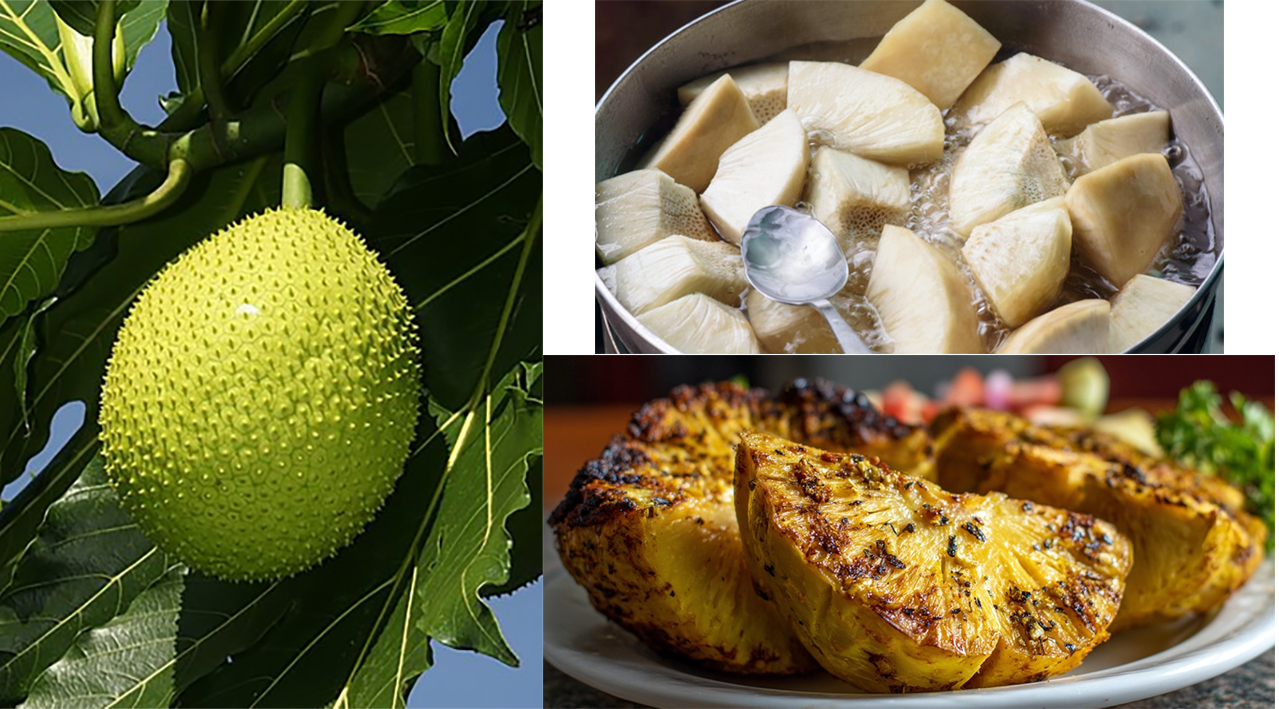
 Breadfruit in the tree show with boiled breadfruit and roast
breadfruit pieces.
Welcome to the summary page for FabulousFusionFood's Cook's Guide entry for Breadfruit along with all the recipes employing Breadfruit presented on this site, with 52 recipes in total.
This is a continuation of an entire series of pages that will, I hope, allow my visitors to better navigate this site. As well as displaying recipes by name, country and region of origin I am now planning a whole series of pages where recipes can be located by meal type and main ingredient. This page gives a listing of all the Breadfruit recipes added to this site.
These recipes, all contain Breadfruit as a major wild food ingredient.
Artocarpus altilis is a species of flowering tree in the mulberry and jackfruit family Moraceae. The namo of its fruit, 'breadfruit' name is derived from the texture of the moderately ripe fruit when cooked, similar to freshly baked bread and having a potato-like flavour.
The fruit serves as a carbohydrate staple in many cultures. Breadfruit is closely related to A. camansi (breadnut or seeded breadfruit) of New Guinea, the Maluku Islands, and the Philippines, A. blancoi (tipolo or antipolo) of the Philippines, and more distantly, A. mariannensis (dugdug) of Micronesia, species that are also sometimes called 'breadfruit'. It is also closely related to the jackfruit.
Breadfruit was spread into Oceania via the Austronesian expansion and is believed to have been selectively bred in Polynesia from the breadnut (Artocarpus camansi). British and French navigators introduced a few Polynesian seedless varieties to Caribbean islands during the late 18th century. Today it is widely grown in tropical regions throughout South and Southeast Asia, the Pacific and Caribbean islands, lowland Central America, northern South America and Africa.
Breadfruit trees grow to a height of 26m. The large and thick leaves are deeply cut into pinnate lobes. All parts of the tree yield latex, which is useful for boat caulking.
The trees are monoecious, with male and female flowers growing on the same tree. The male flowers emerge first, followed shortly afterward by the female flowers. The latter grow into capitula, which are capable of pollination just three days later. Pollination occurs mainly by fruit bats, but cultivated varieties produce fruit without pollination. The compound, false fruit develops from the swollen perianth, and originates from 1,500 to 2,000 flowers visible on the skin of the fruit as hexagon-like disks.
Breadfruit is one of the highest-yielding food plants, with a single tree producing up to 200 or more grapefruit-sized fruits per season, requiring limited care. In the South Pacific, the trees yield 50 to 150 fruits per year, usually round, oval, or oblong, and weighing 0.25–6.0kg. Productivity varies between wet and dry areas. Studies in Barbados indicate a reasonable potential of 15 to 30 t/ha. The ovoid fruit has a rough surface, and each fruit is divided into many achenes, each surrounded by a fleshy perianth and growing on a fleshy receptacle. Most selectively bred cultivars have seedless fruit, whereas seeded varieties are grown mainly for their edible seeds. Breadfruit is usually propagated using root cuttings.
Breadfruit is propagated mainly by seeds, though seedless cultivars can be propagated by transplanting suckers that grow from the surface roots of the tree. The roots can be deliberately injured to induce the growth of suckers, which are then separated from the root and planted in a pot or directly transplanted into the ground. Pruning also induces sucker growth. Sucker cuttings are placed in plastic bags containing a mixture of soil, peat, and sand, and kept in the shade while moistened with liquid fertilizer. Once roots have developed, the transplant is put in full sun until it is ready for planting in the orchard.
Breadfruit is an equatorial, lowland species. It has been spread from its Pacific source to many tropical regions. In 1769, Joseph Banks was stationed in Tahiti as part of the Endeavour expedition commanded by Captain James Cook. The late-18th-century quest for cheap, high-energy food sources for slaves in British colonies prompted colonial administrators and plantation owners to call for breadfruit to be brought to the Caribbean. As president of the Royal Society, Banks provided a cash bounty and gold medal for success in this endeavour and successfully lobbied for a British Naval expedition. After an unsuccessful voyage to the South Pacific to collect the plants as commander of HMS Bounty, in 1791, William Bligh commanded a second expedition with Providence and Assistant, which collected seedless breadfruit plants in Tahiti and transported these to St. Helena in the Atlantic and St. Vincent and Jamaica in the West Indies.
Breadfruit is a staple food in many tropical regions. Most breadfruit varieties produce fruit throughout the year. Both ripe and unripe fruit have culinary uses; unripe breadfruit is cooked before consumption. Before being eaten, the fruit is roasted, baked, fried, or boiled. When cooked, the taste of moderately ripe breadfruit is described as potato-like, or similar to freshly baked bread.
One breadfruit tree can produce 200kg each season. Because breadfruit trees usually produce large crops at certain times of the year, the preservation of harvested fruit is an issue. One traditional preservation technique known throughout Oceania is to bury peeled and washed fruits in a leaf-lined pit, where they ferment over several weeks and produce a sour, sticky paste (masi in Samoa and Tonga, māhi in Tahiti, mā in the Carolines). Stored in this way, the product may endure a year or more. Some pits are reported to have produced edible contents more than 20 years after burial. Remnants of pit-like formations with stone scattered around (presumed to line them) are often clues indicating prehistoric settlement to archaeologists studying pre-contact history of French Polynesia.
Breadfruit is 71% water, 27% carbohydrates, and 1% protein, and contains negligible fat (table). In a reference amount of 100g, raw breadfruit supplies 103 calories, is a rich source of vitamin C (32% of the Daily Value, DV), and provides a moderate source of potassium (16% DV), with no other nutrients in significant content.
Many breadfruit hybrids and cultivars are widely distributed throughout the Pacific though they are seedless or otherwise biologically incapable of naturally dispersing long distances. It is therefore clear that humans aided distribution of the plant in the Pacific, specifically prehistoric groups who colonized the Pacific Islands. To investigate the patterns of human migration throughout the Pacific, scientists have used molecular dating of breadfruit hybrids and cultivars in concert with anthropological data. Results support the west-to-east migration hypothesis, in which the Lapita people are thought to have traveled from Melanesia to numerous Polynesian islands.
For other starchy staples see the entries on potatoes, sweet potatoes, yams, taro/eddoes/cocoyam, tannia, cassava, green banana/plantain and breadfruit.
This is a continuation of an entire series of pages that will, I hope, allow my visitors to better navigate this site. As well as displaying recipes by name, country and region of origin I am now planning a whole series of pages where recipes can be located by meal type and main ingredient. This page gives a listing of all the Breadfruit recipes added to this site.
These recipes, all contain Breadfruit as a major wild food ingredient.
Artocarpus altilis is a species of flowering tree in the mulberry and jackfruit family Moraceae. The namo of its fruit, 'breadfruit' name is derived from the texture of the moderately ripe fruit when cooked, similar to freshly baked bread and having a potato-like flavour.
The fruit serves as a carbohydrate staple in many cultures. Breadfruit is closely related to A. camansi (breadnut or seeded breadfruit) of New Guinea, the Maluku Islands, and the Philippines, A. blancoi (tipolo or antipolo) of the Philippines, and more distantly, A. mariannensis (dugdug) of Micronesia, species that are also sometimes called 'breadfruit'. It is also closely related to the jackfruit.
Breadfruit was spread into Oceania via the Austronesian expansion and is believed to have been selectively bred in Polynesia from the breadnut (Artocarpus camansi). British and French navigators introduced a few Polynesian seedless varieties to Caribbean islands during the late 18th century. Today it is widely grown in tropical regions throughout South and Southeast Asia, the Pacific and Caribbean islands, lowland Central America, northern South America and Africa.
Breadfruit trees grow to a height of 26m. The large and thick leaves are deeply cut into pinnate lobes. All parts of the tree yield latex, which is useful for boat caulking.
The trees are monoecious, with male and female flowers growing on the same tree. The male flowers emerge first, followed shortly afterward by the female flowers. The latter grow into capitula, which are capable of pollination just three days later. Pollination occurs mainly by fruit bats, but cultivated varieties produce fruit without pollination. The compound, false fruit develops from the swollen perianth, and originates from 1,500 to 2,000 flowers visible on the skin of the fruit as hexagon-like disks.
Breadfruit is one of the highest-yielding food plants, with a single tree producing up to 200 or more grapefruit-sized fruits per season, requiring limited care. In the South Pacific, the trees yield 50 to 150 fruits per year, usually round, oval, or oblong, and weighing 0.25–6.0kg. Productivity varies between wet and dry areas. Studies in Barbados indicate a reasonable potential of 15 to 30 t/ha. The ovoid fruit has a rough surface, and each fruit is divided into many achenes, each surrounded by a fleshy perianth and growing on a fleshy receptacle. Most selectively bred cultivars have seedless fruit, whereas seeded varieties are grown mainly for their edible seeds. Breadfruit is usually propagated using root cuttings.
Breadfruit is propagated mainly by seeds, though seedless cultivars can be propagated by transplanting suckers that grow from the surface roots of the tree. The roots can be deliberately injured to induce the growth of suckers, which are then separated from the root and planted in a pot or directly transplanted into the ground. Pruning also induces sucker growth. Sucker cuttings are placed in plastic bags containing a mixture of soil, peat, and sand, and kept in the shade while moistened with liquid fertilizer. Once roots have developed, the transplant is put in full sun until it is ready for planting in the orchard.
Breadfruit is an equatorial, lowland species. It has been spread from its Pacific source to many tropical regions. In 1769, Joseph Banks was stationed in Tahiti as part of the Endeavour expedition commanded by Captain James Cook. The late-18th-century quest for cheap, high-energy food sources for slaves in British colonies prompted colonial administrators and plantation owners to call for breadfruit to be brought to the Caribbean. As president of the Royal Society, Banks provided a cash bounty and gold medal for success in this endeavour and successfully lobbied for a British Naval expedition. After an unsuccessful voyage to the South Pacific to collect the plants as commander of HMS Bounty, in 1791, William Bligh commanded a second expedition with Providence and Assistant, which collected seedless breadfruit plants in Tahiti and transported these to St. Helena in the Atlantic and St. Vincent and Jamaica in the West Indies.
Breadfruit is a staple food in many tropical regions. Most breadfruit varieties produce fruit throughout the year. Both ripe and unripe fruit have culinary uses; unripe breadfruit is cooked before consumption. Before being eaten, the fruit is roasted, baked, fried, or boiled. When cooked, the taste of moderately ripe breadfruit is described as potato-like, or similar to freshly baked bread.
One breadfruit tree can produce 200kg each season. Because breadfruit trees usually produce large crops at certain times of the year, the preservation of harvested fruit is an issue. One traditional preservation technique known throughout Oceania is to bury peeled and washed fruits in a leaf-lined pit, where they ferment over several weeks and produce a sour, sticky paste (masi in Samoa and Tonga, māhi in Tahiti, mā in the Carolines). Stored in this way, the product may endure a year or more. Some pits are reported to have produced edible contents more than 20 years after burial. Remnants of pit-like formations with stone scattered around (presumed to line them) are often clues indicating prehistoric settlement to archaeologists studying pre-contact history of French Polynesia.
Breadfruit is 71% water, 27% carbohydrates, and 1% protein, and contains negligible fat (table). In a reference amount of 100g, raw breadfruit supplies 103 calories, is a rich source of vitamin C (32% of the Daily Value, DV), and provides a moderate source of potassium (16% DV), with no other nutrients in significant content.
Many breadfruit hybrids and cultivars are widely distributed throughout the Pacific though they are seedless or otherwise biologically incapable of naturally dispersing long distances. It is therefore clear that humans aided distribution of the plant in the Pacific, specifically prehistoric groups who colonized the Pacific Islands. To investigate the patterns of human migration throughout the Pacific, scientists have used molecular dating of breadfruit hybrids and cultivars in concert with anthropological data. Results support the west-to-east migration hypothesis, in which the Lapita people are thought to have traveled from Melanesia to numerous Polynesian islands.
For other starchy staples see the entries on potatoes, sweet potatoes, yams, taro/eddoes/cocoyam, tannia, cassava, green banana/plantain and breadfruit.
The alphabetical list of all Breadfruit recipes on this site follows, (limited to 100 recipes per page). There are 52 recipes in total:
Page 1 of 1
| Bajan Sunday Breakfast Origin: Barbados | Bwiro (Fermented Breadfruit) Origin: Marshall Islands | Pitcairn Roasted Breadfruit Origin: Pitcairn Islands |
| Bambukeyo Bongara (Maldives Breadfruit Curry) Origin: Maldives | Citrusy Ripe Breadfruit Cake Origin: Saint Lucia | Roasted Breadfruit and Fried Jackfish Origin: Saint Vincent |
| Breadfruit and Saltfish Bread Origin: Saint Vincent | Curry Breadfruit Origin: Trinidad | Roasted breadfruit and smoked herring Origin: Saint Lucia |
| Breadfruit Chips Origin: Nauru | Féroce d'Avocat (Migan de fruit à pain) Origin: Martinique | Saba Breadfruit Curry Origin: Saba |
| Breadfruit Chips Origin: Palau | Fish and Breadfruit Casserole Origin: Nauru | Saint Vincent Curry Breadfruit Origin: Saint Vincent |
| Breadfruit Chips Origin: Tuvalu | Fried Breadfruit Origin: Kiribati | Saltfish And Breadfruit Hash Origin: Saint Kitts |
| Breadfruit Chips Origin: Pitcairn Islands | Fruit à pain au lait de coco (Breadfruit with Coconut Milk) Origin: Wallis Futuna | St Kitts Saltfish And Breadfruit Pie Origin: Saint Kitts |
| Breadfruit Chips Origin: Wallis Futuna | Fruit à pain frit (Fried Breadfruit) Origin: Wallis Futuna | St Kitts Seasoned Breadfruit Origin: Saint Kitts |
| Breadfruit Crisps Origin: Saint Lucia | Fruit à pain grillé (Barbecued Breadfruit) Origin: Gambier Islands | Stewed saltfish with spicy plantains and coconut dumplings Origin: Saint Kitts |
| Breadfruit Curry Origin: India | Fruit à pain rôti (Roasted Breadfruit) Origin: Wallis Futuna | Stuffed Breadfruit Origin: Dominica |
| Breadfruit Pie Origin: Saint Lucia | FSM Breadfruit Chips Origin: Federated States Micronesia | Tiopu Kuru (Breadfruit Stew) Origin: Cook Islands |
| Breadfruit Poi Origin: Tuvalu | Grenada Breadfruit Soup Origin: Grenada | Tomn-Tomn (Trini-style Breadfruit FuFu) Origin: Trinidad |
| Breadfruit Puffs Origin: Saba | Ground Provisions Origin: Sint Eustatius | Tranches d'arbre à pain frites (Fried Breadfruit Slices) Origin: Wallis Futuna |
| Breadfruit Puffs Origin: Dominica | Inafliton Lemai (Fried Breadfruit Slices) Origin: Comoros | Ukwa (Breadfruit Porridge) Origin: Nigeria |
| Breadfruit Puffs Origin: Guadeloupe | Lam Veritab (Fried Breadfruit) Origin: Haiti | Ulu (Hawaiian Roasted Breadfruit) Origin: Hawaii |
| Breadfruit Puffs Origin: Martinique | Mackerel in Breadfruit Gravy Origin: Liberia | Uru (Roasted Breadfruit) Origin: Society Islands |
| Breadfruit with Coconut Milk Origin: Hawaii | Mafa (Breadfruit Pudding) Origin: Marshall Islands | |
| Breid (Breadfruit Puffs) Origin: Pitcairn Islands |
Page 1 of 1