FabulousFusionFood's Fish-based Recipes 14th Page
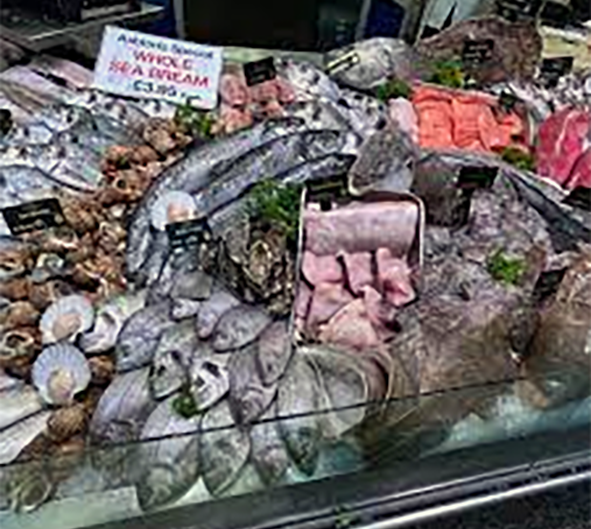 Fish displayed at a fishmonger's stall.
Welcome to FabulousFusionFood's Fish-based Recipes Page — The recipes presented here are all based on Fish (both sea-water and freshwater).
A fish (pl.: fish or fishes) is an aquatic, anamniotic, gill-bearing vertebrate animal with swimming fins and a hard skull, but lacking limbs with digits. Fish can be grouped into the more basal jawless fish and the more common jawed fish, the latter including all living cartilaginous and bony fish, as well as the extinct placoderms and acanthodians. In a break to the long tradition of grouping all fish into a single class (Pisces), contemporary phylogenetics views fish as a paraphyletic group (in that all vertebrates evolved from fishes, so tetrapods, can be classified as belonging to the lobe-finned fish but are not considered such).
Most fish are cold-blooded, their body temperature varying with the surrounding water, though some large active swimmers like white shark and tuna can hold a higher core temperature. Many fish can communicate acoustically with each other, such as during courtship displays. The study of fish is known as ichthyology.
Bony fish, distinguished by the presence of swim bladders and later ossified endoskeletons, emerged as the dominant group of fish after the end-Devonian extinction wiped out the apex predators, the placoderms. Bony fish are further divided into the lobe-finned and ray-finned fish. About 96% of all living fish species today are teleosts, a crown group of ray-finned fish that can protrude their jaws. The tetrapods, a mostly terrestrial clade of vertebrates that have dominated the top trophic levels in both aquatic and terrestrial ecosystems since the Late Paleozoic, evolved from lobe-finned fish during the Carboniferous, developing air-breathing lungs homologous to swim bladders. Despite the cladistic lineage, tetrapods are usually not considered to be fish.
Fish account for more than half of vertebrate species. As of 2016, there are over 33,000 described species of bony fish, over 1,100 species of cartilaginous fish, and over 100 hagfish and lampreys. A third of these fall within the nine largest families; from largest to smallest, these are Cyprinidae, Gobiidae, Cichlidae, Characidae, Loricariidae, Balitoridae, Serranidae, Labridae, and Scorpaenidae. About 64 families are monotypic, containing only one species.
Throughout history, humans have used fish as a food source for dietary protein. Historically and today, most fish harvested for human consumption has come by means of catching wild fish. However, fish farming, which has been practiced since about 3,500 BCE in ancient China, is becoming increasingly important in many nations. Overall, about one-sixth of the world's protein is estimated to be provided by fish. Fishing is accordingly a large global business which provides income for millions of people. The Environmental Defense Fund has a guide on which fish are safe to eat, given the state of pollution in today's world, and which fish are obtained in a sustainable way.
The word fish is inherited from Proto-Germanic, and is related to German Fisch, the Latin piscis, Old Irish īasc and Welsh pysgod, though the exact root is unknown; some authorities reconstruct a Proto-Indo-European root *peysk-, attested only in Italic, Celtic, and Germanic.
Though often used interchangeably, in biology fish and fishes have different meanings. Fish is used as a singular noun, or as a plural to describe multiple individuals from a single species. Fishes is used to describe different species or species groups.
The alphabetical list of all the fish-based recipes on this site follows, (limited to 100 recipes per page). There are 2136 recipes in total:
Page 14 of 22
| Morue Rôtie à la Sauce Tomate (Roast Salt Cod with Tomato Sauce) Origin: Monaco | N'dolé avec Poulet (Chicken N'Dolé) Origin: Cameroon | Nimino de Peixe (Nimino of Fish) Origin: Mozambique |
| Moules à la Luxembourgeoise (Mussels, Luxembourg Style) Origin: Luxembourg | Nachinyonaya Forel (Stuffed Trout) Origin: Georgia | Njanga Rice Origin: Cameroon |
| Mouton à l'Arachide (Lamb with Peanuts) Origin: Benin | Naengi-guk (Shepherd's Purse Soup) Origin: Korea | NjaNjaMoto (Smelt in Njangsa Sauce) Origin: Cameroon |
| Moyin-Moyin Origin: Nigeria | Nam Pla Prik (Chillies in Fish Sauce) Origin: Thailand | Nkatenkwan (Ghanaian Peanut Soup) Origin: Ghana |
| Mpotompoto (Ghanaian Yam Porridge) Origin: Ghana | Nam Prik Pao (Thai Chilli Paste) Origin: Thailand | Nkrakrakwam (Ghanaian Light Soup) Origin: Ghana |
| Mrs Beeton Anchovy Toast Origin: Britain | Namasu (Daikon and Carrot in Vinegar Dressing) Origin: Japan | Nnam Owondo Origin: Cameroon |
| Mrs Beeton's Anchovy Sauce Origin: Britain | Naruto (Japanese Fish Cakes) Origin: Japan | Noix de St-Jacques à la crème d'oignons de Roscoff (Scallops with Roscoff Onion Cream) Origin: France |
| Mrs Beeton's Fish Forcemeat Origin: British | Nasi Lemak Origin: Malaysia | Nom Banh Chok Origin: Cambodia |
| Mrs Beeton's Recipe for Brill Origin: Britain | Nasi Lemak Origin: Cocos Islands | Noodle Curry Paste Origin: Laos |
| Mrs Beeton's Shrimp Sauce Origin: British | Nasi Lemak Origin: Singapore | Num Banh Choc (Rice Noodle Fish Soup) Origin: Cambodia |
| Mtuza wa Samaki (Baked Curried Fish) Origin: Kenya | Nasi Lemak Origin: Christmas Island | Num Pa-chok Tirk Ka-chuii (Khmer Noodle Soup with Fingerroot) Origin: Cambodia |
| Mufete de Causo (Grilled Tilapia with Onion and Chilli Sauce) Origin: Angola | Ndomba de Poisson (Fish Cooked in Banana Leaves) Origin: Cameroon | Numb-fish (Electric Ray) Origin: Roman |
| Mufete de Sardinha (Grilled Sardines with Onion and Chilli Sauce) Origin: Angola | Ndomba de Porc (Pork Cooked in Banana Leaves) Origin: Cameroon | Nuoc Mam Cham (Fish Dipping Sauce) Origin: Vietnam |
| Mukbasa (Yemeni-style Roast Fish) Origin: Djibouti | Ndrovi ya Nazi (Banana with Coconut Milk) Origin: Comoros | Nwa Mee Hinga (Oxtail and Watercress) Origin: Myanmar |
| Mulet Farci à la Saint-Louisienne (Stuffed Mullet in the style of Saint-Louis) Origin: Senegal | Neckham's Green Sauce Origin: England | Nyona Penang Assam Laska Origin: Malaysia |
| Mullet Soup Origin: Cornwall | Nems au poulet (Chicken Spring Rolls) Origin: Tahiti | Oa Pnikta (Eggs Poached with Oil, Wine and Garum) Origin: Roman |
| Mullos Anethatos sic Facie (Red Mullets with Aniseed is Made Thus) Origin: Roman | Nettle Greens and Peanut Stew Origin: African Fusion | Oarweed-cured Tuna Origin: Ireland |
| Murenam aut Anguillas vel Mulos (Moray Eels and Eels or Mullets) Origin: Roman | New Caledonian Raw Fish Salad Origin: New Caledonia | Oat-crusted Fish Pie Origin: Scotland |
| Muscle Sauce (Mussel Sauce) Origin: Britain | New Zealand Fish Pie Origin: New Zealand | Obe Ata (Nigerian Pepper Soup) Origin: Nigeria |
| Mushroom Bhaji Origin: Britain | Nga Atoiba Thongba (Manipuri Broken Fish Curry) Origin: India | Obe Ata Dindin (Nigerian Red Sauce) Origin: Nigeria |
| Muskels in Bruet (Mussels in Bruet) Origin: England | Nga Myin Hin (Butter Fish Curry) Origin: Myanmar | Obe Efo Elegusi (Egusi Soup) Origin: Nigeria |
| Mussel Brose Origin: Scotland | Nga Tha Lout Paung (Sour Fish Curry) Origin: Myanmar | Obe Eja Dindin (Fried Fish Stew) Origin: Nigeria |
| Mussel Pie Origin: Bermuda | Ngege with Peanut Sauce (Tilapia with Peanut Sauce) Origin: East Africa | Obe Eja Tutu (Fresh Fish Stew) Origin: Nigeria |
| Mussel Soup Origin: Scotland | Niban Dashi (Stock For Vegetables and Dipping Sauces) Origin: Japan | Ochazuke (Japanese Green Tea Rice) Origin: Japan |
| Mussels in Cream Sauce Origin: Britain | Nigerian Beans Porridge Origin: Nigeria | Ock-lam (Barbecued Pork with Mushrooms and Beans) Origin: Laos |
| Mussels in Creamy Horseradish Sauce Origin: Ancient | Nigerian Catfish Stew Origin: Nigeria | Ocopa de Camarones (Prawn Ocopa) Origin: Peru |
| Mustard and Honey Drummers Origin: Britain | Nigerian Fresh Fish Pepper Soup Origin: Nigeria | Oenogarum (Wine Sauce) Origin: Roman |
| Mustard Sauce Origin: Britain | Nigerian Goat Meat Pie Origin: Nigeria | Oenogarum cum Thymum et Satureiam in Tubera (Truffles in Savory-thyme Wine Sauce) Origin: Roman |
| Mustard-crusted Herring Origin: Britain | Nigerian Groundnut Soup Origin: Nigeria | Oenogarum et Coriandrum in Tubera (Truffles in Coriander Wine Sauce) Origin: Roman |
| Mustard-glazed Flatfish Origin: Britain | Nigerian Guineafowl Pepper Soup Origin: Nigeria | Ofada-Ugba Jollof (Fermented Jollof Rice) Origin: Nigeria |
| Mutabbaq Samak (Fried Pomfret with Rice) Origin: Kuwait | Nigerian Spiced Chicken Pepper Soup Origin: Nigeria | Ofe Achara (Elephant Grass Stew) Origin: Nigeria |
| Myma (Baked Plaice) Origin: Roman | Nigerian Spiced Goat Meat Pepper Soup Origin: Nigeria | Ofe Ugba (Ugba Soup) Origin: Nigeria |
| N'dolé (Bitterleaf Stew) Origin: Cameroon | Nigerian Spiced Grasscutter Pepper Soup Origin: Nigeria | |
| N'dolé avec Poisson (Fish and Bitterleaf Stew) Origin: Gabon | Nila Bumbu Acar (Sour Spicy Carp) Origin: Indonesia |
Page 14 of 22