FabulousFusionFood's Fish-based Recipes 12th Page
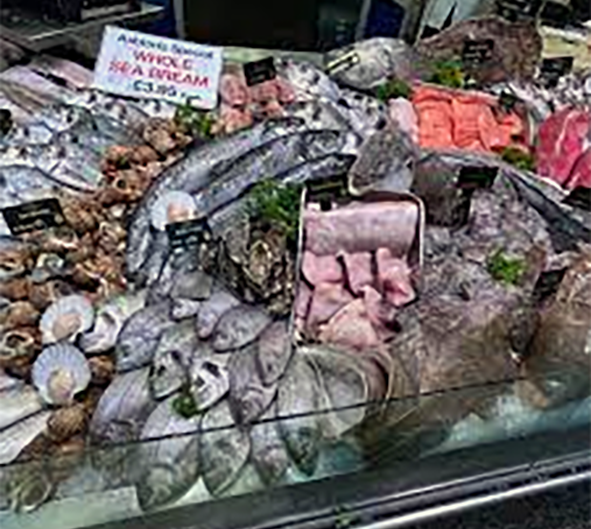 Fish displayed at a fishmonger's stall.
Welcome to FabulousFusionFood's Fish-based Recipes Page — The recipes presented here are all based on Fish (both sea-water and freshwater).
A fish (pl.: fish or fishes) is an aquatic, anamniotic, gill-bearing vertebrate animal with swimming fins and a hard skull, but lacking limbs with digits. Fish can be grouped into the more basal jawless fish and the more common jawed fish, the latter including all living cartilaginous and bony fish, as well as the extinct placoderms and acanthodians. In a break to the long tradition of grouping all fish into a single class (Pisces), contemporary phylogenetics views fish as a paraphyletic group (in that all vertebrates evolved from fishes, so tetrapods, can be classified as belonging to the lobe-finned fish but are not considered such).
Most fish are cold-blooded, their body temperature varying with the surrounding water, though some large active swimmers like white shark and tuna can hold a higher core temperature. Many fish can communicate acoustically with each other, such as during courtship displays. The study of fish is known as ichthyology.
Bony fish, distinguished by the presence of swim bladders and later ossified endoskeletons, emerged as the dominant group of fish after the end-Devonian extinction wiped out the apex predators, the placoderms. Bony fish are further divided into the lobe-finned and ray-finned fish. About 96% of all living fish species today are teleosts, a crown group of ray-finned fish that can protrude their jaws. The tetrapods, a mostly terrestrial clade of vertebrates that have dominated the top trophic levels in both aquatic and terrestrial ecosystems since the Late Paleozoic, evolved from lobe-finned fish during the Carboniferous, developing air-breathing lungs homologous to swim bladders. Despite the cladistic lineage, tetrapods are usually not considered to be fish.
Fish account for more than half of vertebrate species. As of 2016, there are over 33,000 described species of bony fish, over 1,100 species of cartilaginous fish, and over 100 hagfish and lampreys. A third of these fall within the nine largest families; from largest to smallest, these are Cyprinidae, Gobiidae, Cichlidae, Characidae, Loricariidae, Balitoridae, Serranidae, Labridae, and Scorpaenidae. About 64 families are monotypic, containing only one species.
Throughout history, humans have used fish as a food source for dietary protein. Historically and today, most fish harvested for human consumption has come by means of catching wild fish. However, fish farming, which has been practiced since about 3,500 BCE in ancient China, is becoming increasingly important in many nations. Overall, about one-sixth of the world's protein is estimated to be provided by fish. Fishing is accordingly a large global business which provides income for millions of people. The Environmental Defense Fund has a guide on which fish are safe to eat, given the state of pollution in today's world, and which fish are obtained in a sustainable way.
The word fish is inherited from Proto-Germanic, and is related to German Fisch, the Latin piscis, Old Irish īasc and Welsh pysgod, though the exact root is unknown; some authorities reconstruct a Proto-Indo-European root *peysk-, attested only in Italic, Celtic, and Germanic.
Though often used interchangeably, in biology fish and fishes have different meanings. Fish is used as a singular noun, or as a plural to describe multiple individuals from a single species. Fishes is used to describe different species or species groups.
The alphabetical list of all the fish-based recipes on this site follows, (limited to 100 recipes per page). There are 2136 recipes in total:
Page 12 of 22
| La Capitaine Sangha (Nile Perch with Red Sauce) Origin: Mali | Ligge Estren Porth Navas (Port Navas Oyster Soup) Origin: England | Mackerel Pasty Origin: England |
| La Salsa de Cacahuete (Peanut Sauce) Origin: Equatorial Guinea | Lightly-spiced Fish Fajitas Origin: Britain | Mackerel Run Down Origin: Jamaica |
| Laal Maas (Spicy Red Lamb Shank Curry) Origin: India | Limelax (Lime Salmon) Origin: Sweden | Mackerel Stuffed with Samphire and Seasoned with Alexanders and Wild Fennel Seeds Origin: Britain |
| Laap (Beef Salad) Origin: Laos | Ling Fillets with Parsley and Tomato Pesto Origin: Britain | Mackerel Tartare with Pickled Dulse Origin: Britain |
| Labadja Origin: Mali | Llymrïaid (Sand Eels) Origin: Welsh | Mackerel with currant sauce and radicchio Origin: Britain |
| Lactucas (Lettuce) Origin: Roman | Loaded Fish Burritos Origin: Britain | Macrell Ceinewydd (New Quay Mackerel) Origin: Welsh |
| Laj Ntses (Fish Larb) Origin: Laos | Lobster and Clotted Cream Tart Origin: Britain | Macrell gyda Ffenigl (Mackerel With Fennel) Origin: Welsh |
| Lakhou bissap Origin: Senegal | Lobster Croquets Origin: Britain | Macrell wedi'i Grilio gyda Phiwrî Ffa a Garlleg a Iogwrt Bara Lawr (Mackerel Grilled with Broad Bean Puree, Garlic and Laver Bread Yoghurt) Origin: Welsh |
| Langoustines au Breton Kari (Langoustines with Breton Kari Spices) Origin: France | Lobster Curry Origin: Britain | Maelgi Rhost a Saws Bara Lawr (Roast Monkfish and Laverbread Sauce) Origin: Welsh |
| Lao Tam Som (Lao Green Papaya Salad) Origin: Laos | Lobster Sauce Origin: Britain | mafè tatou nènn (Naked Peanut Stew) Origin: Mali |
| Lapas (Griddled Limpets) Origin: Portugal | Locustam et Scillas (Lobsters and Prawns) Origin: Roman | Maffi Hakko Origin: Guinea |
| Lapin au Cidre (Rabbit in Cider) Origin: France | Locustas Assas sic Facies (Roast Lobster is Made Thus) Origin: Roman | Maffi Hakko Bangtura (Sweet Potato Leaf Sauce) Origin: Guinea |
| Large Fungal Caps a Cotoletta Origin: Britain | Lohikeitto (Finnish Salmon Soup) Origin: Finland | Magic Lamb Origin: Namibia |
| Laumproys in Galyntyne (Lampreys in Galingale Sauce) Origin: England | London-style Stewed Eels Origin: England | Mahi Shekam Por (Persian Stuffed Fish) Origin: Iran |
| Le cassoulet de la mer à la bretonne (Breton seaside cassoulet) Origin: France | Lourenço Marques Prawns Origin: South Africa | Makerel in sauce (Mackerel in Sauce) Origin: England |
| Le Goundja (Fish with Aubergines and Cassava Leaves) Origin: Central African Republic | Lowumbo (Ugandan Steamed Fish) Origin: Uganda | Makher Taukari (Fish Curry) Origin: Bangladesh |
| Le Kissar Origin: Chad | Luwombo () Origin: Uganda | Makher Taukari II (Fish Curry II) Origin: Bangladesh |
| Le Me Tsolola Origin: Comoros | M'Boa com Xima (Pumpkin Leaves in Peanut Sauce with Prawns) Origin: Mozambique | Mala Long Xia (Chinese Spicy Crayfish) Origin: China |
| Le Ndolé Camerounais (Cameroonian Ndolé) Origin: Cameroon | Môr-leisiad wedi Potsio gyda Nionyn, Cennin a Ffenigl (Poached Pollack with Onion, Leek and Fennel) Origin: Welsh | Mala Long Xia (Chinese Spicy Crayfish) Origin: China |
| Leftover Mash and Tinned Fish Fishcakes Origin: Britain | M'tsolola (Fish and Plantain stew in Coconut Milk) Origin: Comoros | Mala Xiang Guo (Spicy Numbing Stir-fry Pot) Origin: China |
| Leftover Rice Muffins Origin: Britain | Maacher Chop (Indian Fish Croquettes) Origin: India | Malabar Peralan (Malabar Fish Roast) Origin: India |
| Leftovers Stir-fry with Green Papaya Origin: American | Maboké de Capitaine (Maboke of Nile Perch) Origin: Central African Republic | Málàjiàng (Mala Hotpot Paste) Origin: China |
| Lemon Pepper Sea Bass Origin: Fusion | Maboke (Steamed Nile Perch) Origin: Central African Republic | Malay Chicken Curry with White Pumpkin Origin: Anglo-Indian |
| Lemongrass Pork with Rice Noodles Origin: Australia | Mach Bhaja (Bangladeshi Fish Fry) Origin: Bangladesh | Malaysian Chicken Curry Origin: Malaysia |
| Lenticula ex sphondylis (Mussels with Lentils) Origin: Roman | Machali aur Daal (Fish and Lentil Curry) Origin: India | Malaysian Chicken Curry Origin: Cocos Islands |
| Leporem Farsum (Stuffed Hare) Origin: Roman | Macher Jhol (Keralan Fish Curry) Origin: India | Malaysian Chicken Curry Origin: Christmas Island |
| Les Sardines Farcies aux Blettes et aux Moules (Sardines Stuffed with Chard and Mussels) Origin: Monaco | Macher Jhol (Bengali Carp Curry) Origin: India | Malaysian Laksa Origin: Malaysia |
| Liberian Aubergine Stew Origin: Liberia | Machli aur Tamatar (Curried Halibut with Tomatoes) Origin: India | Malaysian Murtabak (Mamak Omelette Pancake) Origin: Malaysia |
| Liberian Dry Rice Origin: Liberia | Machli ka Salna (Fish Steak Curry) Origin: India | Mallow Leaf Gumbo Origin: Britain |
| Liberian Eggplant Stew Origin: Liberia | Mackerel and Samphire Stew Origin: Britain | Mallow-leaf Stew Origin: African Fusion |
| Liberian Red Oil Okra Soup Origin: Liberia | Mackerel and Seaweed Pâté Origin: Britain | Malu Abulthiyal (Fish Curry with Fragrant Masala) Origin: Sri Lanka |
| Liberian Split Peas Origin: Liberia | Mackerel and Tamarind Noodle Soup Origin: Fusion | Malvani Fish Curry Origin: India |
| Liberian-style Fried Cabbage Origin: Liberia | Mackerel Burger with Sweet Potato Chips Origin: Fusion | |
| Liboké de Poisson (Fish in Banana Leaf) Origin: Central Africa | Mackerel in Breadfruit Gravy Origin: Liberia |
Page 12 of 22