Eliza Acton's Chapter 4: Gluten
SECTION IV.
BREAD RECEIPTS.
PRELIMINARY OBSERVATIONS.
|
1. The first thing required for making wholesome bread is the utmost cleanliness; the next is the soundness and sweetness of all the ingredients used for it; and, in addition to these, there must be attention and care through the whole process. 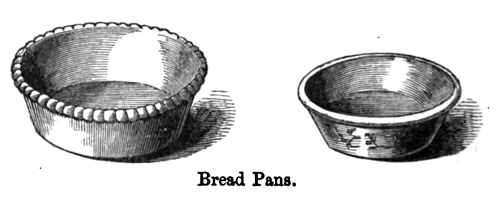
If you have never yet attempted to make bread, and wish to try to do it well, and have nobody to show you the proper manner of setting about it, you may yet succeed perfectly by attending with great exactness to the directions which are given here; but as a large baking is less easily managed than a small one quite at first, and as the loss would be greater if the bread were spoiled, I would advise you to begin with merely a loaf or two. Take, then, let us say, half a gallon of flour, or a quartern, as it is called in some places. This will weigh three pounds and a half, and will make two loaves of nearly two pounds and a quarter each. There are two ways, as I have already stated, of making the dough. If you are sure of the goodness of the yeast you use, it will not much matter which of them you follow. The quickest and easiest mode is to wet it up at once; the safest against failure is to set a sponge thus:—Put the flour into a large earthenware bowl or deep pan; then with a strong metal or wooden spoon, hollow out the middle, but do not clear it entirely away from the bottom of the pan, as in that case the sponge (or leaven, as it was formerly termed), would stick to it, which it ought not to do. Next, take either a large table spoonful of brewers' yeast, which has been rendered solid by mixing it with plenty of cold water, and letting it afterwards stand to settle for a day and night; or nearly an ounce of fresh German yeast. Put it into a large basin, and proceed to mix it so that it shall be as smooth as cream, with three quarters of a pint, or even a whole pint, of just warm milk and water, or water only, though even a very little milk will much improve the bread. To have it quite free from lumps, you must pour in the liquid by spoonfuls just at the beginning, and stir and work it round well to mix it perfectly with the yeast before you add the remainder, otherwise it would probably cause the bread to be full of large holes, which ought never to be seen in it. Pour the yeast into the hole in the middle of the flour, and stir into it as much of that which lies round it as will make a thick batter, in which, remember, there must be no lumps. If there should seem to be any, you must beat them out with the spoon. Strew plenty of flour on the top, throw a thick clean cloth over, and set it where the air is warm; but if there is a large fire, do not place it upon the kitchen fender in front of it, as servants often do, for it will become too much heated there; but let it always be raised from the floor, and protected from constant draughts of air passing over it. Look at it from time to time, when it has been laid for nearly an hour; and when you perceive that the yeast has risen and broken through the flour, and that bubbles appear in it, you will know that it is ready to be made up into dough. Then place the pan on a strong chair, or dresser, or table of convenient height; pour into the sponge a little warm milk or water (about a pint and a quarter will be required altogether for the quartern of bread, so if three quarters of a pint was mixed with the yeast at first, there will be half a pint to add. Sometimes a little more will be needed; but be always careful not to make the dough too moist); stir into it as much of the flour as you can with the spoon, then wipe it out clean with your fingers, and lay it aside. Next take plenty of the remaining flour, throw it on the top of the leaven, and begin, with the knuckles of both hands, to knead it well. Quick movement in this will do no good. It is strong, steady kneading which is required. Keep throwing up the flour which lies under and round the dough, on to the top of it, that it may not stick to your fingers. You should always try to prevent its doing this, for you will soon discover that attention to these small particulars will make a great difference in the quality of your bread, and in the time required to make it. When the flour is nearly all kneaded in, begin to draw the edges of the dough towards the middle, in order to mix the whole thoroughly; and continue to knead it in every part, spreading it out, and then turning it constantly from the side of the pan to the middle, and pressing the knuckles of your closed hands well into and over it. When the whole of the flour is worked in, and the outside of the dough is quite free from it, and from all lumps or crumbs, and does not stick to the hands when touched, it will be done, and may be again covered with the cloth, and left to rise a second time. In three quarters of an hour look at it, and should it have swollen very much, and begin to crack, it will be light enough to bake. Turn it then on to a paste-board, or very clean dresser, and with a large sharp knife divide it in two, when, if it has been carefully and properly made, you will find it full throughout of small holes like a fine sponge. When it is thus far ready, make it up quickly into loaves, and despatch it to the oven. If it is to be baked on a flat tin, or on the oven floor, dust a little flour on the board, and make them up lightly into the form of dumplings, drawing together the parts which are cut, and turning them downwards. Give them a good shape by working them round quickly between your hands, without raising them from the board, and pressing them slightly as you do so; then take a knife in the right hand, and turning each loaf quickly with the left, just draw the edge of it round the middle of the dough, but do not cut deeply into it. Make, also, one or two slight incisions across the tops of the loaves, as they will rise more easily when this is done. Should it be put into earthen pans, the dough must be cut with the point of the knife just below the edge of the dishes, after it is laid into them. To prevent its sticking to them, and being turned out with difficulty after it is baked, the pans should be rubbed in every part with a morsel of butter laid on a bit of clean paper. When they are only floured, the loaves cannot sometimes be loosened from them without being broken. All bread should be turned upside down or on its side as soon as it is drawn from the oven: if this be neglected, the under part of the loaves will become wet and blistered from the steam, which cannot then escape from them. They should remain until they are perfectly cold before they are put away and covered down. The only difference between this and the other way of making dough mentioned at the beginning of these directions, is, the mixing all the flour at first with the yeast and liquid, into a firm, smooth paste, which must be thoroughly kneaded down when it has become quite light, and then left to rise a second time before it is prepared for baking. A pint of warm milk and water, or of water only, may be stirred gradually to the yeast, which should then be poured into the middle of the flour, and worked with it into a stiff batter with a spoon, which should then be withdrawn, and the kneading with the hands commenced. Until a little experience has been gained, the mass of dough which will be formed with the pint of liquid may be lifted from the pan into a dish, while sufficient warm water is added to wet up the remainder of the flour. This should afterwards be perfectly mingled with that which contains the yeast. A better plan is to use at once from a pint and a quarter to a pint and a half of liquid; but learners are very apt to pour in heedlessly more than is required, or to be inexact in the measure*, and then more flour has to be used to make the bread of a proper consistence than is allowed for by the proportion of yeast named in the receipt. It is a great fault in bread making to have the dough so moist that it sticks to the fingers when touched, and cannot be formed into loaves which will retain their shape without much flour being kneaded into them when they are made up for the oven.
To make the dough without setting a sponge.— Merely mix the yeast with the greater part of the warm milk and water, and wet up the whole of the flour at once, after the salt has been stirred to it, proceeding exactly in every other respect as in the directions just given. As the dough will soften in the rising, it should be made quite firm at first, or it will be too lithe by the time it is ready for the oven. When a little experience enables you to undertake a larger baking without danger of spoiling the bread, remember that it will probably require a longer time to become quite light than a very small quantity would; and that it will rise more quickly in warm weather than in cold. When it is to be home-baked as well as homemade, you must endeavour to calculate correctly the time at which it will be ready, and have the oven in a fit state for it when it is so. Should it have to be carried to the baker's, let a thick cloth or two be thrown over it before it is sent. (Sufficient for a week's consumption for ten persons.) With three pecks of the best flour, mix from half to a whole teacupful of salt, according to the taste of the eaters; some persons liking a full proportion of it, and others objecting to more than will very slightly flavour the bread. Next, dilute gradually and smoothly a short half pint of good brewer's yeast,—which has been mingled with plenty of water, and left for at least twenty-four hours—with two or three quarts of warm milk and water, taken from nine quarts, which will be required to make the three pecks of flour into dough. If the quality of the yeast should be doubtful, it will be better to set a sponge with it, by the directions at the beginning of this chapter, with about four quarts of the liquid; but otherwise it may at once be kneaded up with the whole quantity, and left from an hour and a half to two hours to rise. Knead it thoroughly a second time, when it appears perfectly light; and let it remain for another hour, when it will probably be ready for the oven. Turn it then on to a paste-board or dresser, divide it into the number of loaves required, make them up quickly and lightly, dredging a little flour occasionally on the board to prevent their sticking to it, and despatch them quickly to the oven. It is always well to cut them slightly across the tops, as well as round the middle, to assist their rising. When it is necessary, the "Receipt for a quite inexperienced learner" should be attentively studied, and the minute instructions given in it be well understood before any baking on a large scale is undertaken.
|
(From the Wife of a Parish Clerk.)
The good woman whose receipt for bread is given here, is often called upon to supply it to persons who cannot otherwise procure it home-made without much difficulty; and as one feels assured in eating it that it is composed of honest country flour*, and as it is light and well-flavoured, it is often peculiarly acceptable in London and elsewhere. She makes it even for the family of the clergyman of her parish, when their own servants cannot perform that duty; and the constancy with which it is required from her is sufficient evidence of their deficiency in that respect.
"Mix with about five gallons and a half of flour, a teacupful or about six ounces of salt, and three pennyworth, or rather more than a pint, of yeast. Make these up into a dough at once, with something more than a gallon of warm water; let it stand to rise until it is quite light, and in the meantime, kindle the fire in the oven, and heat it well. A fourpenny faggot is all the fuel that is used for it; but it is always heated once a week, and sometimes twice, so that it requires less than ovens which are not so regularly used. Divide the dough into four-pound loaves, and bake them well. They will be nicely done in about two hours."
This bread, when carefully stored, remains perfectly good in cool weather for ten days; and has occasionally been found quite eatable at the end of a fortnight, which it would not have been unless it had been wholesomely made and thoroughly baked. I think it might be slightly improved by diminishing a little the proportion of yeast used for lightening it, and allowing it to lie rather longer after it is kneaded down, before it is put into the oven. A portion of milk, too, is always a desirable addition to bread when it can be had.
|
Flour (resembling what is called households, but excellent of its kind), four gallons and a half; salt, one small teacupful; fresh brewers' yeast, three pennyworth (or rather more than a pint); water, four to five quarts; made into a firm dough at once, and left to rise for an hour; kneaded down, and shortly afterwards divided into 41b. loavesa" baked in well-heated brick oven two hours. |
(The most nutritious and economical of any.)
This bread is composed of wheat ground into meal, and used without any portion—even the bran—being taken from it; and it is highly recommended by some of the first scientific men of the present day as containing a larger amount of nourishment, and being more easy of digestion than that which is made with fine flour only, because it is now ascertained that the bran (which was formerly considered as altogether unfit for food), contains in reality more gluten, or nutriment of the best kind, than any other part of the corn; and it is stated by a very superior writer, that it possesses also a peculiar kind of ferment, which has the property of dissolving the bread or flour with which it is mixed, and rendering it more easily digestible in the stomach. He adds: "To this quality of bran, as well as to the nourishment it yields, are to be ascribed some of the wholesome qualities which many persons have recognised in whole-meal bread."
Now, it will be seen, that very great advantages would attend the general use of the wheat merely reduced by grinding to a proper state for being converted easily into bread, which is more strengthening in its nature than any other, and therefore of more value to those whose toil is heavy and exhausting; and which, from its digestible character, is also well suited to persons of sedentary habits, and to invalids.* In the ordinary procesess which the corn undergoes in separating its various parts, there is always considerable loss; and the consumption of wheat in the country would be materially lessened if this loss were in a great measure avoided by the adoption of the whole-meal bread. There would soon be a perceptible difference if a portion of it only were consumed in every family which is at present supplied entirely with that made with fine wheaten flour. After a time, it would be preferred by the eaters generally to white bread; and the poorer classes of the people, who now reject with absolute disdain every form of brown bread, from an idea that it is of inferior quality to the finer and more expensive kinds, would gradually lose their prejudice against it if they saw it commonly adopted for consumption by the wealthy.†
To derive from it all the advantages which it will undoubtedly yield, the following points should be observed:—The corn should not be damped before it is ground; and it should lie over for some weeks, and be kept very dry after the grinding, before it is converted into bread. Quite at first it will be well to mix a certain portion of flour with it for persons who are not in strong health, or who are unaccustomed to eat brown bread, as it will otherwise sometimes occasion a little irritation of the stomach for a few days; but this is easily avoided by using, it only in part for a time, and by diminishing at each baking the proportion of flour added to it.
In making dough with the whole-meal, it will be seen that it absorbs more liquid than flour does, and requires rather more yeast to render it light, or a longer time to rise. It should not be made very stiff, or it will be too dry after it is baked, yet it should always be workable, and not stick to the hands. If well managed, its flavour will be peculiarly sweet and agreeable. It is prepared in precisely the same manner as white bread, and the directions already inserted will serve equally for either kind, with the slight variation in the quantity of yeast and liquid for the brown, which has already been mentioned.
|
Whole-meal, one gallon; good flour, one gallon; fresh German yeast, two ounces and a half; or well washed beer yeast, two tablespoonfuls; salt, four to six teaspoonfuls, or one ounce to one and a half; warm water, or milk and water, full three quarts. To rise from one hour to one hour and a half, the first time, or until it is evidently quite light; the second time about an hour. To be well baked in moderately heated oven. Or, whole-meal, seven pounds; flour, three pounds and a half; solid beer yeast, three large dessert spoonfuls, or fresh German yeast, nearly two ounces; liquid, rather more than four pints and a quarter; salt as above. Or, whole-meal, one gallon; German yeast, one ounce and a quarter in summer, one ounce and a half in winter; or solid brewers' yeast, three dessert spoonfuls; all else as in foregoing receipt. |
An economical, and at the same time a very agreeable and nutritious kind of bread may be made with wheaten flour, and what is commonly called sharps, or middlings. It would be preferred by many persons to that which is composed of the whole-meal, as it is less dark in appearance; and if carefully fabricated, may be rendered as light as the finest wheaten rolls. It is, in any case, infinitely superior to the common brown bread sold by the bakers in this country. One gallon of sharps, and two of flour, should be stirred together in the bread-trough or pan until the whole appears of one colour, and it may then be managed exactly like white bread, with the difference only of a little more yeast being allowed for it, as for other brown bread; or rather more time for the rising. The dough will absorb a somewhat larger proportion of liquid than flour does, and it should not be made very stiff, or it will not ferment freely.
Some years since, when unfermented bread was first becoming known, I had it tried very successfully in the following manner; and I have since been told that an almost similar method of preparing it is common in many remote parts both of England and Ireland, where it is almost impossible to procure a constant supply of yeast. Blend well together a teaspoonful of pounded sugar and fifty grains of the purest carbonate of soda; mix a salt spoonful of salt with a pound of flour, and rub the soda and sugar through a hair sieve into it. Stir and mingle them well, and make them quickly into a firm but not hard dough, with sour buttermilk. Bake the loaf well in a thoroughly heated but not fierce oven. In a brick, or in a good iron oven, a few minutes less than an hour would be sufficient to bake a loaf of similar weight. The buttermilk should be kept till it is quite acid; but it must never be in the slightest degree rancid, or otherwise bad. All unfermented bread, it must be repeated, should be placed in the oven directly it is made, or it will be heavy. For a larger baking, allow rather less than an ounce of soda to the gallon (7 lbs.) of flour.
Observation.—There are cases in which a knowledge of this, or of any other equally easy mode of bread-making,would be invaluable. The inhabitants of the Isle of Skye depend entirely for bread on supplies brought to them from Glasgow; and they are often entirely without when the steamer, which ought to arrive at intervals of eight days, is delayed by stress of weather. The residents are then compelled to have recourse to scones—as a mixture of flour and water and a little soda (cooked on a flat iron plate) is called—or to ship's biscuit; and these are often found unsuitable for young children and invalids. There are no ovens in the houses, though there are grates for coal fires, in front of which small loaves of unfermented bread could be baked extremely well in good American ovens, or better still in the small revolving portable ones, invented by Mr. Balls, of which mention has already been made. Buttermilk can always be procured; and if not, a provision of carbonate of soda and muriatic acid might be kept at hand to ensure the means of making wholesome bread. In many other localities the same plan might prove of equal benefit.
(The Rectory Receipt.)
I am indebted for the following receipt to an admirable housekeeper,—the wife of a country clergyman,—in whose own words I present it to the reader. It is given with so much exactness in all its details, that I have not considered it needful to have it tested before inserting it here, especially as it is the result of positive and long experience.
"We have been for some time in the habit of using a portion of rice for our bread. We commenced this plan when flour was very dear; and we think the bread so much improved by the addition, that now we seldom omit it. We generally bake two stone (that is to say, four gallons, or twenty-eight pounds) of flour; and for this quantity we allow two pounds of rice. We first wash the rice, and then soak it for three or four hours in six pints of water. It is next turned, with the whole of the water, into a large tin dish with a cover (a Nottingham jar well tied down would be a good substitute for this), and put it into a tolerably hot oven for two hours, when it will be nicely swollen, and will have absorbed all the water. When it has cooled down sufficiently to be handled easily, we rub it into half the flour, in the same way that we should rub butter or lard into it for pastry, and proceed to make the bread. If we can procure good home-brewed yeast, we prefer it to any other, and find a quarter of a pint sufficient for our baking; but we very frequently use bakers' yeast, which we find we can depend on better than on the brewers'. It is a thin liquid, somewhat resembling beer, of which we are obliged to mix three quarters of a pint with the dough. We add first to the flour and rice two small handfuls of salt, and then wet them up gradually with ten pints of warm water, reserving the yeast until they are tolerably well moistened, when we pour it equally over the mass, and beat it in well with the hand, and knead it about. This dough will be very lithe. We make it about four o'clock in the afternoon, and place it by the fire, or on the top of the oven, where it remains until nine in the evening, when three quarters of a stone (a gallon and a half) more of flour is kneaded into it, and it is left to rise until the morning, when the remaining half gallon of flour will fit it for the oven. It should be put into large tins and allowed to rise to their tops before it is set into the oven. We divide it into ten loaves, which are baked for two hours. We consider that the rice renders the bread lighter, and prevents the crust of it from becoming hard, and it materially increases its weight. The four gallons of flour, two pounds of rice, and sixteen pints of water, produce forty-two pounds of excellent bread.
"To improve the yeast, and insure its being good, I would recommend that three or four well boiled potatoes should be smoothly mashed and mixed with as much hot water as will bring them to the consistence of batter, and that, a small plateful of warm flour and the yeast should be gradually added and well beaten to them. This done, the mixture must be placed before the fire, and in two hours, or less, the whole bowl will be in a state of fermentation. Then is the time to lay the bread with it. It is a little additional trouble, but is a certain improvement also. Servants, however, will not often take all this trouble; and mistresses cannot always attend to such matters themselves."
|
Two pounds of rice soaked in three quarts of water, and afterwards swollen in it for two hours in a moderately hot oven; to be cooled down a little, then worked into a stone (two gallons) of flour; two small handfuls of salt; a quarter of a pint of yeast of home-brewed beer (or three quarters of a pint of bakers' yeast), and five quarts of warm water to be added to them, and well mixed into a lithe dough. To stand near the fire, or on the top of the stove oven, from four o'clock in the afternoon until nine in the evening; a gallon and a half more of flour worked into it, left until the morning; the remaining half gallon of flour used in kneading and making it ready for the oven. This dough is divided into ten loaves, put into large square tins, left until it has risen to their tops, put immediately into a well heated oven, and baked for two hours. The product of this receipt,—forty-two pounds of bread. |
(Cold made.)
As bread made in the usual way, when prepared over-night for early baking on the morrow, is liable to ferment too much in very sultry weather, I recommend the following method, which I have many times had tried with entire success, as very convenient, and as producing at the same time bread of excellent quality. Mix with two pounds of fine wheaten flour a saltspoonful of salt, and put into a basin half as much finely powdered sugar, with a teaspoonful only of solid yeast, which has been procured at least one day before, and stirred up with plenty of spring water, as already directed in another part of this volume. Mix these well with nearly three quarters of a pint of new milk, and proceed to make the flour into a firm and smooth dough: add, in doing this, a little more milk if required. Flour a thick cloth lightly, roll the bread closely in it, turn the ends under, lay it into a pan, and throw another cloth, once or twice, folded, on it, Place it on a table away from a thorough draught of air, and leave it until the morning. Before lighting the fire, knead it down, should it appear very light, as it ought to be, and either leave it until the oven is nearly hot enough to bake it, or make it up at once into small loaves or rolls, and let them remain upon a tin until it is ready for them. Our bread made in this way has been excellent, both in colour and in flavour. Baked in a brick oven it would probably be better still. We had it made about ten o'clock in the evening, and baked between eight and nine the next morning in an iron oven, moderately heated. The rolls, which were not small, remained in it three quarters of an hour. They were perfectly light, and tasted almost like cake.
|
Fine wheaten flour, two pounds; one saltspoonful of salt, and half as much pounded sugar; solid brewers' yeast, one teaspoonful; new milk (or equal parts of milk and water) three quarters of a pint; a little in addition, if required, to make up the paste quite firmly. To remain all night; kneaded down in the morning, and moulded into rolls or small loaves: to prove about one hour. Baked from twenty to thirty minutes if small, longer if large, in iron stove-oven. |
For works of a practical nature, our own every-day experience,—even though small,—is of more positive utility than a large amount of information derived merely from hearsay, or from books; because the successful working of any process is often more or less affected by many trifling circumstances which escape observation at first, and which are rendered apparent only by repeated trials. For this reason I give, familiarly and in detail, in what I shall call my bread experiences, the result of my own close observation of the effects produced by various influences on the receipts which I have myself had carried into practice for daily domestic use. In following these, or any others contained in the present volume, all due allowance must be made for the difference of temperature in various parts of England; for in the South,—where these have all been tested with full success,—the natural warmth of the atmosphere is sufficient in midsummer to excite and to maintain the fermentation of bread dough to the proper degree; and the cold of winter seldom approaches in rigour that of our northerly, or wild moorland districts; but whenever and wherever it is severe, all precaution must be taken to protect both the yeast and dough from its effects.*
The foregoing receipt for Breakfast Bread was the result of a first experiment, made some years since, with cold ingredients, and a very small proportion of yeast, and answered admirably; but more recent trials of the same process, with German yeast, have been attended with an equally good effect in many hours less of time.
Flour four pounds, mixed in a very large bowl with a teaspoonful of salt. The middle made hollow, and a single tablespoonful of brewer's yeast (which has been well watered for two days, and kept in a cool larder) very smoothly mixed with a pint of cold milk and water,—of which one part of three was new milk, and two were filtered water,—poured in, and stirred and beaten well with as much of the surrounding flour as made it into a stiff batter. On this a thick layer of flour was strewed, the spoon removed, and a large cloth twice doubled was laid over the pan, which was placed on a table in a north room. It was left for two hours, when the sponge had quite burst through the flour, and risen much; and was immediately made into a firm dough, with the addition to the sponge of about a quarter of a pint of warm water. In from half to three-quarters of an hour it was divided, and very lightly kneaded up into two loaves; put into shallow, round baking dishes, previously rubbed with butter, placed on a tray, covered with a thick double cloth, and sent to a baker's oven, which was a quarter of a mile distant. This bread proved excellent.
|
Flour, four pounds; salt, one teaspoonful; brewers' yeast (two days watered), one tablespoonful; cold milk and water, one pint: two hours. Warm water, one quarter of a pint; kneaded into firm dough: rising nearly three-quarters of an hour. |
A gallon and a half of flour, and a dessertspoonful of salt, were made at once into a firm, well-kneaded dough with an ounce only (a pennyworth) of German yeast smoothly diluted with part of nearly five pints of weak milk and water, all of which was used quite cold. The pan, covered with a thick cloth, was then placed in a room without a fire, but with the door and windows closed, and left for two hours and a half, or rather longer. The dough, which was then perfectly light, was well kneaded a second time, and in half an hour afterwards was made up lightly into five loaves of different sizes and sent, in shallow pans, to a baker's oven. This bread was exceedingly good, and very light, proving the small quantity of yeast really required for use in general, during the summer months.
|
Flour, one gallon and a half; salt, one dessertspoonful; German yeast, one ounce; good new milk, full three-quarters of a pint; cold water, exact imperial measure, two quarts: rising two hours and a half to three hours. Kneaded down; rising again, half to three-quarters of an hour : five loaves. These, if of equal size, would not require, in a well-heated brick oven, more than an hour and a quarter's baking, perhaps rather less: in a common iron oven, more time might be needed for them. |
————The ounce (or pennyworth) of German yeast with which this bread was made was brought in from a baker's late on the evening of Friday, Sept. 5th, and put immediately into an exact half-pint of cold filtered water, and remained undisturbed in a cool larder until about one o'clock on the following Monday. When the water was then gently poured from it, it was found to have settled at the bottom of the jug, and was perfectly sweet. It was mixed with three-quarters of a pint of water, in addition to that which was originally stirred to it, the whole being fully milk warm, and three pounds and a half (one quartern) of the best flour—purchased from a factor in Tottenham Court Road,—with a large teaspoonful of salt, were kneaded up with it into a very smooth dough, which at the end of an hour had become exceedingly light. It was then again kneaded into a smooth mass, and left for nearly three quarters of an hour, when it was sent to a baker's oven, after being divided into one small and one large loaf. It was well baked (in pans) and proved in every respect excellent bread, though rather less yeast would have been sufficient for it. I give these minute particulars to show that the German yeast may be preserved fit for use in the same manner as brewers', when the weather is not excessively sultry. During part of the month of August last, when the heat was unusually intense, all kinds of yeast appeared to be more or less affected by it, and it was extremely difficult to obtain good bread in consequence. In such a case it is well to have recourse to unfermented bread.
|
German yeast, one ounce, put into half a pint of cold filtered water (which was not changed) on Friday evening, Sept. 5th, kept in cool larder until Monday, Sept. 8th; diluted altogether with one pint and a quarter of warm water, and mixed with one quartern (half a gallon) flour, and one large teaspoonful of salt; left to rise one hour. Kneaded down; left three-quarters of an hour; divided and sent to oven. Bread very good and light. |
The following memoranda of small bakings are inserted to show the average weight of the bread obtained from a gallon (seven pounds) of flour, much of which was purchased from the baker to whom the bread was sent to be baked, and not re-weighed before it was used. Occasionally the best quality of country flour supplied the place of this; which will probably account for some difference in the quantity of liquid used for the dough, and the amount of the product in bread.
No. 1.—Flour half a gallon (three pounds and a half); salt, one small teaspoonful; German yeast, half an ounce; warm milk and water one pint and a half; kneaded up at once. Rising altogether two hours and a quarter. When baked, weighed exactly four pounds and a half.
No. 2.—Flour seven pounds (one gallon); German yeast, one ounce; milk and water, moderately warm, two pints and three quarters. Made into dough at once; rising two hours and a half. Weighed, after baking, nine pounds, minus one ounce.
No. 3. (Feb.)—Flour, one gallon; salt, one teaspoonful; 'yeast, one ounce; milk and water, two pints and full half: rising two hours and a half. Weighed in bread nine pounds and a half.
No. 4.—Flour, three pounds; yeast, nearly half an ounce; salt, as usual; liquid, one pint and a quarter: rising two hours. Weighed three pounds twelve ounces.
These slight examples will serve as some guide to the practical housewife who may wish to know the most minute particulars connected with domestic bread-making. For the present, further space cannot well be dedicated to such details, lest it should compel the omission of other matter which is equally essential.
It is scarcely possible to have bread superior to that made by the receipt which I insert here, and which I give to show how perfectly the plan of slow fermentation answers when it is well conducted, as it was in the following instance. The bread, I must observe, was sent to me from a distance, and was made by a servant who a few months before knew little or nothing of the art of preparing it, but who had the good sense to profit by the instructions which were offered to her, and who is now an excellent bread maker, much to her own advantage, as well as to that of her employers. "Cook mixed a tablespoonful and a half of good yeast, fresh from the brewery, with nearly three pints of warm milk and water, and made up a gallon of flour with it into a firm dough at once, after she had stirred in a dessertspoonful of salt. It was then left to rise from two to three hours, turned on to a pasteboard and well kneaded, and again left in the pan until it was ready to send to the oven. It was rising altogether between four and five hours, and was baked in two large tins at the baker's. The tops of the loaves were glazed with beaten egg."
|
Good and quite fresh brewers' yeast, one tablespoonful and a half; best Suffolk flour, one gallon; salt, one dessertspoonful; warm milk and water, nearly three pints: rising altogether between four and five hours. Baked in two loaves at baker's oven from one hour and a half to two hours. |
Sift a gallon of the very best flour through a hair sieve, and mix with it two ounces of fine salt. Dissolve a quarter of a pound of butter in a pint of new milk, and when it is sufficiently cooled down, stir it to another pint or pint and a half, which has been very smoothly blended with two ounces of fresh German yeast, or with three tablespoonfuls of home-brewed or of brewers' yeast, which has stood for a night after being stirred up with plenty of water. Make the flour with these, and as much more warm new milk as may be needed, into a light dough, and leave it until it has risen to its fullest height, but do not let it begin to sink. Knead it up, and divide it into loaves of one or two pounds weight, and form them into rouleaux. Place them some inches apart upon flat baking-tins and set them in a warm place to prove, or rise again; and when they have swollen considerably despatch them to a quite quick oven. From twenty to thirty minutes will bake them should they be small, and longer time must be allowed when they are large; but, from their form, they will not require such long baking as round high loaves do. They should be well browned, and be rasped as soon as they are perfectly cold. Sometimes as much as three quarters of a pound of butter is used for them, which is far more than is needed, or than is wholesome; sometimes they are made entirely without, and are still very good, if rich new milk be used for them. Nearly a quart of this will be required for the gallon of flour. As I have stated before, a little cream is an excellent substitute for butter in bread.
Mix intimately two ounces of good powdered ginger,—called in the shops prepared ginger,— and a little salt, with two pounds of flour, and make it into a firm but perfectly light dough with German or brewers' yeast, in the usual manner. Bake it either in one loaf, or divide it into six or eight small ones.
|
Flour, 2lbs.; prepared ginger, 2oz.; little salt; German yeast, 1/2 oz, or fresh brewers' yeast 1 large dessert-spoonful; milk, or milk and water, 1 pint: to rise one hour or until quite light: to be kneaded down and left again to rise until light. |
Any kind of light fermented bread may easily be converted into rolls by allowing the dough to rise much more than the usual time, after it has once been kneaded down: this is better than making them with a large proportion of yeast. When the dough has swollen to its full height turn it on to the paste-board, and divide it into parts of equal size; work them up very lightly into the form of rolls, and place them on tins, leaving spaces of two fingers width between them. Let them stand awhile to prove, or swell again; then bake them for about twenty minutes in a somewhat quick oven. To keep them hot until they are wanted for table, wrap them in a warm thick flannel, which should be kept for the purpose, and lay them into a pan or basket placed near the fire. The dough used for them should be made entirely or in part with milk.
Crumble down, very small indeed, an ounce of butter into a couple of pounds of the best flour, and mix with them a large salt-spoonful of salt. Put into a basin a dessert-spoonful of solid, well-purified yeast, and half a tea-spoonful of pounded sugar; mix these with half a pint of warm new milk; hollow the centre of the flour, pour in the yeast gradually, stirring to it sufficient of the surrounding flour to make a thick batter; strew more flour on the top, cover a thick double cloth over the pan, and let it stand in a warm kitchen to rise. In winter it must be placed within a few feet of the fire. In about an hour, should the sponge have broken through the flour on the top, and have risen considerably in height, mix one lightly-whisked egg, or the yolks of two, with nearly half a pint more of quite warm new milk, and wet up the mass into a very smooth dough. Cover it as before, and in from half to three quarters of an hour turn it on to a paste-board, and divide it into twenty-four portions of equal size. Knead these up as lightly as possible into small round or oval-shaped rolls; make a slight incision round them, and cut them once or twice across the top, placing them as they are done on slightly floured baking sheets, an inch or two apart. Let them remain for fifteen or twenty minutes to prove; then wash the tops with yolk of egg, mixed with a little milk, and bake them in a rather quick oven from ten to twelve minutes. Turn them upside down upon a dish to cool after they are taken from the tins. An additional ounce of butter and another egg can be used for these rolls when richer bread is liked; but it is so much less wholesome than a more simple kind, that it is not to be recommended. When it can easily be procured, a cup of good cream is an admirable substitute for butter altogether, rendering the rolls exceedingly delicate both in appearance and in flavour. The yeast used for them should be stirred up with plenty of cold water one day, at least, before it is wanted. Half an ounce of German yeast will have an equally good effect, and can often be procured more easily in these days than good brewers' yeast.
|
Flour, 2 lbs.; butter, 1 oz.; sugar, 1/2 tea-spoonful; salt, 1 salt-spoonful; new milk, 1/2 pint. To rise about one hour. Additional milk, nearly 1/2 pint; 1 whole egg or yolks of 2: three quarters of an hour. Baked in 24 small rolls, ten to twelve minutes, in rather quick oven. |
Polenta is the name under which Italian flour of maize is sold at the foreign warehouses in this country. It is much superior in quality to that which is imported from America, and is harvested with more care; but its consumption here is comparatively small, and it is sold at a price which must, while it is maintained, prevent its general use for bread, of which it makes a pleasant variety when mixed with twice the quantity of wheaten flour. Blend intimately in an earthen pan one pint of the polenta with a quart of the best flour, and rather less than the usual proportion of salt. Dilute gradually a dessert-spoonful of solid yeast, or half an ounce of German yeast, with a pint of warm new milk, (a few spoonfuls more than this quantity may be required, but it is better not to add it at first), and make the dough up at once. Let it be firm without being hard, as it will become lithe in rising. Leave it covered with a cloth until it appears quite light; then knead it down thoroughly, and let it again stand to rise. Divide it into large rolls or small oval loaves, place them, some distance apart, on a floured tin, and bake them in a moderate oven from three quarters of an hour to an hour. The polenta imparts a pleasant flavour to this bread, which eats almost like rice-cake*, which it may be made to resemble still further by dissolving an ounce of butter in the milk with which it is made.
|
Polenta, 1 pint; wheat-flour, 1 quart; little salt; solid yeast, 1 dessert-spoonful (or oz. German yeast); milk, 1 pint or rather more. |
The oil contained in the cocoa-nut imparts a peculiar richness to bread biscuits and cakes, as well as to various other preparations of food; and to many persons its flavour is very agreeable. The rasped nut therefore, when fresh, may be used with advantage for them. If in the slightest degree rancid, it will produce a very unpleasant effect. Put four ounces† of the finely-grated nut into a quart of new milk, heat it slowly, and let it simmer very gently indeed, that there may be no great reduction of the quantity, for about three quarters of an hour; then withdraw it from the fire, and when it has cooled down a little, strain it through a fine sieve or cloth with so much pressure as shall leave the nut quite dry. Use the milk while it is still warm with yeast and flour as for common bread, and manage it in exactly the same manner. The grated nut in substance may be used instead of the flavoured milk; but the bread will then be less delicate and less wholesome. When this is done, it should be thoroughly blended with the flour before-the dough is moistened.
|
Rasped fresh cocoa-nut, 1/4 lb.; milk, 1 quart; simmered three quarters of an hour. The milk expressed from the nut to be used for dough in the usual manner. Or, with each pound of flour, 3 oz. of the grated nut to be well mixed, and the yeast and liquid to be added. |
Blanch and pound to a perfectly smooth paste some fine Jordan almonds, moisten them gradually with boiling milk or thin cream, and then simmer them for a few minutes together. Wring the milk from the almonds, with strong pressure, through a thick cloth or a tammy, and use it like other milk for making the required quantity of the best flour into dough. It may be slightly tinged with saffron when it is liked, and sweetened with a small quantity of pounded sugar.
|
Jordan almonds, 6 oz.; milk, 1 1/2 pint; best flour, 2 to 3 lbs.; German yeast, 1/2 to 3/4 oz.; rising as usual. |
This may be made either with wheaten-meal, or with two parts of flour and one of sharps (or middlings). With the addition of a little sugar it will resemble a common cake, and will usually be very acceptable to children, to many of whom it will also be suitable and wholesome. Put rather less than the usual quantity of salt into a quartern of meal, or of meal and flour, or of flour and sharps mixed, and stir well into it three ounces of fresh whole carraway seeds, or two ounces which have been ground. When they are properly mingled, proceed to make the dough with full three-quarters of an ounce of German yeast, or a large tablespoonful of purified beer-yeast, and as much skimmed milk, or new milk and water, as will render it moderately firm. Less than a pint and a half of liquid will be needed for it when any portion of sugar is added, as this has always a softening effect in paste. It must be left to rise, and be kneaded down at the proper time like other bread. About two hours altogether will fit it for the oven, sometimes rather less. Precise directions for the general management of dough, do not need repetition with each receipt here, as they are so fully given at the commencement of this part of the book, that they ought to be sufficient guide without.
Obs.—In Germany, aniseed is commonly mixed with bread. Indeed it is sometimes quite difficult to procure any that is free from it; and it is very distasteful to some eaters when flavoured with it.
(A North Country Receipt.)
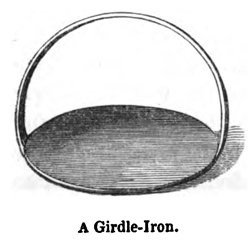 The large thin oaten-cakes, called clapped bread in the North of England, are made by mixing fine Scotch oatmeal with a little salt and cold water quickly into a moderately stiff paste, and patting it with the hands, with plenty of oatmeal strewed under and over it, until it is as thin as it can be made. The cakes, which should be about the size of a breakfast-plate, must be prepared singly, baked on a girdle-iron, turned while they are doing, and afterwards toasted a little before the fire to render them crisp. They must always be kept very dry. If mixed with warm water, the paste is more easily made into thin cakes, but is not so short and nice.
Oat-cakes may be baked in an iron-oven when but moderately heated. So much only of the meal should be moistened at once as will serve for a single cake, because the paste dries so rapidly, that it cannot be properly managed else. A Scotch cook, celebrated in the family in which she lived for the excellence of her oaten breakfast cakes, used to crumble a bit of butter about the size of a walnut into a quart of meal, wet it up with milk (or water, as the case might be) in suitable portions, roll it out as thin as it could be rendered, and bake her cakes in the oven of the kitchen stove.
These are made simply of Scotch oatmeal mixed into a paste with water, and made into cakes about the size of a common saucer, and quite half an inch thick. They are then baked of a light brown in a moderate oven.
(An Irish Breakfast Cake.)
"Break up very small an ounce and a half of butter into a pound of meal just as it comes from the mill (whole meal is meant by this), and make it into a paste with about half a pint of milk. Roll it out to the size of a plate, and to the third of an inch thick, and bake it on a griddle or in an oven. If made with buttermilk and a pinch of soda, it will be improved." This is the exact receipt by which the brown fadge is made in Ireland, where it is served at the breakfast-table, even in wealthy households, and in those of some of the nobility. If rich slightly acid buttermilk were used to make it, and a small but due proportion of carbonate of soda were well mingled with the meal, the butter might be omitted.
|
Meal as it comes from the mill, 1 lb.; butter, 1 1/2 oz.; little salt; nearly 1/2 pint of milk. Baked in oven about 20 minutes, or on a griddle. |
To make a batter-sponge, which may easily be converted into many different kinds of "fancy bread," as it is called, or into buns or cakes, first mix, very smoothly indeed, a pint of warm new milk with an ounce* of quite fresh German yeast, or with the same quantity which has been put into water for one night†, and make with them one pound of the best flour into a batter entirely free from lumps. A saltspoonful of fine salt should previously be well stirred to it. Throw a cloth over the pan, and place it where the air is warm. When it has risen extremely high, and the surface is covered with large bubbles, take another pound of flour, which in winter it is well to have slightly warmed before it is used; stir and beat smoothly part of it into the sponge, and when it is firm enough knead in the remainder until the whole is perfectly blended. The dough thus made will soon be ready for the oven, and may be moulded into small shapes, placed some inches apart on a flat tin (as they will spread and rise considerably), glazed with beaten egg, and rather quickly baked; or the dough, when first made, may at once be put into tins or pans, and left in them to rise to its full height before it is placed in the oven.
To make a Sally Lunn, dissolve three ounces of good butter, cut small, in less than half of the milk with which the sponge is to be set; cool it down with the remainder; and, if a sweetened preparation be liked, stir three ounces of pounded sugar to the flour before it is moistened; pour gradually the milk and butter to the yeast, of which there must be a full ounce, and proceed in all else as above. Three hours will sometimes be required to bring this sponge to its height. When it is ready add the second pound of flour to it, put it into a round buttered tin or tins, which it should not more than half fill, and when it has risen nearly to the edge let it be put without delay into the oven, and baked a nice brown. An egg or two, when they are considered requisite, can be mixed with the milk and butter either for the Sally Lunn, or to convert the dough into buns; but, to allow for the addition, a few spoonfuls of the milk should be omitted. Carraway-seeds, currants, or candied citron or orange-rind, can be kneaded in with the other ingredients when the second pound of flour is mixed with the sponge, or immediately after it is worked in. Two or three ounces more of sugar may, for many tastes, be thought needful for the buns.
|
Bread.— Best flour, 1 lb.; new milk, 1 pint; little salt; German yeast, 1/2 oz., to rise 2 hours or more; or yeast, 1 oz., 1 to 2 hours. Flour, 1 additional lb.; to rise 1/2 to 3/4 hour. Sally Lunn. — Flour, 1 lb.; butter, 3 oz.; pounded sugar, 3 oz.; German yeast, full ounce; 2 to 3 hours, or until extremely light. Flour, in addition, one pound; to stand in tins until risen to their edges. Buns.—Butter, yeast, and milk, as above, with an addition of sugar and an egg or two at pleasure; carraway-seeds, 1 oz.; or currants,1/2 lb. |
In point of fact, no bread is so really cheap as that composed entirely of good wheat-flour or meal, because there is none which affords the same amount of pure, wholesome, strength-sustaining nourishment; and a larger quantity will generally be required of any inferior kind to support, in an equal degree, the powers of life; but when the price of wheat is very high, it is sometimes impossible for poor families to obtain a sufficiency of it fully to satisfy the appetite; and in such cases any of the following receipts, which have all been well proved, may be had recourse to with advantage.
This is one of the best varieties of mixed or cheap bread when it is made with care, as its flavour is excellent, and it remains moist longer than any other except rice-bread; but the potatoes used for it should be good, thoroughly boiled, well dried afterwards by having the water poured from them, and then standing by the side of the fire to steam; and be reduced to a perfect paste by mashing, or be rubbed quickly through a cullender or other coarse strainer. They should be perfectly mixed with the flour or meal while they are still warm; and after the addition of rather more salt than for common bread, the dough, which will require less liquid than wheaten-dough, should be made up smoothly and firmly, and be managed afterwards like other bread, but be baked in a more gentle oven. Seven pounds of potatoes, weighed after they are cooked and peeled, may be added to each gallon of meal or flour. Should it be necessary, from circumstances that cannot be controlled, to use such as are watery, the moisture may be partly wrung from them, in a warm thick cloth, before they are mixed with the other ingredients.
Dark-coloured, but very nutritious and by no means unpalatable bread, may be made with equal parts of wheat-meal, maize-flour, and rye-flour; and it will also be cheap as regards the price of the ingredients, and profitable from the weight of the bread produced by them. Persons accustomed, as the English people are, to live habitually on wheaten bread only, do not immediately become reconciled to any other; and the flavour of Indian corn, being dissimilar to that of any grain which is common amongst us, is often not relished by them at first; but a taste for it is very soon acquired. Three pounds each of the maize, the rye-flour, and the wheat-meal, with two not large teaspoonfuls of salt, a quarter of a pint of thick yeast, and about, or nearly, two quarts of warm liquid, thoroughly mixed and well kneaded into a smooth dough, which should stand to rise until it is unmistakeably light, both before it is kneaded down and again previously to being sent to the oven, will produce twelve pounds of substantial satisfying bread well suited to stay the demands of hunger, and perfectly wholesome in its nature. It may be divided into three loaves, and should be baked in a well-heated but not fierce oven.
|
Flour of maize, or Indian corn, 3 pounds; rye flour, 3 lbs.; wheat-meal, 3 lbs.; salt, 2 teaspoonfuls; thick yeast, 1/4 pint; water, or milk and water, about 2 quarts. Product in bread, 12 lbs. |
The seed of the white varieties of French-bean, boiled quite tender, and rubbed through a strainer to divest them of their skins, and mixed with two-thirds of their weight of flour or meal, will make bread which in flavour and appearance can scarcely be known from genuine wheaten bread; and as the bean is one of the most nutritious by far of all vegetables, it will replace very advantageously a portion of wheat-flour for persons whose digestion is not extremely delicate: by those who are out of health, this bread is perhaps better avoided.* After the beans have been prepared as above, the pulp from them should be intimately mixed with the flour or meal, and the bread finished in the usual way. It will be seen, as the dough is gradually moistened, that less liquid will be required for it than for common wheaten-bread; but the exact difference cannot easily be specified. The dough should be mixed entirely at once, and be made rather firm. The seed of the scarlet-runner, or any other coloured variety of the vegetable (if the flavour were not strong), would probably answer as well as the white, particularly for brown bread.
|
Pulp of white French beans (haricots blancs), 1 lb.; wheat-flour or meal, 2 lbs., made into dough with the common proportion of yeast, rather less liquid, and a little more salt. Fermented and baked like other bread. |
Many vegetables may be used in part for making bread; but it is only in cases of real need that such an expedient is recommended. When corn is unusually dear, the produce of a kitchen-garden or of an allotment ground will serve, in combination with it, to furnish wholesome bread; but, with the exception of potatoes and the seed of the French bean, all vegetables will impart their peculiar flavour to it, though their presence may not otherwise be perceptible. Parsneps, Swedish turnips, and beet-root will all answer for dough (parsneps the best of any) if boiled tender, mashed to a smooth pulp*, and stirred in a saucepan over a gentle fire until tolerably dry, and left to become cool before they are mixed with flour or meal for the purpose.
Half Indian flour and half wheaten flour, made and managed like common dough, and baked in a moderate oven, will produce good and economical bread. The meal is sometimes scalded* before it is mixed with the flour; but it is then rather less pleasant in flavour, and a little more difficult to preserve of a proper consistence, as it will absorb as much liquid as will be required for the bread altogether. The yeast must therefore be stirred to it when it is at the proper degree of warmth, and the flour worked in immediately after. No bread, of which Indian-corn forms a part, should be baked in a very hot oven. One third only of sound yellow maize-flour, with two thirds of wheat-flour, will form a mixture which will generally be liked, and with which it is perhaps better to begin the use of Indian-corn until the taste is a little accustomed to it.
The most perfectly wholesome kind of unfermented bread is that made with muriatic acid† and carbonate of soda, of which the combination forms common salt, and cannot therefore be in any way unhealthful, though it is often denounced by ignorant people as such; but until some experience has been gained, there will be a chance of failure in this bread, in consequence of the variation in the strength and quality of the acid, which must have just sufficient power to neutralise the soda and evolve the necessary portion of carbonic acid gas for rendering it light, without either ingredient being in such excess as to impart its flavour, in the slightest degree, to the dough.
The soda, which should be of the best kind, and in fine powder, should be rubbed through a hair-sieve with a wooden spoon into the flour, and mixed intimately with it before the acid is poured in. The proper proportions of all the ingredients will be found, with directions for mixing them, at page 100. Both brown bread and white may be made in the same manner, and should be well but quickly kneaded as soon as they have been mingled so far as they can be with a large strong wooden spoon. No metal should be used in the process. The loaves should be expeditiously made, and set into a moderately heated oven without the least delay.
Unfermented Bread made with Tartaric Acid.— Though perhaps not well adapted for long.continued consumption, this bread, which is more easily made with perfect success than the preceding, may be eaten occasionally without any disadvantage. For each pound of flour allow one drachm of bi-carbonate of soda, and rub it through a sieve over the pan which contains it, and stir them together until the soda is equally distributed amongst it. Dissolve fifty grains of tartaric acid in half a pint of water, knead it up well, but very quickly, and place it in the oven the instant it is ready. Salt must be added to this bread as for common dough; but none is required for that which is made with the muriatic acid. A very small portion of pounded sugar is an improvement to it; about half a teaspoonful to the pound of flour. For delicious bread, made with tartaric acid and butter-milk, see "Dairy-Bread," page 147.
Take a half-baked loaf from the oven, and tear it into small rough bits with a couple of forks; lay these on a tin, and put them back into the oven for ten minutes. If a light loaf be made for the purpose, with new milk and two ounces of butter, they will quite resemble rusks. A sweet light cake pulled apart in the same manner is likewise very good.
The common shape of bakers' loaves is given by dividing the portion of dough intended for one loaf into two parts of unequal size, the smaller one being little more than a third of the whole. These are made into the form of very thick cakes, and then placed one on the other, care being taken that there shall be no flour between them, and then pressed together, and a deep indentation made in the centre of the upper one, sometimes by the baker's elbow.
The loaves technically called "bricks," which are baked in tins, are of convenient form for making toast or for slicing bread and butter.
Crusty, or College Loaves.— These are more frequently made in private families than for sale. The dough for them should be tolerably firm, and be first moulded and slightly cut round in the usual manner; and then, with a sharp knife, the tops should be divided into large dice of equal size, the paste being cut down nearly half through to form them. They will spread open in the baking, and furnish plenty of nice crisp square crusts for amateurs.
French Loaves.— In France the usual form given to common bread is that of a rouleau or cylinder, which spreads and flattens a little in the baking. The loaves are sometimes two or three feet in length. One advantage of having them moulded thus is, that they are more perfectly and regularly baked than loaves of massive construction. Some few London bakers have adopted the French shape for their bread.
EXTRACTS FROM THE REPORT OF THE MEDICAL OFFICER OF HEALTH FOR THE DISTRICT OF HOLBORN, ON THE ADULTERATION OF BREAD. MARCH 16lH, 1857.
It is with no wish to exaggerate the importance of any fact connected with the subject of bread-adulterations, that I return to it here; but because the opinions expressed upon it in the following passages of Dr. Gibbon's report appear worthy of general respect and consideration; and, so far as the bakers are concerned, they are written in a most frank and liberal spirit.
"It is my deliberate opinion that, although alum is not a poison, yet that its use in the manufacture of bread is injurious to health, and concurs indirectly with other things in increasing the mortality, especially of young children, the staple article of whose dietary is bread.
"The more effectually to discountenance this practice, I will briefly detail some of the grounds whereon this opinion is founded.
"It is well known that small doses of alum repeated for a considerable time will produce at first costiveness, and afterwards great irregularity of the bowels. The quantity of alum which I have generally met with in bread has been in the proportion of from half a drachm to one drachm in the 4lb. loaf; so that the man who consumes half a loaf a day swallows every 24 hours from 15 to 30 grains of alum. Now, it is found that even 12 grains per diem, taken by a healthy adult, will produce constipation. Its effects on children would, of course, be greater than on adults; a smaller quantity would suffice to produce the diarrhoea and dysenteric symptoms, and they would appear sooner. Alum enters into chemical combination with the gluten of the flour, therefore I admit that its effects in bread are less active and injurious than when administered in its pure state. I have little hesitation, however, in assigning this impurity in the bread as the chief cause of the frequent constipation, headaches, liver derangements, &c, of those who are dependent on bakers for their bread. The fatal diarrhoea of infants under three years of age may also have arisen from, or have been aggravated by, this cause.
"As this adulteration has been practised for a very great length of time, I cannot recommend the adoption of any harsh measures for its suppression; I would suggest that all bakers in the district should be cautioned against it. If any flagrant case occurs where the injury to health is clearly made out, I shall feel it to be my duty to advise your board to take the necessary proceedings to prevent its recurrence.
"When the bakers are duly informed of this opinion, I am in hopes that they will of their own accord cease to use alum in making bread. The bakers' plea at present is that it is harmless, that the public 'like it' and 'will have it.' So that the more effectually to put down an adulteration which is injurious to health, the public on their part should cease to set so high a value on those qualities in a loaf which alum is used to produce.
"The following particulars will, I trust, enable the purchaser to distinguish a loaf that does not contain alum from one which does:—
"Alum increases the whiteness and firmness of the bread made from inferior flour, and thereby causes it to resemble bread made from the very best flour. The qualities which alum imparts to a loaf are very unimportant, having reference merely to the appearance, 'lightness' neatness of shape, &c.
"The chemical action of alum on moistened flour is analogous to tanning, and destroys in a considerable degree its nutritiveness. It converts the gluten (the most nutritious portion) of the flour into a kind of tough tenacious 'wash leather,' which is difficult of digestion. This gives the dough a tenacity and firmness, enabling it to retain the thousands of little air bubbles (given off by the yeast) which constitute the 'lightness ' or spongy porous character of the bread. Hence, flour that will not 'rise' may be made to do so by means of alum. Another object in the use of alum is that it preserves the upright form of the loaves, and prevents them from adhering firmly together, thereby enabling the baker to separate them more readily on their removal from the oven—the 'batch parts clean,' as the expression is, without tearing. An unalumed loaf is, with a little practice, distinguishable from an alumed one by its appearance alone; it is wanting in all those peculiarities which I have mentioned as the effects of alum; it is not so bulky, nor so symmetrical in its shape; its sides are roughened and torn in being separated from the batch. Unalumed bread 'bites short' alumed bread 'bites tough' and the rough, sour taste of alum is slightly perceptible in it. The most marked contrast, however, is apparent in 'crumbling' when a day or two old; unalumed bread crumbles with the greatest facility by rubbing it between the hands; whereas alumed bread, however old, 'crumbles' with difficulty. In the same way alum renders the new loaf less liable to crumble when cut.
"These, then, are the qualities and appearances in a loaf which I recommend the purchaser to disregard.
"Septimus Gibbon, M.D.,
"Medical Officer of Health."
There are now in various parts of the continent —in France and Belgium more particularly,— subscription-bakeries, or, as they call them, "Friendly Bread Associations,"* which are reported to answer remarkably well in every respect. Some of them are on a small scale, and conducted on a plan which enables persons of very limited means to profit by their advantages. The subscriptions, which can be constantly renewed, do not exceed eight or ten shillings; and bread, sufficient for the daily consumption of a family, is supplied to that amount, until it is exhausted, much better in quality and rather lower in price than that sold by the bakers. The wheat, as in the large factories already mentioned, is purchased of the grower, by which a considerable saving is effected, and the genuineness of the bread is secured; and the profits which arise from the suppression of all unnecessary expenses, after a time are divided amongst the subscribers. When a building has to be purchased or erected in the first instance for the bakery, and all the accessories for the fabrication of the bread have also to be purchased, a certain period must elapse before any clear profits can be expected, beyond those which are in reality afforded by the purity and cost of the bread furnished to the members of the association.
A thorough knowledge of practical business details is, of course, necessary in organising these friendly companies; and an entire absence of what is familiarly called "jobbing," and which is said to prevent the satisfactory working of many enterprises in this country.
To supply the labouring part of the population of Paris with the fine white bread with which alone they will be satisfied, has become an object of natural anxiety in that capital, now that provisions of all kinds have risen to so very high a price there; and the first scientific men of the day are seeking to discover processes, by means of which this false taste may be gratified at a less serious cost than it is at present. As real popular education advances, and people are brought to see the truth of things, as it becomes more and more developed by the aid of science, and by the efforts of enlarged and enlightened minds, it is probable that the deeply-rooted prejudices (which have their origin often in profound ignorance) that now stand opposed to much of what is best and most profitable as food, will give place—with many others—to a just appreciation of convincingly-exposed facts.
The man who understands the nature of the component parts of wheat, will not quarrel with the mere colour of the bread he eats, when he knows that it is not the result of any sophistication of the materials of which it is composed. He will not insist on the sacrifice of a large portion of the grain, the whole of which is so important to him as nutriment, merely to gratify an irrational prepossession in favour of white bread. In England—and in London more particularly, amongst the working classes—this prepossession exists quite as generally as in any part of the world; the consumption of brown bread being confined almost entirely to the families of the more affluent orders.
Only a cursory mention can now be made here of the recent discoveries reported at considerable length, to the Académie des Sciences at its meeting of January 12th, 1857, and published in the Moniteur Universel of the 20th (and in other French journals most probably), and partly also in the form of a slight pamphlet, entitled "Extraction and Conversion of the whole of the Flour of Wheat into White Bread of the first Quality, by M. Mège-Mouriès. To be had of MM. Firmin Didot Frères, Libraires, and of the Author, Rue Jacob 19."
A short extract or two from the above-named report may give the reader some idea of its tendency, and of its claim to attention.
"Report made to the Academy of Science, of a Memorial by M. Mège-Mouriès, entitled 'Chemical Researches on Wheat, Flour, and Bread-making.'
"At its sitting of June 9th, 1856, M. Mège-Mouriès presented to the Academy the result of his researches on Panification, partly theoretical and partly practical;—partly theoretical, because the author explains the real cause of the dark hue of brown bread, and indicates the manner by which it may be avoided, even when the bran is left in the dough; partly practical, because he proposes a new system of panification which is something more than a mere project, since one of the colleges of Paris has for three months past been supplied with the bread made by it; and the occupants of the orphan asylum of Saint Charles (of the 12th arrondissement) have lived on it since last June to the exclusion of all other.
It must be observed here that the Académie des Sciences has naturally much influence with the French government on questions of this nature, and that it considered the discoveries of M. Mège-Mouriés of sufficient importance to appoint a commission to ascertain their practical value; and this commission, after having seen his new processes in all their details, carried into operation at a small bakery, which he had himself established, applied to the prefect of the Seine for permission to have them tested by more extensive experiments, at the bakery of the hospitals of Paris, which was immediately accorded, and they were placed in communication with M. Salone, the director of the Boulangerie de Scipion; in conjunction with whom M. Mège-Mouriés pursued his labours until a definite result was obtained for the. further investigation of the commissioners, who then proceeded with their examinations.
The positive advantages afforded by the new system appear to be, the deriving from seventeen to twenty per cent more of fine white bread from wheat than is commonly done, and reducing to comparative simplicity the present most elaborate and tedious method of making it; of which the following account will give an idea.
In a modified degree the same plan is pursued by the baking trade of England. The intelligent reader will judge how far it is favourable to the production of sweet and nutritious bread.
Common mode of Panification practised in Paris.—The white bread of Paris is made with the best flour. If a hundred parts of wheat have yielded seventy of flour it is said to be "bolted to seventy," which is the quality used for the consumers of that capital. This is the process:—
"At eight o'clock in the evening a bit of paste* is taken, composed of eight kilogrammes of flour and four kilogrammes of water,† This is left until six o'clock in the morning, and constitutes the main leaven (levain de chef).
Eight kilogrammes more of flour and four kilogrammes of water are then added: this forms the leaven of the first degree.
At two o'clock in the afternoon sixteen kilogrammes of flour and eight of water are added: this is the second quality of leaven.
At five o'clock the complete leaven is prepared by adding a hundred pounds of flour and fifty-two kilogrammes of water, mixed with from two hundred to three hundred grammes of yeast (levure).
At seven o'clock a hundred and thirty-two kilogrammes of flour and sixty-eight kilogrammes of water, holding in solution two kilogrammes of salt, and mixed with from three hundred to six hundred grammes of yeast, are added to the leaven, and made into well-kneaded dough.
With this quantity of paste five or six batches of bread are made in the following manner:—
|
1st Batch.—This is composed of half the dough prepared as above, which is moulded and left to rise, and then set into the oven. 2nd Batch.—The dough remaining of the first batch is mixed with a hundred and thirty-two kilogrammes more of flour and sixty-eight kilogrammes of water, mixed with the same proportion of salt and yeast as the preceding batch. Half of this dough forms the second baking, the bread of which is whiter and better than the first. 3rd Batch.—The same quantity of flour, water, and salt, with three hundred grammes of yeast, are again added to the dough, of which half is baked as usual. 4th Batch.—Same proceeding as for the third. 5th Batch.—This is prepared like the foregoing, and produces what is called fancy bread (pains de luxe), the finest quality of any. |
I have used the word yeast as we understand it in English for the "levûre" mentioned in the process, though it may possibly differ from that which is commonly used amongst us.* The papers relative to M. Mège-Mouriés' discoveries, though published some months since, have reached me only just in time to permit of this very slight notice, leaving no means of ascertaining any particulars about them. The chief novelty which they disclose is the existence in wheat of a strongly fermenting principle which he calls "céréaline," of which the action gives, he asserts, its brown colour to bread. It is not possible to condense the substance of the report, from which I have taken the short extracts inserted here, in such a manner as to render its scientific and practical details intelligible; and to adapt it, at the same time, for admission into this small volume—brought at present so near its conclusion; but if real and great advantages are to be derived from the introduction of the new processes, by which M. Mège-Mouriés is endeavouring to replace the old ones, they will soon become extensively known, and will scarcely fail to attract the attention of the persons most interested in the important question of bread improvement, which is beginning, at least, to create the general and active interest which it deserves.
M. Mouriés has drawn his conclusions from the closest anatomical inspection of the grain of wheat, confirmed by microscopical examinations of it, made conjointly with him by a clever young botanist named Trécul, highly considered by the Academie. The position of the cells which contain the céréaline (which has been a principal object of experiment to the first of these gentlemen), is minutely described, together with its nature and the method of partly or entirely neutralising its activity in panification, in which it exercises a powerful decomposing influence in its natural state. It is asserted that the brown colour of bread is not attributable to the mixture of bran or pollard with the flour, but to the energetic fermentation produced by the céréaline.
(For Baking Bread, and for General Cookery.)
The establishment of large, well-regulated public ovens, to which the bread and other food of families could be taken to be baked, without danger of loss from dishonesty or mis-management, would be an inestimable boon to the labouring classes of the English people, and a valuable one to many others; and if the charge of such ovens were entrusted to persons who combined integrity and intelligence, with a due knowledge of the practical operations required from them, a new and profitable system of cookery might be generally adopted through their means, by the agency of a low, but equally sustained degree of temperature. When enclosed in earthen jars with covers, or other suitable vessels, pasted down, or secured in such a manner as to prevent the escape of the steam arising from them, and mingled with so much liquid only as is necessary for their preparation, meat, fish, fruit, rice*, and an infinite variety of other articles of food may be cooked in the very best manner, and without the loss of any portion of the nourishment which they contain. A thick layer of pie-crust will often be a convenient substitute for the cover of a jar, in baking these, and will effectually confine the steam if carefully fastened to the edge.
The favourite but most unfrugal baked joints of meat of the people, on which often a large portion of a poor man's weekly wages is expended for one day's meal only, have been too often the subject of comment and remonstrance, for their wastefulness not to be generally recognised; and yet one would not willingly deprive those who have so few enjoyments, of the occasional savoury repasts which many of them earn with the heaviest labour, and for which they seem content frequently to pay the price of many days of comparative privation. Much greater economy, however, might be effected even in the "baked meats" for which the common national taste is so decided, and which dwindle in size so strikingly in the over-heated ovens of the bakers. They would be infinitely more succulent and nutritious, or more really resembling well-roasted meat, in fact, if long and gently cooked, and would lose far less in weight.
In very populous places it might answer to have several ovens in the same office, varying in their degrees of temperature, and so adapted to, and always ready at certain hours, for different preparations.
But it is most of all in many of our villages that better accommodation is required than now exists for baking generally, and for baking bread especially; for great discouragement to the makers often attends the sending it to a common baker's oven, should there chance to be one at hand, which in many instances there is not. It is a real grievance to the poor but industrious housewife to have the dough which she has prepared carefully and well, given back to her either underbaked or burned, or partially spoiled, by standing for hours in the heated air of the bake-office after it was ready for the oven. It is a disadvantage, under any circumstances, to be compelled to send bread from home to be baked; and in severely cold weather there is always a chance, unless great precautions be taken against it, of the dough being rendered heavy by exposure to the influence of the external air. The rich, who interest themselves in the well-being of the poor, would effect a good work in their favour by aiding in the erection of village-bakeries, which should remove the present difficulties of numbers of the rural population; but no beneficial results would ensue unless their management were entrusted to kind, conscientious, and efficient agents.
I extract the following passage from a small pamphlet which has just fallen into my hands, entitled "Our Daily Bread," (written and published by Mr. William Horsell, 492. New Oxford Street,) because it appears to me to contain a simple and sensible suggestion for the improvement of bread, and in consequence to deserve consideration:—
"Those who have given little attention to this subject, will probably think that the trouble of washing all their bread-stuff before it is ground, would be much greater than any benefit which would result from it. But a short experience in the matter would convince every one who has a proper regard for the character of his bread, that the trouble of washing his grain bears no comparison to the improvement effected by it. Indeed, those who have been accustomed to wash their grain, will soon cease to regard it as a trouble; and the improvement in the whiteness and sweetness of their bread will be so great, that they would be very unwilling to give up the practice.
"Having raised or purchased a quantity of the best new wheat, it should be put away in clean casks or bins where it will keep perfectly dry and sweet; and, according to the size of the family, take, as they need it, one or two bushels, and wash it thoroughly but briskly in two or three waters, and then spread it out on the drying sheet or table, made for the purpose, and which is considerably inclined, so that the water remaining with the wheat will easily run off, Being thinly spread out upon the sheet or table in a good drying day, it will be sufficiently dry in a few hours for grinding. Let any one who loves good bread wash his grain a few times in this manner, and he will be very reluctant to return to the use of bread made of unwashed grain."
It is with the greatest satisfaction that I find myself enabled to mention, before I close this work entirely, a movement which has commenced amongst the better order of bakers for supplying the public with really genuine bread. Some specimens have been sent to me which were truly excellent, and which remained good for so unusual a length of time, that I have no doubt they had been fabricated in a perfectly wholesome manner.
It would, perhaps, be only fair to give the names of those members of the trade who are foremost in the path of improvement; but believing that many others will quickly unite with them in their good and conscientious work, I prefer to wait a little before I add anything to this slight notice of a welcome fact.
This is an evil which presses so heavily and painfully on the very poor, and which prevails, I regret to state, to so serious an extent, that I cannot withhold a few words of comment upon it, trusting sincerely that it will be one of the first abuses which the reforming spirit of the age will entirely abolish. It is not sufficient for genuine bread to be supplied to the public if the full value of the price exacted for it be not given in its weight as well; and the instances in which all that I have had tested (and which has been purchased of various bakers) has come up to the proper standard, have been very few. There may be some difficulty, perhaps, in having it always exact to an ounce; but five or six ounces of loss in every four-pound loaf, which is the average deficiency, is a serious consideration to the poor and scantily fed; and there is never any overplus of weight to make them compensation for it.
(To serve instead of Biscuits for Dessert, or to Invalids.)
Cut thin shavings of bread from a stale loaf, spread them on a dish, or lay them singly on the tin tray of an American oven, and dry them very gradually until they are perfectly crisp; then bring them to a pale straw colour; withdraw them from the fire, and, as soon as they are cold, pile them on a napkin, and serve them without delay. They require an extremely gentle oven to produce the proper effect on them; but, if well managed, will retain their crispness for several hours; and it may always be renewed by heating them through afresh. By many persons they are much preferred to biscuits, being considered far more delicate. A small American oven answers for them extremely well if placed at a distance from the fire: they require quite half an hour to dry them as they ought to be done.
Notes:
[*] Servants and young people are too apt often to merely guess at the measure of liquid which they use.
[†] Flour, though it varies considerably as to the quantity of water which it will absorb, seldom requires so much as this; so it should be added cautiously and in small portions, when the dough is nearly mixed.
[*] Occasionally with that of the wheat grown in her own allotment ground, or with that which her family have gleaned,—the leasing corn,—supposed to make the best bread of any; and hers has been certainly most sweet and nice in flavour.
[*] I have received the warmest commendations of the whole-meal bread from persons who have eaten it exclusively for years, and who in point of health have derived the greatest benefit from its use. It may possibly not suit all eaters equally, but it seems at least worthy of a fair trial.
[†] In the family of a very intelligent London physician, all the members of which live entirely on brown bread prepared at home, white bread has always to be provided for the servants.
[*] It is well to warm the bread-pan or tub, and the flour also, before using them for dough in seasons of excessive cold: and thick coverings should be laid over, but not upon, the dough, after it is made.
[*] I am informed that the polenta is carefully granulated between large stones set in a peculiar manner for the purpose; this probably renders it so dissimilar to the common maize-flour. The variety of Indian corn from which it is prepared is much smaller than that grown commonly in America.
[†] This proportion of a full-flavoured nut is sufficient; but it can always be increased at pleasure. It should be grated down on a delicately clean and bright grater; or, on occasion, it may be infused in the milk, after having been merely pared, sliced thin, and cut up small; but a much larger quantity of it must then be used to impart an equal degree of flavour.
[*] For bread, half this quantity is really sufficient; but when butter is added in any quantity to the mixture, much 'more will be required.
[†] This yeast becomes perfectly smooth by being put into water; and sometimes the surface of it is hardened, so as to render this an advantage
[*] The French-bean seed, known as haricots blancs, served so abundantly at foreign tables, and very much now in England also, is not considered, even where it is so much eaten, as well adapted to invalids. When quite fresh, it is less objectionable than after it is harvested for winter consumption.
[*] The beet-root, which may also be baked, must be grated.
[*] One peculiarity of the maize is, its becoming difficult to convert into various preparations, if quite boiling liquid be previously mixed with it. Half a pint of cold water to a quart taken in full ebullition, will cool it down sufficiently.
[†] I have in my possession a pamphlet written by a baker, who has received the marked public testimony of a scientific man of repute, as to the purity of his bread, in which he attacks his brethren of the trade rather vehemently as "poisoners of the people," &c. &c. In his list of wicked adulterations, muriatic acid is included.
[*] An establishment of the same nature exists, I believe, at Manchester, or Birmingham. Some notice of it was given by one of the subscribers in The Times, not very long since; but the particulars have escaped my recollection, and I cannot recall the date of the journal which contained them.
[*] This is probably a portion of the paste called leaven: if it were merely flour and water, it would not become a ferment in so short a time: many days keeping in a certain temperature would be required to produce spontaneous fermentation in it. Formerly, this kind of leaven — which always imparts a certain degree of acidity to bread — was used commonly in England, and it is so still in various parts of the Continent. After the first preparation of the ferment, a bit of the dough made with it is kept from one baking to another (well covered with flour), and serves the purpose of yeast when well kneaded up with the other ingredients.
[†] Sixteen pounds of flour and four quarts of water. The gramme is the thirtieth part of an ounce.
[*] If beer yeast had been meant, it would probably have been called levûre de bière.
[*] The value and wholesomeness of rice as food, depend entirely on the mode of preparing it, which is ill understood in this country, and to which the above system is peculiarly adapted.